Inspiration
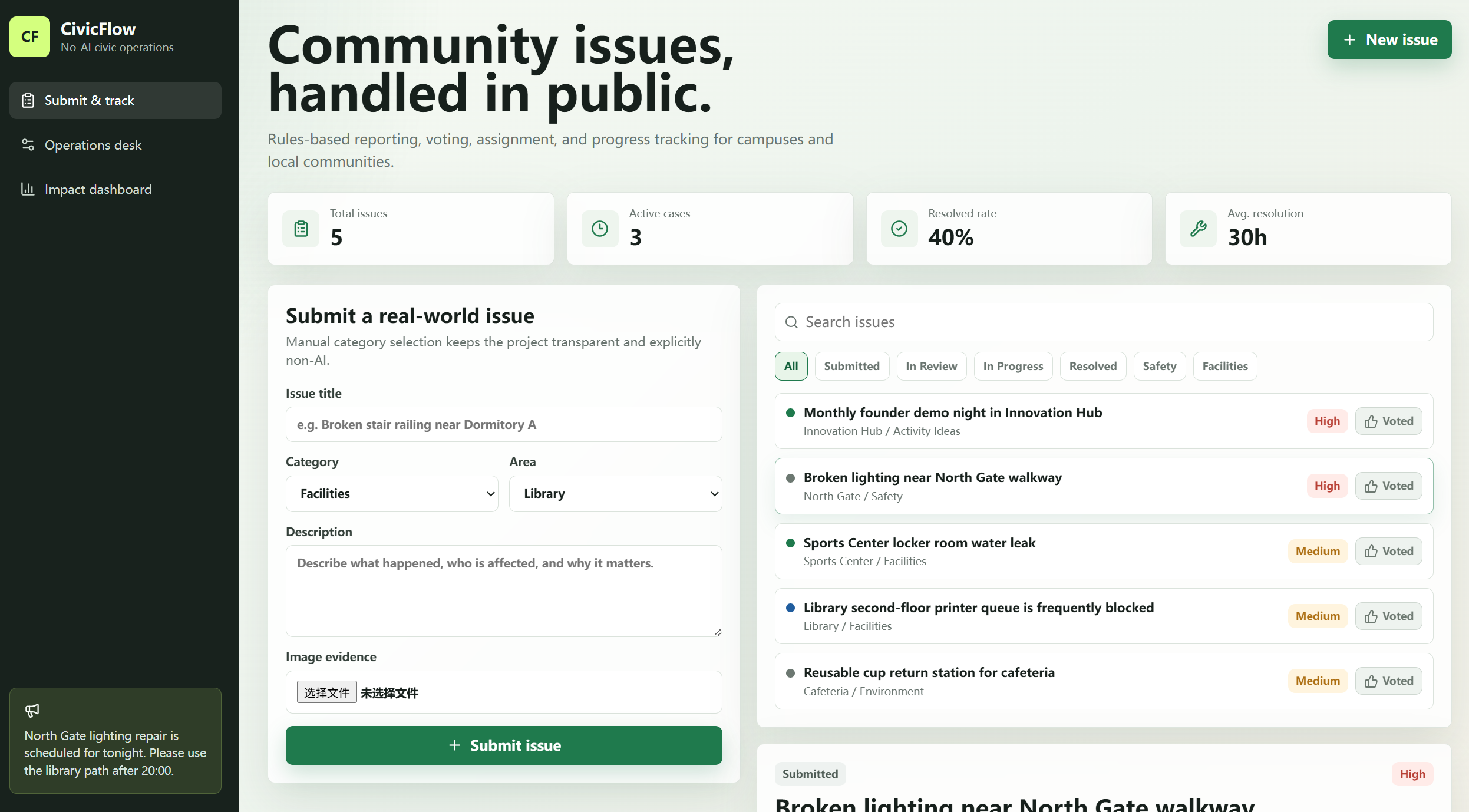
CivicFlow was inspired by a common problem in campuses and communities: issues are often reported informally through chats, verbal complaints, or scattered forms, but there is no clear way to track what was submitted, who is responsible, and whether the problem was resolved.
We wanted to build a transparent, no-AI coordination system that turns everyday problems into visible, accountable workflows.
What it does
CivicFlow allows users to submit community or campus issues, vote once per issue, add comments, and track progress. Administrators can review issues, update status, assign owners, adjust priority, and publish public announcements.
The dashboard shows useful operational metrics such as total issues, active cases, resolved rate, average resolution time, category distribution, workflow pipeline, and area heat map.
How we built it
We built CivicFlow as a React single-page application using Vite. The interface includes a citizen reporting portal, an operations management desk, and an impact dashboard.
The application uses browser localStorage to persist submitted issues, announcements, and voting records. A lightweight Node.js static server serves the production build locally.
Challenges we ran into
One challenge was making the voting system reliable so each browser can only vote once per issue, even after refreshing the page. We solved this by storing voted issue IDs in localStorage.
Another challenge was keeping the system explicitly no-AI while still feeling smart and useful. We focused on transparent rule-based logic, clear workflows, and measurable dashboard insights instead of automated decisions.
Accomplishments that we're proud of
We are proud that CivicFlow is more than a basic feedback form. It provides a full issue lifecycle: submission, voting, tracking, assignment, status updates, comments, announcements, and impact reporting.
We are also proud of building a clean, responsive interface that can be demonstrated as a complete MVP.
What we learned
We learned how important transparency is in civic and campus operations. A useful system does not always need AI; sometimes the biggest value comes from clear structure, visible ownership, and measurable progress.
We also learned how to design a product around accountability, not just data collection.
What's next for CivicFlow
Next, CivicFlow could be expanded with user authentication, role-based access control, backend database storage, real image uploads, timestamped audit logs, notifications, department dashboards, and exportable reports.
A future production version could support multiple campuses, communities, or organizations with configurable categories, teams, and workflows.
Built With
- css
- javascript
- lucide-react
- node.js
- react
- vite

Log in or sign up for Devpost to join the conversation.