
We were inspired by a simple problem: many people may qualify for government and social-support programs, but they struggle to discover the right program, understand complicated eligibility requirements, and know which documents they need.
Students, families with limited income, rural communities, and people who are unfamiliar with government portals often have to search through multiple websites and complicated information before they can even begin an application.
We wanted to build something that turns this confusing process into a simple conversation.
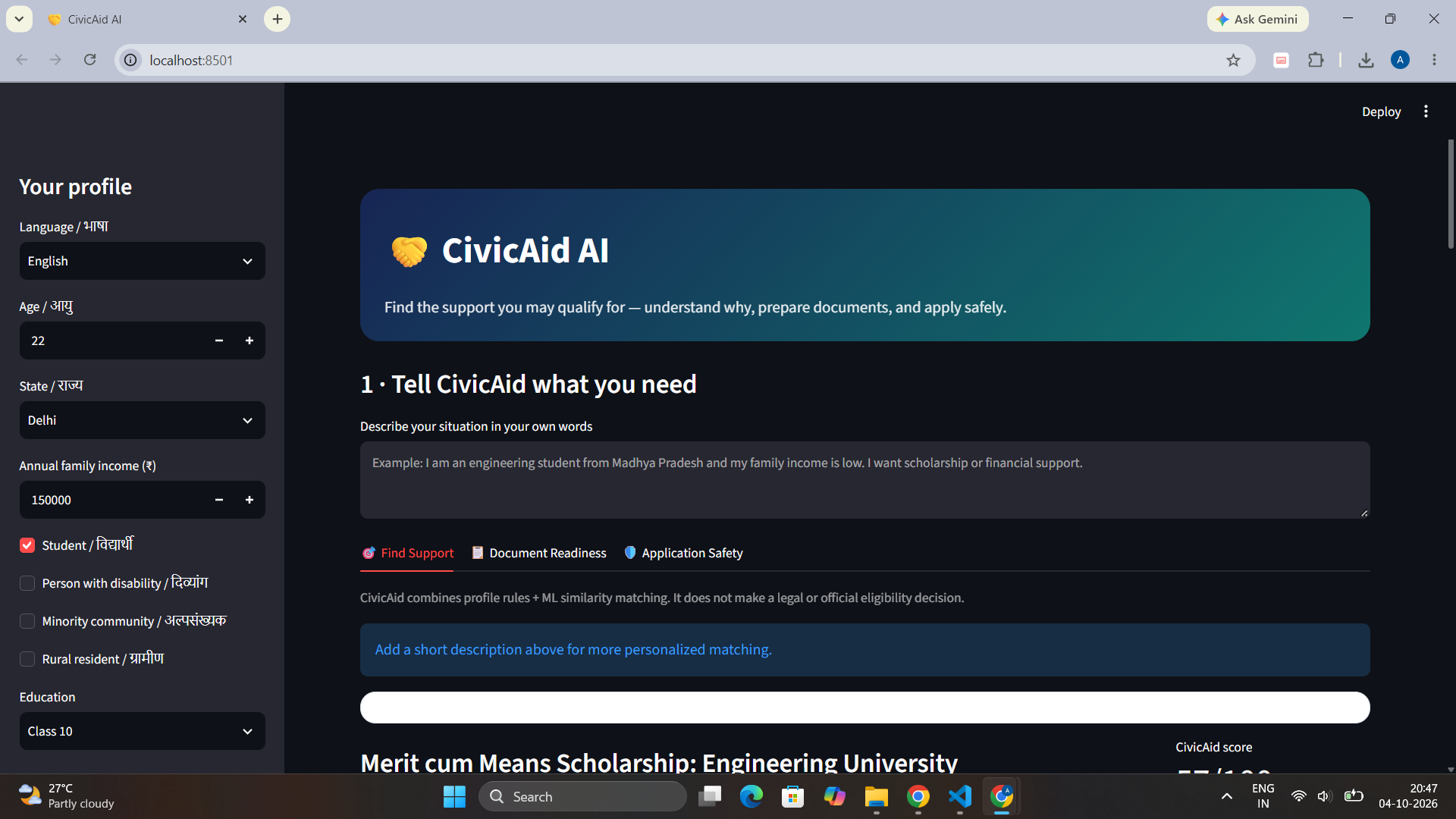
That idea led us to CivicAid AI — an AI-assisted public-benefit navigator designed to help people find relevant support, understand why it may fit their situation, prepare the required documents, and follow safer application pathways.
What We Built
CivicAid AI combines machine learning with transparent rule-based checks instead of relying only on a chatbot.
A user can describe their situation in natural language, for example:
"I am an engineering student from Madhya Pradesh and my family income is low. I need financial support."
The system analyzes the user's profile and needs, compares them with available support programs, and produces ranked recommendations.
Our prototype includes:
- AI-powered scheme matching
- Natural-language need understanding
- Eligibility-aware filtering
- Explainable CivicAid Score
- Why this matched? explanations
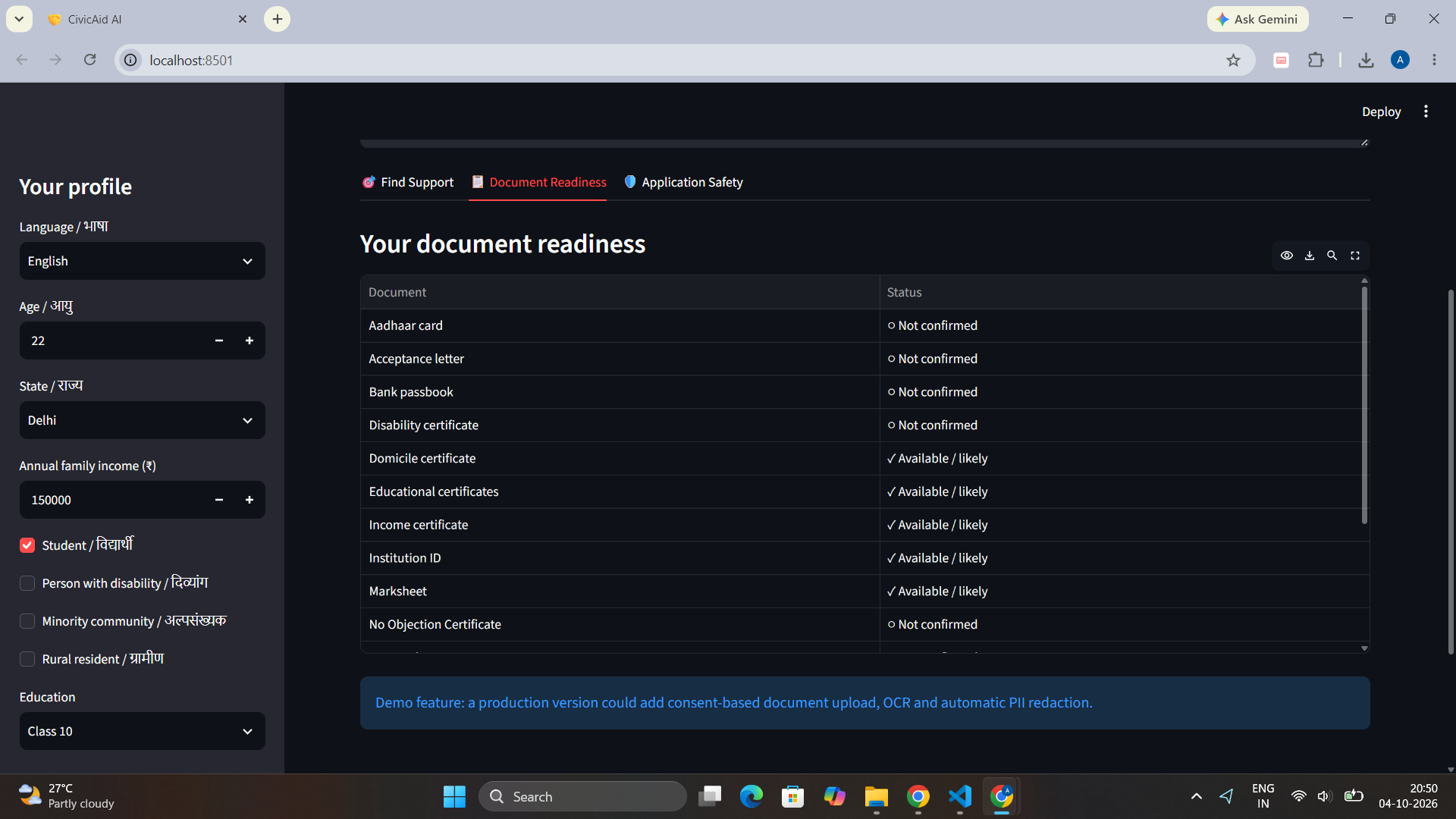
- Document Readiness checklist
- Application Safety guidance
- User profile-based personalization
- Simple and accessible Streamlit interface
The matching system uses TF-IDF vectorization and cosine similarity to compare the user's needs with program descriptions, while deterministic rules provide additional eligibility signals.
The result is a hybrid AI approach that is more explainable and easier to validate than a purely conversational system.
How We Built It
We built CivicAid AI using:
- Python for the core application
- Streamlit for the interactive web interface
- Pandas for structured data processing
- Scikit-learn for machine-learning-based text matching
- JSON for the initial program dataset
- Rule-based eligibility logic for transparent checks
- GitHub for version control and project documentation
The architecture follows a simple pipeline:
User Profile + Natural Language Need → Eligibility Signals → Semantic Matching → Ranked Programs → Explanation → Document Readiness → Application Safety
This approach allowed us to build a functional prototype while keeping the reasoning understandable to users.
What We Learned
One of our biggest learnings was that AI does not always need to be a complicated deep-learning model to create meaningful impact.
For this problem, explainability and reliability are extremely important. A recommendation should not simply say "This program is suitable for you." It should also explain why it was recommended and what information still needs to be verified.
We also learned how to combine:
- Machine learning
- Natural-language processing
- Rule-based reasoning
- User-centered design
- Responsible AI principles
- Data organization
- Product thinking
Most importantly, we learned that building for social impact requires thinking beyond model accuracy. Trust, accessibility, transparency, and safe user actions are equally important.
Challenges We Faced
One major challenge was designing a system that could provide useful recommendations without pretending to make official eligibility decisions.
Government and social-support programs can have detailed conditions, changing requirements, location-specific rules, and documentation requirements. Because of this, we designed CivicAid AI as an assistance and discovery tool, not an official eligibility authority.
Another challenge was balancing AI flexibility with predictable behavior. A completely free-form chatbot could produce unclear or unsupported recommendations. We therefore combined semantic similarity with deterministic eligibility signals and explanations.
We also had to think about the safety of application guidance. Instead of encouraging users to trust random websites or links, CivicAid emphasizes verifying information through official sources.
Responsible AI
CivicAid AI is designed with responsible use in mind.
The system:
- Does not make official eligibility decisions.
- Clearly separates recommendations from confirmed eligibility.
- Encourages users to verify current requirements.
- Avoids presenting AI output as government approval.
- Can be extended with citations and verified sources.
- Is designed with accessibility and multilingual support in mind.
For a production system, we would use a continuously verified database of official programs and retrieval-augmented generation (RAG) with source citations.
Future Vision
CivicAid AI can grow into a multilingual public-benefit assistant supporting people across different regions.
Future versions could include:
- Hindi and regional-language voice interaction
- Verified government scheme database
- RAG with official-source citations
- Document OCR with privacy protection
- Personalized application checklists
- District-level support discovery
- Accessibility features for users with disabilities
- Voice input and output
- Consent-based document assistance
- Real-world usability and impact evaluation
Our long-term goal is simple:
Make finding and understanding public support as easy as having a conversation.
CivicAid AI is not trying to replace government systems. It is trying to make the path to those systems clearer, safer, and more understandable.
Built With
- data
- explainable
- github
- machine-learning
- natural-language-processing
- pandas
- python
- streamlit

Log in or sign up for Devpost to join the conversation.