WelfareAI – Smart Scheme Navigator
Inspiration
Government welfare schemes provide important support to citizens in areas such as education, healthcare, agriculture, housing, and financial assistance. However, many people find it difficult to discover schemes relevant to their circumstances because information is spread across different websites, eligibility criteria can be confusing, and application procedures may require multiple documents.
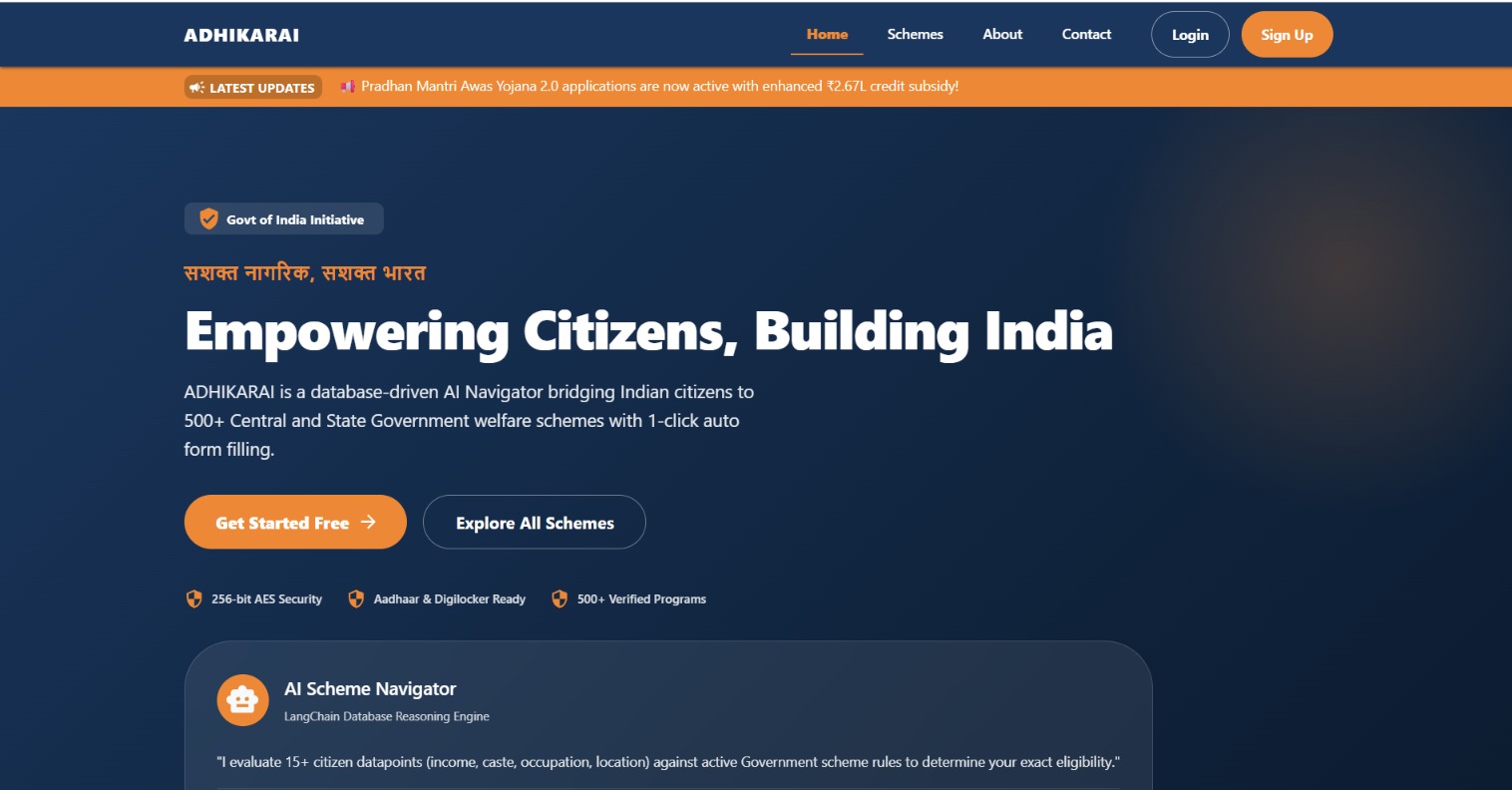
We were inspired to develop WelfareAI – Smart Scheme Navigator, an AI-powered platform designed to make government welfare information easier to access and understand. Our goal is to help citizens identify potentially relevant schemes, understand eligibility requirements, and navigate application procedures through a centralized, user-friendly platform.
What It Does
WelfareAI aims to simplify the process of discovering and understanding government welfare schemes through the following features:
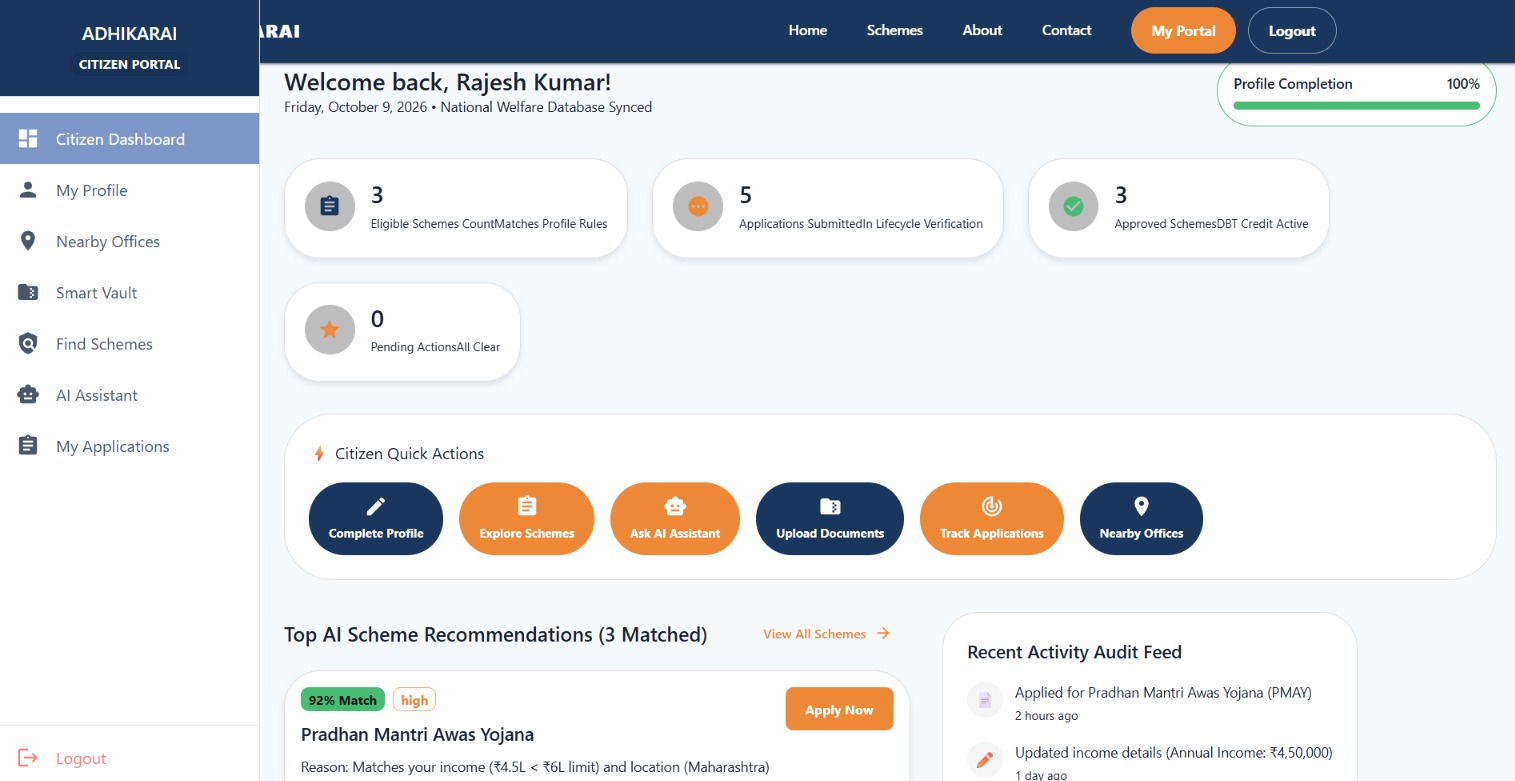
- AI-Powered Scheme Recommendations: Suggests potentially relevant schemes based on user-provided details such as age group, occupation, income range, and other relevant eligibility factors.
- Eligibility Assistance: Compares user information with published scheme criteria and explains which requirements appear to be satisfied or still need verification.
- Scheme Information Hub: Organizes scheme descriptions, eligibility rules, required documents, benefits, and application instructions in one place.
- Application Guidance: Provides step-by-step instructions to help users understand how to apply for suitable schemes.
- Benefit Status Tracking: Offers a dashboard for tracking application progress using available application data. In the prototype, simulated statuses may be used where official integrations are unavailable.
- Accessible Information: Aims to make complex scheme information easier to understand, with potential support for regional languages.
The platform is intended to assist citizens in finding and understanding welfare opportunities. Final eligibility decisions and benefit approvals remain with the relevant government authorities.
How We Built It
We designed WelfareAI as a web-based application that combines a user-friendly interface, structured welfare scheme information, and AI-assisted recommendations.
The proposed development approach includes:
- Frontend: React.js for building a responsive interface where users can enter their details, explore schemes, and view recommendations.
- Backend: Node.js and Express.js for handling requests, processing user inputs, and connecting the frontend with application services.
- Database: MySQL or MongoDB for storing structured scheme information, user preferences, and prototype application records.
- AI Recommendation Engine: An AI-assisted component that evaluates user-provided information against published scheme criteria and explains why a scheme may be relevant.
- Eligibility Matching: Rule-based checks combined with AI-generated explanations to make eligibility information easier to understand.
- Dashboard: A centralized interface for viewing recommended schemes, required documents, application guidance, and available status information.
The intended workflow is:
User Profile → Scheme Matching → Eligibility Explanation → Application Guidance → Status Tracking
We also considered the importance of protecting personal information and using reliable, up-to-date scheme information. Government database access and direct benefit transfer integration would require appropriate authorization and are not assumed to be available in the prototype.
What We Learned
This project helped us understand how AI can be applied to public-service accessibility and social welfare. We explored how user information can be matched against structured eligibility criteria and how AI-generated explanations can make complicated information more understandable.
We also learned that a useful AI application requires more than a recommendation model. Accurate data, understandable results, privacy protection, accessible design, and clear communication of limitations are essential when a system may influence important decisions.
Another key learning was the value of combining deterministic eligibility rules with AI assistance. Eligibility checks should follow published criteria wherever possible, while AI can help explain requirements and guide users through the process.
Challenges We Faced
One of the main challenges was the complexity and variation of government welfare scheme eligibility criteria. Different schemes may have different income limits, age requirements, occupation restrictions, residency conditions, and document requirements. Organizing this information consistently is essential for meaningful recommendations.
Another challenge was designing a recommendation process that provides relevant results without misleading users into believing that an initial eligibility match guarantees approval.
Maintaining accurate scheme information is also important because eligibility rules, benefits, deadlines, and application procedures can change. In addition, secure handling of personal information and the absence of guaranteed access to official government systems present practical implementation challenges.
We address these challenges by prioritizing structured scheme data, transparent eligibility explanations, clear disclaimers, and a modular design that can be improved as reliable data sources become available.
Impact and Future Scope
WelfareAI aims to reduce the effort required to discover relevant welfare schemes and help citizens better understand their potential eligibility and application requirements.
Future enhancements could include multilingual conversational assistance, document checklist generation, duplicate scheme recommendations, verified government data integration, accessible voice-based navigation, and notifications about application deadlines.
With reliable data and appropriate partnerships, the platform could be extended to support students, farmers, workers, families, and other communities seeking government assistance.
Conclusion
WelfareAI – Smart Scheme Navigator explores how AI and web technologies can make welfare information more accessible, understandable, and organized. By combining personalized scheme discovery, eligibility assistance, and application guidance, our vision is to help bridge the information gap between citizens and government welfare opportunities.
Built With
- ai
- api
- artificial
- computer
- data
- express.js
- generative
- intelligence
- javascript
- language
- learning
- machine
- mongodb
- natural
- node.js
- processing
- python
- react
- react.js
- rest
- vision

Log in or sign up for Devpost to join the conversation.