-
-
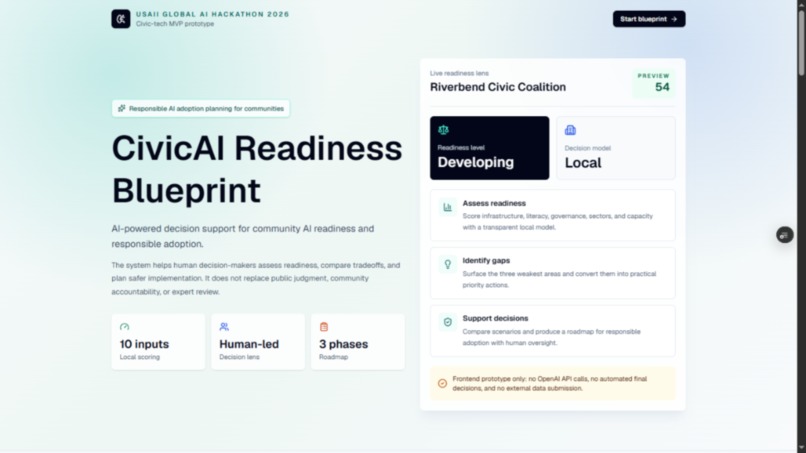
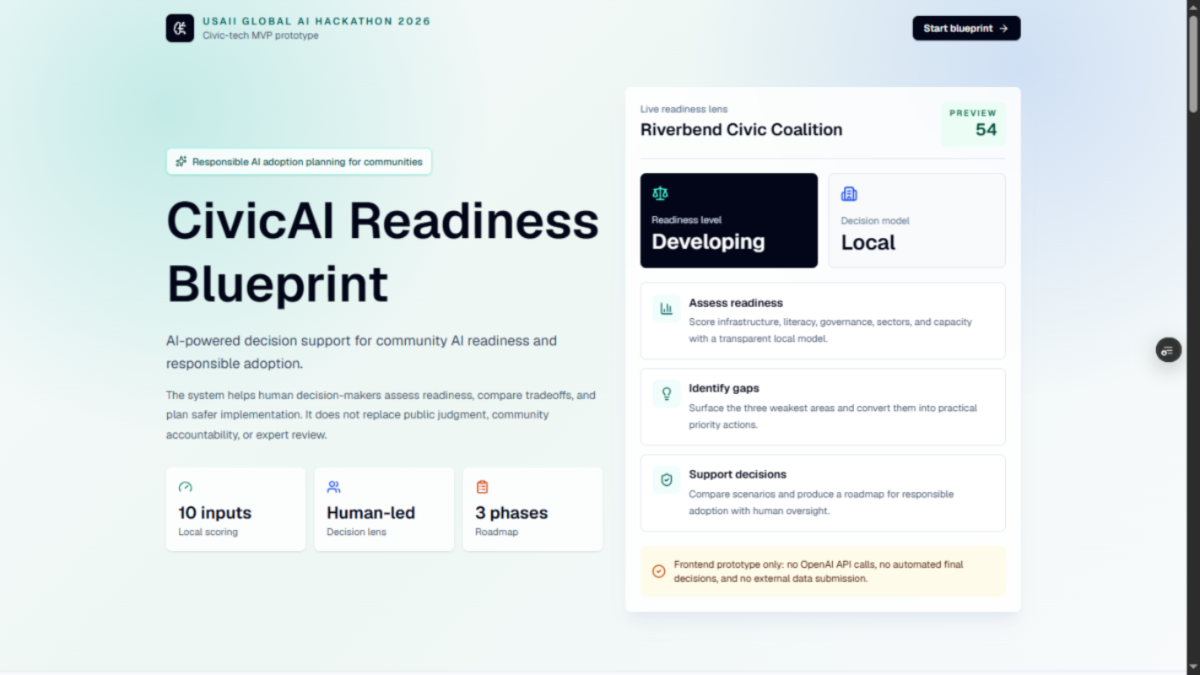
Landing view showing the CivicAI Readiness Blueprint concept, readiness lens, and human-led decision-support approach.
-
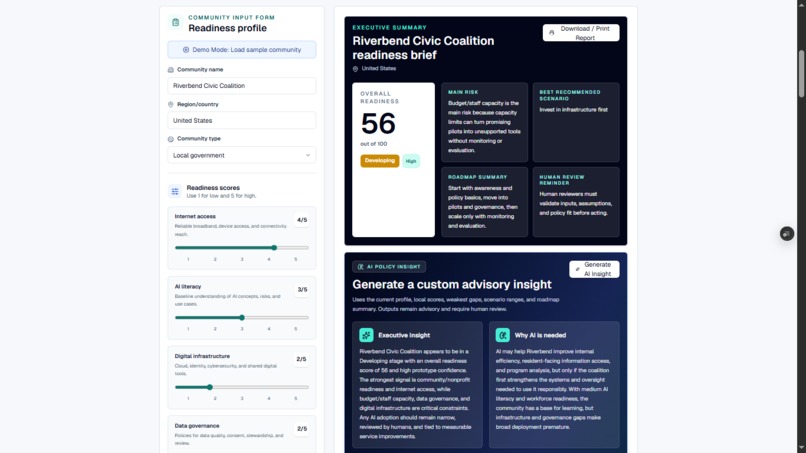
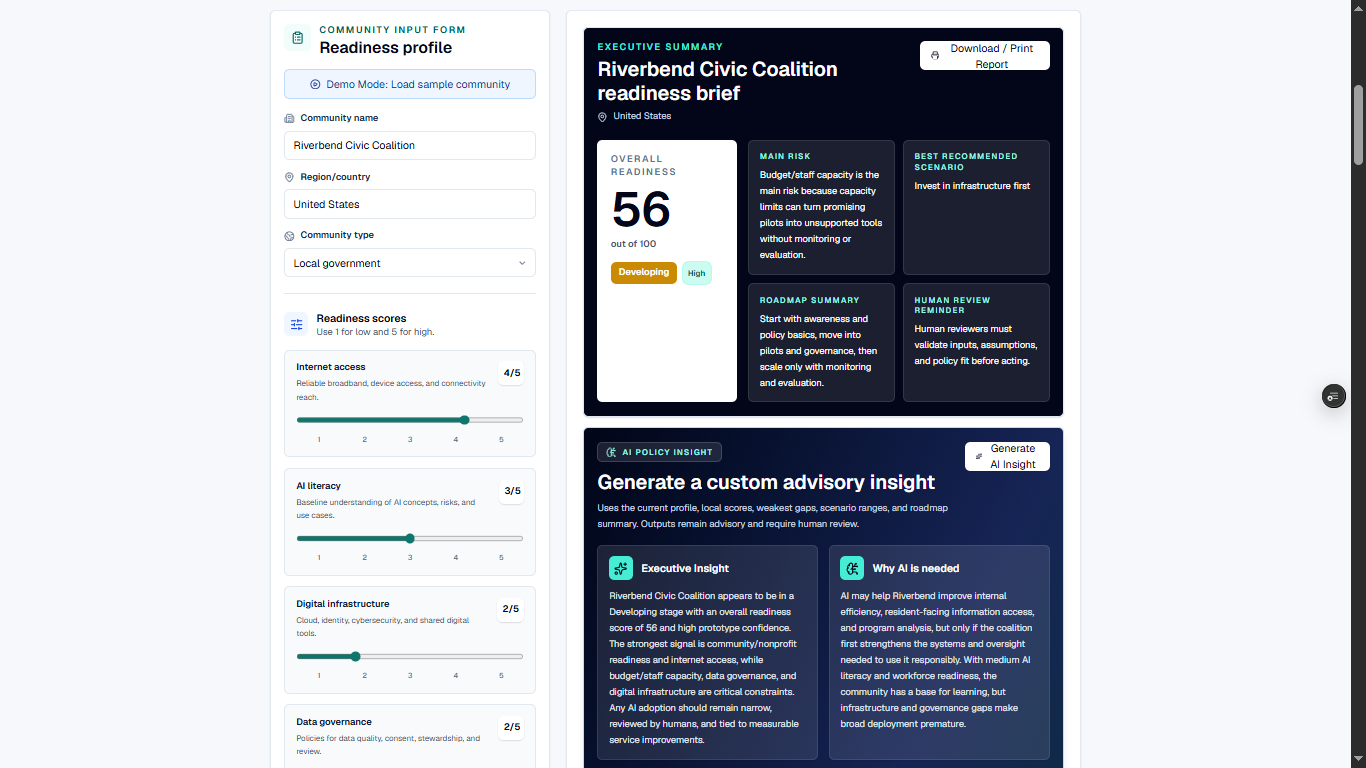
AI Policy Insight section generating advisory recommendations, risk notes, data limitations, and human review guidance.
-
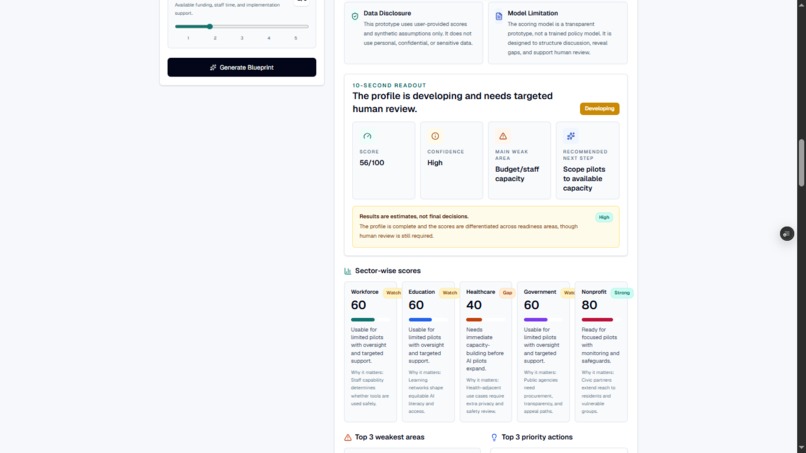
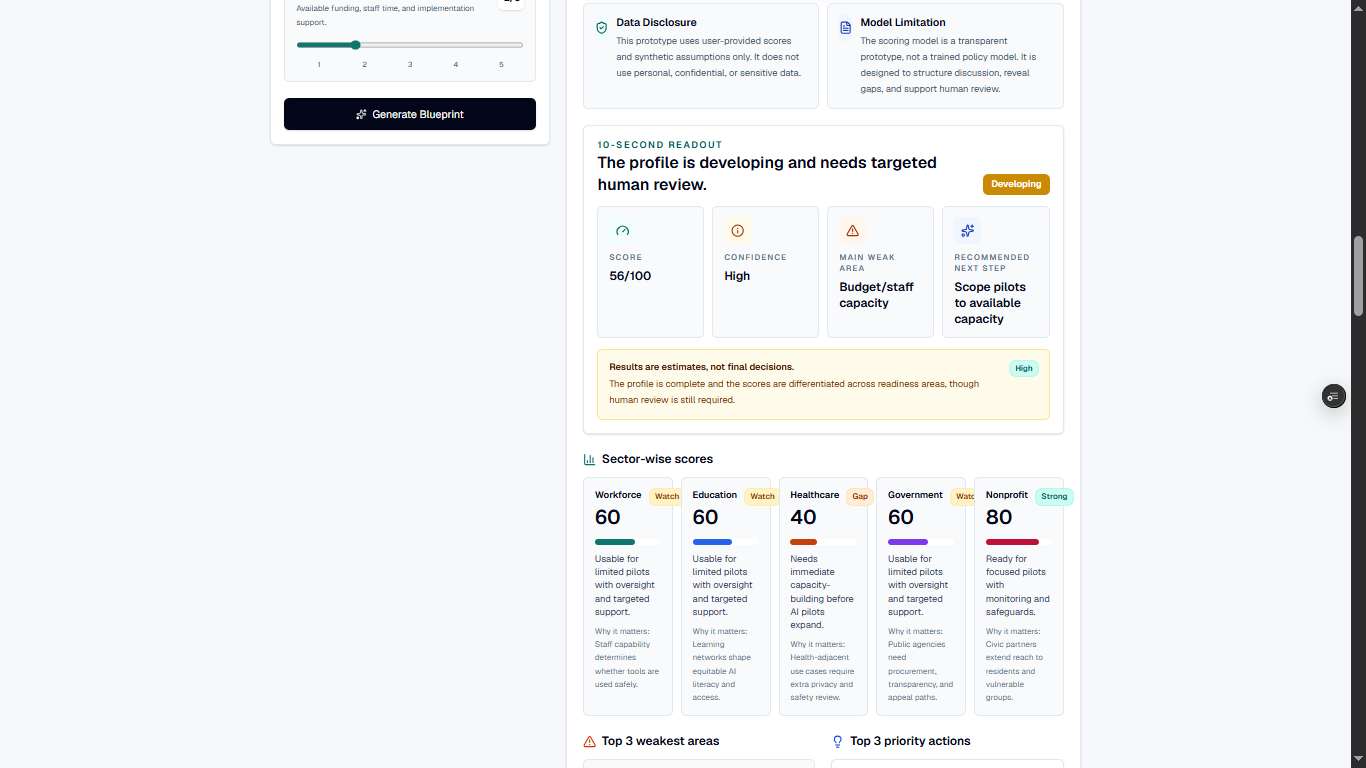
Generated readiness blueprint showing the community score, sector analysis, weak areas, priority actions, and dashboard insights.
Inspiration
Communities are being pushed to adopt AI, but many institutions do not have a clear way to understand whether they are actually ready. AI readiness is not only about having access to tools. It also depends on internet access, digital infrastructure, AI literacy, workforce capacity, data governance, public-sector readiness, nonprofit readiness, budget capacity, and human oversight.
CivicAI Readiness Blueprint was built for Graduate Challenge 6: Community AI Readiness Blueprint. The goal is to help communities and institutions assess AI readiness, identify gaps, compare adoption paths, and create responsible implementation roadmaps.
What it does
CivicAI Readiness Blueprint is an AI-powered decision-support dashboard for community AI readiness planning. A user enters readiness scores for a community or institution across key areas such as internet access, AI literacy, digital infrastructure, data governance, workforce readiness, education readiness, healthcare readiness, government readiness, nonprofit readiness, and budget capacity.
The system then generates an overall AI readiness score, sector-level readiness scores, top readiness gaps, priority actions, scenario comparisons, a 3-phase responsible AI roadmap, human decision points, lifecycle and governance controls, evaluation strategy, non-goals, responsible AI guardrails, and an AI-generated policy insight.
The system is designed to support human decision-makers, not replace them.
How we built it
We built the prototype as a Next.js web application using TypeScript, React, Tailwind CSS, Recharts, the OpenAI API, GitHub, and Vercel.
The app combines two layers. The first layer is a transparent local scoring model that calculates readiness scores, sector gaps, priority actions, scenario ranges, and roadmap phases. The second layer is an AI Policy Insight Generator that uses the current community profile, scores, weakest gaps, scenario comparison, and roadmap summary to generate advisory recommendations.
The architecture follows:
Data Input → Scoring Engine → AI Policy Insight → Dashboard Insights → Human Decision Support → Feedback & Updates
Challenges we ran into
The biggest challenge was making the project more than a simple checklist. The challenge brief required graduate-level thinking, so we added scenario comparison, confidence labels, non-goals, human review points, lifecycle governance, data disclosure, model limitations, and responsible AI safeguards.
Another challenge was balancing usefulness with caution. Since the system supports public-sector and community decisions, we made sure the AI does not make final policy, funding, or access decisions. Its outputs are advisory and require human review.
Accomplishments that we're proud of
We are proud that CivicAI Readiness Blueprint became more than a basic AI demo. It combines transparent local scoring, scenario comparison, AI-generated advisory insight, human review checkpoints, responsible AI guardrails, data disclosure, and lifecycle governance in one working prototype.
We are also proud that the system clearly separates AI support from human decision-making. It does not claim to make final policy or funding decisions. Instead, it helps decision-makers understand readiness gaps, compare tradeoffs, and plan responsible AI adoption with human accountability.
What we learned
We learned that responsible AI is not just about generating answers. It also requires clear boundaries, uncertainty handling, governance, evaluation, and human accountability.
We also learned that a strong AI system for communities should explain why it recommends something, when it should not be trusted, and where human review is required.
What's next for CivicAI Readiness Blueprint
Future improvements could include real public datasets, local government open-data integrations, exportable PDF reports, multi-community comparison, stakeholder review workflows, expert validation, and stronger evaluation against real policy planning outcomes.
The next step would be turning this prototype into a more complete civic-tech platform that helps communities plan AI adoption responsibly, transparently, and with humans still in control.
Built With
- github
- next.js
- openai-api
- react
- recharts
- tailwind-css
- typescript
- vercel


Log in or sign up for Devpost to join the conversation.