-
-
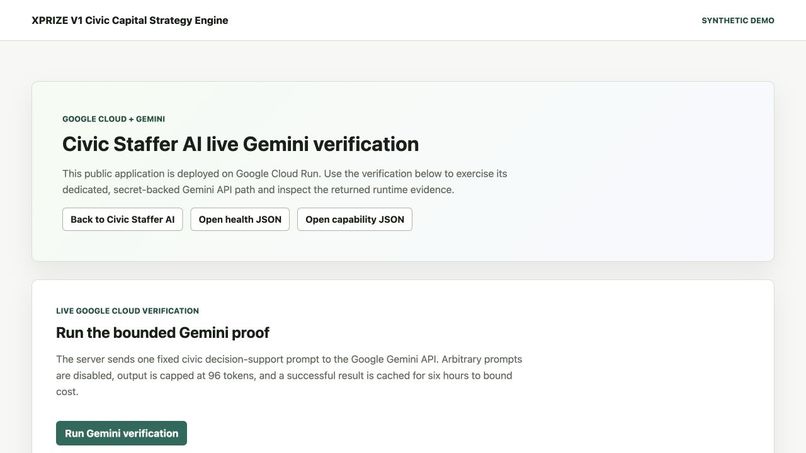
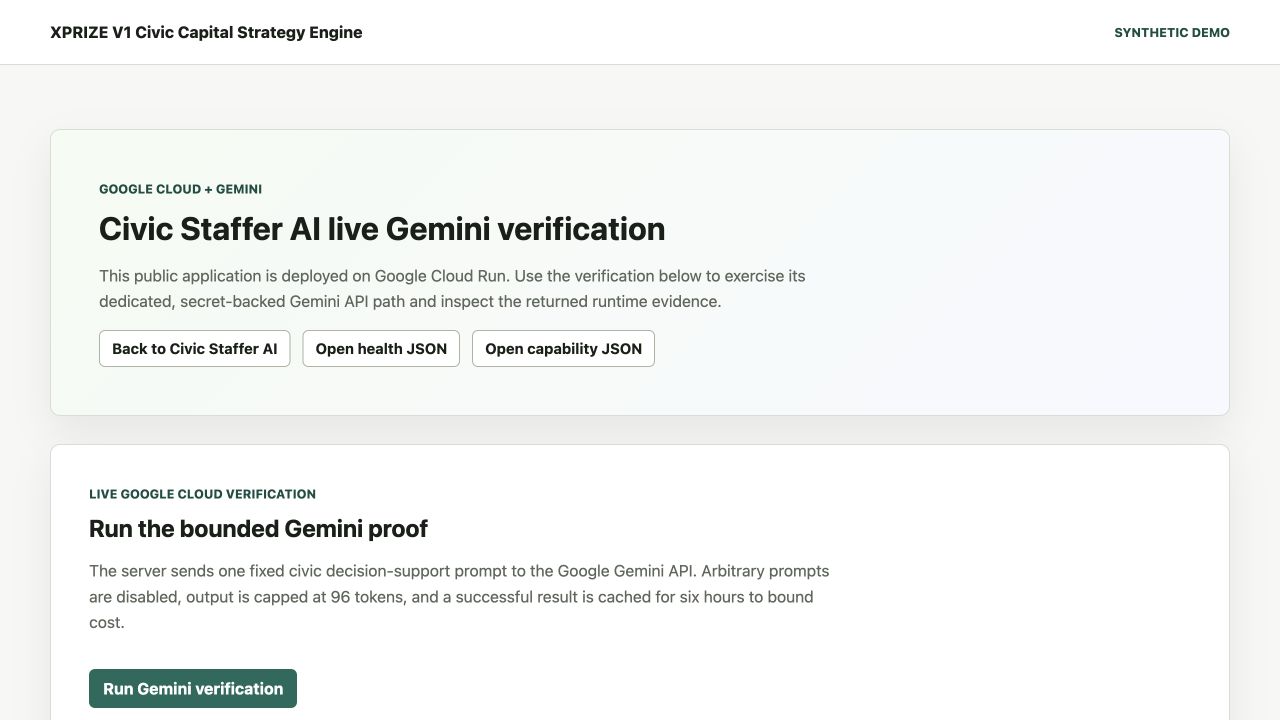
Public Cloud Run proof of a real, traceable Gemini result; the broader human-led decision-paper engine remains under development.
A virtual strategy team for better public decisions
Public servants are asked to make consequential choices about infrastructure, facilities, funding, and public services, often without an on-demand strategy bench. The hard part is not producing more prose. It is assembling authorized evidence, separating facts from assumptions, comparing credible options, checking calculations, exposing risks, and giving decision-makers a recommendation they can inspect. Traditional consulting can be valuable but episodic; generic AI can be fast but difficult to trust. Civic Staffer AI is being built to close that strategy-capacity gap.
The intended customer experience starts with one consequential question and the evidence a public-sector team is authorized to use. Civic Staffer AI acts like a virtual consultant team: AI-assisted research workflows organize the record and surface conflicts; analyst workflows compare options and tradeoffs; critic stages challenge weak or unsupported claims; and writer stages assemble a reviewable decision paper. The goal is not a black-box answer. It is a faster path from question to an evidence-grounded decision process with a visible trail.
This is AI-native production with human-led delivery. AI is designed to do the repeatable work of synthesis, analysis, critique, drafting, evaluation, and revision. Deterministic software handles source binding, calculations, limits, identifiers, receipts, and quality gates. Public officials and Civic Staffer professionals remain responsible for authorizing evidence, applying legal and political context, resolving ambiguity, managing relationships, and owning every recommendation, approval, and public decision. The product is meant to expand human strategy capacity, not replace accountable judgment.
The broader decision-paper engine is under active development, not presented as a finished customer deployment. For this submission, the public application provides a narrow, inspectable production proof: it runs on Google Cloud Run, sends one fixed civic decision-support prompt to gemini-3.5-flash-lite, and displays the real answer with model, completion reason, token use, call time, Cloud Run service and revision, application call ID, and response digest. The route is public and testable without an account. This proves the required Google Cloud and Gemini path without claiming that the full customer experience is already deployed.
The commercial path begins with one bounded paid pilot around an upcoming capital or funding decision. The pilot would deliver a reviewable decision paper and measure cycle time, evidence coverage, unsupported-claim rate, correction rounds, human review burden, and usefulness. If the work creates value, the relationship can expand into recurring decision-portfolio support, a team agreement, or organization licensing, with optional implementation support. Standardized workflows and bounded model and hosting costs can concentrate scarce professional time on high-value judgment instead of repetitive production. Pricing has not yet been set, and these are forward plans rather than historical sales.
The business is pre-customer and pre-revenue. Through the August 15 reporting cutoff, revenue was $0; external users and paying customers were 0; related-party revenue was $0; marketing and customer-acquisition spend was $0; and no testimonials or measured public-sector impact are claimed. Tracked model-call development costs total $843.6875 across 86 run identifiers; 18 selected records are incomplete, so that estimate is not represented as audited cash accounting. Those boundaries matter because credible public-sector work must distinguish demonstrated facts from ambitions.
In Professional Services Access, Civic Staffer AI's category claim is a workflow redefinition: move from buying an isolated report to building a persistent, inspectable evidence-to-decision capability inside a public team. AI handles repeatable production and challenge; humans retain context, relationships, and accountability. That claim still has to be tested through real pilots, renewals, retained use, and verified decision-quality and cycle-time outcomes.
We are looking for people who want to help put this to work: builders who can strengthen reliability and usability; public servants who can ground the workflow in real constraints; subject experts who can challenge the evidence and evaluation methods; pilot governments willing to test one bounded decision; and supporters who can connect the project to the right people and resources. Build it. Test it. Put it to work - so public teams can make better decisions and do more public good.
Built With
- artifact-registry
- cloud-build
- cloud-logging
- gemini-api
- google-cloud-run
- nextjs
- node.js
- react
- secret-manager
- typescript

Log in or sign up for Devpost to join the conversation.