-
-
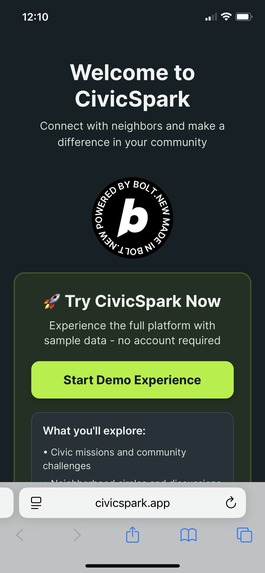
CivicSpark from iphone

Inspiration
I built CivicSpark out of a deep frustration — and a deeper hope. Civic life in the U.S. is increasingly dominated by partisanship, polarization, and pay-to-play politics. Meanwhile, trust in institutions is falling and millions — especially youth and marginalized communities — feel shut out of the process.
CivicSpark is my response: a platform that rebuilds civic life from the neighborhood up, using modern tools like mobile tech, gamification, and AI to reconnect people around shared action and inclusive leadership.
What it does
CivicSpark is a mobile-first civic engagement platform designed to help users — especially youth and underrepresented communities — connect locally, take action, and grow as community leaders.
At its core, CivicSpark transforms civic life into something that feels personal, achievable, and even fun. Rather than focusing on parties, elections, or donations, the app empowers users to:
- 📍 Join Neighborhood Circles: Engage in civil, topic-based discussion with people in your geographic area or interest zone.
- 🎯 Complete Civic Missions: Actions like attending a town meeting, learning about local history, helping a neighbor, or nominating a community leader.
- 🧩 Track Your Impact: Every mission, nomination, and comment contributes to your verified Civic Resume.
- 🏅 Earn Achievements: Users receive badges for meaningful engagement and leadership — reinforcing positive, inclusive participation.
- 💬 Connect and Collaborate: Chat features allow users to discuss ideas and support each other’s civic growth.
The MVP allows users to create and join Circles, create and complete Missions, engage in civic conversations, and track progress via a sample Civic Resume. Even in this early version, testers have reported it feels accessible and fresh — a sign we're on the right track.
Roadmap includes:
- 🌐 Geolocation-based Circles for authentic local context
- 🤖 AI-powered Moderation to ensure respectful, inclusive dialogue — especially for youth ages 10+
- 🗳️ Nominate Everyday Leaders and crowdsource local change makers
CivicSpark is where civic engagement begins — not at the ballot box, but at the block level.
How we built it
CivicSpark began with idea exploration using tools like ChatGPT to shape initial concepts. I iterated quickly, using Bolt to build out the core experience and integrate essential systems like GitHub and Netlify. The process was both technical and intuitive — “vibe coding” through each roadblock while adapting what I learned in real time. I'd also like to give a special shout out to the Women Defining AI (WDAI) community who offered technical and moral support to its members who joined this hackathon. I'm excited to see all the projects from this great group of people.
Challenges we ran into
The biggest challenge was building a backend that could support both live demos and scalable features. I hit issues with badge integration, but eventually resolved them by reworking the code from the ground up. Every obstacle became a prompt to learn, pivot, or simplify.
Accomplishments that we're proud of
The most rewarding moment was seeing real users interact with CivicSpark and offer early feedback. Having early testers tell me that it might be a great app to trial for their library or school was exciting to hear. A neighbor just asked me if she could share with others she thought would be interested, I said "of course!"
What we learned
I discovered this tool might benefit more than just U.S. users. I also learned the power of low-code tools: I could translate civic intuition into working software faster than I expected.
What's next for Civic Spark
Next, I’ll focus on integrating AI moderation, geofencing for local Circles, and launching a micro-pilot. I’m also exploring open-sourcing the project — with care for data privacy and civic trust baked in from day one.
Built With
- amazon-web-services
- bolt
- github
- ionus
- javascript
- netlify
- sql
- stackblitz
- supabase
- typescript

Log in or sign up for Devpost to join the conversation.