

## Inspiration

Important real-world processes are rarely difficult because people cannot follow instructions. They are difficult because instructions are often **fragmented, conditional, constantly changing, and spread across multiple official sources**.

Government processes are a perfect example. Before submitting an application, a person may need to understand:

- Which process actually applies to their situation?
- Are they eligible?
- Which documents are required?
- Are there special conditions or blockers?
- Which official source should they trust?
- What should they do first?
- What should they avoid doing too early?

Traditional checklists help only after someone already knows the correct path. Generative AI can explain a process, but an explanation alone is not enough when a wrong assumption could lead to wasted fees, missed appointments, rejected applications, or unnecessary delays.

That inspired **Civic Preflight**:

> **Verify the path before you act.**

Our goal is to turn complex official procedures into **source-backed, decision-aware, executable workflows**.

---

## What it does

Civic Preflight combines two complementary capabilities.

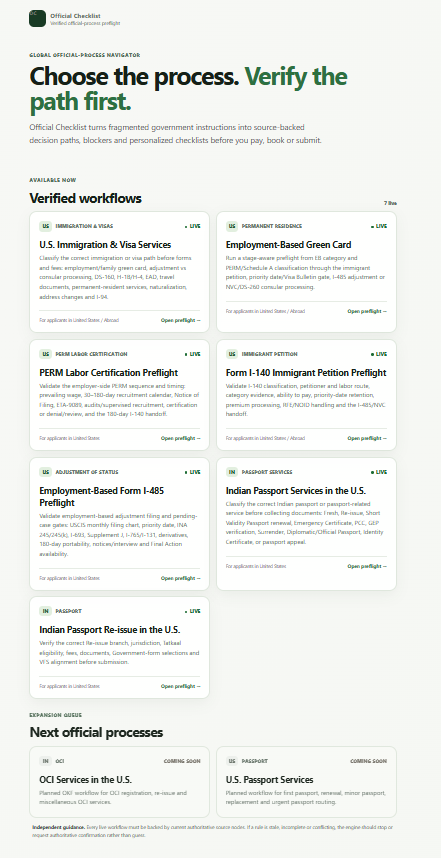
### Official Checklist — determine the correct path

The Official Checklist engine guides users through a structured preflight before they take action.

Instead of generating a generic checklist, it asks relevant questions and evaluates the answers against a structured process model.

It can:

- classify which workflow applies,
- identify blocking conditions,
- surface warnings,
- determine required and conditional documents,
- provide the appropriate next step,
- and connect the result back to authoritative official sources.

The core philosophy is:

> **Do not guess when the process requires evidence.**

When information is uncertain, incomplete, conflicting, or potentially stale, the system should request clarification or direct the user back to an authoritative source rather than confidently inventing an answer.

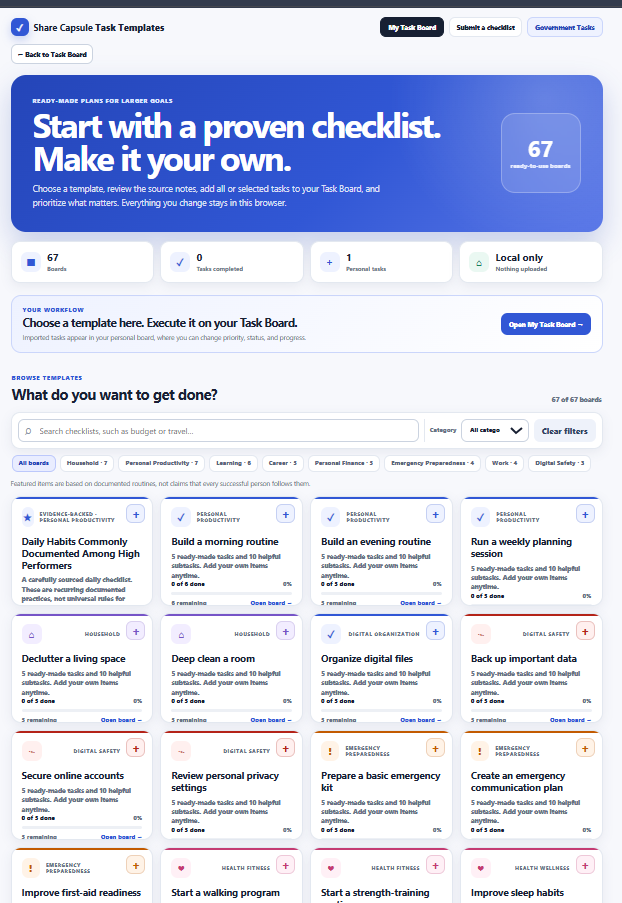
### Task Checklist — turn the decision into action

Once users understand the correct process, Civic Preflight helps them execute it.

Users can:

- browse reusable checklist templates,
- add selected tasks to a personal Task Board,
- assign priorities,
- track status,
- update progress,
- and manage their own execution plan.

The full workflow becomes:

```text
Understand the situation
        ↓
Determine the correct path
        ↓
Detect blockers
        ↓
Generate the verified checklist
        ↓
Turn checklist items into tasks
        ↓
Track execution until completion
Civic Preflight connects:
decision → evidence → checklist → execution
How we built it
We designed the project around reusable, structured process definitions rather than hard-coded instructions.
Process definitions
Each official process can describe:
- questions,
- conditional branches,
- eligibility rules,
- blockers,
- warnings,
- required documents,
- conditional documents,
- next actions,
- and authoritative source references.
Decision engine
User answers are evaluated against deterministic process rules to produce a personalized preflight result.
Instead of asking an LLM to independently invent eligibility or requirements, we use structured rules wherever deterministic behavior matters.
Source-backed guidance
Authoritative links and source freshness are treated as part of the workflow itself.
The official source remains the final authority whenever guidance changes or conflicts.
Execution layer
The verified result connects naturally with our Task Checklist system, allowing users to convert requirements into actionable tasks and track them through completion.
Privacy-first architecture
For the current implementation, answers, task progress, priorities, and personal tasks can remain in browser storage. Users can benefit from the workflow without first creating an account or uploading personal information.
Challenges we ran into
Modeling real-world complexity
Government procedures contain many exceptions and conditional requirements. Representing that complexity without overwhelming users required separating the internal decision structure from the simple questions presented in the UI.
Preventing confident hallucinations
A conversational AI may try to answer even when information is incomplete.
For Civic Preflight, uncertainty is meaningful.
Sometimes the correct result is:
Official confirmation needed.
That can be safer and more useful than generating a plausible but unsupported answer.
Keeping official information current
A workflow that is correct today may become outdated when an agency changes a rule, form, fee, or requirement.
We therefore had to think about source freshness, provenance, and authoritative references as core parts of the process model rather than optional documentation.
Separating official requirements from personal tasks
Users should be able to customize their Task Board without changing what the official process actually requires.
This led us to keep two distinct layers:
verified process definition
and
personal task execution
Designing for reuse
The first use cases focus on government procedures, but we wanted the architecture to work beyond one country, agency, or process.
That required thinking of workflows as reusable decision graphs rather than one-off pages.
Accomplishments that we're proud of
We are especially proud that Civic Preflight evolved beyond a simple checklist application.
We created a system that can:
- model conditional official processes,
- determine which route applies to a user,
- identify blockers before submission,
- distinguish required and conditional items,
- preserve links to authoritative sources,
- generate an actionable result,
- and connect that result to a personal Task Board.
We also built the platform so that official process logic and personal execution remain separate.
That means users can personalize priorities and progress without altering the verified workflow itself.
Another accomplishment is the architecture's broader potential. The same approach can be applied to:
- immigration and consular processes,
- passport services,
- education applications,
- healthcare administration,
- insurance procedures,
- employee onboarding,
- compliance workflows,
- travel documentation,
- and other rule-driven processes.
What started as an Official Checklist became something larger:
Verified Process Intelligence.
What we learned
Our biggest learning was that a checklist is often the output of a decision system, not the starting point.
A static checklist assumes every user follows the same path.
Real processes look more like this:
Question
   ├── Answer A
   │      ├── Requirement X
   │      └── Additional condition
   │              ├── Yes → Document Y
   │              └── No  → Continue
   │
   └── Answer B
          └── Different workflow
We also learned that AI becomes much more useful when combined with deterministic structure.
AI can help with:
- understanding natural-language questions,
- explaining complicated requirements,
- extracting information from documents,
- and guiding users conversationally.
But decisions involving eligibility, mandatory documents, deadlines, or official requirements benefit from explicit rules, traceability, and evidence.
Instead of:
"Ask AI what to do."
we believe the stronger model is:
Use AI to navigate a verifiable decision system.
What's next for Civic Preflight
Our next goal is to expand Civic Preflight into a reusable platform for representing complex procedures as machine-verifiable action graphs.
Planned capabilities include:
- additional government processes and countries,
- automated monitoring for changes to official sources,
- source freshness alerts,
- document-assisted preflight,
- discrepancy detection between documents and user-provided information,
- explainable decision traces,
- multilingual guidance,
- reusable process bundles,
- agent and MCP integration,
- and APIs for external applications.
Eventually, another application or AI agent should be able to ask:
Given this user's situation, what is the verified next action?
Our broader vision is:
Complex processes should behave like navigation systems.
Users should not have to manually read dozens of pages, reconcile conflicting instructions, and construct their own path.
Civic Preflight should help determine:
where they are → which route applies → what is blocking them → what evidence supports the route → and what they should do next.
Built With
- ai
- civic-tech
- decision-engine
- explainable-ai
- functiontool
- generative-ai
- github
- google/adk
- govtech
- javascript
- llmagent
- pwa
- react
- typescript
- vite
- workflow-automation

