-
-
Architecture
-
Overview
CivicLens is an AI-powered Smart City Operating System that enables governments, city authorities, and citizens to collaboratively monitor, analyze, and improve urban infrastructure using real-time data and predictive intelligence.
The platform combines citizen reports, AI-powered traffic violation detection, digital twin visualization, urban health analytics, and predictive risk modeling into a unified dashboard that helps cities proactively identify problems before they escalate.
Instead of reacting to potholes, accidents, pollution hotspots, or unsafe zones after they occur, CivicLens enables authorities to make proactive, data-driven decisions.
Problem Statement
Modern cities generate enormous amounts of urban data, yet much of it remains fragmented across departments or is reported only after problems become severe.
This leads to: Delayed infrastructure maintenance Poor visibility into traffic violations Increasing accident-prone zones Slow citizen grievance resolution Lack of predictive planning for city administrators Citizens often have no simple way to report civic issues, while authorities struggle to prioritize resources effectively.
Our Solution
CivicLens creates a unified AI-driven platform where:
Citizens can report civic issues with images and locations. AI analyzes reports to identify severity and trends. Traffic violations can be detected and documented. Authorities receive an Urban Health Score for different regions. Predictive analytics identify future risk hotspots. A Digital Twin dashboard visualizes city-wide conditions in real time.
The platform transforms scattered urban information into actionable insights for smarter governance.
Key Features
AI-powered Urban Health Score Digital Twin City Dashboard Citizen Issue Reporting Traffic Violation Monitoring Predictive Risk Engine Infrastructure Analytics Real-time Administrative Dashboard Location-based Heatmaps Data-driven Decision Support
AWS Services Used
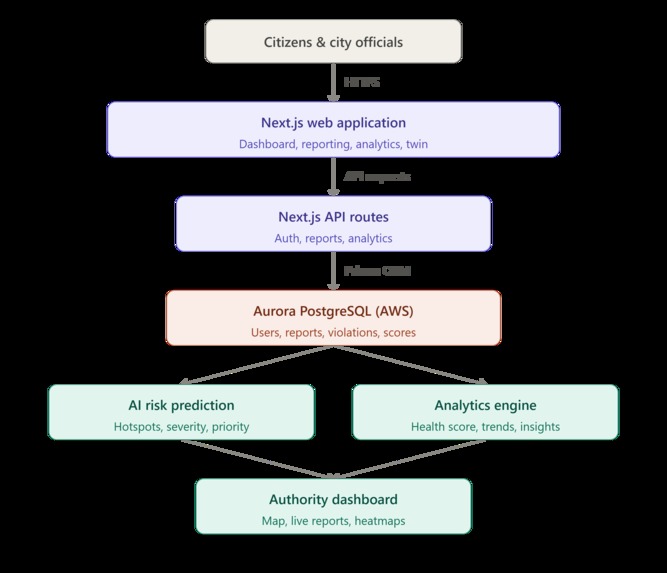
Amazon Aurora PostgreSQL — Primary relational database for storing users, reports, violations, analytics, dashboards, and city datasets. Amazon EC2 — Backend deployment and secure access for development and database connectivity. Amazon RDS (Aurora) — Managed PostgreSQL-compatible database infrastructure.
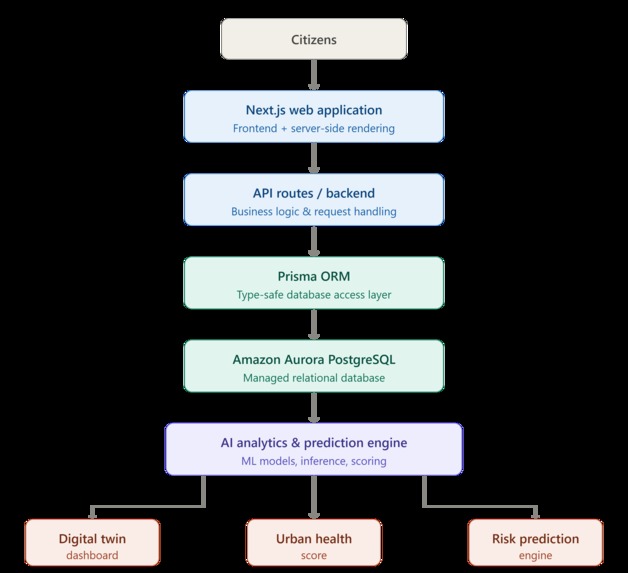
The application uses Prisma ORM to interact with Amazon Aurora PostgreSQL.
Technology Stack
Next.js React TypeScript Prisma ORM Amazon Aurora PostgreSQL Amazon EC2 Tailwind CSS AI-powered analytics and prediction engine
The frontend is deployed on Vercel. The application architecture is designed around Amazon Aurora PostgreSQL running on AWS, with EC2 used for backend execution. Due to networking constraints encountered during the final deployment window, the public demo uses the existing application flow while showcasing the intended AWS-backed architecture and database configuration.
Built With
- amazon-web-services
- aurora
- prisma
- vercel
- vo

Log in or sign up for Devpost to join the conversation.