Inspiration
As an international student moving to a new country, one of the primary concerns for both students and their parents is the safety of the neighborhood. When I arrived, I had to conduct extensive research to determine whether the neighborhood was safe. To alleviate these concerns for future international students and their families, we are building this platform. Additionally, the platform is designed to help businesses find the perfect location for their new ventures by providing comprehensive information about the locality, its safety, and other essential factors.
~ Bobby
What it does
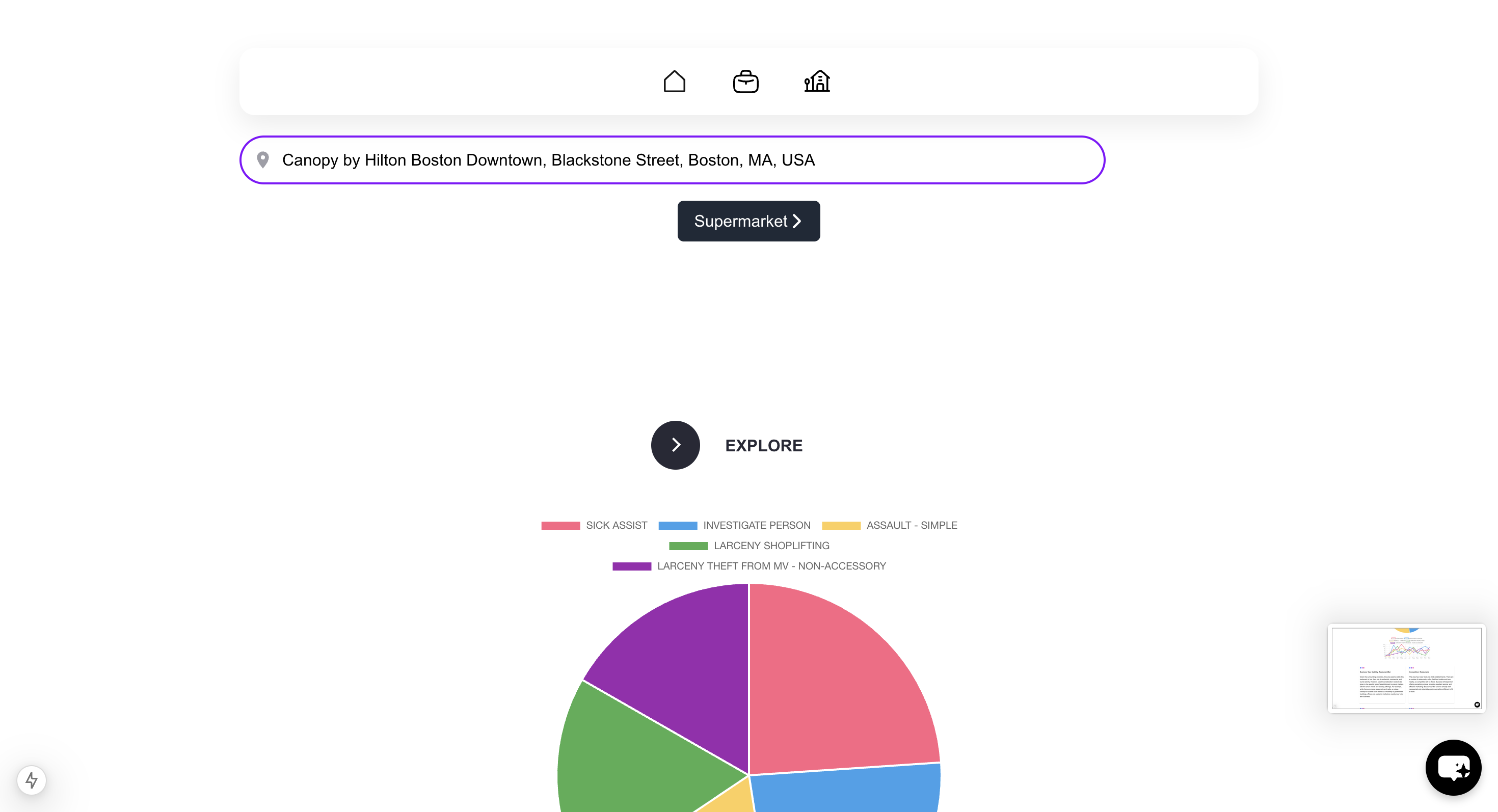
Civic Compass is a web application designed to provide comprehensive insights about specific neighborhoods. By simply entering an address, users receive a dynamically generated summary that covers:
Public Safety and Regulatory Data:
- Crime statistics
- Building violations
- Other municipal issues or alerts
Community Amenities and Infrastructure:
- Nearby cafes and restaurants
- Public transportation options
- Other local conveniences that may impact quality of life
Tailored Insights for Different User Groups:
- Renters and Residents: Pros and cons related to neighborhood safety, amenities, and livability.
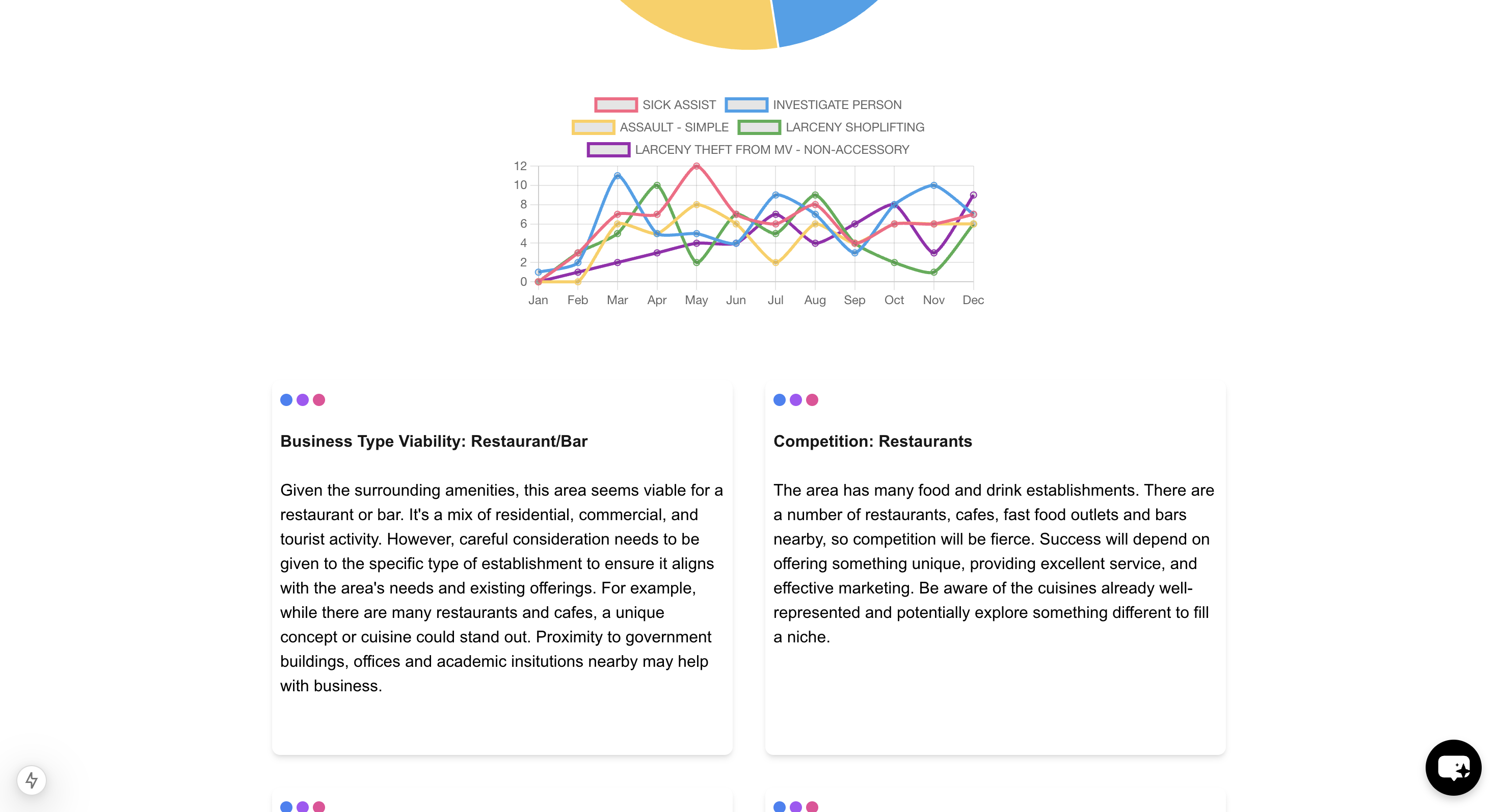
- Small Business Owners (food trucks, startups, etc.): Business-relevant insights like proximity to universities, local crime data, foot traffic trends, and overall market potential.
- Awesome Chatbot for all the information about where to rent These summaries are generated through a GenAI engine that processes aggregated government and public data, presenting users with an easily digestible overview of the neighborhood’s characteristics.
How we built it
The development of Civic Compass involved several key components and technologies:
Front-End and Framework:
- Next.js: Our choice of Next.js allowed us to build a fast, SEO-friendly, and server-side rendered application. This framework helped ensure that our web app remains responsive and scales effectively with user demand.
Data Integration:
- Government and Public Data APIs: We integrated various data sources to capture information on crimes, building violations, transportation networks, and local amenities.
- Data Aggregation Pipelines: These pipelines standardize and preprocess data, ensuring consistency before feeding it to the GenAI engine.
Generative AI (GenAI) Integration:
- Prompt Engineering: We carefully designed prompts to query our language model, ensuring that the generated summaries are contextually relevant and accurate.
- Training and Tuning: By leveraging historical government data and user feedback, we refined the model’s outputs to balance factual accuracy with readability.
- RAG Setup: We used a set of files with information about the Boston housing market and crime statistics and used them in a RAG setup to provide the chatbot with relevant, grounded information.
User Experience:
- Address Input and Geocoding: Users can input an address, which is then translated into geolocation coordinates. This step is crucial for querying nearby amenities and local statistics accurately.
- Responsive UI/UX: The interface is designed to be intuitive, ensuring that both renters and business owners can quickly understand and act on the provided insights.
We brainstormed useful data sources we'd want to include to best understand a neighborhood. Our next step was to build pipelines for data sources that would allow them to be readable by an LLM, as this was one of the best ways to collate and summarize so many datasets together. The project is a NextJS-based project and we are using the Gemini AI API to power the recommendations cards.
Challenges we ran into
Building Civic Compass presented several challenges:
Data Integration Complexity:
- Heterogeneous Data Sources: We had to reconcile various formats, update frequencies, and levels of data granularity from multiple government sources.
- Data Quality and Timeliness: Ensuring that data is both accurate and up-to-date was a continuous challenge, requiring regular validation and error-handling mechanisms.
Prompt Engineering and AI Reliability:
- Balancing Detail and Clarity: Crafting prompts that deliver succinct yet informative summaries without overloading the user was a key challenge.
- Ensuring Factual Accuracy: Given the high stakes (e.g., safety, investment decisions), verifying that the AI’s summaries were not only engaging but also factually correct required iterative testing and fine-tuning.
Accomplishments that we're proud of
Several key milestones stand out in the Civic Compass project:
Successful Data Aggregation:
- We managed to integrate diverse data sets into a cohesive backend, providing a single, comprehensive source of neighborhood insights.
Effective GenAI Summaries:
- The application consistently generates balanced and actionable summaries, enabling users to make informed decisions about renting or starting a business.
- We did a lot of interesting work with OpenStreetMap to get data about neighborhoods.
- Representing the data as interactive charts is something we are very proud of.
What we learned
- We learned more about Boston's datasets and how merging government data with AI-generated insights can transform raw data into actionable intelligence. It’s not just about data; it’s about context.
- We learned about the importance of teamwork by using Github and also working on a lot of merge conflicts.
- We also did a deep dive on Next.js and other famous tech stacks.
What's next for idontknowwheretorent
Enhanced Personalization:
- Tailor summaries more closely to user profiles and preferences, allowing for customizable insights that better match individual needs.
Mobile Application Development:
- Develop a dedicated mobile app to reach a broader audience and provide on-the-go access to neighborhood insights.
Improved AI Model Integration:
- Continuously refine the prompt engineering and fine-tune the generative AI model to ensure higher accuracy and more nuanced outputs.
- Explore additional AI capabilities, such as predictive analytics or anomaly detection, to further empower users with foresight about potential neighborhood changes.
Data Expansion:
- Expand the data sources used to include things like pricing and potentially even local news.
Built With
- chart.js
- css
- genai
- html
- javascript
- next.js
- react.js
- tailwind


Log in or sign up for Devpost to join the conversation.