Inspiration
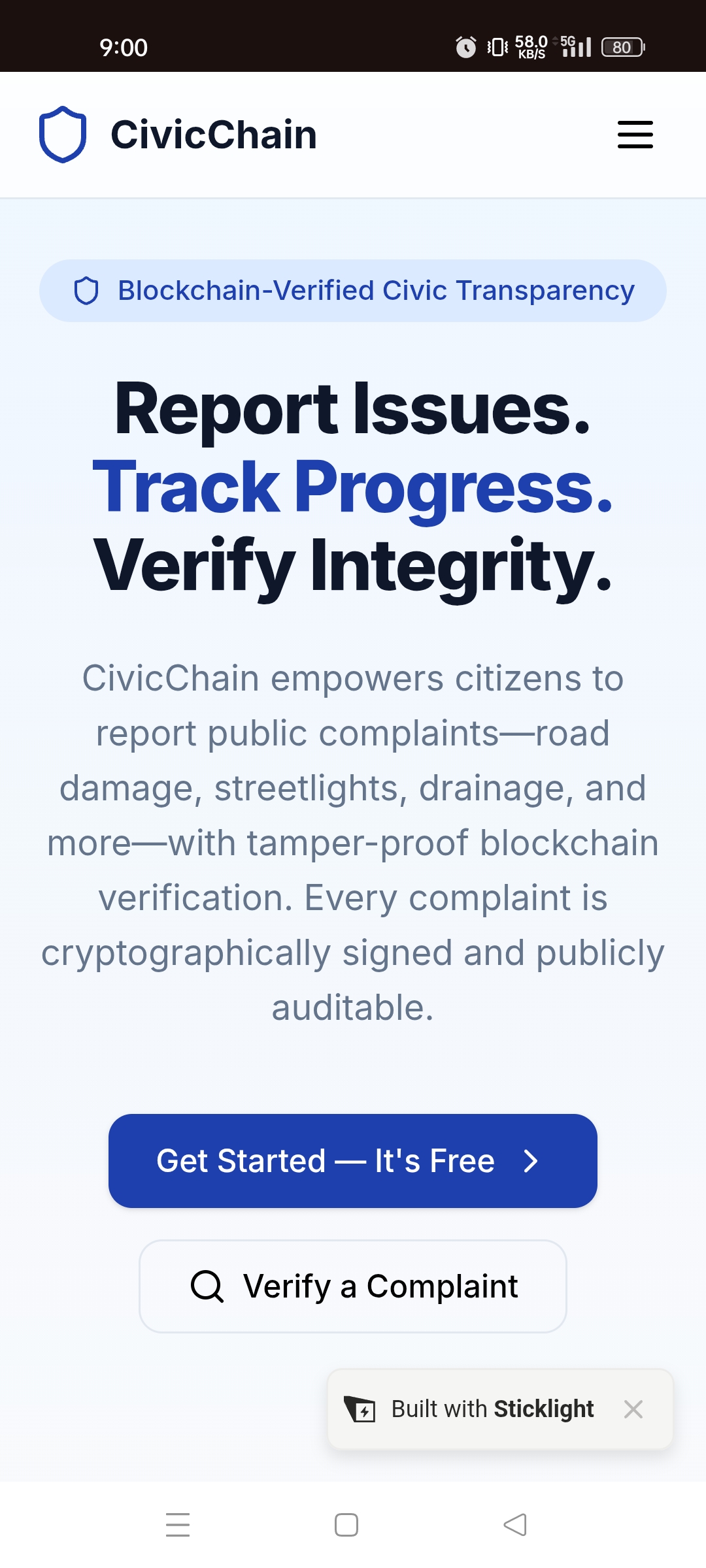
Civic issues such as damaged roads, drainage problems, waste management, and broken streetlights are often reported through systems where citizens have limited visibility into what happens after submission. We wanted to create a system that improves transparency and accountability by making important complaint events verifiable and resistant to unauthorized modification. This led us to build CivicChain, combining conventional civic-service management with blockchain-based verification. What it does CivicChain allows citizens to submit and track public complaints through a unique Complaint ID. Authorities can review complaints, assign departments, update statuses, add resolution details, and maintain a complete timeline. Important complaint events are cryptographically hashed and recorded for verification. Citizens can also use a QR code or Complaint ID to check the complaint history and verify whether the recorded information has been altered. How we built it We built CivicChain as a full-stack Web3 application with a responsive web interface, backend services, database storage, and blockchain integration. Complaint information is stored off-chain, while cryptographic hashes and important verification records are stored on the blockchain. A hash-chain mechanism connects successive complaint events, allowing the system to detect inconsistencies. We also implemented role-based access for citizens and authorities, wallet connectivity, complaint tracking, QR-based verification, and blockchain verification. Challenges we ran into One of our main challenges was deciding which information should be stored on-chain and which should remain off-chain. We needed to balance transparency, privacy, cost, and performance. Implementing a reliable hash-chain verification process and connecting the application backend with the blockchain also required careful handling of transactions and data consistency. Accomplishments that we're proud of We are proud of building a working concept that uses blockchain for a practical real-world problem rather than cryptocurrency or DeFi. CivicChain brings together complaint management, cryptographic verification, blockchain records, status tracking, and QR-based public verification in one platform. What we learned Through this project, we learned how blockchain can be applied beyond financial applications. We gained practical experience with smart contracts, cryptographic hashing, wallet integration, backend–blockchain communication, database architecture, and designing systems where transparency must be balanced with privacy. What's next for CivicChain Our next goal is to expand CivicChain into a scalable civic-service platform. Future versions could integrate IoT-based evidence, location verification, automated complaint categorization, department-level analytics, decentralized identity, and integration with existing municipal systems. We also want to improve blockchain verification and make the platform suitable for real-world deployment across different public-service departments.
What it does
How we built it
Challenges we ran into
Accomplishments that we're proud of
What we learned
What's next for Civic chain
Built With
- antigravity

Log in or sign up for Devpost to join the conversation.