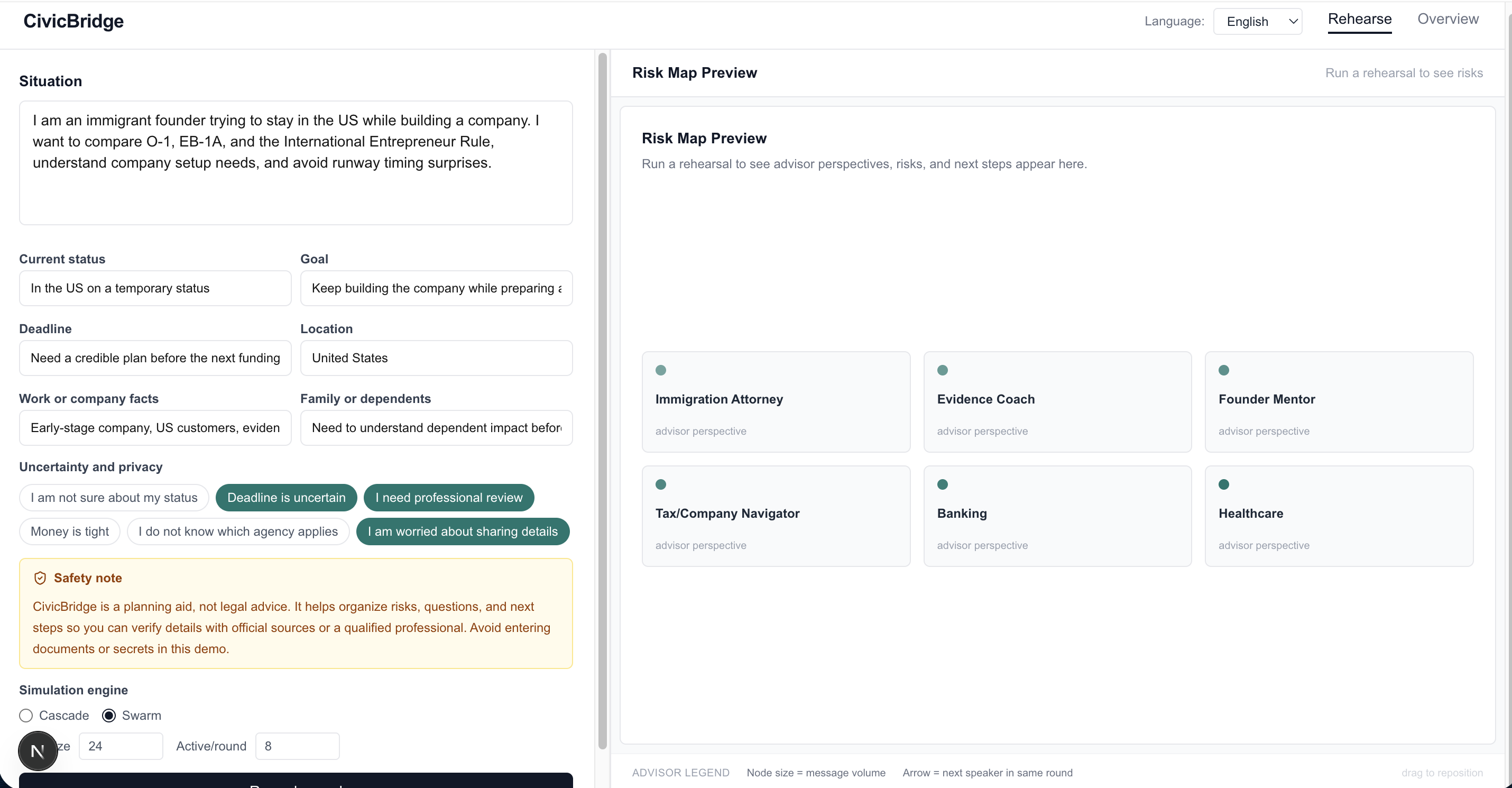
Inspiration Modern immigration systems force people to make life-altering decisions under uncertainty, fragmented information, and time pressure. We were inspired by how many immigrants, founders, students, and creatives struggle not only with legal complexity, but with the cascading effects immigration decisions have on housing, banking, healthcare, taxes, employment, and family stability. Existing tools often provide static information, but very few help people rehearse scenarios before they act. We wanted to build a system that feels less like a search engine and more like a situational planning layer for real life. What it does CivicBridge is an AI-powered immigration rehearsal platform that helps users simulate pathways, risks, and institutional interactions before making major decisions. Users describe their situation in natural language, and the platform generates advisor-style perspectives, highlights uncertainties, surfaces downstream risks, and organizes actionable next steps. Instead of pretending to replace legal professionals, CivicBridge acts as a preparation and orientation tool. It helps users compare immigration pathways, understand dependencies between systems, and identify where professional review may be necessary. The system can model perspectives from immigration attorneys, founder mentors, tax navigators, evidence coaches, and other institutional viewpoints to help users understand how decisions ripple across their lives. How we built it We built CivicBridge as a lightweight AI simulation environment using a modern web stack and multi-agent orchestration concepts. The frontend was designed as an interactive rehearsal interface where users can input contextual information about their immigration and life situation. On the backend, we structured a “swarm” simulation engine where multiple AI advisor personas analyze the same scenario from different institutional perspectives. Rather than generating one monolithic answer, the system creates layered outputs that resemble a real-world advisory ecosystem. We focused heavily on contextual reasoning and cascade analysis. The system maps how one decision — such as choosing a visa pathway or changing company structure — can affect timelines, dependents, finances, and operational stability. We also emphasized privacy-aware interaction design by encouraging users not to upload sensitive documents during the demo phase. Challenges we ran into One of the biggest challenges was balancing usefulness with responsibility. Immigration is a high-stakes domain, so we had to carefully design the product to avoid presenting itself as legal advice while still providing meaningful guidance. Another challenge was orchestrating multiple AI perspectives in a coherent way. Multi-agent systems can easily become repetitive or contradictory, so we had to experiment with prompt structure, sequencing, and role separation to create outputs that felt additive rather than noisy. We also struggled with simplifying highly complex institutional systems into an interface that remained approachable for non-technical users. Designing trust, clarity, and emotional accessibility was just as important as the technical implementation. Accomplishments that we're proud of We’re proud that CivicBridge reframes immigration support as a systems-planning problem instead of just a document-filing problem. The platform introduces a new interaction model where users can rehearse futures, identify blind spots, and understand institutional complexity before consequences occur. We’re also proud of the multi-perspective simulation engine and the way the interface visualizes cascading impacts across different domains of life. Even in prototype form, the platform demonstrates how AI can support vulnerable populations through contextual awareness rather than simple automation. Most importantly, we created something that feels empathetic and empowering rather than bureaucratic. What we learned We learned that users often do not just need answers — they need orientation, confidence, and situational clarity. AI becomes far more valuable when it helps people understand relationships between decisions instead of simply returning isolated information. We also learned how difficult it is to design AI systems for high-trust environments. Transparency, disclaimers, and uncertainty communication are essential. In many cases, helping users understand what they do not know is just as important as giving recommendations. Technically, we learned a great deal about multi-agent orchestration, contextual prompting, and designing interfaces for ambiguity rather than certainty. What's next for CivicBridge Next, we want to evolve CivicBridge into a broader “life infrastructure rehearsal” platform for immigrants and globally mobile individuals. We plan to improve the simulation engine with deeper institutional modeling, timeline forecasting, and memory-aware context systems. We also want to integrate official policy sources, build multilingual support, and develop personalized continuity tools that help users track evolving pathways over time. Long term, we see CivicBridge becoming a contextual layer between individuals and complex institutional systems — helping people navigate uncertainty with more clarity, preparation, and agency.
civic bridge
CivicBridge is an AI-powered immigration Python Simulation platform that helps immigrants navigate complex life and legal pathways before costly mistakes happen.
Updates

Leave feedback in the comments!
Log in or sign up for Devpost to join the conversation.