Inspiration
It started with a simple but uncomfortable question: what happens when a citizen has a real problem — a broken water pipe, a collapsed road, an unsafe street — but has absolutely no idea how to make their voice heard?
In many underserved communities, the gap between having a problem and getting it fixed isn't a technology gap — it's a language and access gap. Filing an official complaint requires knowing which government office is responsible, writing in a formal administrative tone, and having the time and literacy to navigate bureaucracy. For millions of people, that barrier is enough to make them give up before they even start.
We kept coming back to one idea: what if AI could become the translator between an ordinary citizen's everyday words and the formal language of institutions? Not replacing the citizen's voice — amplifying it, and giving it the structure it needs to be taken seriously.
That question became CivicAI — "Your voice, written in the language of the law."
This idea aligned perfectly with the AI × Social Good theme of STEMINATE HACKS 2026, sitting directly at the intersection of Equity & Justice (access to civic participation and legal-style communication) and Community & Access (a tool designed for people who are normally excluded from digital civic infrastructure).
What it does
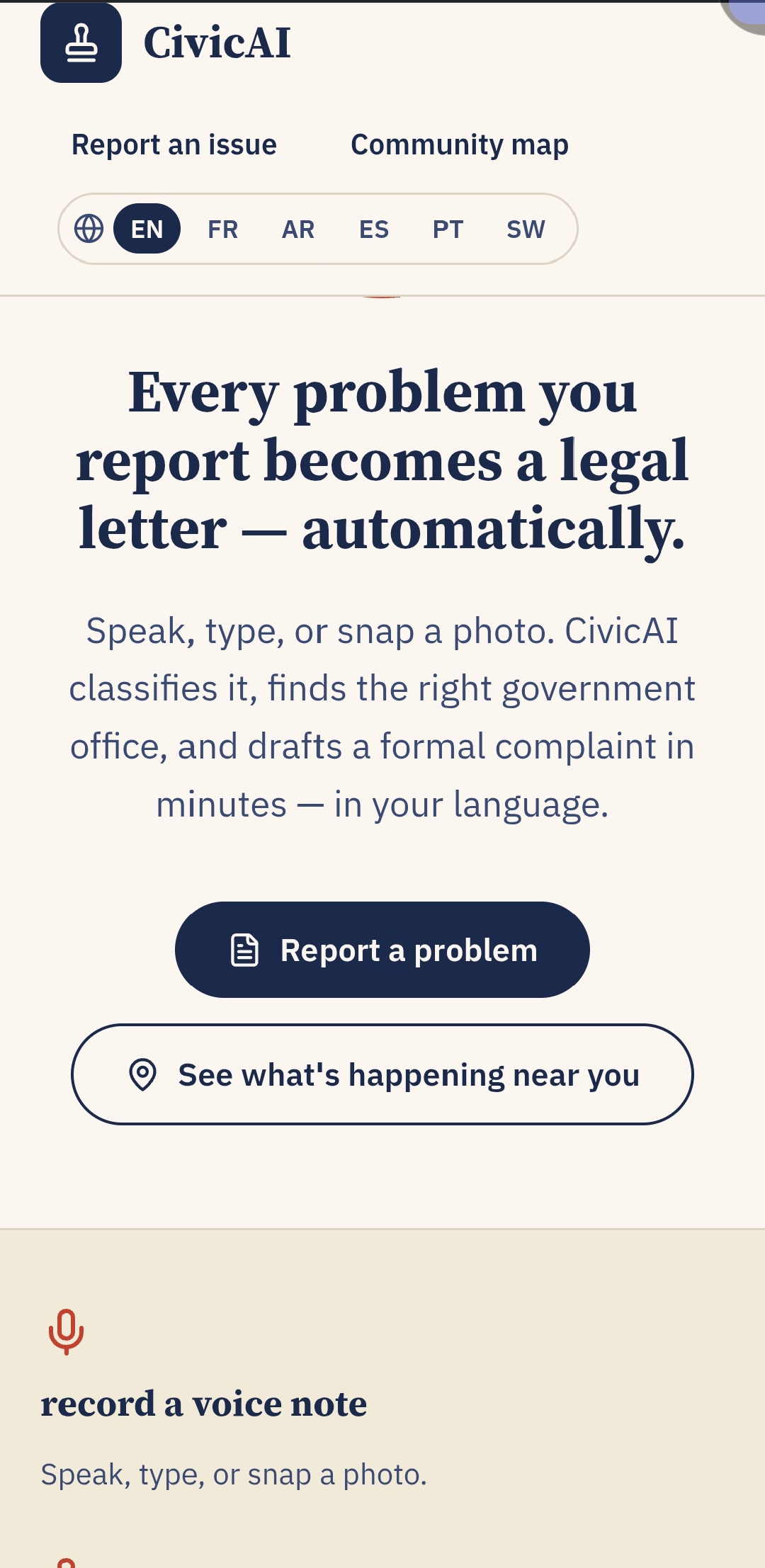
CivicAI is a multilingual, multimodal civic action platform that transforms a citizen's plain-language description of a local problem into a formal, structured, government-ready complaint — instantly, and at zero cost.
Here is the full pipeline, end to end:
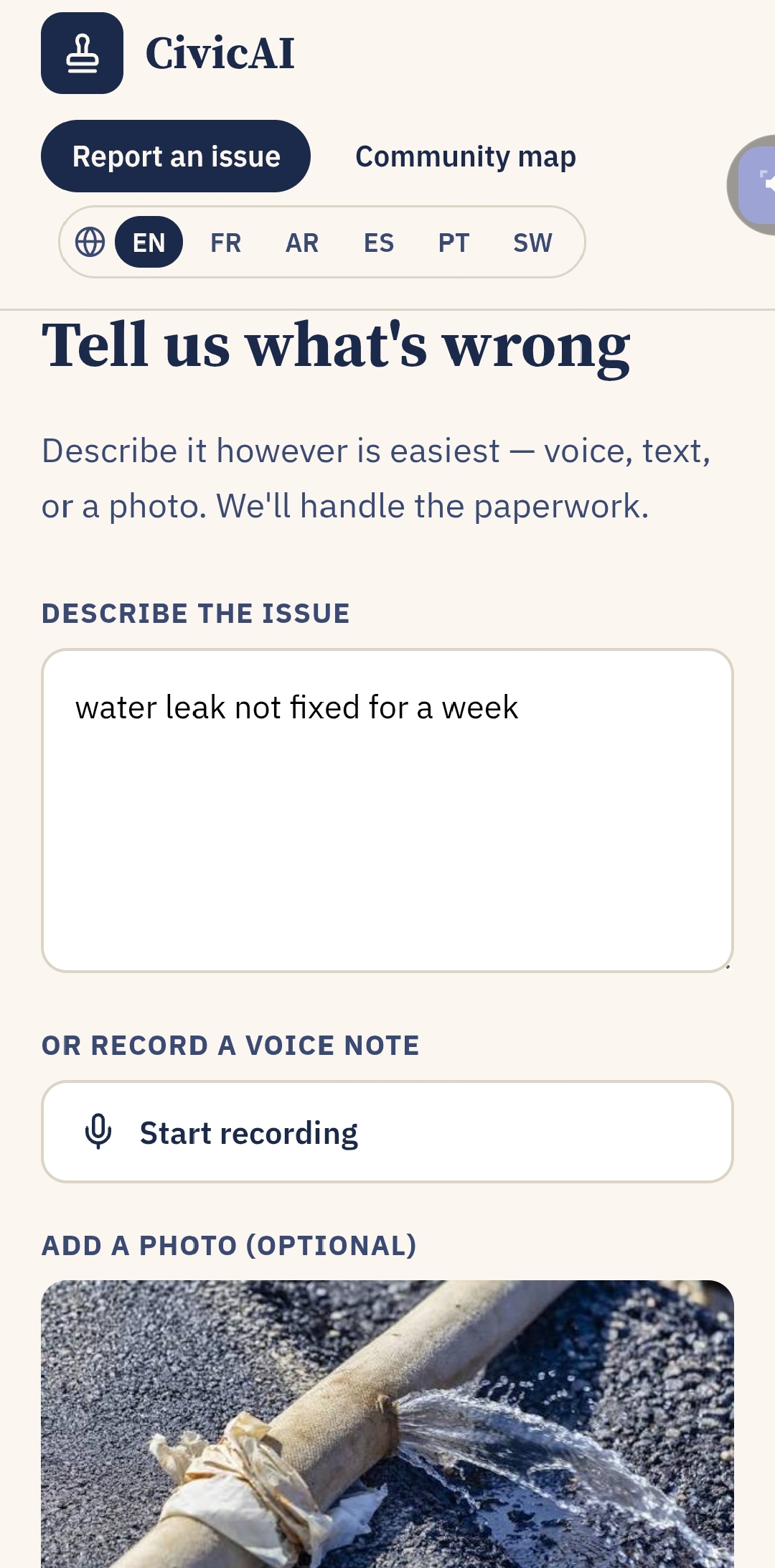
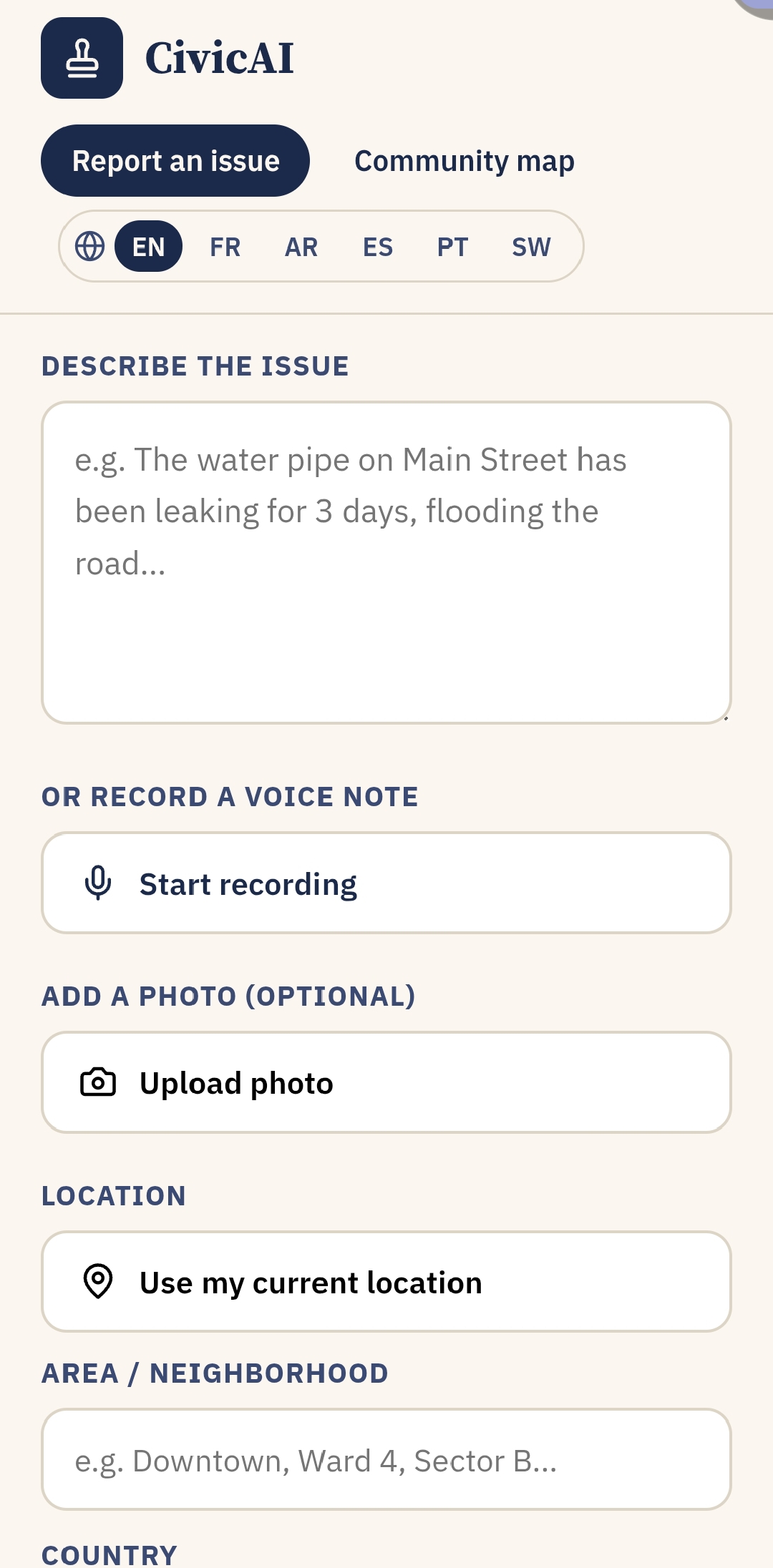
- Reporting an issue — A citizen describes a local problem (broken infrastructure, water outages, unsafe streets, corruption, etc.) using text, voice input, or by attaching context such as location.
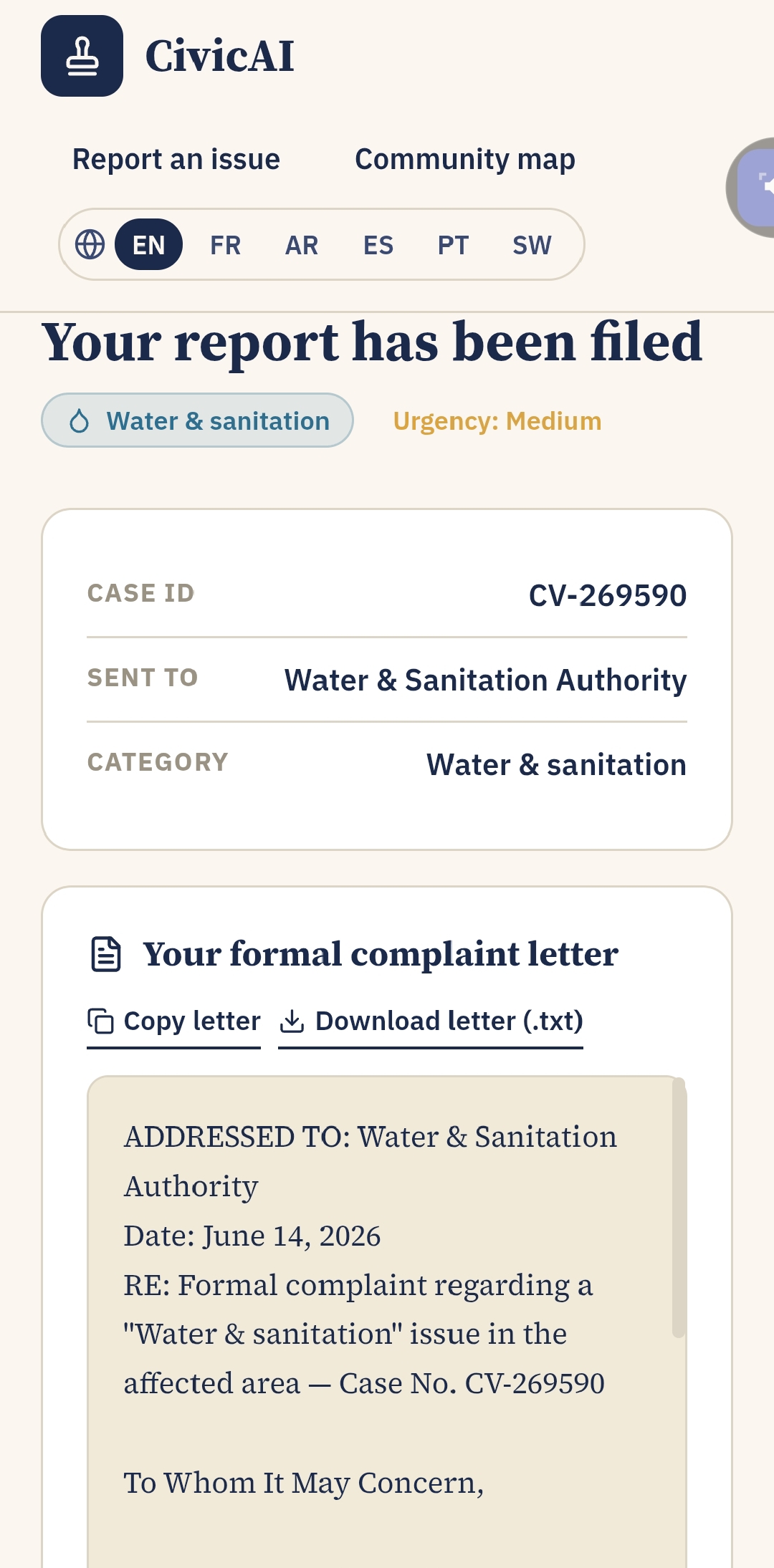
- Automatic classification — The system analyzes the description and classifies it by issue category (e.g., water access, road infrastructure, electricity, safety) and assigns an urgency level, using multilingual keyword and context analysis.
- Location enrichment — Using the browser's Geolocation API combined with OpenStreetMap's Nominatim reverse-geocoding service, each report is automatically tagged with a precise location and timestamp — no manual address entry required.
- Authority routing — Based on the issue category, CivicAI identifies which type of government authority is responsible and generates the complaint addressed accordingly.
- Formal letter generation — The platform automatically drafts a complete, professionally-worded complaint letter, structured the way an administrative authority expects to receive it — something that would normally require legal knowledge or paid assistance.
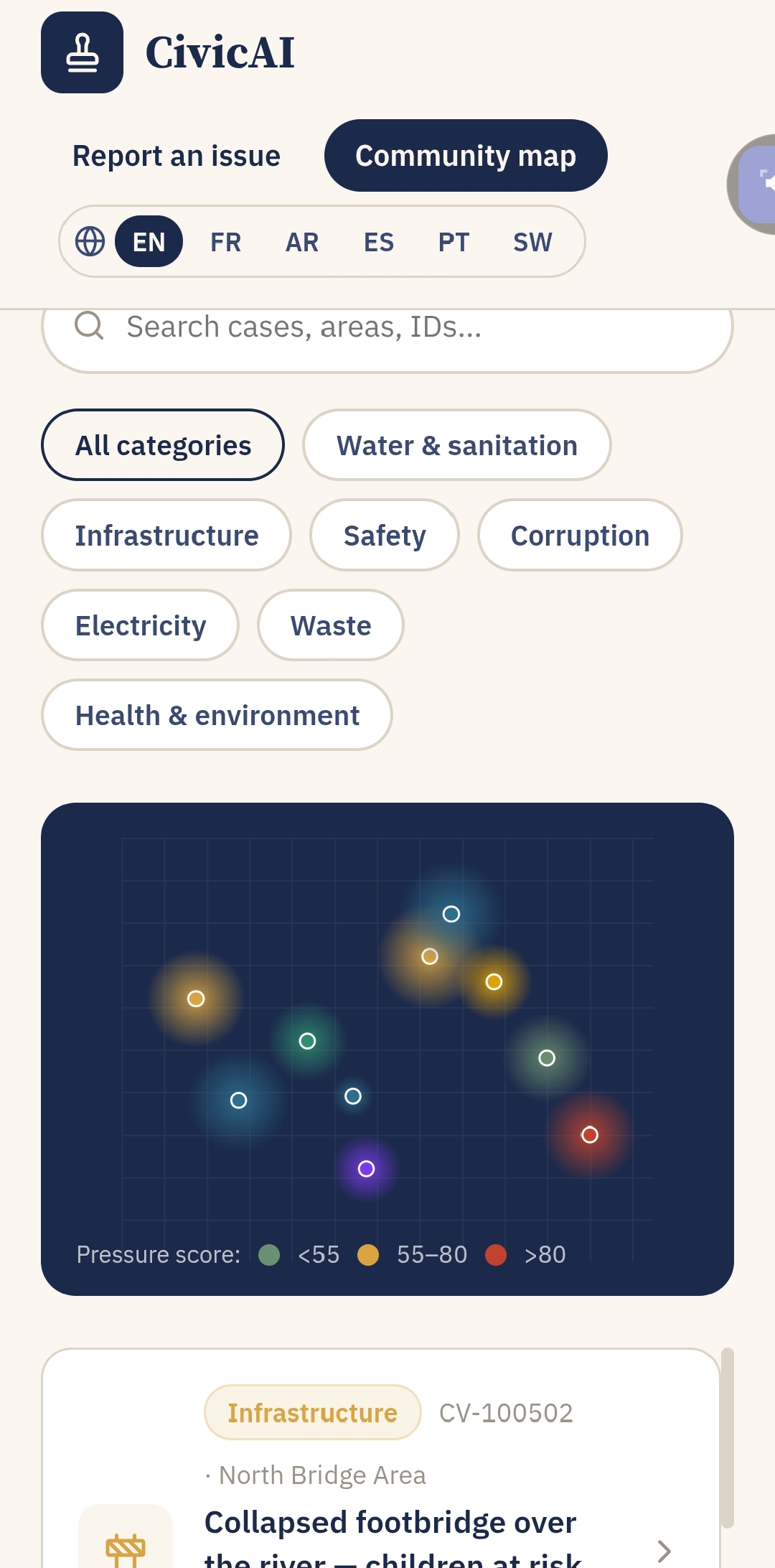
- Community clustering & pressure scoring — When multiple citizens report the same or similar issue in the same area, CivicAI clusters these reports into a single community case and calculates a Community Pressure Score. A single complaint can be ignored; fifty identical, clustered, geotagged complaints become statistically very difficult to dismiss.
- Transparent tracking & escalation — Every case moves through a visible status pipeline — Submitted → Acknowledged → Under Review → Resolved — and stalled cases are flagged for automatic escalation letters.
- Public dashboard — A heatmap-style dashboard visualizes all active community issues, giving citizens, NGOs, and journalists a real-time picture of where systemic problems are concentrated.
The entire interface is multilingual by design, supporting English, French, Arabic, Spanish, Portuguese, and Swahili, including full right-to-left layout support for Arabic — because a tool for underserved communities cannot assume everyone speaks the language of the institutions they're complaining to.
How we built it
CivicAI was built as a fully self-contained, frontend-first web application, deliberately engineered to deploy instantly with zero infrastructure overhead — a deliberate choice to maximize feasibility within the hackathon timeframe while keeping a clear path to a production-grade backend.
Core stack:
- React 18 + Vite for a fast, modern, component-based frontend architecture
- lucide-react for a clean, accessible icon system across the UI
- Browser Geolocation API + OpenStreetMap Nominatim for free, key-less reverse geocoding — converting raw GPS coordinates into human-readable addresses
- Web Speech API for voice-to-text input, enabling citizens to speak their complaint rather than type it, which matters enormously for accessibility and literacy barriers
localStorage-based persistence layer, including a seeded demo dataset, designed so the app works fully offline and statelessly for the prototype — with a clearly designed migration path to a real database
Architecture highlights:
The project is organized around a clean separation of concerns:
App.jsx— the main application UI and orchestration logici18n.js— a complete translation layer for all six supported languagescategories.js— the issue taxonomy, including icons, colors, and associated authority typeslib/classify.js— a multilingual classification engine that analyzes report text and assigns category + urgencylib/letters.js— the template engine that generates formal complaint and escalation letterslib/storage.js— persistence, demo seed data, and the community clustering algorithmlib/geo.js— geolocation and reverse-geocoding utilities
This modular structure was intentional: it means the most "AI-critical" pieces of the system — classification (classify.js) and letter generation (letters.js) — are isolated, swappable modules. In the current MVP, these are implemented using carefully engineered multilingual heuristic logic so the application runs with zero API keys and zero backend, making it instantly deployable and demoable. However, the architecture is explicitly designed so that these modules can be swapped for live LLM-powered calls (e.g., the Anthropic Claude API) behind a serverless function, without touching the rest of the application — turning rule-based classification into true generative, context-aware reasoning.
We deployed the application on Vercel, with a vercel.json configuration ensuring zero-config builds straight from the Vite output.
Challenges we ran into
1. Designing for people who don't think in "categories." Real citizens don't describe problems the way databases expect. Someone might write "there's no water again" instead of "water infrastructure outage." A major challenge was building a classification layer that could map natural, informal, multilingual phrasing onto a structured taxonomy of issue types and urgency levels — without requiring a paid LLM API for the base prototype to function.
2. Multilingual support that goes beyond translation. Supporting six languages — including Arabic with full right-to-left layout — meant every UI component had to be tested for directionality, text expansion/contraction, and cultural tone in the generated letters. A "formal" tone in French administrative writing is structurally different from formal English, and our letter templates had to respect that.
3. Making "community pressure" meaningful, not just cosmetic.
The hardest conceptual challenge was the clustering logic: how do you decide that two reports — possibly written in different languages, with slightly different wording, from nearby but not identical coordinates — represent the same underlying issue? We built a clustering approach in storage.js that groups reports by category, geographic proximity, and time window to produce a single aggregated community case with a calculated pressure score.
4. Balancing ambition with feasibility under time pressure. The original vision included a live backend, real LLM-based reasoning, and a shared database across users. With a tight hackathon window, we made a deliberate architectural decision: build a fully functional, demo-ready, zero-dependency frontend MVP first, with every "AI module" cleanly isolated so it can be upgraded to a true LLM-powered backend without a rewrite. This let us ship a working, polished, deployable product rather than an incomplete full-stack system.
5. Geolocation without compromising accessibility. Many citizens in target communities may not grant location permissions, or may be on devices/browsers with limited support. We had to design the geolocation + reverse-geocoding flow (via OpenStreetMap Nominatim) to degrade gracefully — enriching reports when location is available, without blocking submission when it isn't.
Accomplishments that we're proud of
- Transforming informal citizen complaints into structured, actionable civic reports
- Building a multilingual system supporting 6 languages including Arabic RTL support
- Designing a working AI pipeline without requiring external APIs
- Creating a community pressure score that amplifies collective citizen voices
- Making the entire system fully functional, fast, and deployable with zero setup
## What we learned
Accessibility is an architectural decision, not a UI afterthought. Supporting six languages and right-to-left layouts from day one forced us to structure the entire codebase — from
i18n.jsto component layout — around accessibility rather than retrofitting it later. - The most powerful AI systems for social good aren't always the most computationally expensive ones. A well-designed classification heuristic, combined with a clear upgrade path to LLM-based reasoning, can deliver a genuinely useful, instantly deployable tool — proving that meaningful AI-driven impact starts with thoughtful system design, not just raw model size.
- Aggregation is where individual voices become collective power. Building the community clustering and pressure-scoring logic taught us that the real social innovation in CivicAI isn't the letter-writing — it's the transformation of isolated, ignorable complaints into statistically significant, structured civic signals.
- Zero-infrastructure design is a legitimate engineering strategy. Choosing
localStorageand a fully static deployment wasn't a limitation — it was a way to guarantee the project works flawlessly for judges, on any device, with zero setup, while keeping a clean, documented path toward a production backend with Postgres/PostGIS and a real LLM integration.
What's next for Civic AI
The README itself documents a clear roadmap for evolving this MVP into a production system:
- Replacing the heuristic classifier and letter templates with live Anthropic Claude API calls via serverless functions, enabling true generative, context-aware classification and letter drafting
- Migrating from
localStorageto a shared Postgres + PostGIS (or Supabase/Firebase) backend, so community reports and pressure scores are visible across all users and devices in real time - Integrating a hosted speech-to-text service (such as Whisper) for full multilingual, offline-capable voice input
- Building a real authority directory per country/region, with actual government department names, emails, and addresses
- Implementing automatic escalation via scheduled jobs that detect stalled cases and generate follow-up letters without human intervention
Our long-term vision is simple: every citizen, regardless of language, literacy, or technical skill, should be able to turn "something is wrong here" into a formal, trackable, collectively-amplified civic action — in seconds, for free.
CivicAI — your voice, written in the language of the law.
Built With
- browser-geolocation-api
- css-in-js
- javascript
- localstorage
- lucide-react-icons
- openstreetmap-nominatim-(reverse-geocoding)
- react18
- vite
- web-speech-api


Log in or sign up for Devpost to join the conversation.