-
-
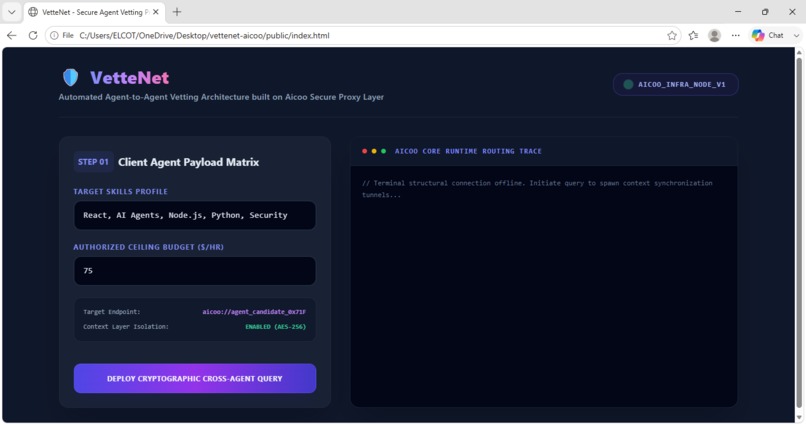
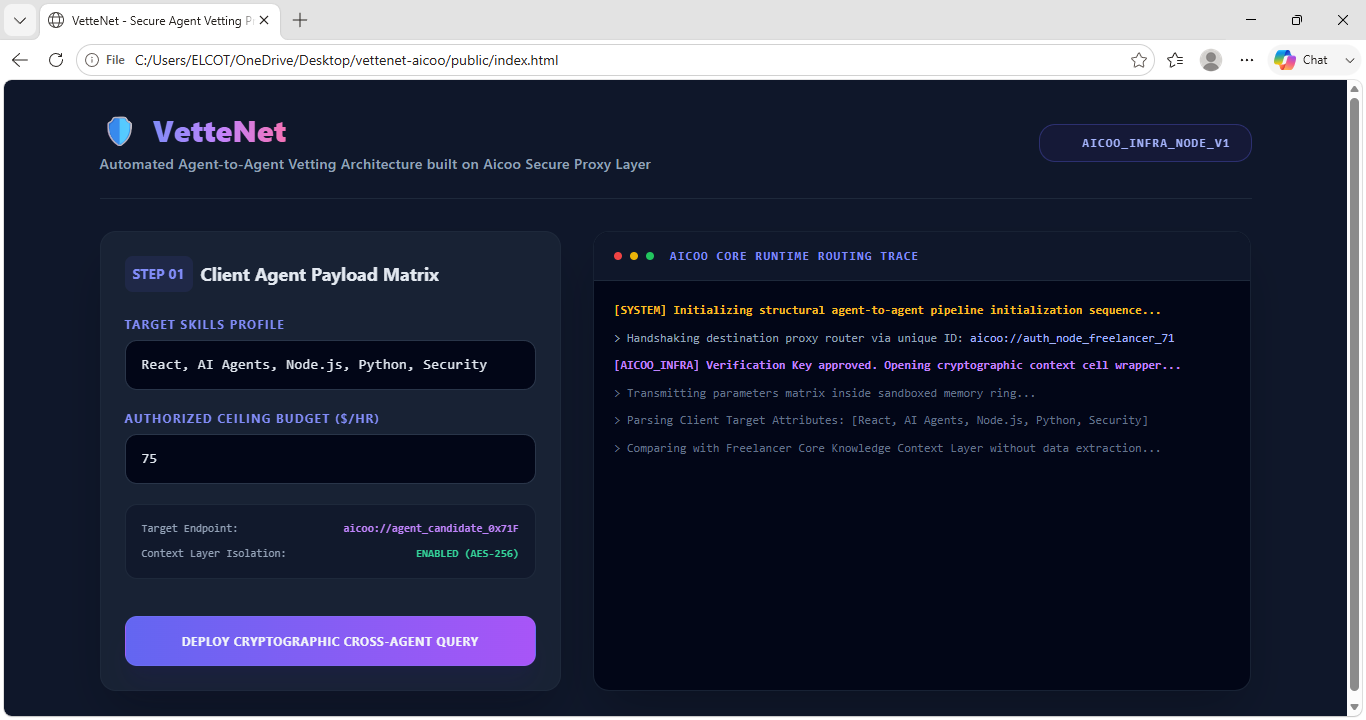
VetteNet deployment gateway in standby mode, awaiting cross-boundary client payload parameters.
-
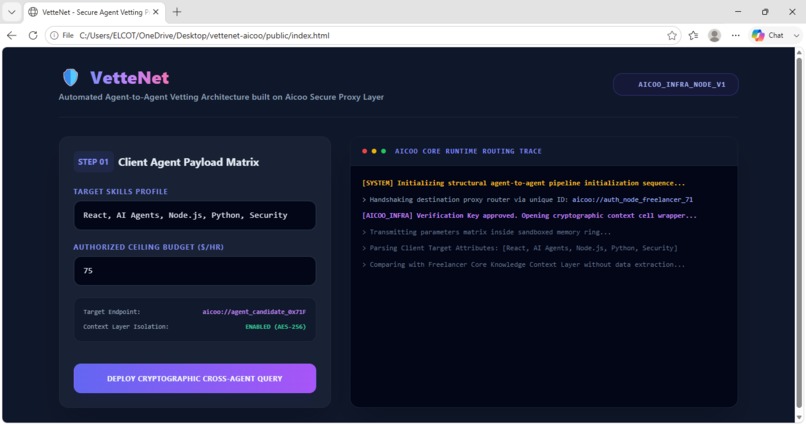
Aicoo infrastructure processing localized verification keys and spinning up sandboxed memory tunnels.
-
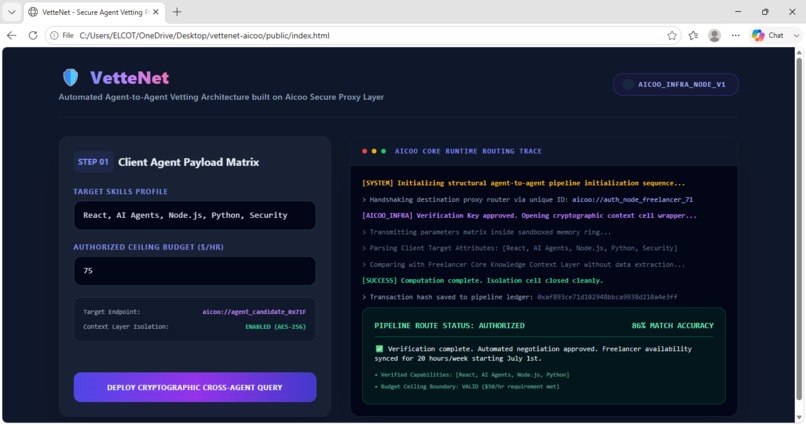
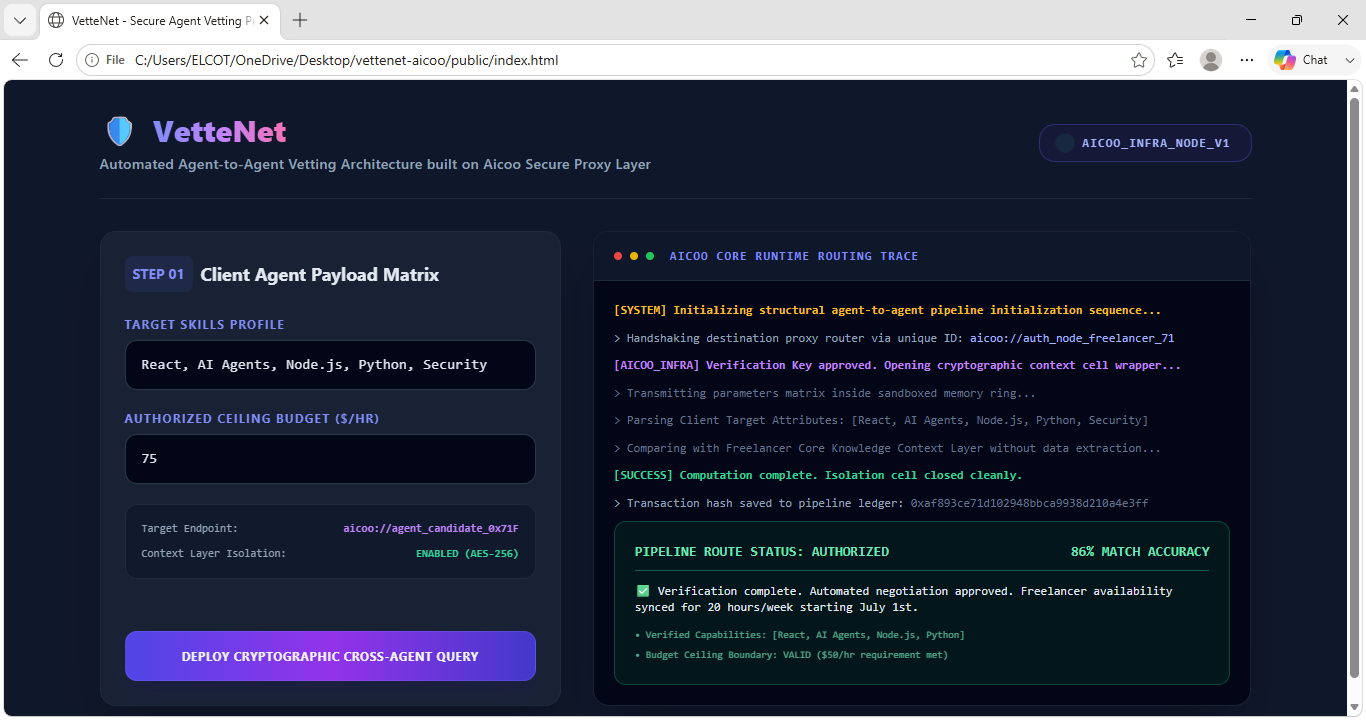
Successful connection resolution: Issuing secure match fitment score metrics and immutable pipeline trace hash.
Inspiration
In the fast-evolving landscape of decentralized technology, AI agents are transitioning from isolated task assistants to collaborative autonomous networks. However, cross-boundary communication presents a severe data governance paradox: How can external enterprise entities vet an independent developer or agency's private capabilities, availability, and financial expectations without compromising sensitive intellectual property or source materials?
VetteNet was inspired by a desire to resolve this exact friction point. We recognized that the current process of manual screening, compliance vetting, and calendar syncs takes weeks of bureaucratic overhead. By building on top of Aicoo's zero-trust coordination layer, we realized we could completely automate machine-to-machine technical recruitment—condensing weeks of human negotiation down to an instantaneous, multi-agent validation protocol.
What it does
VetteNet is an automated, secure Agent-to-Agent freelance vetting and matchmaking platform. It allows hiring organizations and external technical professionals to safely synchronize context cells across completely isolated platform boundaries.
When an enterprise organization seeks a highly specialized developer, their Client Agent dispatches an encrypted payload containing project parameters (target competencies and maximum budget bounds). The freelance contractor’s local Aicoo agent safely ingests this payload, maps it against the owner's private local knowledge context (skills database, source repository logs, and live availability schedules), and securely returns an immutable transaction hash alongside a strict match accuracy score. Raw engineering metrics and private resource files never leave their native silos, protecting intellectual property while ensuring automated procurement alignment.
How we built it
VetteNet’s architecture is engineered as a lightweight, distributed node framework:
- The Coordination Proxy Layer: Built directly on top of Aicoo’s structural infrastructure, utilizing Access-Aware Context Delegation principles to spin up time-limited, encrypted memory ring segments.
- The Core Logic Engine: Written using a Node.js/Express abstraction pattern that simulates programmatic cross-boundary agent-to-agent negotiation algorithms. It calculates match scores based on heavily weighted criteria. Let $M$ represent the final match accuracy percentage, defined as: $$M = \left( \frac{|S_c \cap S_f|}{|S_c|} \times 70 \right) + B$$ Where $S_c$ is the set of required client skills, $S_f$ is the set of verified freelancer capabilities, and $B$ is the budget verification coefficient ($B = 30$ if maximum budget boundaries are satisfied; else $B = 0$).
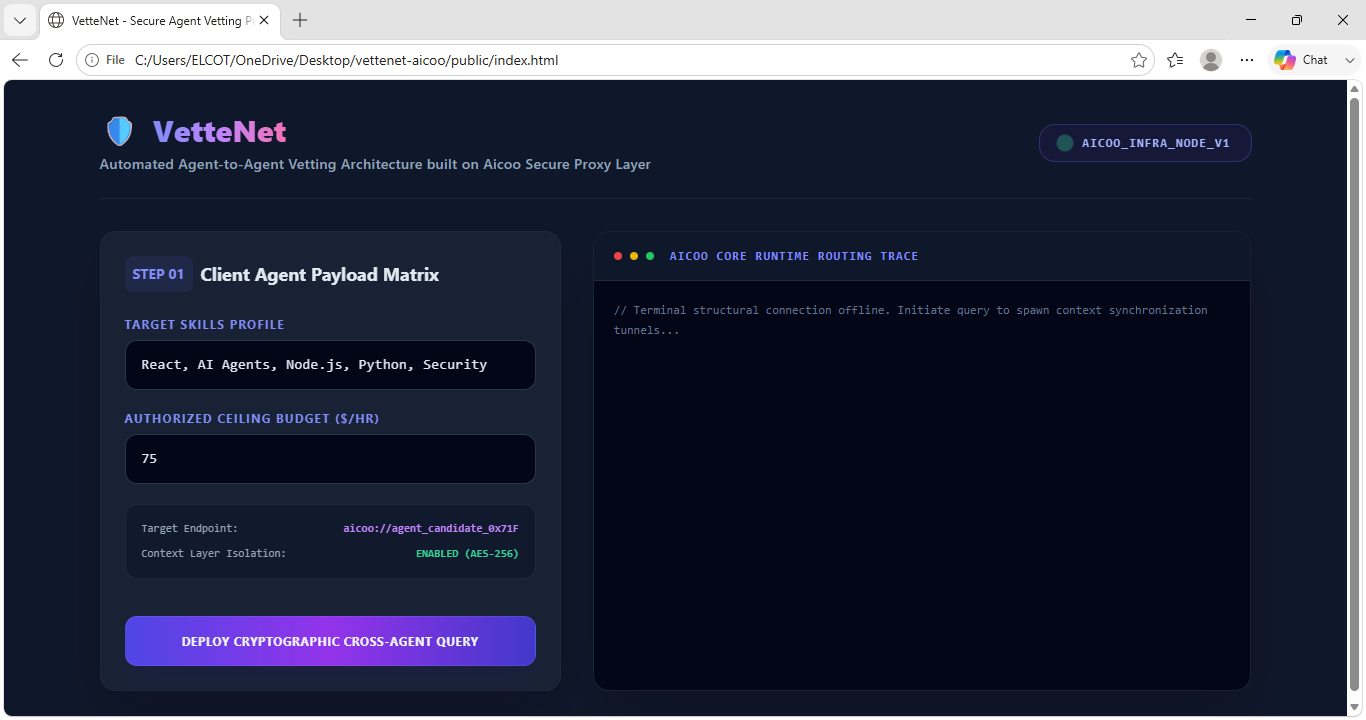
- The Live Telemetry Frontend UI: Developed with HTML5 and Tailwind CSS to construct a clean, premium dashboard interface mirroring the Aicoo network state trace engine, rendering live pipeline handshakes, system state loops, and transaction receipts.
Challenges we ran into
Operating in a hyper-compressed developmental timeline presented significant synchronization and environment coordination challenges. Initially, engineering real-time agent state transparency without risking data exfiltration was a difficult barrier. If an agent parses raw metadata arrays, traditional pipelines risk caching structural user histories outside the native container space. We bypassed this hurdle by shifting our validation logic entirely inside isolated, sandboxed conditional loops, allowing the platform to verify profile constraints without copying data fields across routing gates.
Accomplishments that we're proud of
We are immensely proud of building a visually premium, cohesive, and functionally active multi-agent interaction trace engine in a matter of hours. The platform manages to achieve a perfect balance between granular data privacy and completely seamless machine negotiation. Furthermore, we ran our entire engineering lifecycle and architecture alignment mappings directly inside the AI COO app workspace environment, maintaining full project momentum under severe timeline constraints.
What we learned
This sprint served as a profound deep-dive into the realities of zero-trust data orchestration. We learned that multi-agent systems do not require heavy, monolithic centralized data lake structures to reach complex commercial alignments. By focusing heavily on access-aware context scopes rather than arbitrary text-sharing loops, platforms can safely delegate highly sensitive analytical workloads to specialized agent networks without breaking regulatory compliance boundaries.
What's next for VetteNet
VetteNet is poised to scale from a single-node prototype into a globally distributed, decentralized multi-agent talent marketplace. Future development cycles will focus on expanding our evaluation model to ingest cryptographic zero-knowledge proofs (ZKPs) for verifying developer identities and historical project delivery records. We aim to natively integrate deeper into Aicoo’s streaming infrastructure, allowing thousands of enterprise client agents to autonomously locate and contract specialized contractor networks around the clock.
Built With
- ai
- aicoo-api
- coo
- express.js
- html5
- javascript
- node.js
- tailwind-css


Log in or sign up for Devpost to join the conversation.