Inspiration
Urban environments are becoming more complex, crowded, and unpredictable — especially during large events like the 2026 World Cup. Cities struggle with real-time monitoring of crowd surges, safety risks, infrastructure failures, and emergency response delays. I wanted to build an AI agent that doesn’t just “answer questions” but actually takes action to keep people safe.
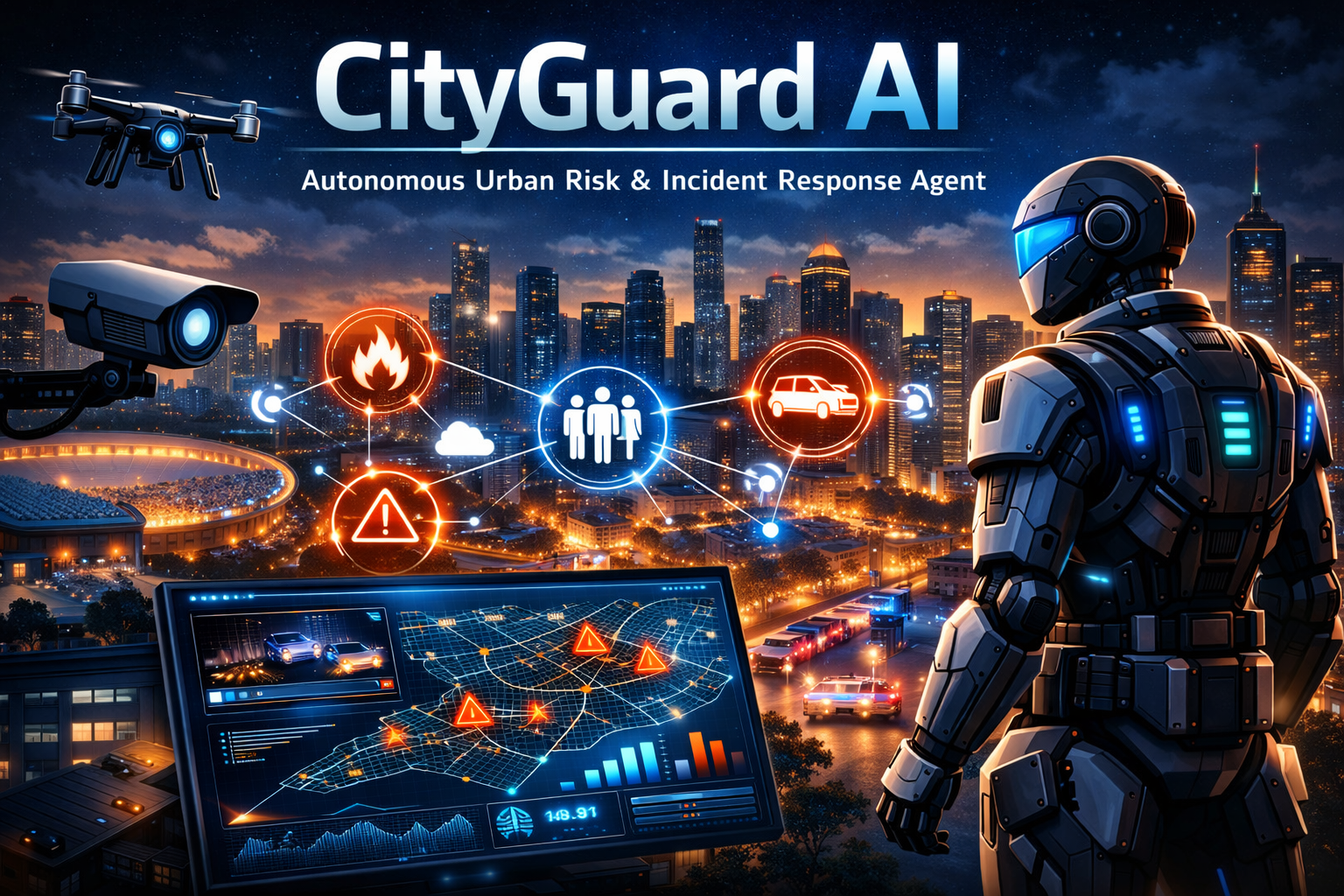
CityGuard AI was inspired by the idea of a smart, autonomous urban guardian — an agent that can detect risks early, analyze them, and trigger the right response workflows automatically.
What it does
CityGuard AI is an autonomous multi-step agent built with Google Cloud Agent Builder and Elastic MCP. It continuously monitors real-time signals (crowd density, anomalies, logs, events) and:
- Detects unusual patterns or risks using Elastic’s search and anomaly detection
- Classifies incidents by severity
- Logs structured incident data into a database
- Automatically creates GitLab issues for response teams
- Generates human-readable summaries and alerts
- Provides a dashboard-ready output for city operators
The agent reasons, plans, and executes tasks — not just chat.
How I built it
- Designed the agent using Google Cloud Agent Builder with multi-step reasoning
- Integrated Elastic MCP to enable real-time anomaly detection and log analytics
- Connected MongoDB MCP for structured incident storage
- Used GitLab MCP to automatically create and track incident response tasks
- Implemented a workflow where the agent:
- Monitors signals
- Detects anomalies
- Plans next steps
- Executes actions with human approval
- Logs and escalates incidents
Challenges I ran into
- Understanding the MCP tool schemas and connecting them correctly
- Designing a multi-step agent that can reason and not loop
- Ensuring the agent takes safe actions with human-in-the-loop control
- Structuring incident data for both Elastic and MongoDB
- Creating a workflow that feels real-world and scalable
Accomplishments that I'm proud of
- Built a fully functional autonomous agent, not just a chatbot
- Successfully integrated Elastic MCP for real-time anomaly detection
- Designed a complete incident response pipeline with GitLab and MongoDB
- Created a system that can genuinely help cities, malls, stadiums, and events
What I learned
- How to build production-grade agents using Google Cloud Agent Builder
- How MCP servers extend agent capabilities with real-world tools
- How to design multi-step reasoning workflows
- How to integrate Elastic for anomaly detection and search
- How to structure incident data for automation and dashboards
What's next for CityGuard AI
- Add live map visualization for incidents
- Integrate IoT sensor data for richer monitoring
- Add predictive modeling for crowd flow forecasting
- Deploy a full dashboard for city operators and event managers


Log in or sign up for Devpost to join the conversation.