Inspiration
Urban sustainability is often discussed in policy documents but rarely experienced as a dynamic decision-making process.
As a solo developer, I wanted to explore how sustainable cities are not built through ideal policies alone, but through constant trade-offs between financial stability, institutional trust, and crisis response.
City Under Pressure was inspired by the question:
What does governance actually feel like when resources are limited and public trust is fragile?
The project translates SDG 11 and SDG 16 into an interactive system where players experience institutional pressure firsthand.
What it does
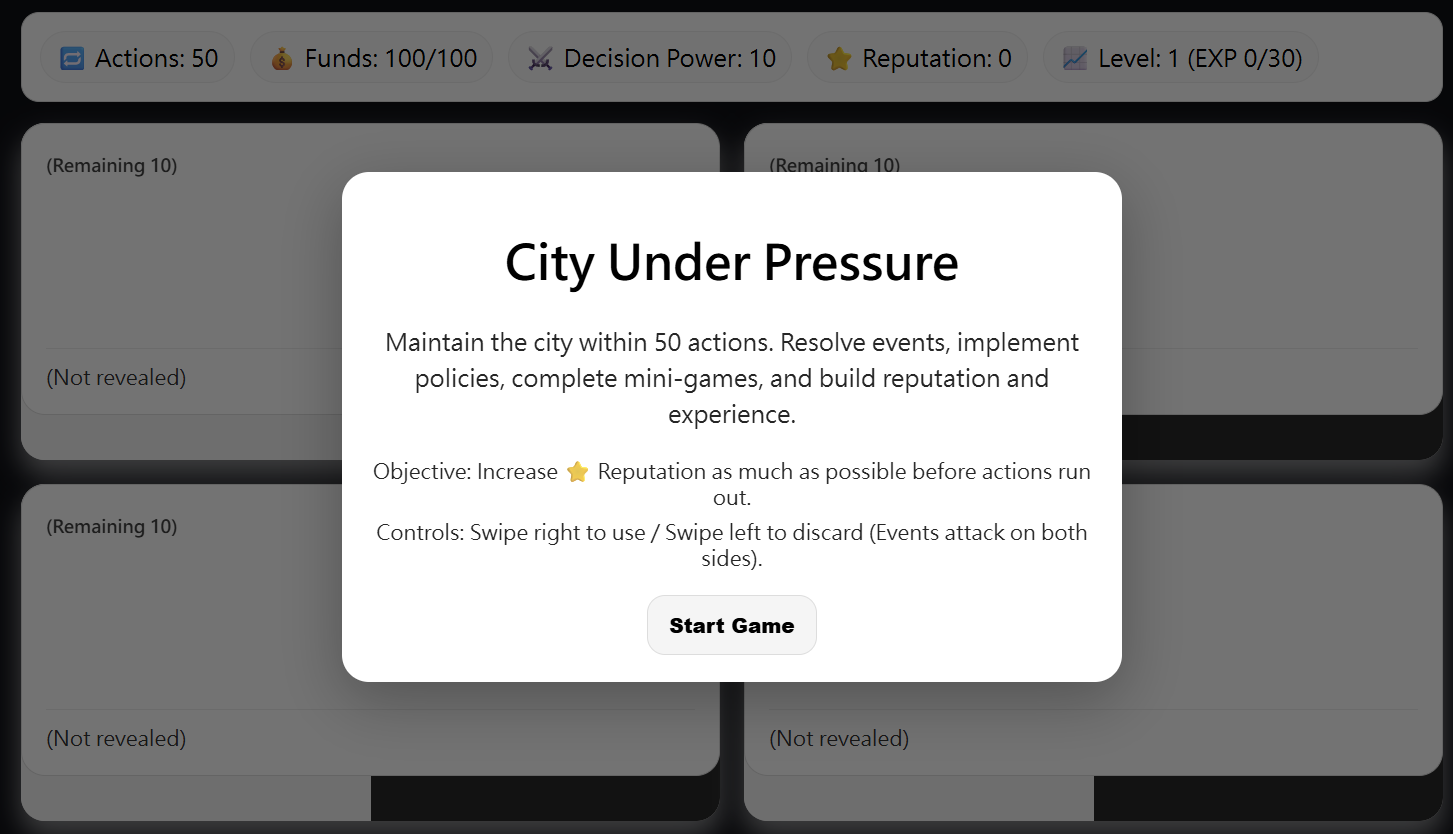
City Under Pressure is a browser-based governance simulation game.
Players take on the role of a city leader tasked with:
- Managing limited public funds
- Responding to infrastructure and social crises
- Implementing policies with trade-offs
- Maintaining institutional trust The core objective is to maximize Reputation, which represents public confidence and institutional legitimacy.
Through:
- Event resolution
- Strategic policy deployment
- Civic participation mini-games the game models how sustainable governance requires balancing transparency, accountability, and fiscal responsibility.
Reputation functions as a proxy for trust and once lost, it is difficult to rebuild.
How we built it
The project was developed independently using:
- Vanilla JavaScript (ES Modules)
- Modular state management architecture
- Custom card-based game engine
- Integrated mini-game system
- Web Audio API for interactive feedback
- HTML/CSS responsive layout
The architecture separates:
- Core governance logic
- Card resolution system
- Civic mini-game modules
- Reputation and progression systems This modular structure enables scalable expansion of policies, crises, and engagement simulations. ## Challenges we ran into Designing a governance simulation as a solo developer required balancing system complexity with clarity.
One major challenge was maintaining game balance. Events, policies, and mini-games all influence the same limited resources. Ensuring that trade-offs felt meaningful without making the game either too easy or impossible required multiple structural adjustments.
Finally, translating abstract SDG principles into interactive gameplay without oversimplifying real-world governance complexities required careful design choices.
Accomplishments that we're proud of
- Translating abstract SDG goals into a playable governance system
- Designing a trade-off-based decision framework instead of a linear scoring model
- Building a modular mini-game engine that integrates directly with core governance mechanics
- Deploying a fully playable browser demo as a solo project
- Modeling institutional trust through a dynamic reputation system City Under Pressure demonstrates how interactive systems can simulate complex civic and institutional challenges. ## What we learned I learned that sustainable governance is not about maximizing a single metric. It is about balancing competing pressures under uncertainty.
Modeling public trust as a dynamic variable revealed how fragile institutional legitimacy can be when fiscal and political constraints intensify. I also learned the importance of system architecture when building simulation-based projects independently.
What's next for City Under Pressure
Future development includes:
- AI-based policy advisor
- Dynamic crisis scaling
- Data-driven sustainability metrics
- Multiplayer governance simulation
- Educational civic literacy deployment The long-term vision is to evolve City Under Pressure into an interactive educational tool for understanding sustainable governance.

Log in or sign up for Devpost to join the conversation.