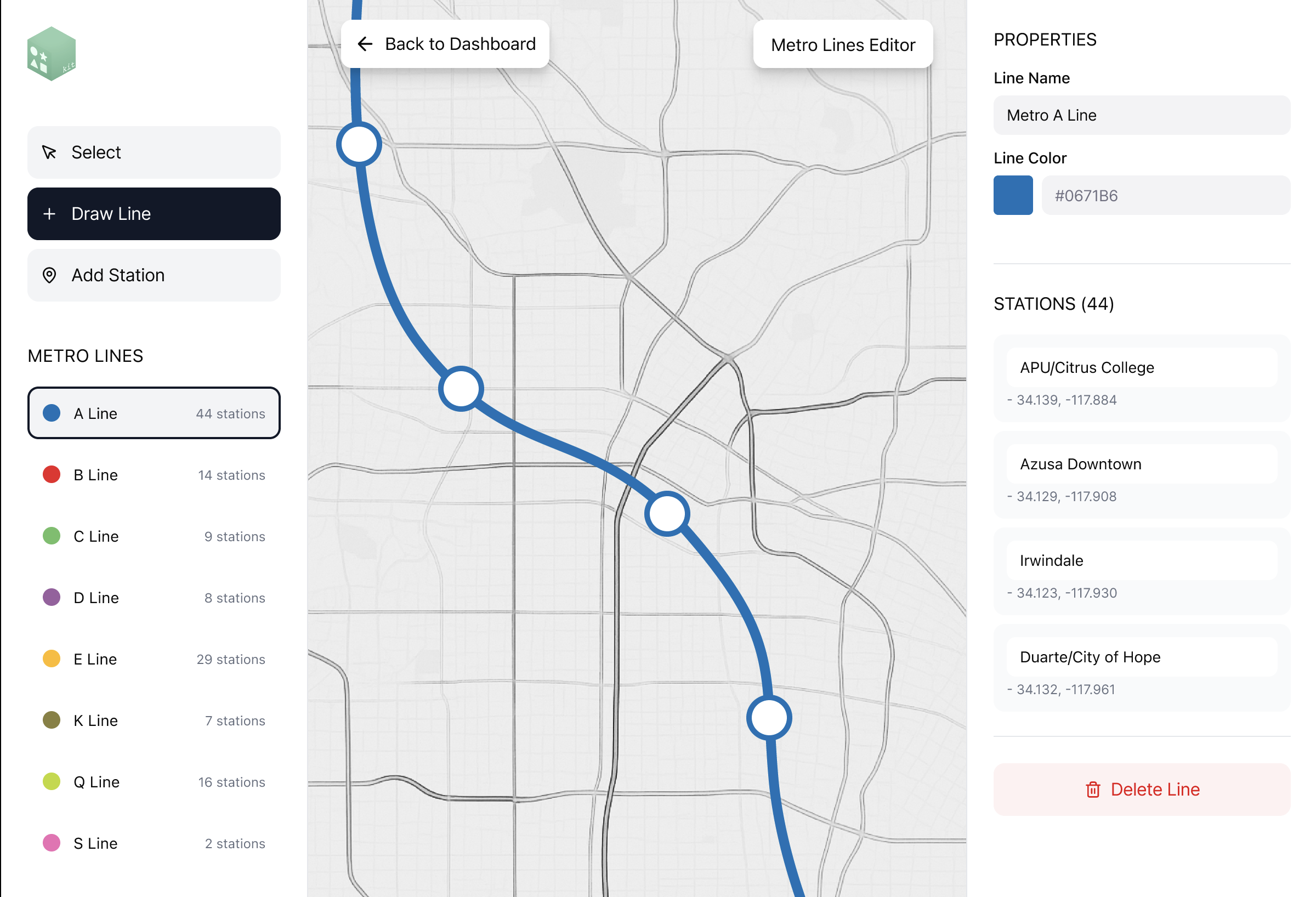

Inspiration: The LA Congestion-Equity Trap Our team was inspired by a challenge specific to Los Angeles: the cycle of traffic, pollution, and social inequity. LA is known for having some of the worst congestion and air quality in the nation, but despite significant investment, metro ridership continues to struggle. We realized the core problem is a lack of equitable and convenient connectivity. For many, especially those who rely on transit, the system doesn't effectively connect them to essential opportunities like jobs and, critically, schools. We wanted to build a tool that shifts urban planning focus from simply reducing traffic (a car-centric goal) to maximizing Social Good and Sustainable Access.
What We Built: An Agentic Planning Tool We built City Kit, a single-stop, AI-powered decision support system designed for city planners and students. Its core innovation is a multi-agent AI system that simulates and scores the social and environmental impact of transit policy changes in real time.When a user proposes a new transit line (metro or bus rapid transit), City Kit instantly evaluates it against two objective, quantifiable metrics:
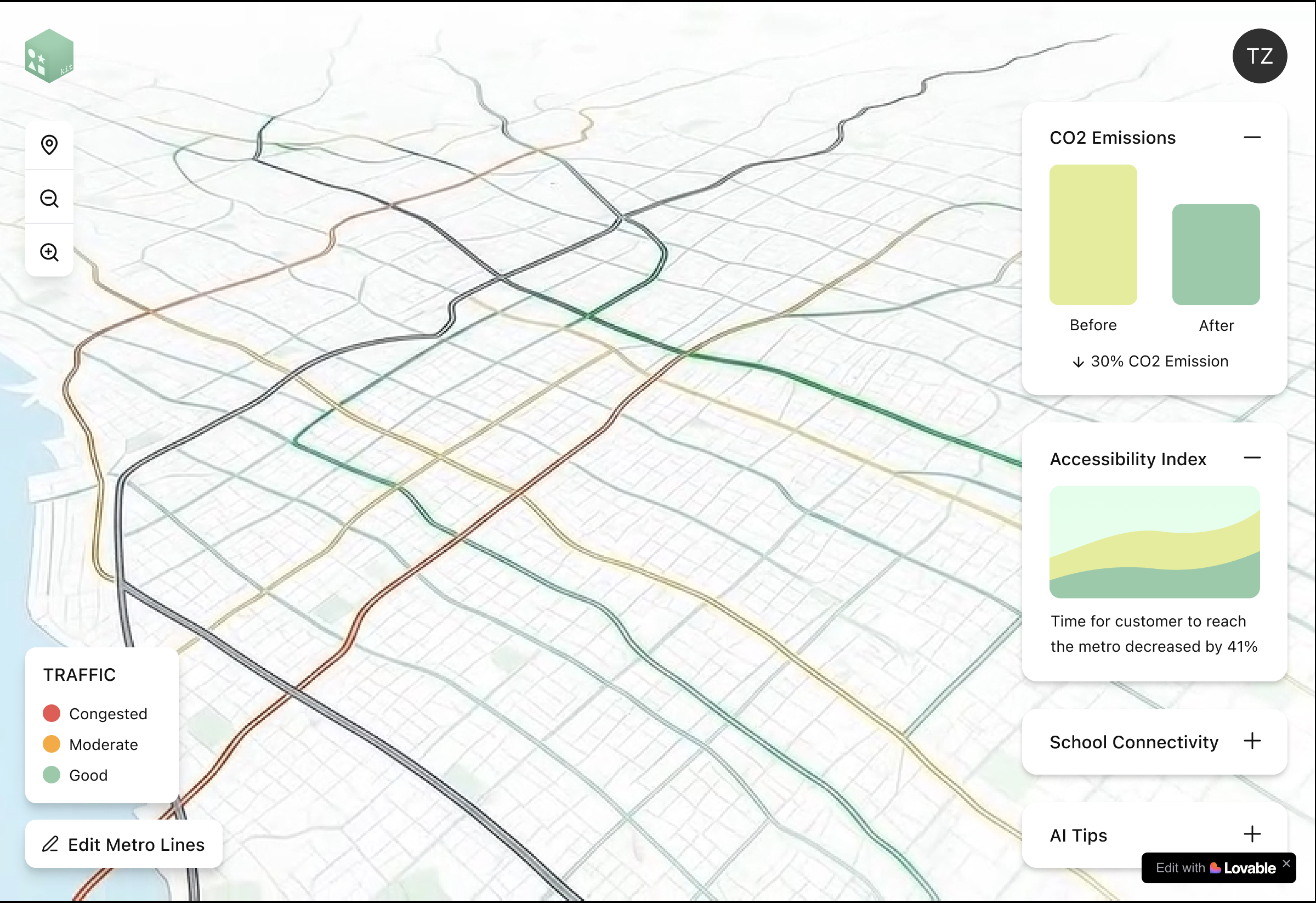
- The Sustainability Score: This metric quantifies the environmental benefit by estimating the CO2 reduction achieved when drivers switch to the new transit line.
- The Accessibility Index: This score ensures equity by measuring the reduction in travel time for vulnerable populations, focusing specifically on School Connectivity. It highlights whether the new line efficiently connects underserved communities to essential services.The user interface uses a simple Red-Yellow-Green system to guide policy creation, transforming complex geospatial data into clear, actionable ethical decisions.
How We Built City Kit (The Role of Lovable AI) Our rapid development was possible by leveraging Lovable AI to focus our limited time entirely on the specialized AI logic.Lovable AI's Role: We used the Lovable platform to generate the full-stack architecture, including the base user authentication and the data handling for the map layer. This no-code foundation allowed us to bypass boilerplate setup.Custom AI Agents: Our team then integrated specialized AI Agents to perform the heavy lifting: one agent handles geospatial simulation (traffic and route modeling), and another handles social impact scoring (calculating the Accessibility Index based on demographic data).The Visualization: The agents' outputs are fed into a clean 3D map rendering of Los Angeles, where the user can visually drag and drop potential transit lines and see the resulting score changes instantly.
Challenges and Lessons Learned Our journey presented two primary challenges:Translating Social Good into Math: The biggest hurdle was defining quantifiable metrics for abstract concepts like "equity." We solved this by focusing on measurable outcomes: instead of vague definitions, we defined equity as a function of travel time to schools and the number of low-income households connected. This allowed us to calculate the Accessibility Index (Ai) using a clear, data-driven methodology.$$\text{Accessibility Index} \propto \frac{\text{Population Density} \times \text{Opportunity Score}}{\text{Average Travel Time}}$$Simulating the LA Mindset: We recognized that simply building new transit isn't enough; we had to address the reason Angelenos avoid it (inconvenience and lack of connectivity). Our solution to this was ensuring the tool prioritizes superior connectivity in its recommendations, thereby solving the car hater problem by designing a system that is genuinely better than driving for key trips.We are proud to have built a tool that provides both LA City Planners and students learning urban design with an ethical AI platform. After vetting this idea with professionals in the urban planning industry, we are excited to keep building City Kit into a tool that fosters a truly sustainable and equitable Los Angeles. Check out a demo of the product here: https://youtu.be/bbG-sfS0PB8
Built With
- api
- lovable
- open-source