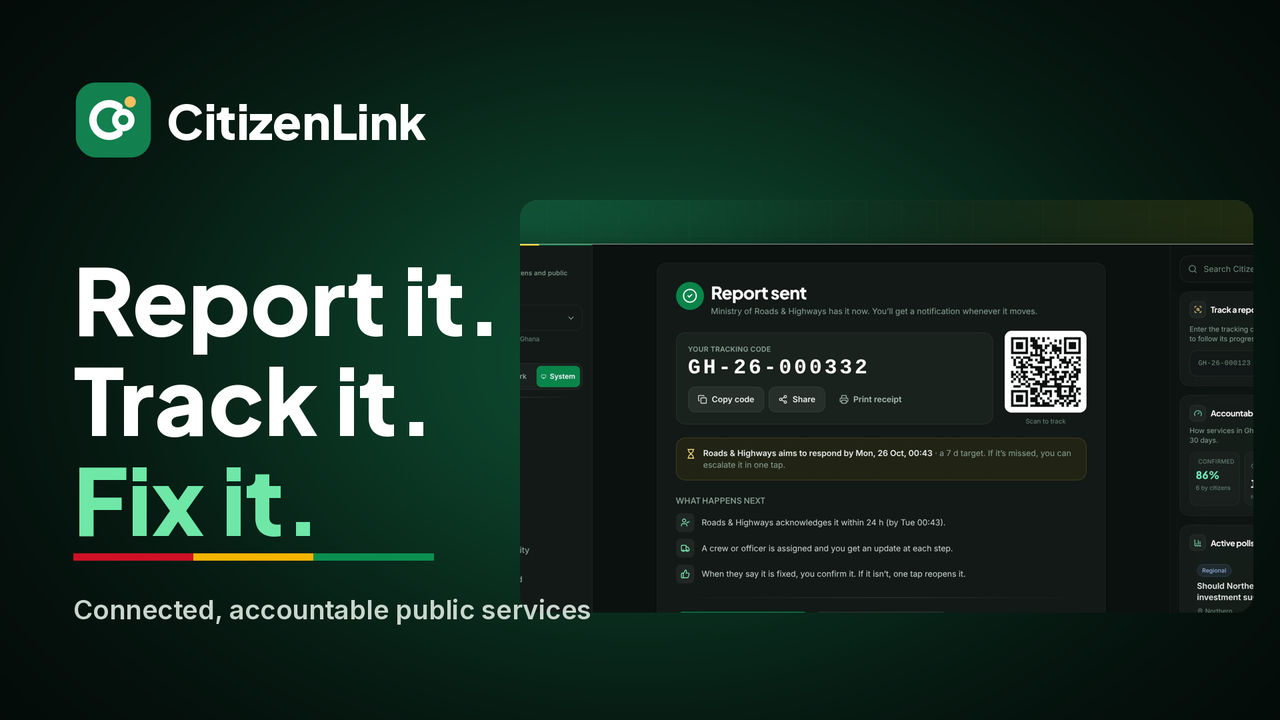
CitizenLink — Connecting Citizens, Government and Essential Services
Inspiration
A citizen should not have to struggle through multiple offices, repeat the same information, submit the same documents repeatedly, or wonder whether a government institution will respond to a legitimate complaint.
A broken road, unreliable electricity, unsafe water supply or unresolved public issue can affect an entire community. Yet reporting a problem is only the first step. Citizens also need transparency, accountability and a reliable way to know what happens next.
Another challenge is the fragmentation of public records. A person's birth, identity, education, health coverage, travel documents and other official records are often managed through separate processes. This can create unnecessary paperwork, delays and repeated verification.
CitizenLink was created around one question: What if citizens could access public services through one connected platform, from birth throughout their lives, while also holding institutions accountable for the services they provide?
What CitizenLink does
CitizenLink is a multi-country civic technology platform that combines public-issue reporting, government accountability, digital identity and connected public services.
1. Report public problems and track real progress
Citizens can report electricity outages, water problems, damaged roads, safety concerns and other community issues using a guided reporting process.
The platform supports smart category suggestions, duplicate-report detection, location-based reports, tracking codes, QR receipts, notifications and report histories.
Citizens can follow existing reports, confirm whether a problem has actually been fixed, dispute an inadequate resolution and escalate overdue cases.
Every report follows a transparent workflow from submission and acknowledgement through assignment, investigation, resolution and citizen confirmation.
2. Hold institutions accountable
CitizenLink gives public institutions tools to manage incoming reports, assign cases, monitor deadlines, document decisions and escalate unresolved problems.
Its accountability dashboards compare institutional and regional performance using response times, overdue cases, resolution rates, citizen-confirmed fixes and satisfaction ratings.
Rather than simply counting reports marked as resolved, CitizenLink distinguishes between an institution declaring a problem fixed and the citizen confirming the outcome.
3. Start a lifelong citizen record at birth
One of CitizenLink's core ideas is a connected citizen record that begins with an officially registered and verified birth.
An authorised hospital registrar can initiate a birth registration. The responsible civil registry then reviews and approves it. Following approval, the system creates a person record, links verified parent or guardian records where appropriate, and generates the applicable birth-registration reference and certificate record.
This becomes the foundation for a lifelong record that can be connected to other authorised public-service systems.
As the person grows, the record can support identity verification and applications for eligible services such as national identity cards, passports, driving licences, health insurance cards and other official documents.
4. Make government services simpler
Instead of repeatedly entering the same personal information, citizens could have eligible details securely prefilled from their verified records when applying for a government service.
With authorised integrations, a participating institution could verify relevant information directly from its authoritative source rather than requiring unnecessary photocopies and repeated data entry.
Citizens could submit applications, monitor their progress, receive notifications, schedule collections and access approved digital documents where legally permitted.
Importantly, connected records do not mean automatic approval of every application. The responsible agency retains its legal authority, verification requirements and eligibility checks.
5. Put citizens in control of their information
CitizenLink is designed around controlled access to personal information.
Authorised officers must have a legitimate purpose and an appropriate legal basis to access protected records. Access is restricted according to institutional responsibilities, recorded in an audit log and made visible to citizens where permitted.
Additional safeguards include access requests, data-protection oversight, dispute mechanisms, restricted sensitive records and purpose-based permissions.
The goal is to make government services more connected without treating citizens' personal information as unrestricted public data.
6. Improve public safety and community cooperation
CitizenLink also includes lost-and-found reporting, missing-person workflows, police-verified notices, anonymous tips and private communication between relevant users.
Privacy controls are especially important for children, missing persons, sensitive cases and people who submit reports involving potential criminal activity.
7. Work across countries
CitizenLink uses a configurable multi-country model for local identity formats, geography, languages, currencies, public institutions, emergency contacts and service-response targets.
The current demonstration includes Ghana, Nigeria and Kenya, with Rwanda represented in the onboarding process.
The objective is to adapt the platform to different national systems rather than force every country to follow the same administrative structure.
How we built it
CitizenLink is being developed as a frontend demonstration with a mock API and realistic seeded data.
The application includes citizen-facing workflows, institutional dashboards, national and regional administration, simulated report progression, public accountability views, a civil registry and document-request workflows.
The mock data allows reviewers to explore how the system could operate across multiple institutions and countries without requiring access to real government databases.
The prototype demonstrates the proposed user experience and application logic. Live inter-agency integrations, production identity verification, legally authorised document issuance and deployment across government infrastructure would require cooperation with the responsible institutions, secure backend services, formal agreements and appropriate legal approvals.
Challenges we considered
A platform connecting multiple public institutions must do more than provide a convenient interface.
It must account for different government structures, conflicting or outdated records, privacy, access permissions, sensitive information, institutional accountability and the risk of unauthorised access.
CitizenLink addresses these challenges in its proposed design through country-specific configuration, source-sector attribution, controlled access requests, audit logs, escalation rules, privacy-aware public views and explicit government decision-making workflows.
The next major challenge is moving from simulated data to secure integrations with real institutions.
What makes CitizenLink meaningful
CitizenLink is not just a place to submit complaints. It is a proposal for a more connected relationship between citizens and the institutions responsible for serving them.
A child should be able to establish a verified identity through the appropriate birth-registration process. As that person grows, authorised services should be able to reuse verified information appropriately, reducing repetitive administrative work. At the same time, that citizen should be able to report public problems, monitor official responses and see how institutions perform.
The long-term vision is one connected citizen experience across essential public services, supported by accountable institutions and protected personal data.
What's next
Our priorities are to connect the prototype to a secure production backend, validate the workflows with citizens and public-service officers, and explore authorised integrations with civil registration, national identity and relevant service agencies.
We also aim to evaluate the platform through a small pilot, measuring report acknowledgement and resolution times, citizen satisfaction, document-processing time, repeat data entry and successful service completion.
CitizenLink is a work in progress, but its ambition is clear: make public services easier to access, public problems harder to ignore, and government institutions more accountable to the people they serve.
Built With
- google-gemini-api
- indexeddb
- javascript
- leaflet.js
- react
- rest
- tailwind-css
- vite


Log in or sign up for Devpost to join the conversation.