-
-
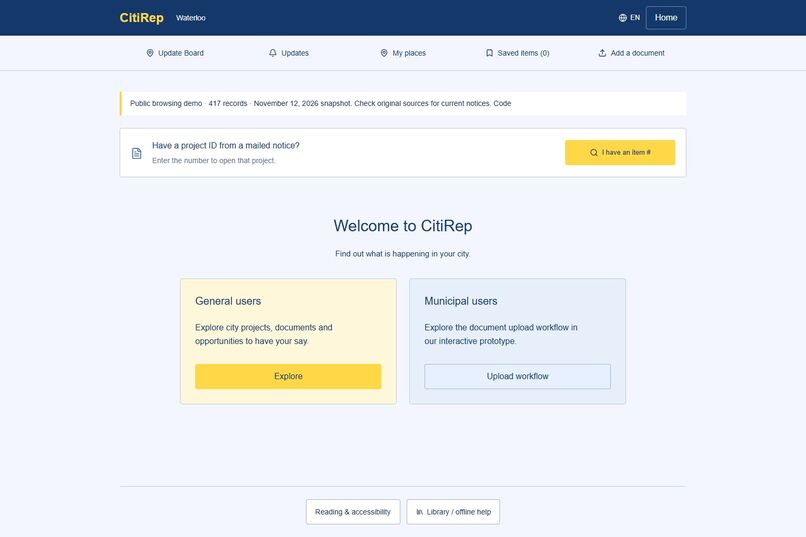
Welcome
-
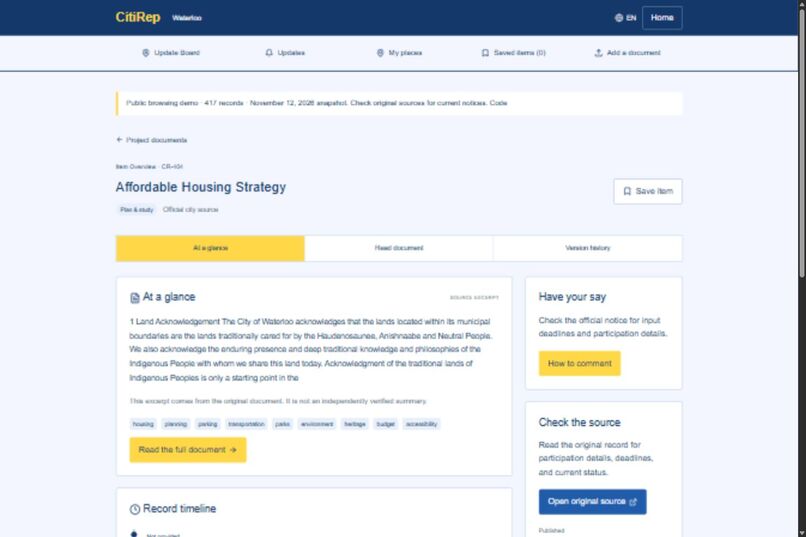
Item Overview
-
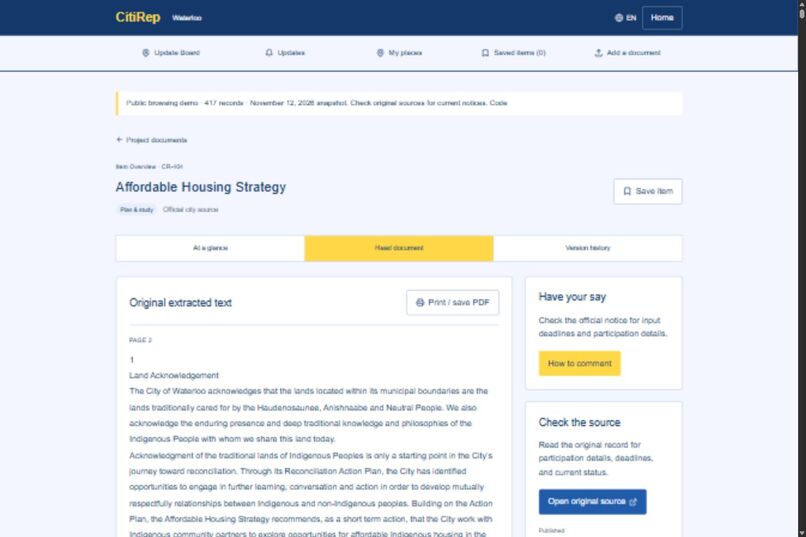
Document Reader
-
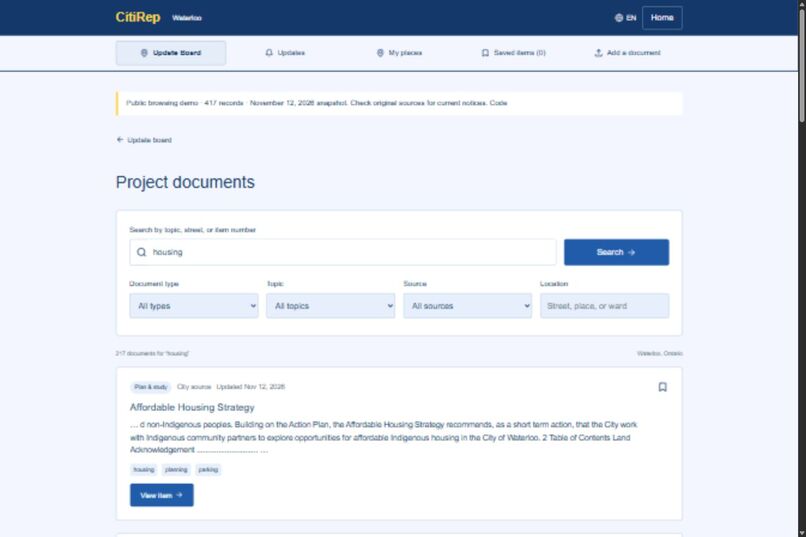
Search
Inspiration
You find out about construction happening on your street the day a building is bulldozed. You search online to learn more about the project, finding that answers are hidden in long municipal reports and reference bylaws you have never heard of. You still want to know what is changing and whether you can do anything about it, then you find out the consultation period ended a year ago. That is the problem we chose for CitiRep. We started with Waterloo and the public information the city already publishes. Our aim was to make that information easier to find and follow, especially for someone who does not know the language of municipal planning. Mentor conversations also challenged us to think about the people using the system: residents with limited access to technology, and municipal staff who would have to fit another tool into an already busy day.
What it does
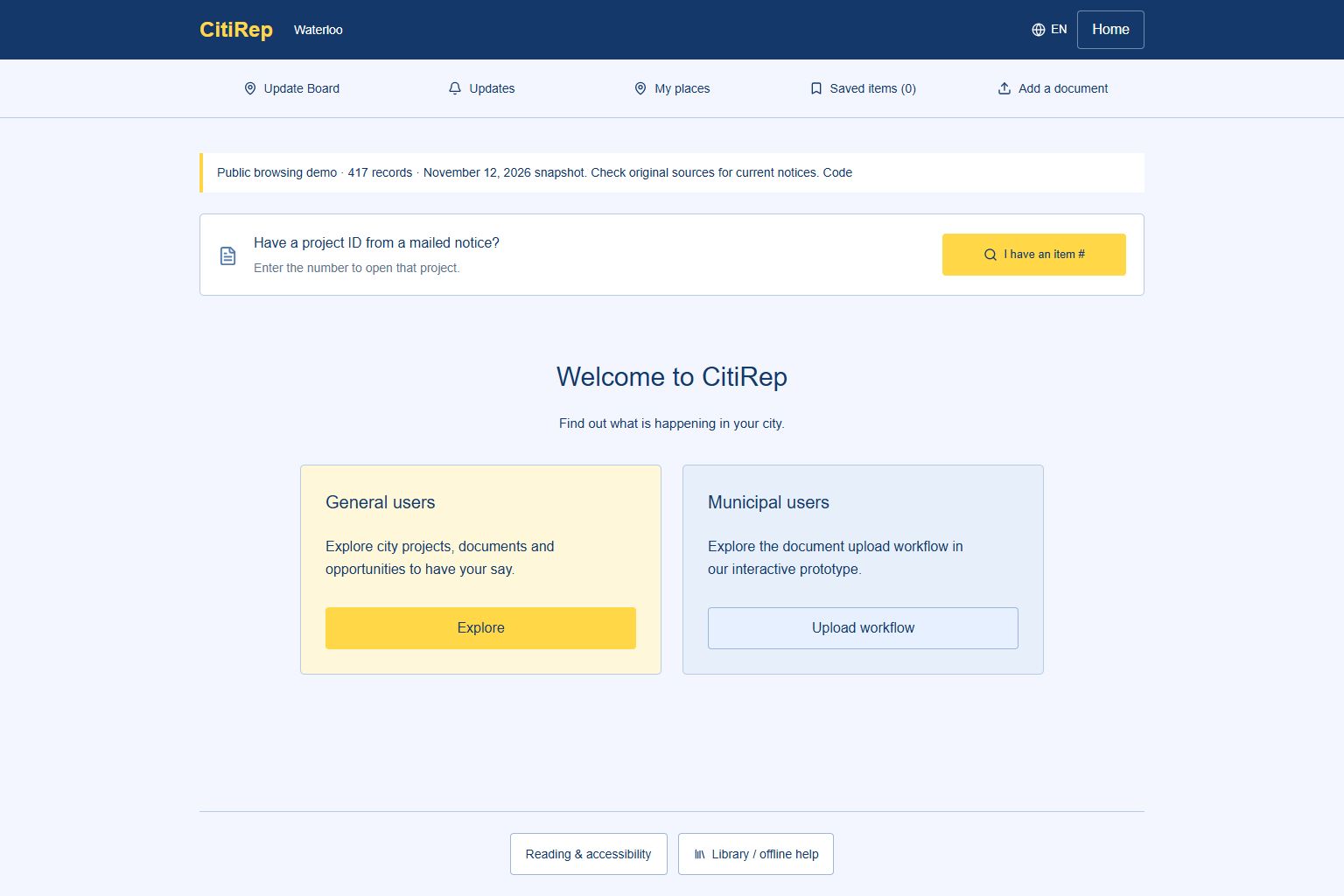
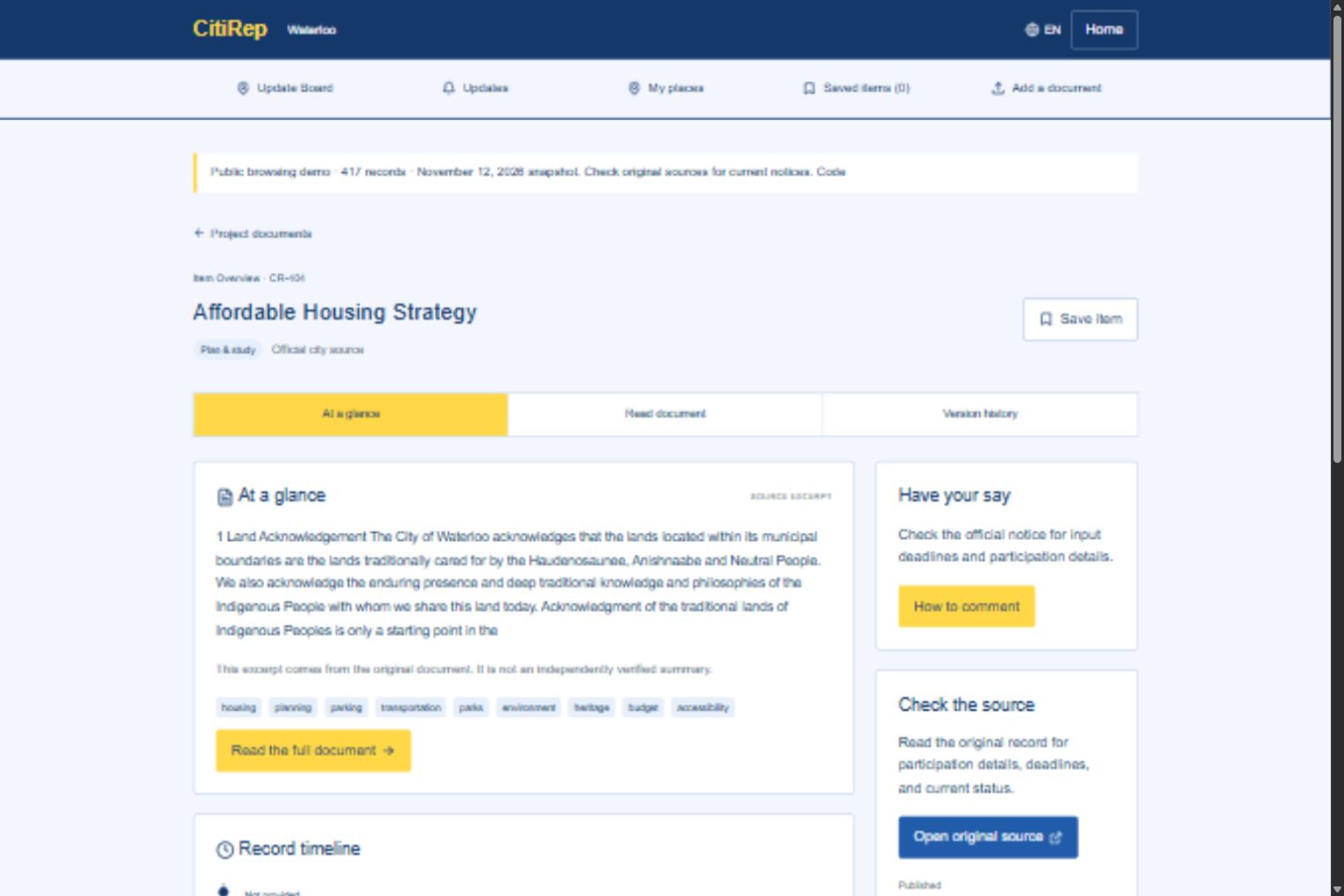
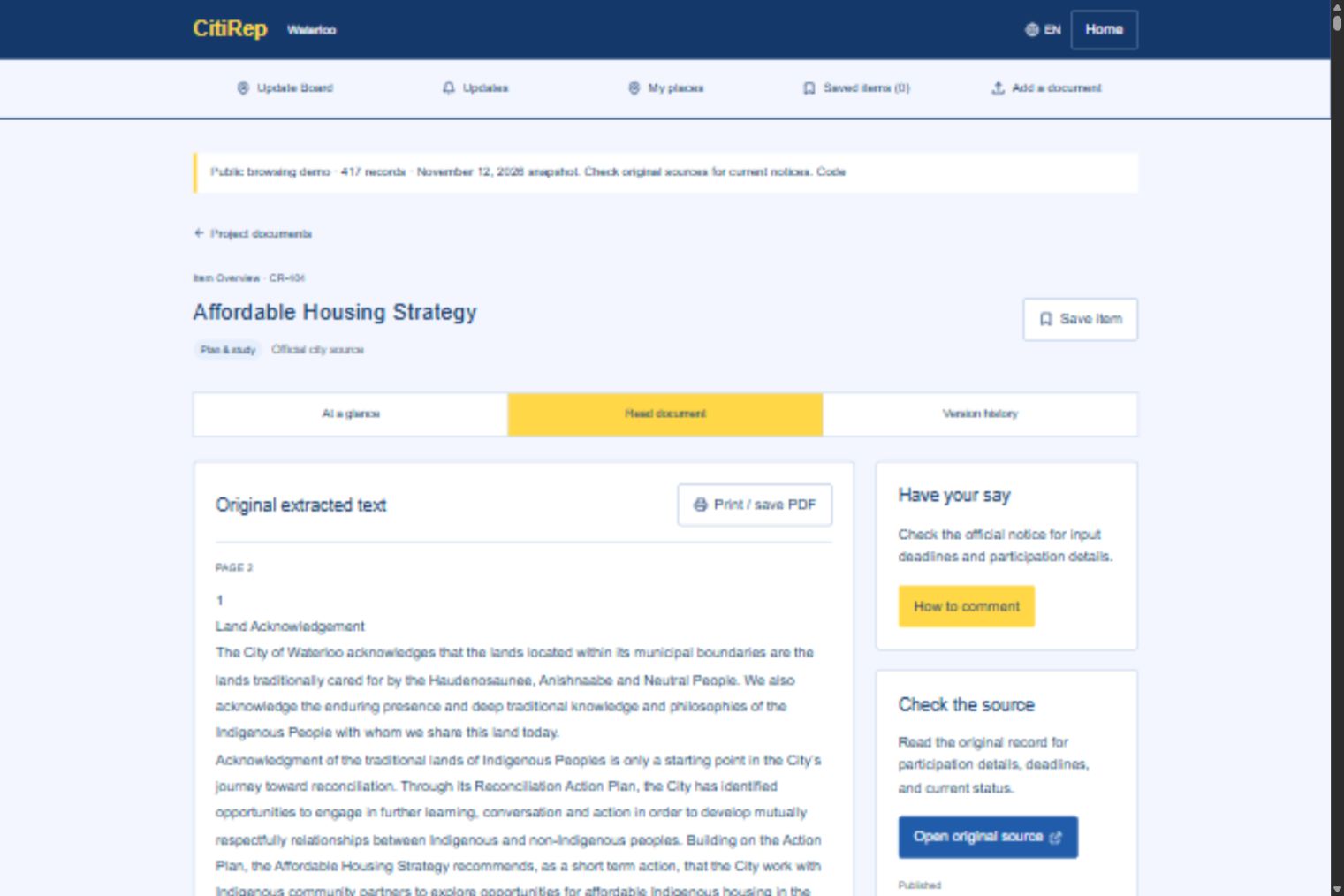
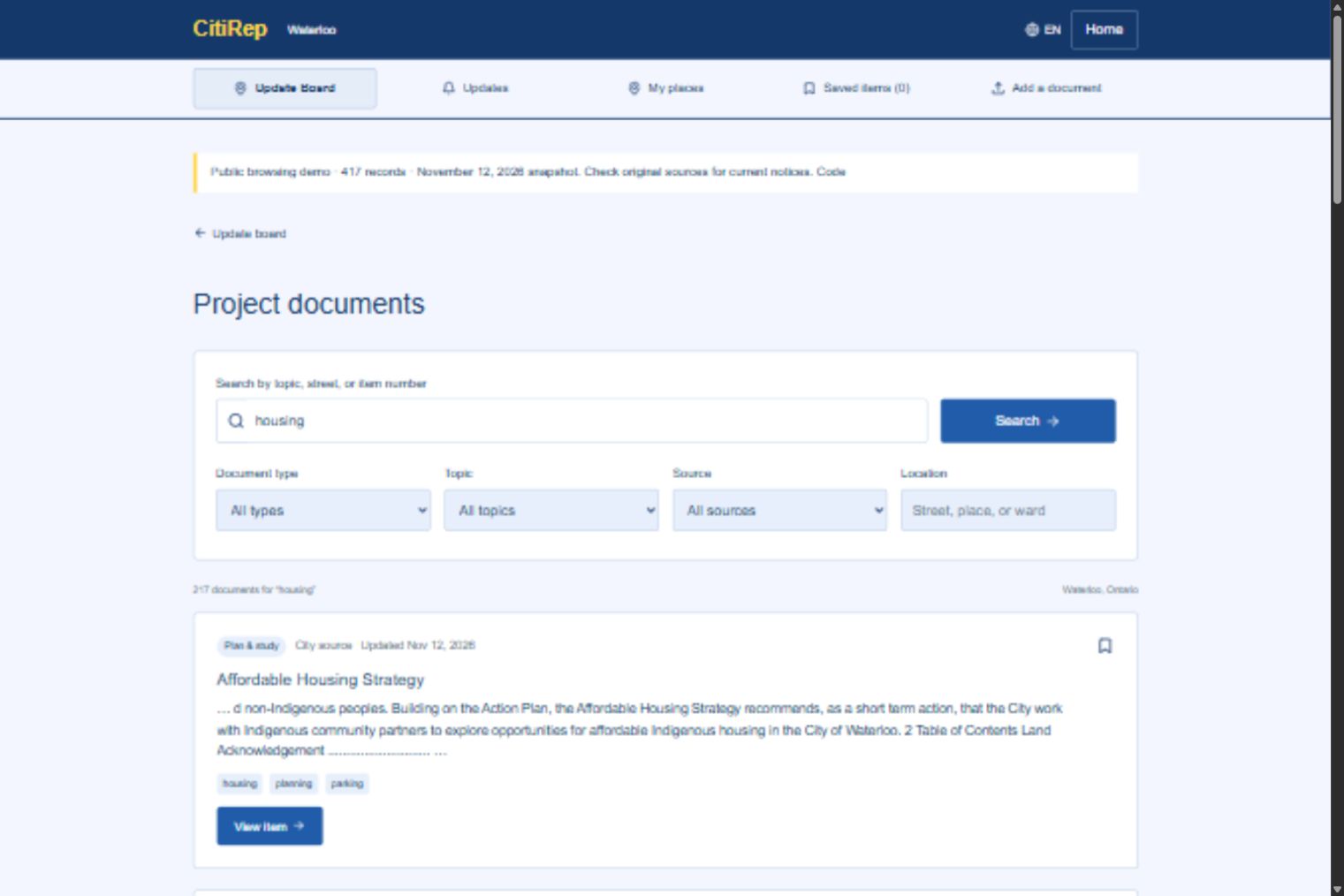
CitiRep brings municipal documents into a searchable repository. Residents can search by topic or street, filter by document type, read relevant source excerpts and open the original documents. Someone with a CitiRep record number can jump straight to that record. Related bylaws and captured document versions help readers explore the background. Our public demo contains 417 Waterloo records from a November 12, 2026 snapshot. It supports browsing, search, document reading and saved items. It does not accept uploads or send alerts. The Python backend in our repository supports document uploads and parsing; the public demo runs independently on GitHub Pages. Our Figma prototype explores the wider experience: clear project timelines, commenting periods, nearby consultation events, preferences for local updates, and a staff workflow for reviewing summaries before publication. These flows are prototypes, not connected municipal services.
How we built it
We designed the resident and municipal workflows in Figma, then built a React and TypeScript frontend. The backend uses Python, FastAPI and SQLite with full-text search. It collects public City of Waterloo and EngageWR records, extracts text from web pages and documents, and keeps source links and captured versions. We kept the current descriptions as source excerpts. Generated summaries need a review process, so our prototype shows staff checking claims against specific pages and correcting wording before publication. ChatGPT/Codex helped with development, debugging, writing and prototype work.
Challenges we faced
Municipal information has several dates that mean different things. A document's publication date, the day we collected it, a meeting date and a comment deadline cannot be treated as interchangeable. We also had to distinguish a bylaw that a document actually references from one that simply covers a similar topic. Search performance was another challenge. One query repeatedly loaded entire documents for every matching passage. Changing when those documents were loaded made the demo usable without adding a larger database system. Hosting exposed a practical problem too: a temporary link stopped working. We moved the browsing demo to GitHub Pages so judges can use it without relying on our laptop staying open.
What we learned
Making a report shorter does not automatically make it trustworthy. Readers need to see where an explanation came from and when the source was checked. We also learned to separate a project's location from the venue where a public meeting takes place. Accessibility shaped more than the visual design. We included a direct item-number lookup, readable document views, print options and library information. The next step is testing those choices with residents, including people who use screen readers or need help getting online.
What's next
We want to connect verified consultation dates and venues to Waterloo's project-location data, then add optional alerts when nearby commenting periods open. We found 172 application records in the city's ArcGIS feed, with coordinates for 145, but that feed still needs to be joined with consultation details from the linked project pages. Before a municipal pilot, we would test the upload and review workflow with staff, assign responsibility for updates and corrections, and complete accessibility testing. We would start with one planning process and adapt the timeline for other decision types as we learn.
Built With
- beautiful-soup
- claudecode
- codex
- css
- fastapi
- figma
- github
- html
- httpx
- javascript
- pypdf
- python
- python-docx
- react
- sql
- sqlite
- typescript
- vite
