-
-
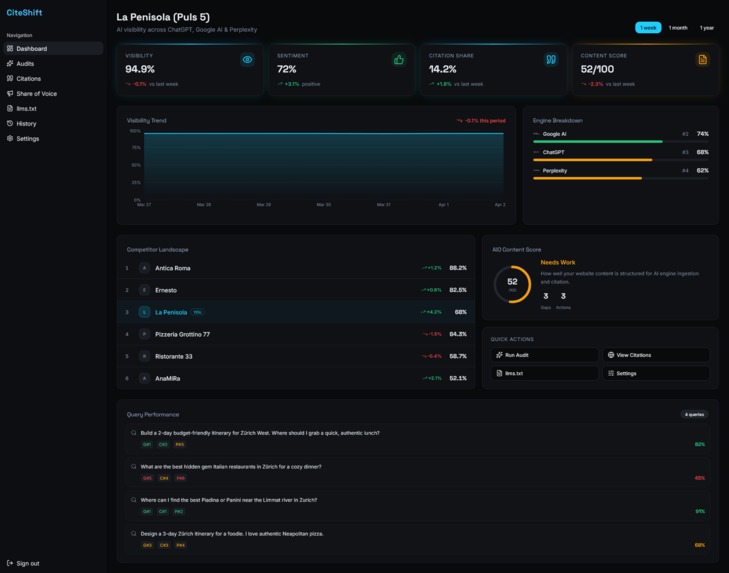
Screenshot CiteShift Dashboard
-
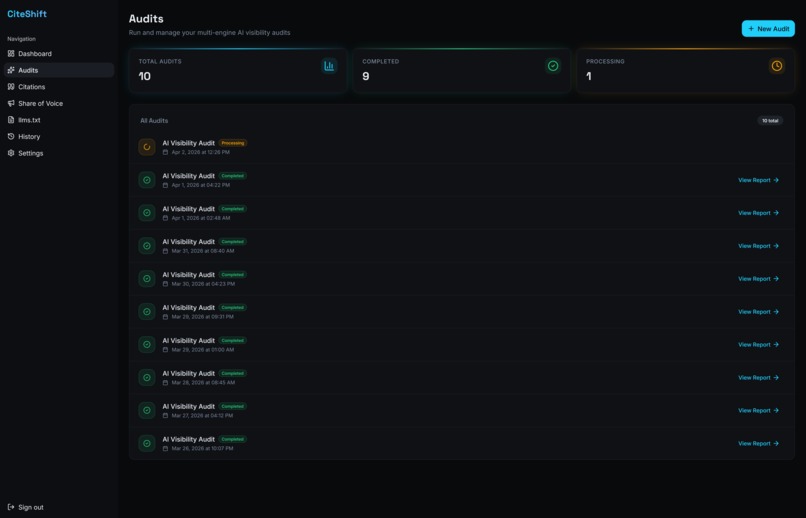
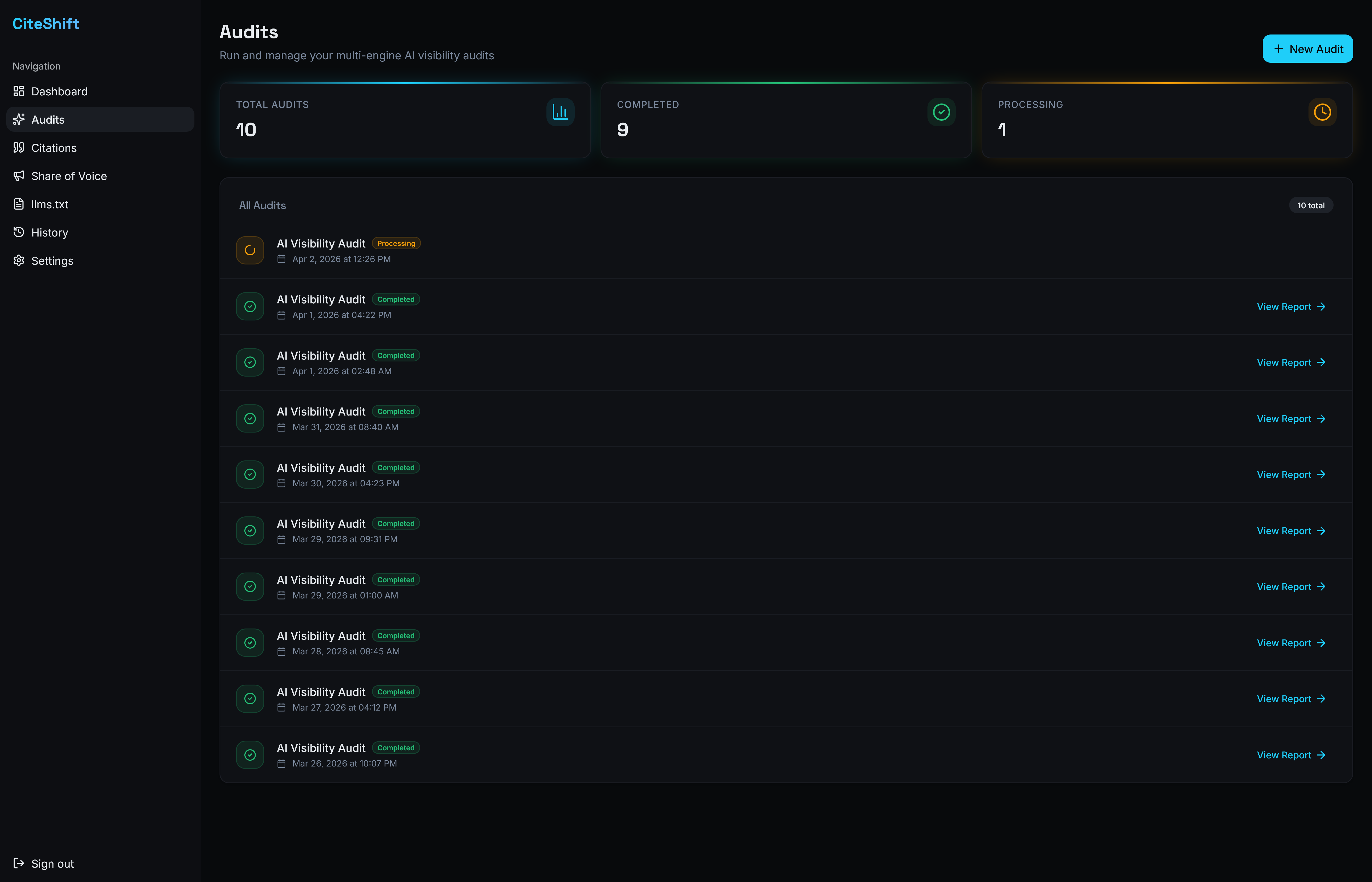
Screenshot CiteShift Audits
-
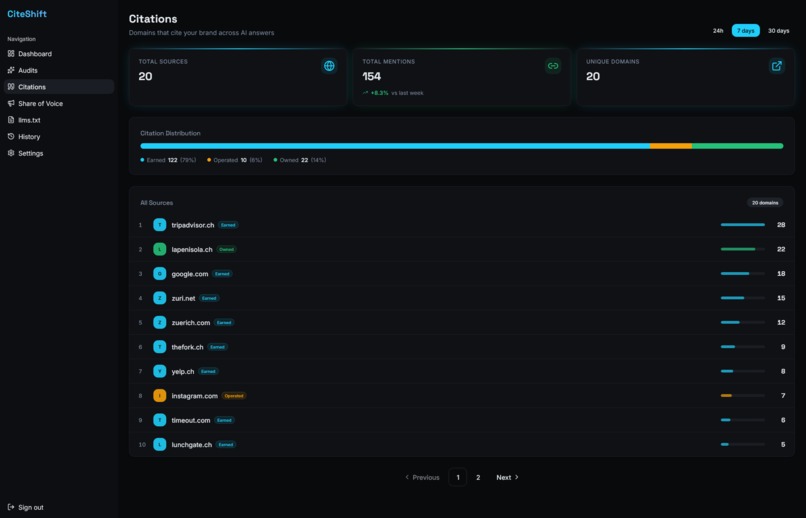
Screenshot CiteShift Citations
-
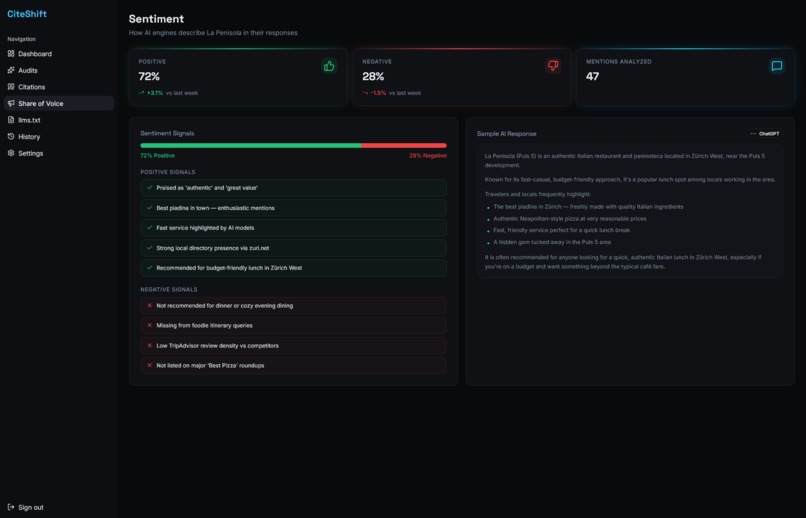
Screenshot CiteShift Share of Voice
-
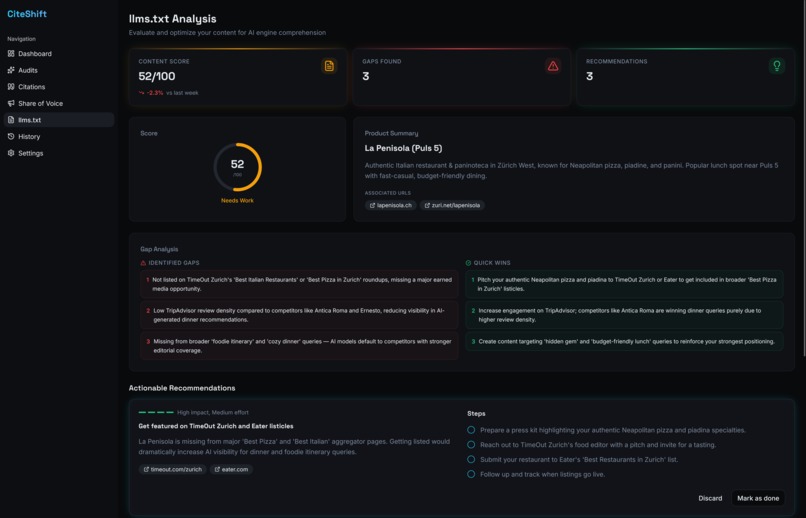
Screenshot CiteShift llms.txt Analysis
-
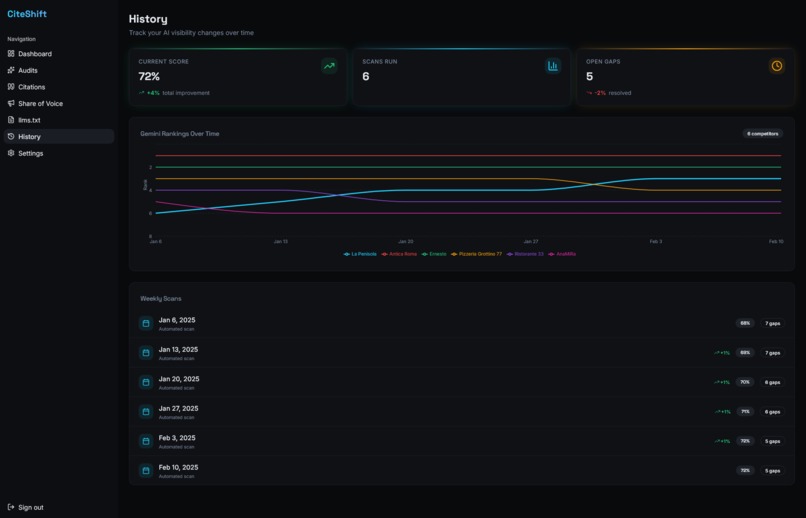
Screenshot CiteShift History View
-

Milan Ferus-Comelo

The Problem: Your Business Is Becoming Invisible
For twenty years, digital visibility meant one thing: ranking in the top ten blue links of search engines. We built an entire industry (Search Engine Optimization, aka SEO) around tracking, measuring, and optimizing for these clicks.
That era is over.
Today, users aren't clicking links; they are asking ChatGPT, Perplexity, and Google AI Overviews. The shift from search engines to AI answers is happening at breakneck speed, but the tooling hasn't caught up. Businesses are suddenly flying blind. Traditional rankings are no longer transparent, traffic is dropping, and even companies with phenomenal products are losing their visibility because they don't know how to track or optimize for LLM-driven answers.
This shift is already measurable:
- In 2024, 58.5% of U.S. Google searches and 59.7% of EU Google searches ended without a click. Source: SparkToro + Datos (2024).
- For every 1,000 Google searches, only 360 clicks (U.S.) and 374 clicks (EU) reached the open web. Source: SparkToro + Datos (2024).
- In Google's own launch update, AI Overviews had already been used billions of times in Search Labs, fundamentally altering top-of-funnel discovery. Source: Google Search announcement (May 2024).
With 6+ years of experience as a full-stack web developer and SEO analyst, I have seen this transition firsthand. Even well-executed SEO programs are collapsing when brands are not represented in AI-generated answers.
For the $10 Trillion Travel & Hospitality industry, this is an existential threat. Travelers no longer search for "best hotel zurich", they ask ChatGPT to "Build a 3-day weekend itinerary." If an AI doesn't include your local business in that itinerary, to the tourist, you simply no longer exist in their buying journey.
The Solution: A New Category of Intelligence
CiteShift helps businesses understand, measure, and improve how they appear in AI-generated itineraries. Instead of tracking outdated keyword positions, CiteShift introduces the Visibility Score: a unified, cross-engine metric that measures exactly how prominently your brand appears across the AI ecosystem.
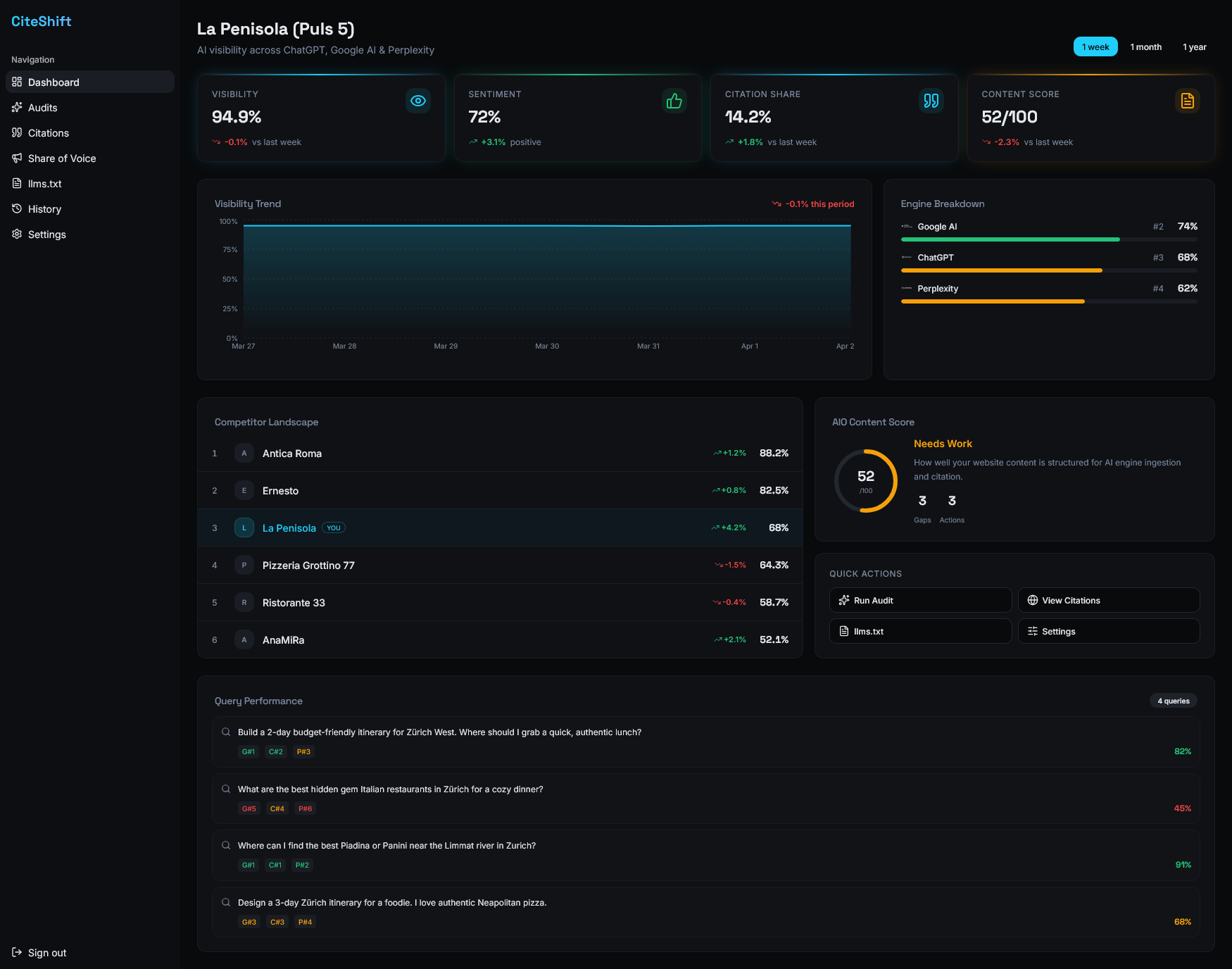
It provides competitive intelligence, source-level tracking, and actionable recommendations to help you engineer your presence in the LLMs of tomorrow.
Product Walkthrough
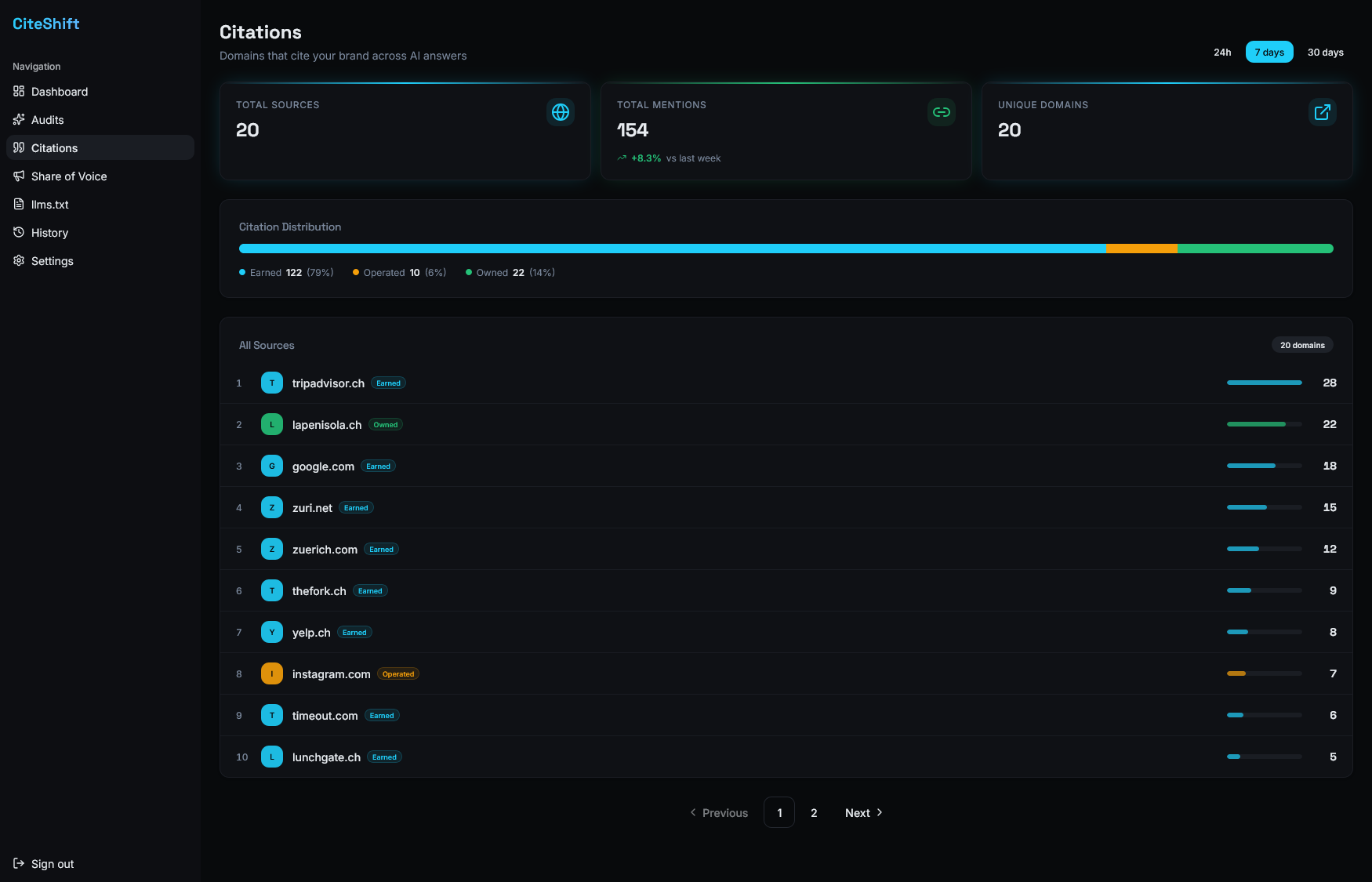
The Citations view breaks down exactly which domains are cited in AI answers and classifies them as Owned, Operated, or Earned sources, so teams can understand where authority is really coming from.
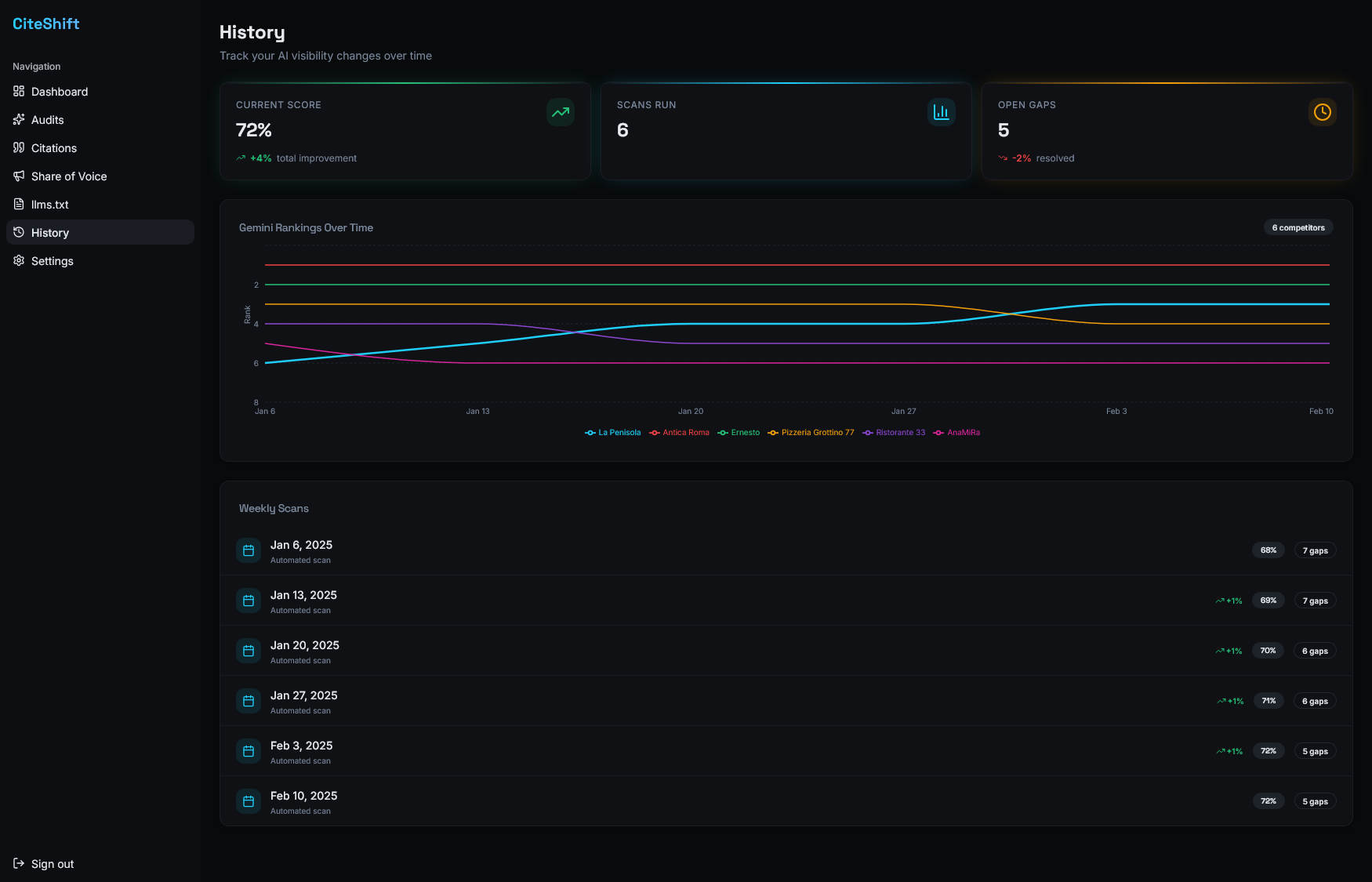
The History view turns weekly scans into a longitudinal record of ranking movement and score shifts, helping teams measure the impact of content and GEO changes.
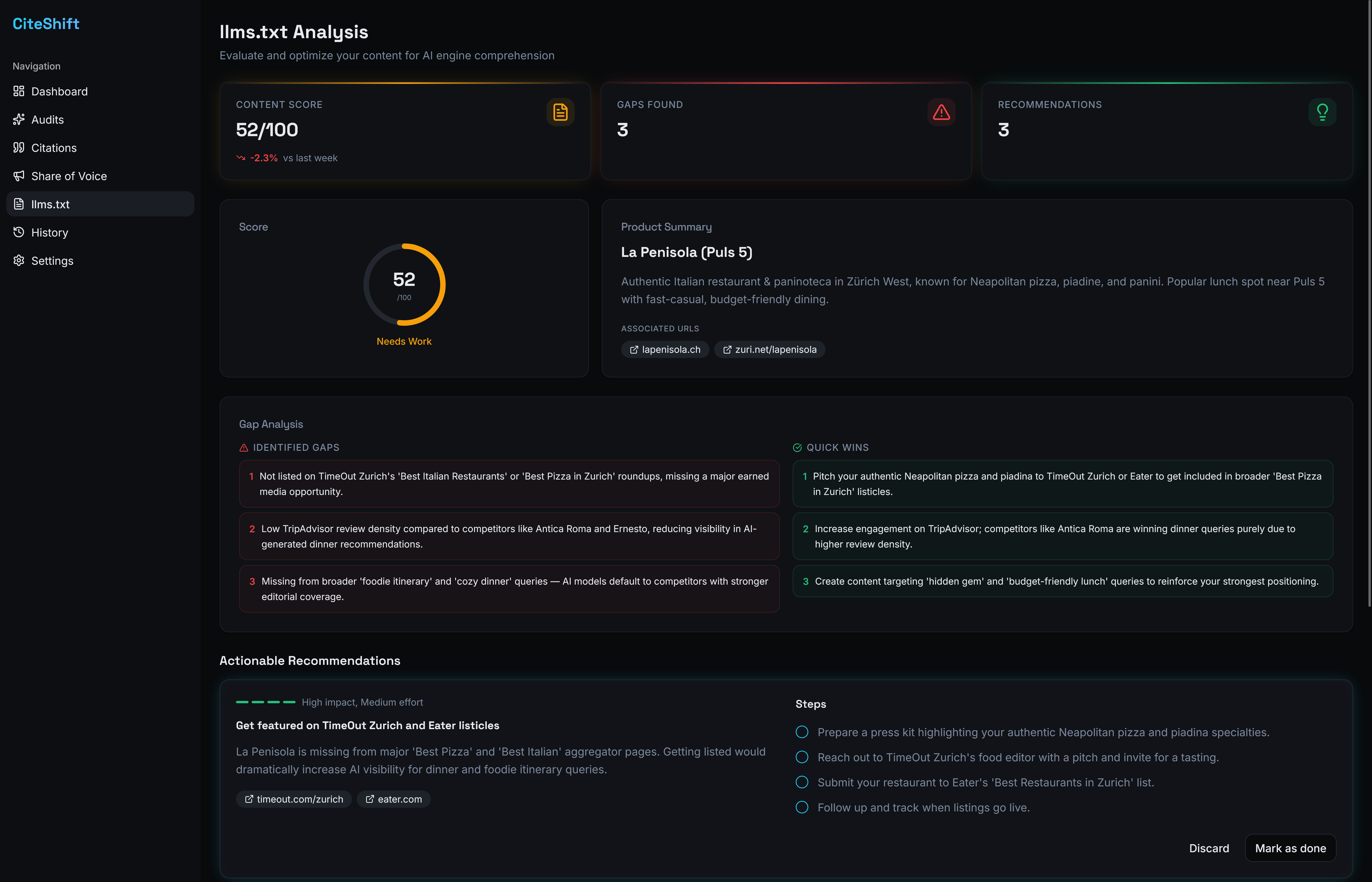
The llms.txt Analysis view evaluates LLM-readiness directly, highlights context gaps, and generates prioritized recommendations to improve machine-readable brand context.
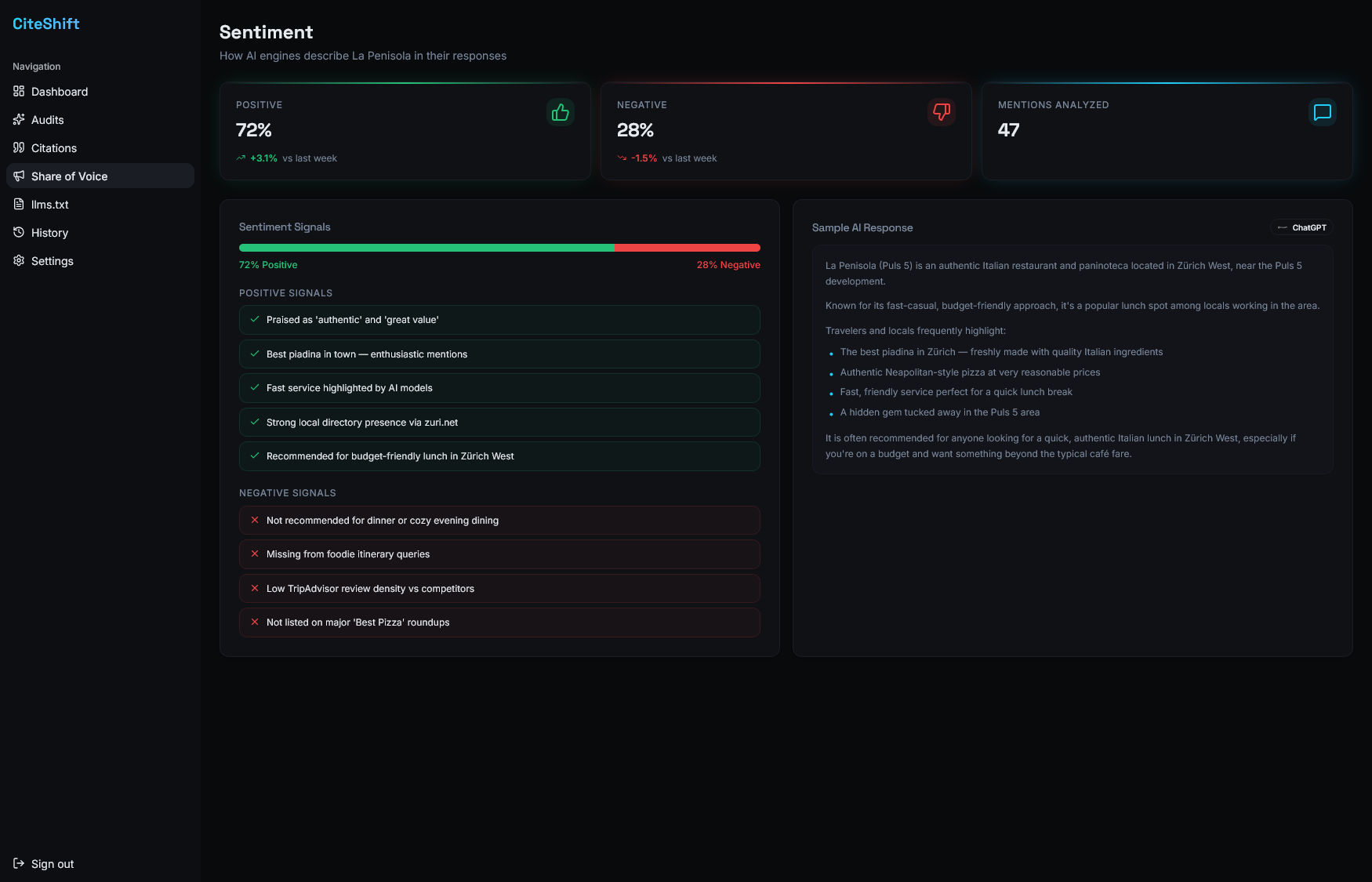
The Share of Voice view compares your visibility with direct competitors and shows trend lines over time, making it easy to spot who is gaining AI mindshare in your category.
How It Works
- Zero-Click Input: You enter your company URL. That's it. No manual keyword guessing.
- Dynamic Persona Generation: Gemini 3.1 Flash Lite automatically reads your site, determines your business "vibe", and simulates real traveler personas to generate the exact conversational prompts tourists are using today (e.g., "Where can I grab a quick, authentic lunch near Puls 5?").
- Data Collection: CiteShift deploys Apify Actors to query ChatGPT, Perplexity, and Google AI Overviews, extracting the full AI-generated itineraries and citation links.
- AI Analysis: Gemini acts as the reasoning engine to extract competitors, evaluate ranking positions per query, and cross-reference mentions across all engines.
- Scoring: CiteShift calculates the Visibility Score for you and your competitors.
- Source & llms.txt Analysis: The system maps the exact URLs driving the AI answers and checks your domain’s
/llms.txtfile for LLM-readiness. - Insights Delivery: A structured report and visual dashboard present the intelligence, showing exactly where you are losing out and how to fix it.
Technical Architecture
CiteShift requires a robust pipeline capable of bridging unstructured web data with precise, structured reasoning.
- Data Collection Layer (Apify): We use Apify Actors (
apify/google-search-scraperandapify/website-content-crawler) for collecting AI-generated answers from search-integrated LLM systems. This captures the full answer text, cited sources, and query context. - Intelligence Layer: We leverage Gemini 3.1 Flash Lite as our core reasoning engine. It ingests the raw AI outputs, performs competitor identification, ranks them per query/engine, and aggregates cross-query intelligence.
- Domain Normalization & Source Classification: The system extracts, deduplicates, and resolves cited URLs, classifying them into Owned (your site), Operated (your social/app profiles), and Earned (third-party articles).
- Visibility Score Logic: A custom algorithm that weights frequency of mentions, ranking positions in the generated text, and presence across multiple queries to compute the final score.
Real-World Validation: The Apify Case Study
To validate the platform in a real environment, we ran a case study on Apify using its own domain and high-value industry queries. The results were clear: a key competitor was repeatedly ranked above Apify in AI-generated answers.
The Source Intelligence layer explained why. LLMs were frequently citing Apify's own blog content, but that same content was being interpreted in ways that supported competitor recommendations.
This exposed a critical visibility vulnerability and triggered a direct discussion with Apify's marketing team about how their content is being read and reused by AI systems. The same pattern can affect any company whose content is being consumed by LLMs but not strategically shaped for AI-era discovery.
What Makes CiteShift Unique
- The Only Brick-and-Mortar GEO Platform: While existing enterprise GEO tools focus exclusively on B2B software and e-commerce, CiteShift is the first and only platform built specifically for physical, local businesses. We measure spatial, real-world itineraries, not just digital mentions.
- The Visibility Score: We are replacing traditional keyword rankings with the first unified metric designed explicitly for AI-era visibility.
- Multi-LLM Analysis: We don't just look at one engine. We aggregate ChatGPT, Perplexity, and Google AI.
- Source-Level Intelligence: We don't just tell you if you were mentioned; we track why. We identify the exact Owned, Operated, and Earned URLs driving the LLM's output.
- Automated llms.txt Evaluation: CiteShift automatically fetches your
/llms.txtfile. Gemini summarizes the content, scores it (0–100), identifies critical context gaps, and gives recommendations. If you don't have one, CiteShift flags it as a high-priority technical GEO vulnerability. - Actionable Insights: We don't just output data; we output strategy.
Challenges & Learnings
Building a deterministic metric out of probabilistic outputs is incredibly difficult.
- Extracting Structured Data: Normalizing inconsistent, conversational outputs from various LLM architectures into a strict, analyzable schema.
- Source Attribution: LLMs cite sources in drastically different ways (inline brackets, footnotes, raw links). Standardizing this data required intensive tuning.
- Designing the Visibility Score: Figuring out how to weight a "mention" in a ChatGPT answer versus a primary citation in Perplexity took significant iteration to make the metric actually meaningful.
Future Vision
CiteShift is just getting started. This hackathon project is the MVP of what will become a full-scale B2B SaaS platform.
Our roadmap includes:
- Continuous Monitoring: Tracking AI visibility over time.
- Automated Alerts: Slack/Email notifications when your Visibility Score drops or a competitor overtakes you in a high-value query.
- GEO Tooling: Real-time recommendations for tweaking landing page copy specifically for LLM ingestion.
In the future, entire cities and Destination Marketing Organizations (DMOs) could use CiteShift to analyze how their cities are being portrayed by LLMs. Instead of AI autonomously funneling millions of tourists to the exact same saturated landmarks (like the Eiffel Tower), cities can use CiteShift to engineer the AI's brain, injecting hidden gems into AI itineraries to improve crowd congestion and distribute economic value to local neighborhoods.
Built With
- Apify (Actors for complex web/search data extraction)
- Gemini 3.1 Flash Lite (High-speed, cost-effective reasoning engine)
- LLM-based structured analysis pipelines
- Python (Backend orchestration and data transformation)
- Lovable (React) (Dashboard visualization)
Acknowledgements
This project would not have been possible without the support, feedback, and insights from GenAI Zurich mentors and the Apify team.
- Benjamin Fuchs (AI Automation Specialist)
- Dušan Vystrčil (AI Product Manager @ Apify)
- Aleš Wilk and Kateryna Shvets (Marketing @ Apify)
- Pascal Vetter (AI Ecosystem Enabler @ AI Startup Center Zürich)

Log in or sign up for Devpost to join the conversation.