In June 2026, KPMG pulled a flagship AI report after investigators found that only 5 of its 45 citations pointed to real, supporting sources. The industry named the failure mode "vibe citing": AI text whose citations look real — the URLs resolve, the papers exist — but don't say what the text claims they say.
Prompting can't fix this; grounding can. Verification is a tool-shaped problem: someone has to actually fetch the source and read it. So we built the tool — and made it an agent that other agents can call.
What it does
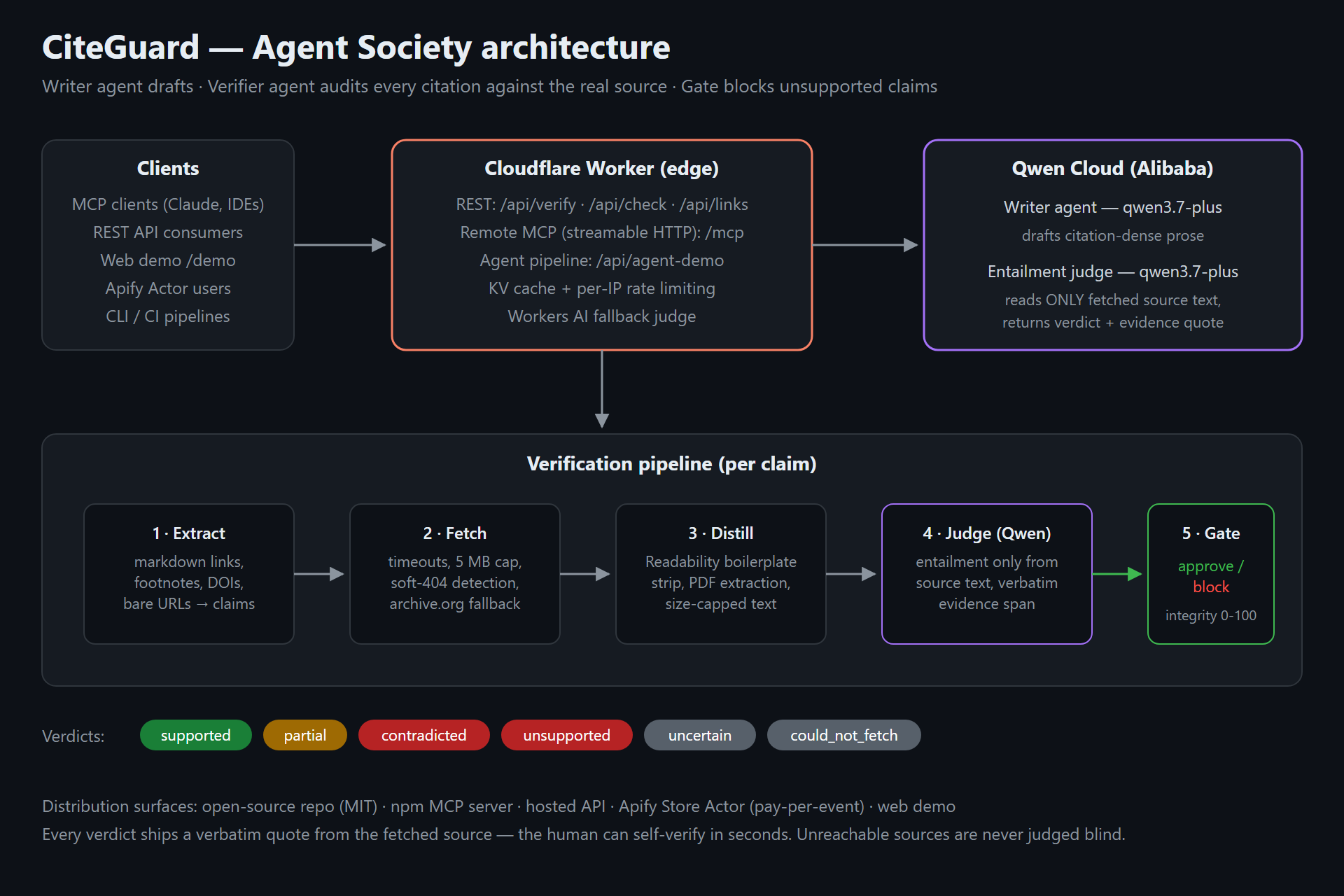
CiteGuard is a verification agent with one job: given claims and the sources they cite, decide whether each source actually supports each claim.
For every citation it:
- Extracts claim+source pairs from raw text (markdown links, footnotes, DOIs, bare URLs)
- Fetches the cited source — dead links fall back to archive.org automatically; redirects to homepages are flagged as "soft 404s"
- Distills the real content (Readability boilerplate-stripping, PDF text extraction)
- Judges entailment with Qwen: the model reads only the fetched source text — never its own world knowledge — and returns one of six verdicts with a verbatim evidence quote
- Gates the document: contradicted or unsupported citations block approval; the report carries a 0–100 citation integrity score
The Agent Society demo shows the full loop live: a writer agent (qwen3.7-plus) drafts a cited paragraph on any topic, the verifier agent (CiteGuard + Qwen judge) audits every citation in real time, and the gate approves or blocks the draft. One AI catches another AI's fabrications, live, with receipts.
Try it now (no signup): https://citeguard.boundy.workers.dev/demo
How we built it
- Core (TypeScript): citation parser, hardened fetcher (timeouts, size caps, soft-404 detection, archive.org fallback), Readability+linkedom content extraction, unpdf for PDFs, provider-agnostic entailment judge
- Qwen Cloud: qwen3.7-plus powers both agents via the OpenAI-compatible DashScope International endpoint — the writer generates citation-dense prose; the judge performs strict entailment with a JSON-only contract and quote-extraction requirement
- Edge deployment: Cloudflare Worker serves the REST API, the web demo, and a remote MCP endpoint (streamable HTTP) so any MCP client — Claude, IDEs, agent frameworks — can call
verify_claims/check_document/check_linksas tools - Distribution: open-source core (MIT) on GitHub; also published as a monetized Apify Actor ("AI Citation Auditor")
Challenges we ran into
- The judge must not "know things." Early prompts let the model use world knowledge, which defeats the purpose — a judge that "knows" the Eiffel Tower is in Paris will approve the claim even if the cited source is about pastry recipes. The final prompt contract forces verdicts derived only from the provided source text, with a mandatory verbatim quote that makes every verdict human-checkable.
- The web fights back. Paywalls, bot-blocking, JS-only pages, link rot. The pipeline never judges blind: unfetchable sources return an honest
could_not_fetchinstead of a hallucinated verdict, and archive.org rescues a surprising share of dead links. - Calibration over confidence. A verifier that overclaims is worse than none. Borderline cases land in
uncertain, and "partially_supported" exists because most real-world citation failures are subtle — the right number, the wrong year.
Accomplishments we're proud of
- End-to-end live product in days, not weeks — and every layer is real: real fetches, real entailment, real evidence quotes
- The gate demo: watching the writer agent get blocked because its Britannica citation doesn't actually contain the claimed fact is genuinely satisfying
- Zero-cost, globally distributed deployment that anyone can use right now
What we learned
Citation verification is tractable if you refuse to let the LLM freelance. Constrain the judge to fetched text, require quotable evidence, admit uncertainty honestly — and the verdicts become something a human can trust and check in seconds.
What's next
- Calibration benchmark: published accuracy numbers on a hand-labeled claim set
- APA/BibTeX-style citation parsing and PDF input documents
- CI integration (GitHub Action): block PRs that add unsupported citations
- Verifier-as-middleware for agent frameworks — every write-then-publish pipeline needs a gate
Built with
TypeScript · Qwen Cloud (qwen3.7-plus, DashScope Intl) · Cloudflare Workers + KV · Model Context Protocol SDK · Mozilla Readability · linkedom · unpdf · Apify SDK
Links
- Live demo: https://citeguard.boundy.workers.dev/demo
- Open-source repo (MIT): https://github.com/Franksterino/citeguard
- Hosted API + remote MCP: https://citeguard.boundy.workers.dev
- Apify Actor: https://apify.com/franksterino/ai-citation-auditor
Built With
- cloudflare-workers
- linkedom
- mcp
- qwen
- readability
- typescript
- unpdf


Log in or sign up for Devpost to join the conversation.