-
-
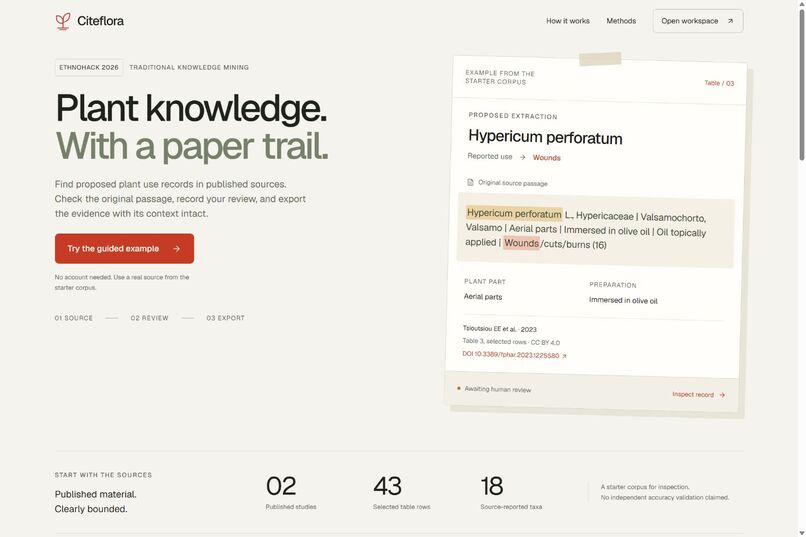
01. Plant knowledge with a paper trail: the live source, review and export workflow, with a clearly stated two-paper starter scope.
-
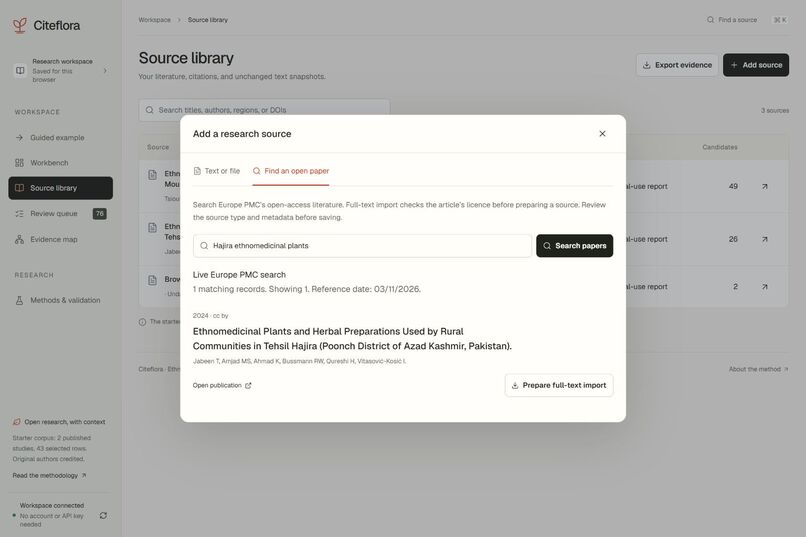
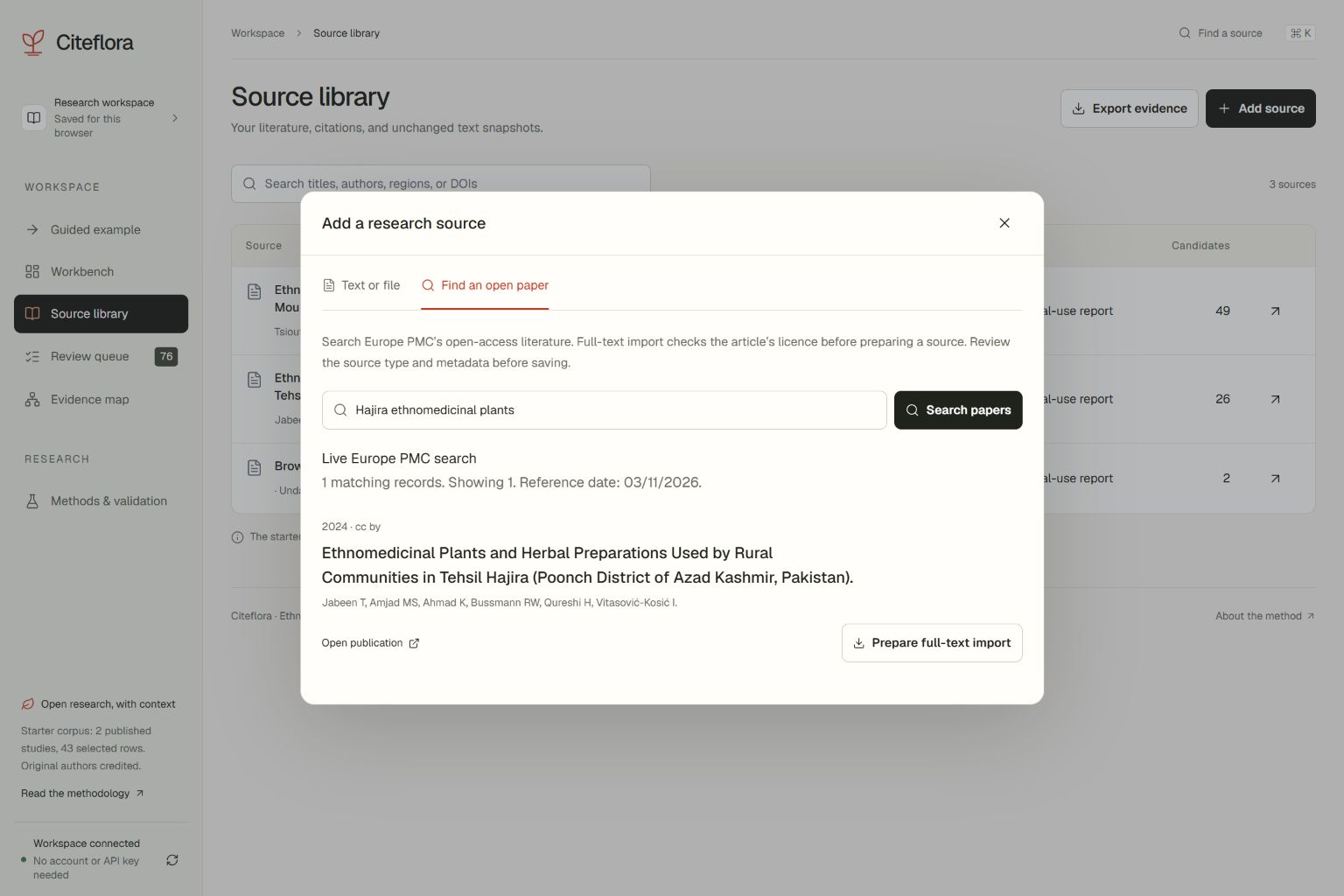
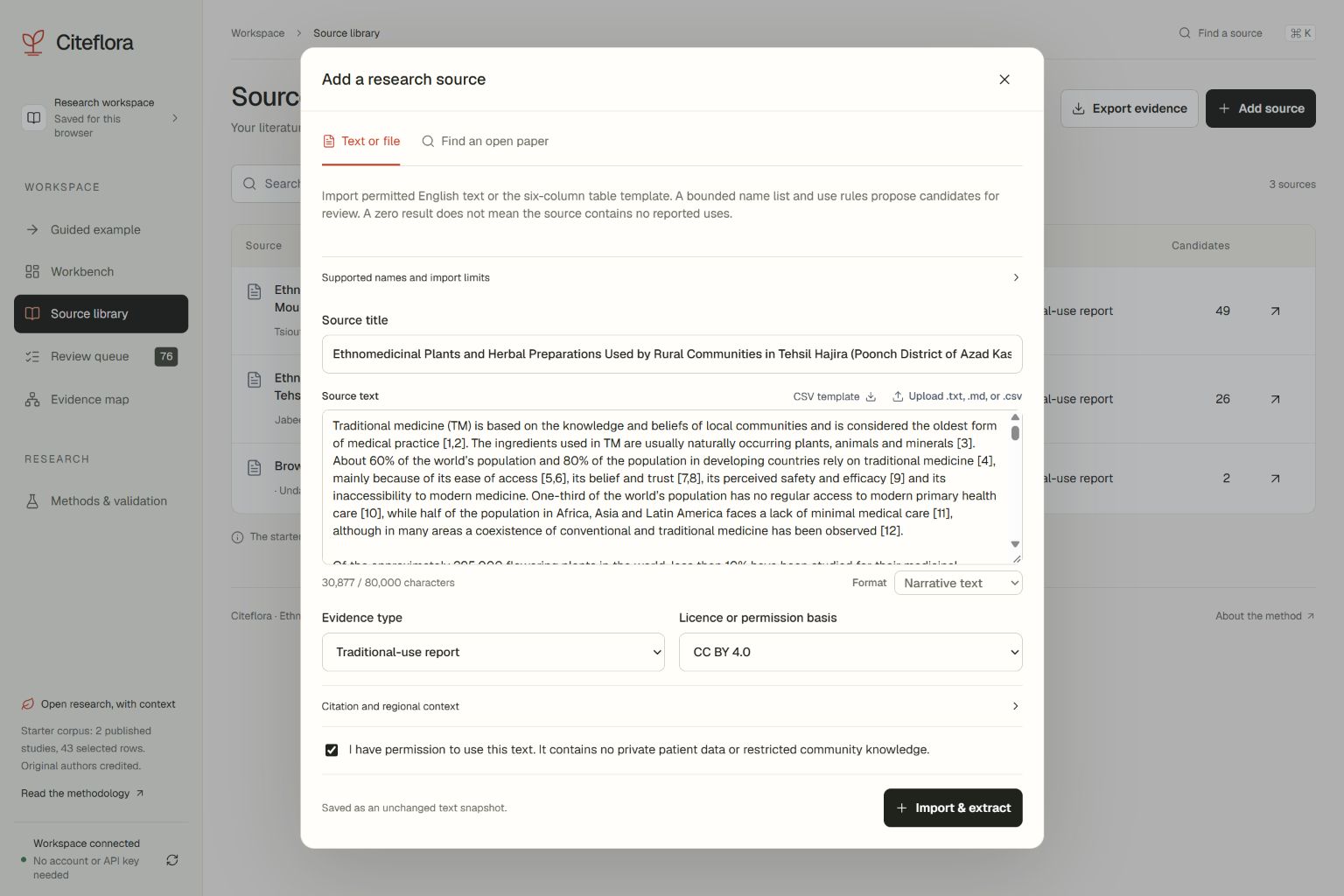
10. A live Europe PMC search returns the real Hajira paper, its authors and DOI. Reference fallbacks are explicitly labelled.
-
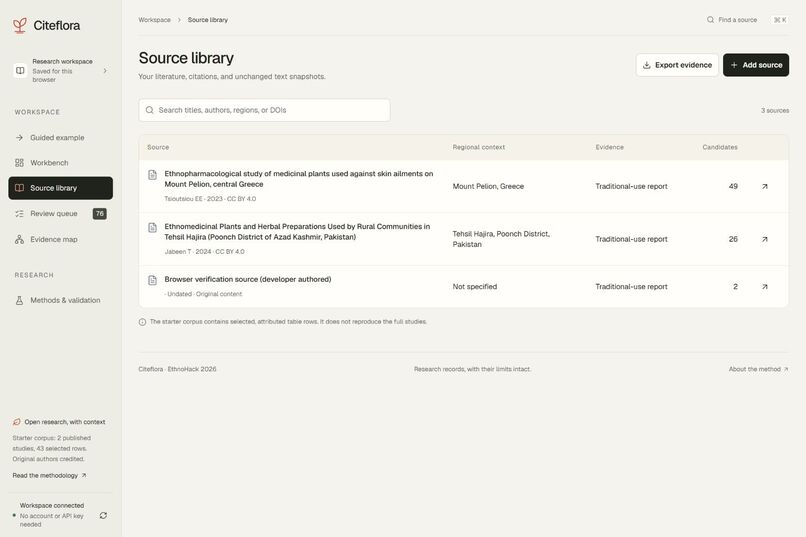
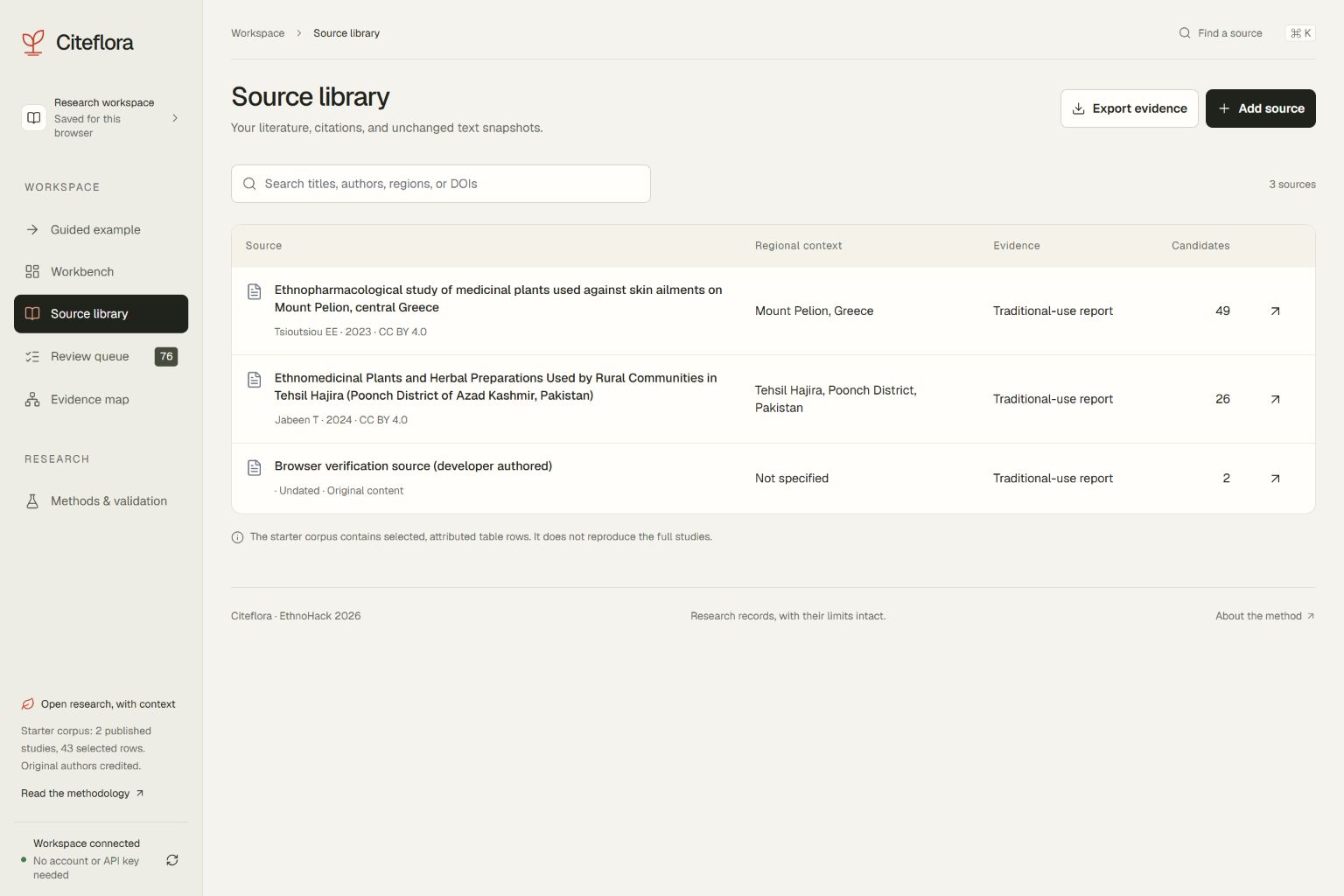
09. The source library keeps published studies and imports attributable and searchable by title, author, region or DOI.
-
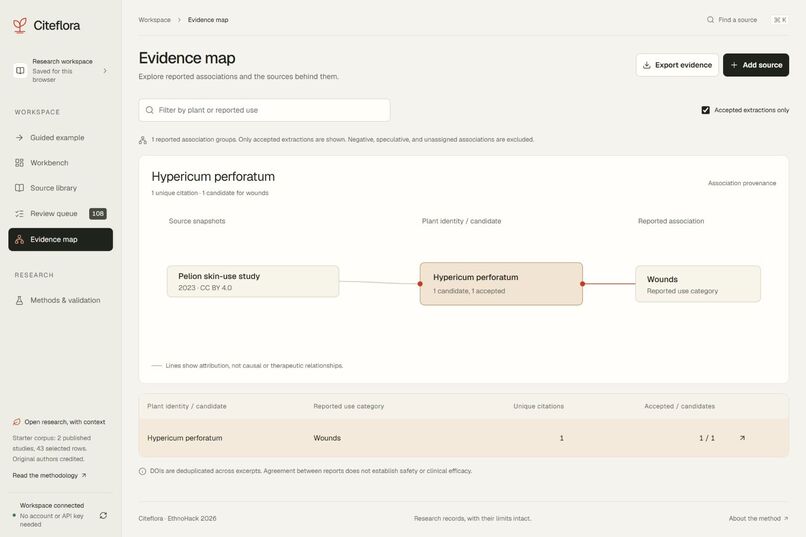
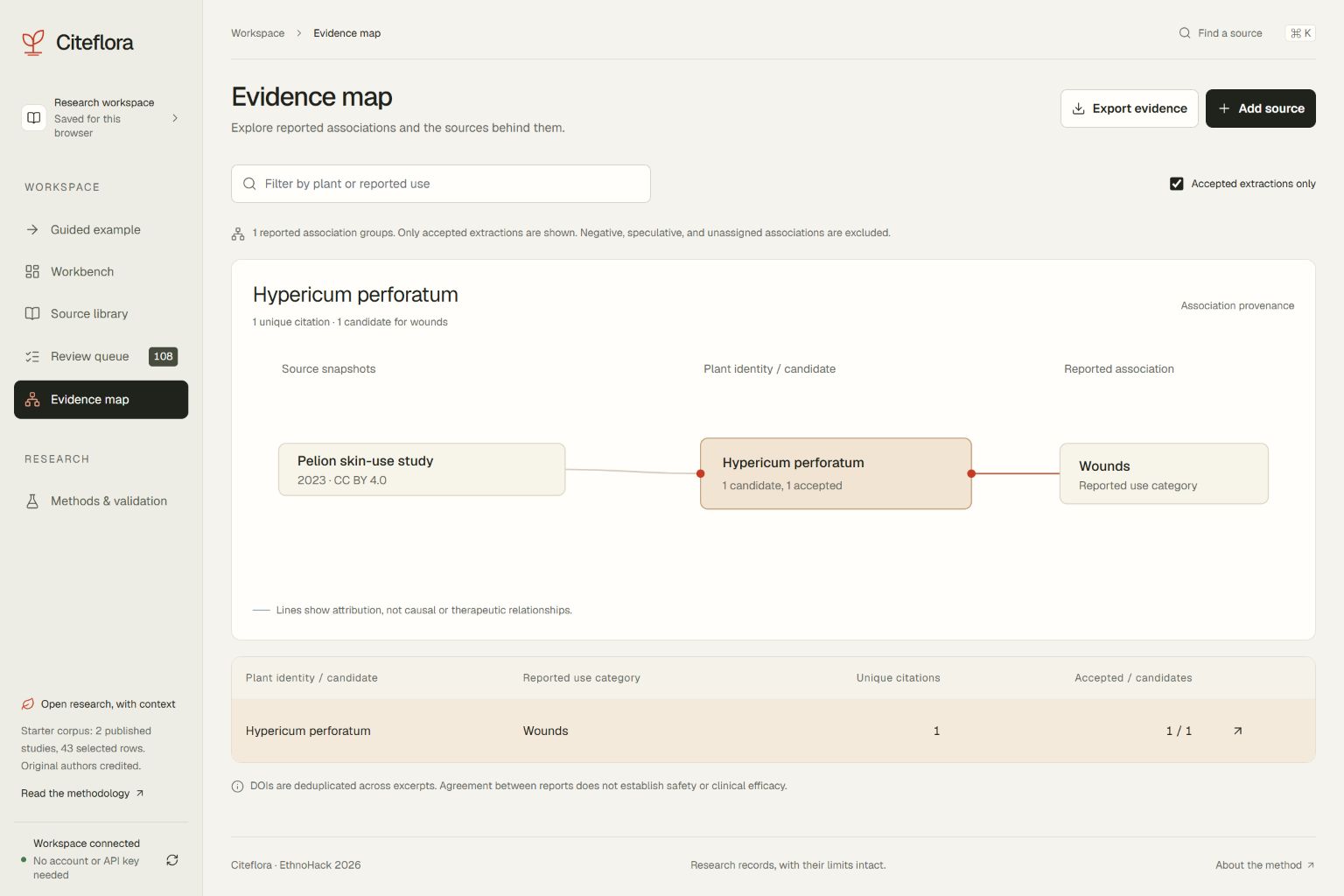
13. Accepted-only evidence traces saved reviews to sources. DOI deduplication avoids counting excerpts as independent citations.
-
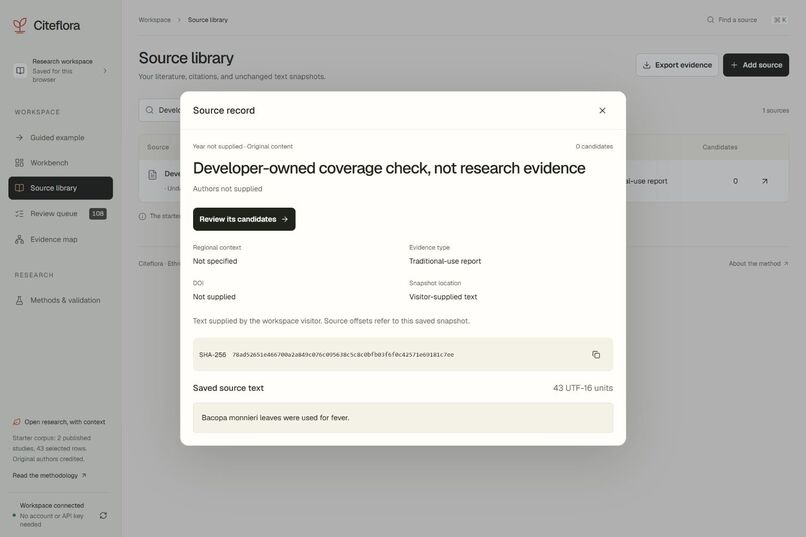
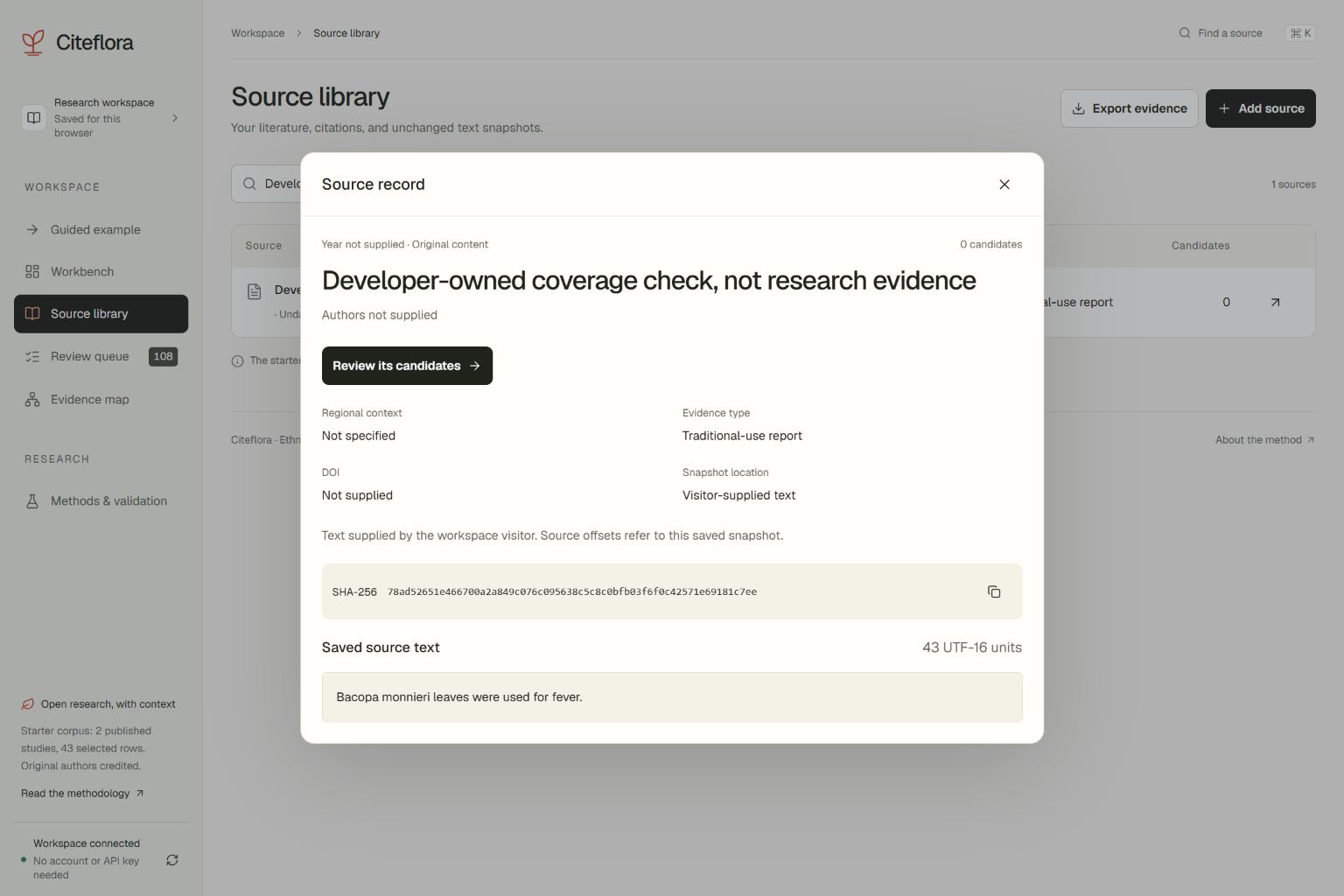
15. A labelled coverage test saves zero candidates for an unlisted genus. Zero extraction does not prove absence of reported use.
-
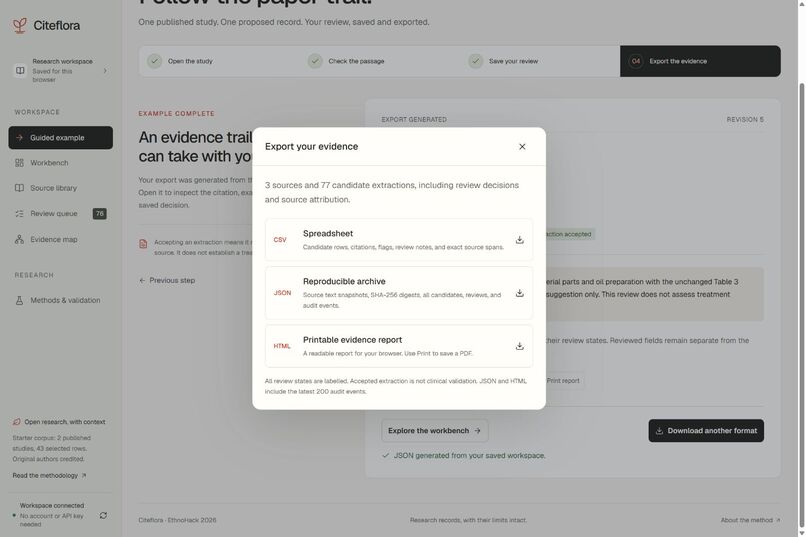
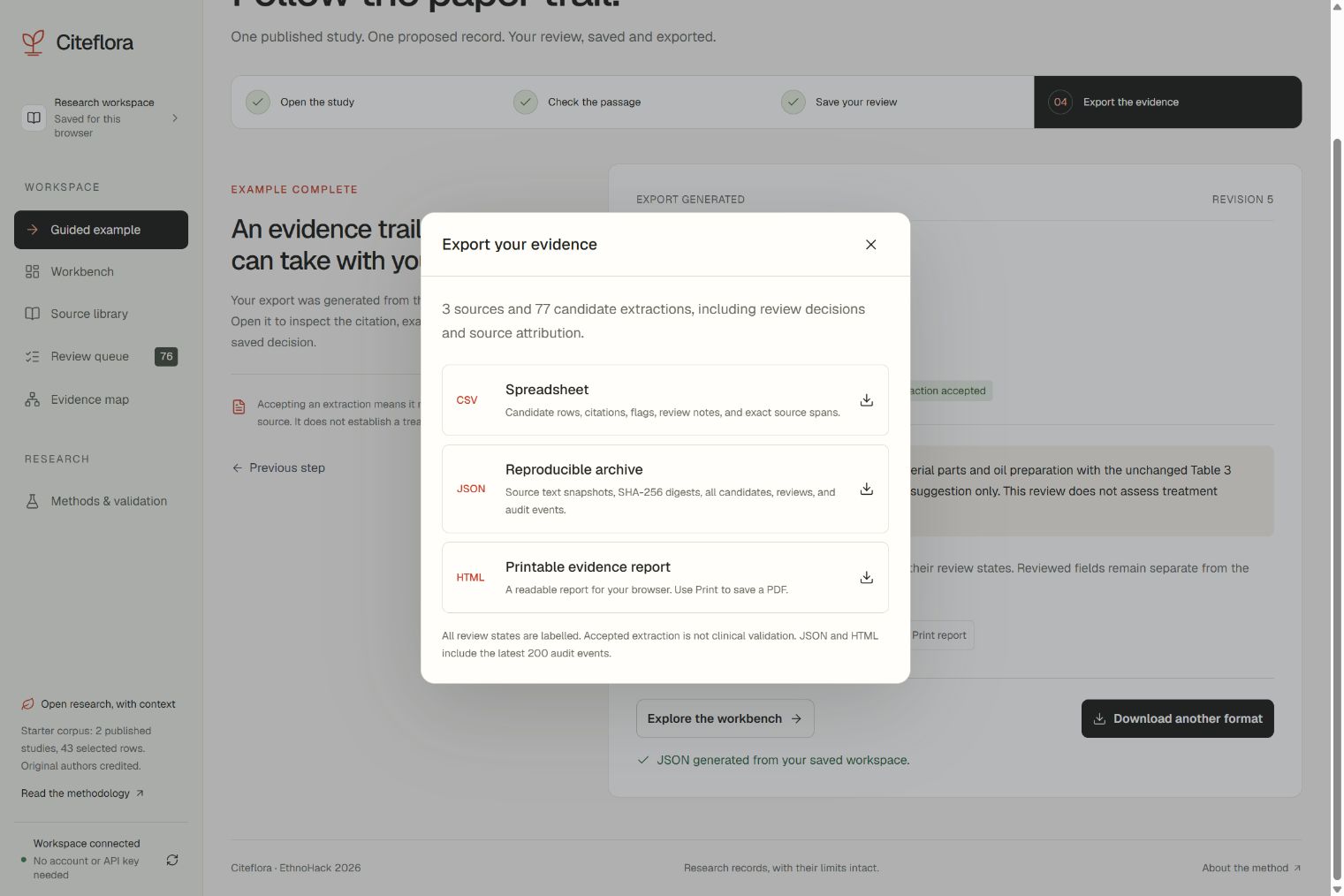
08. CSV, JSON and printable HTML retain citations and review states. The guide completes after the actual JSON export succeeds.
-
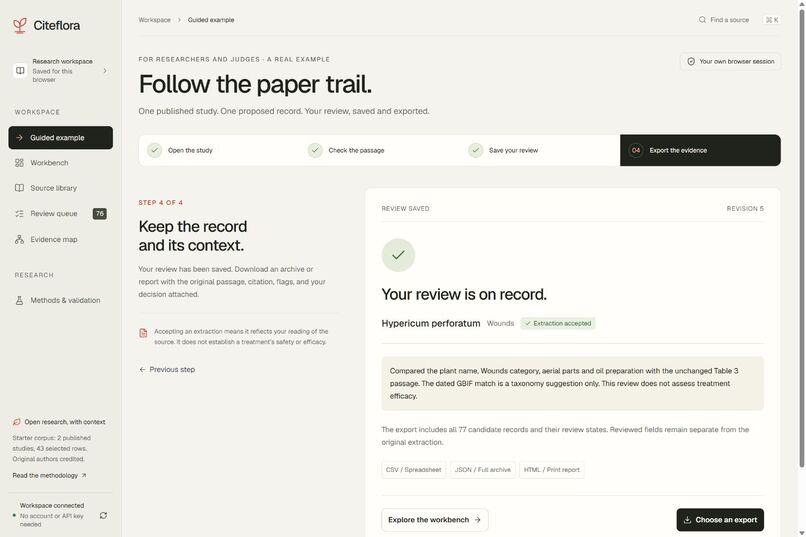
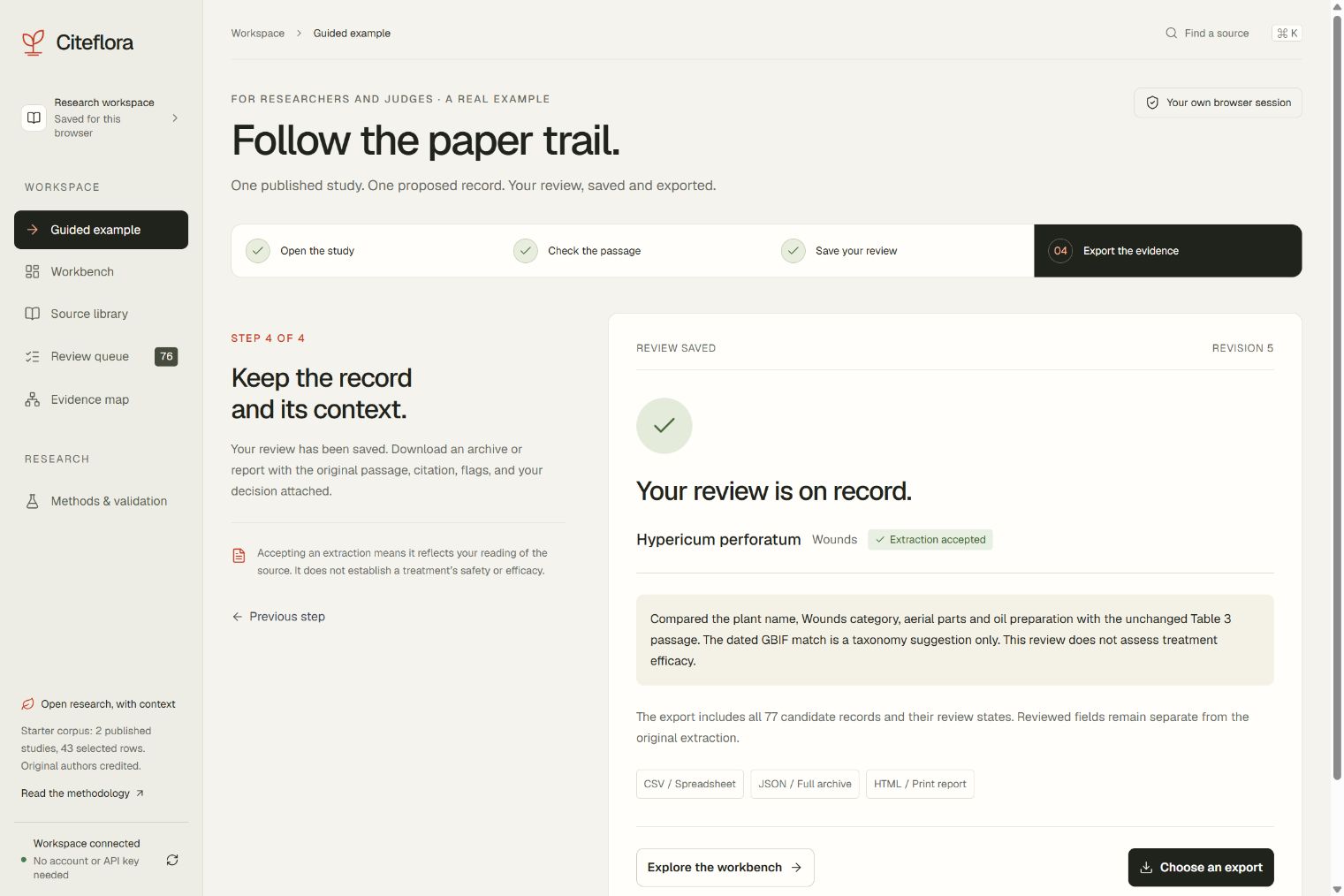
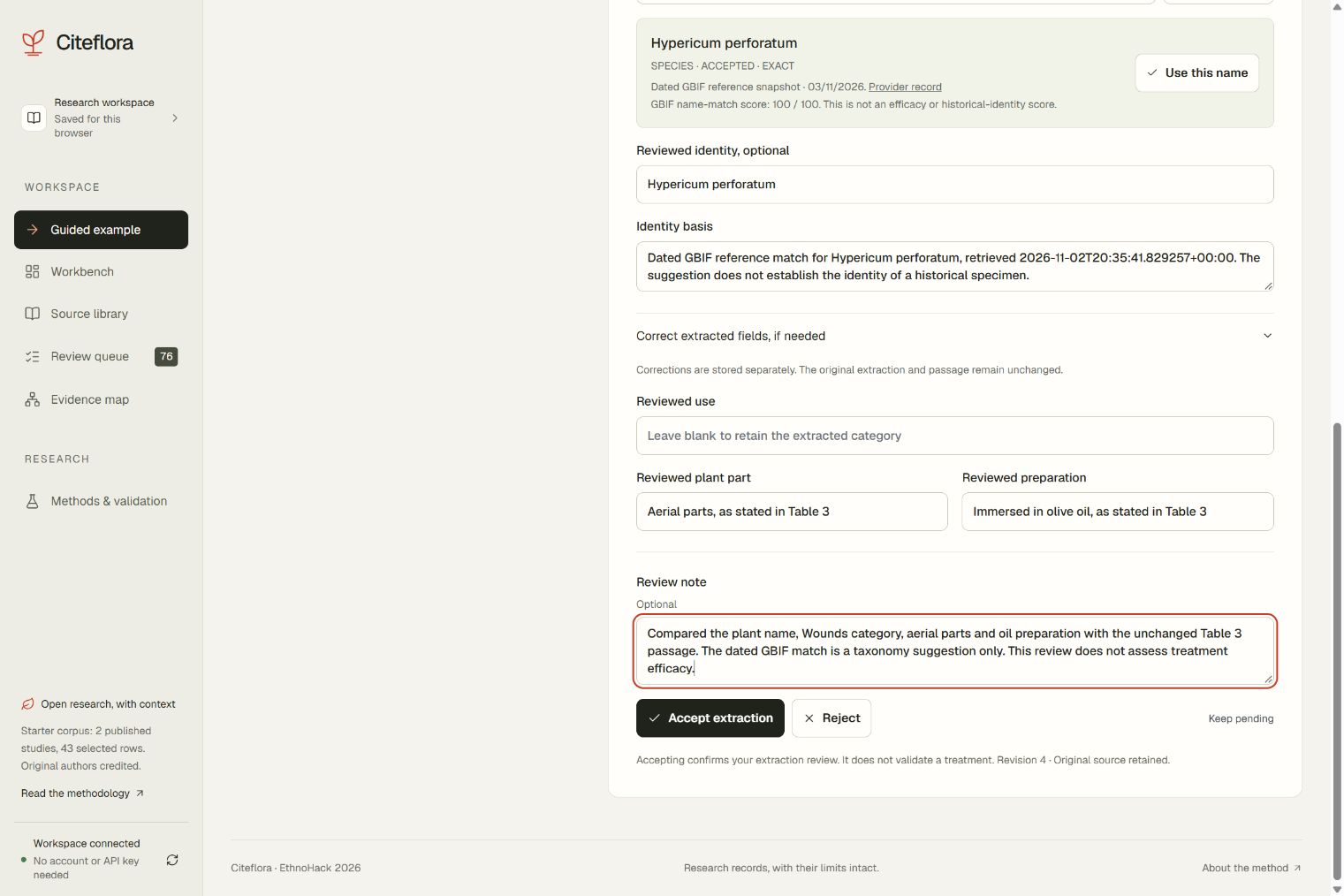
07. A real database save records the review decision and a new revision. Accepted extraction does not mean clinical validation.
-
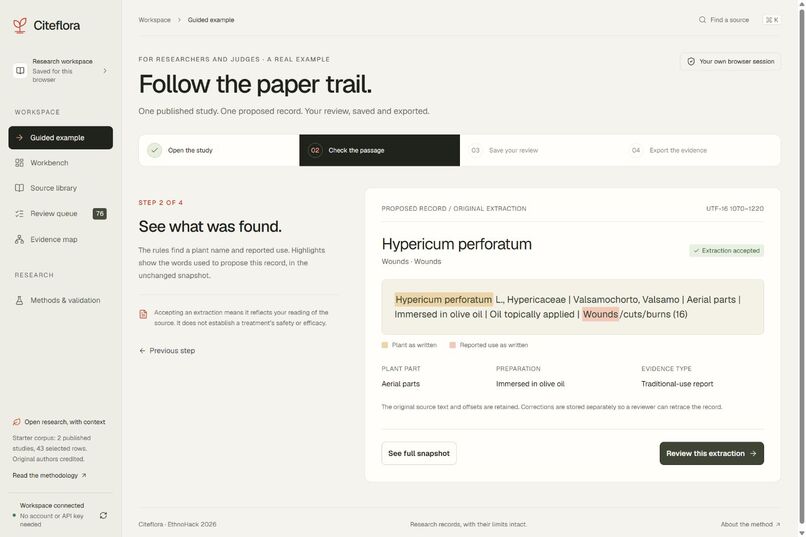
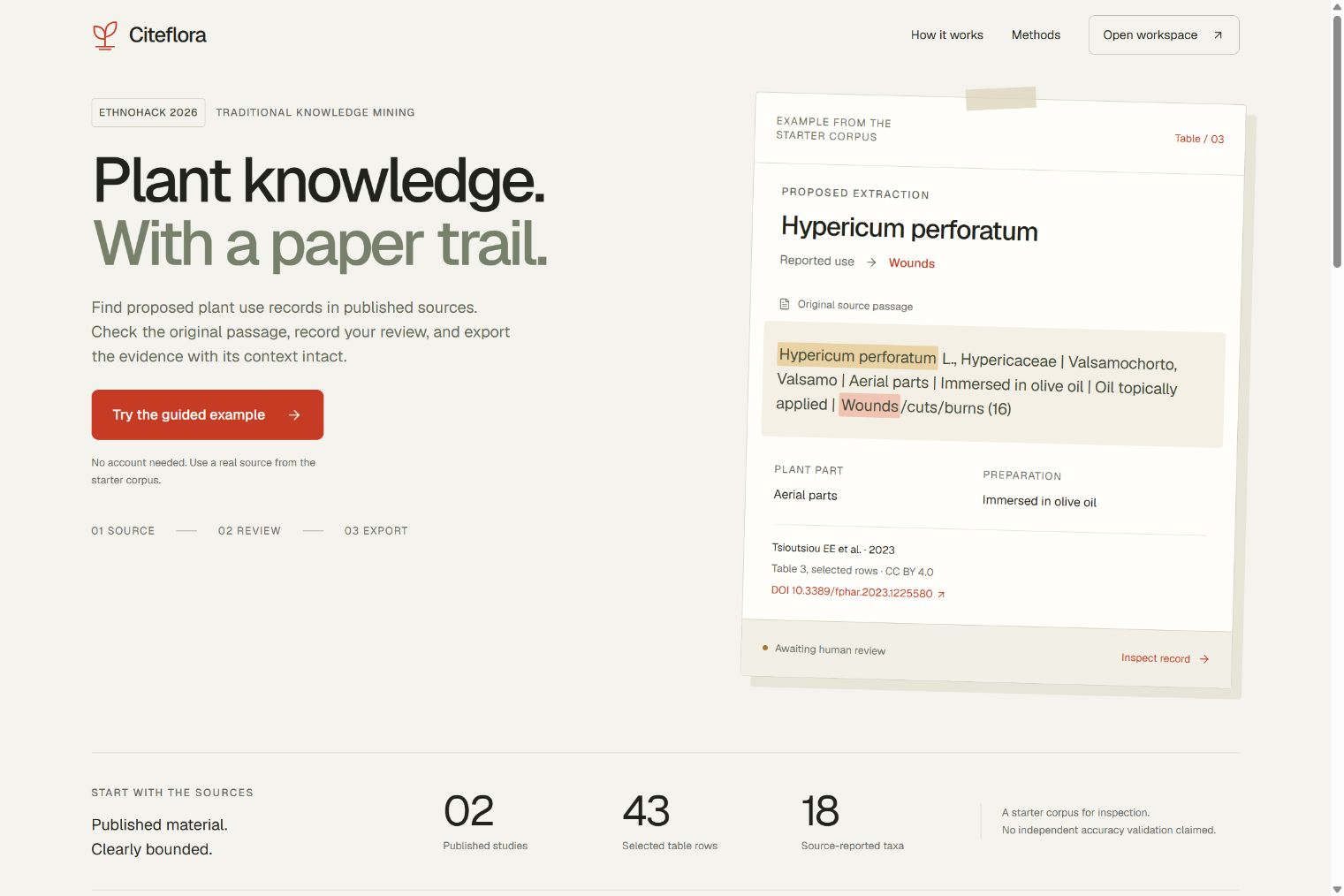
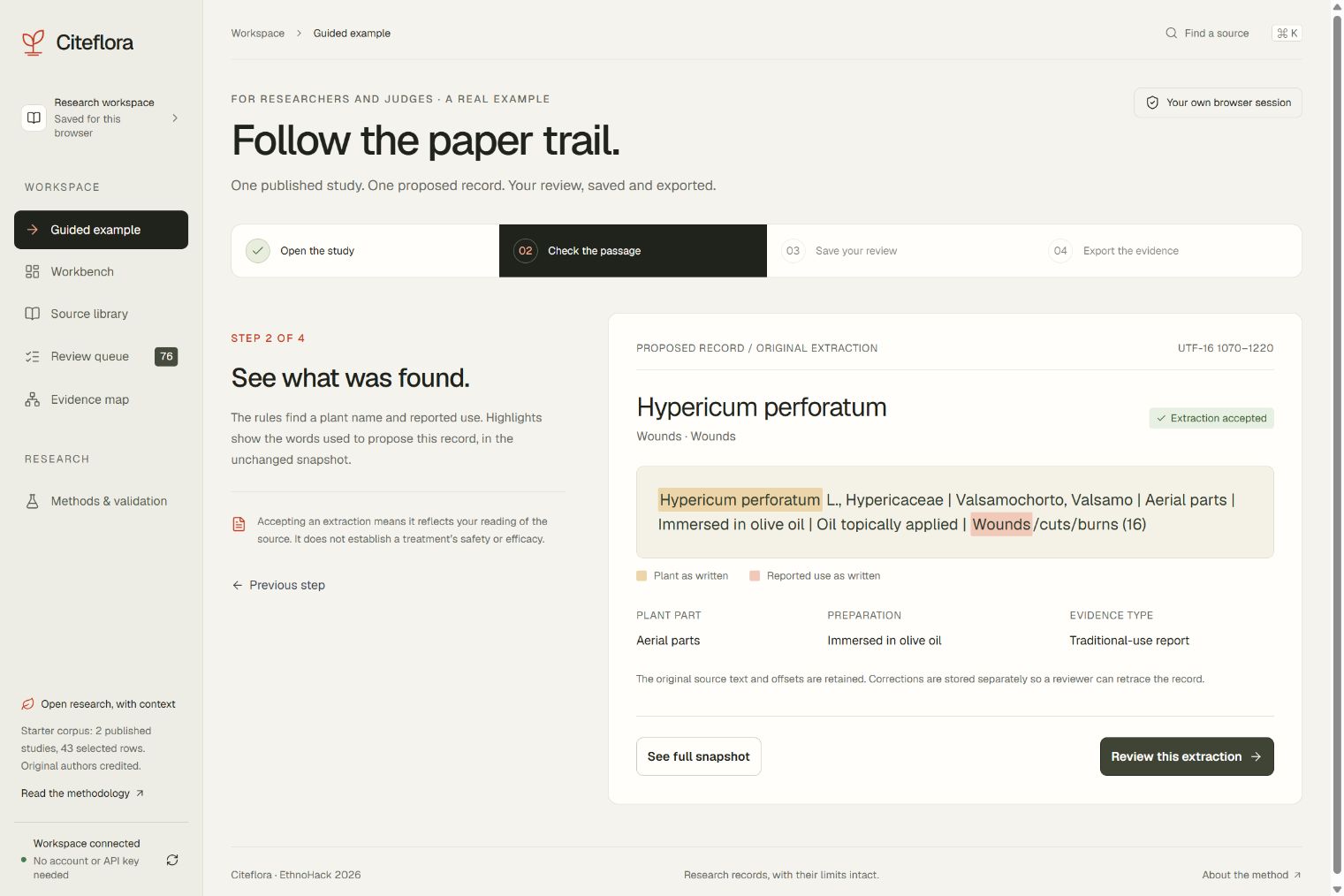
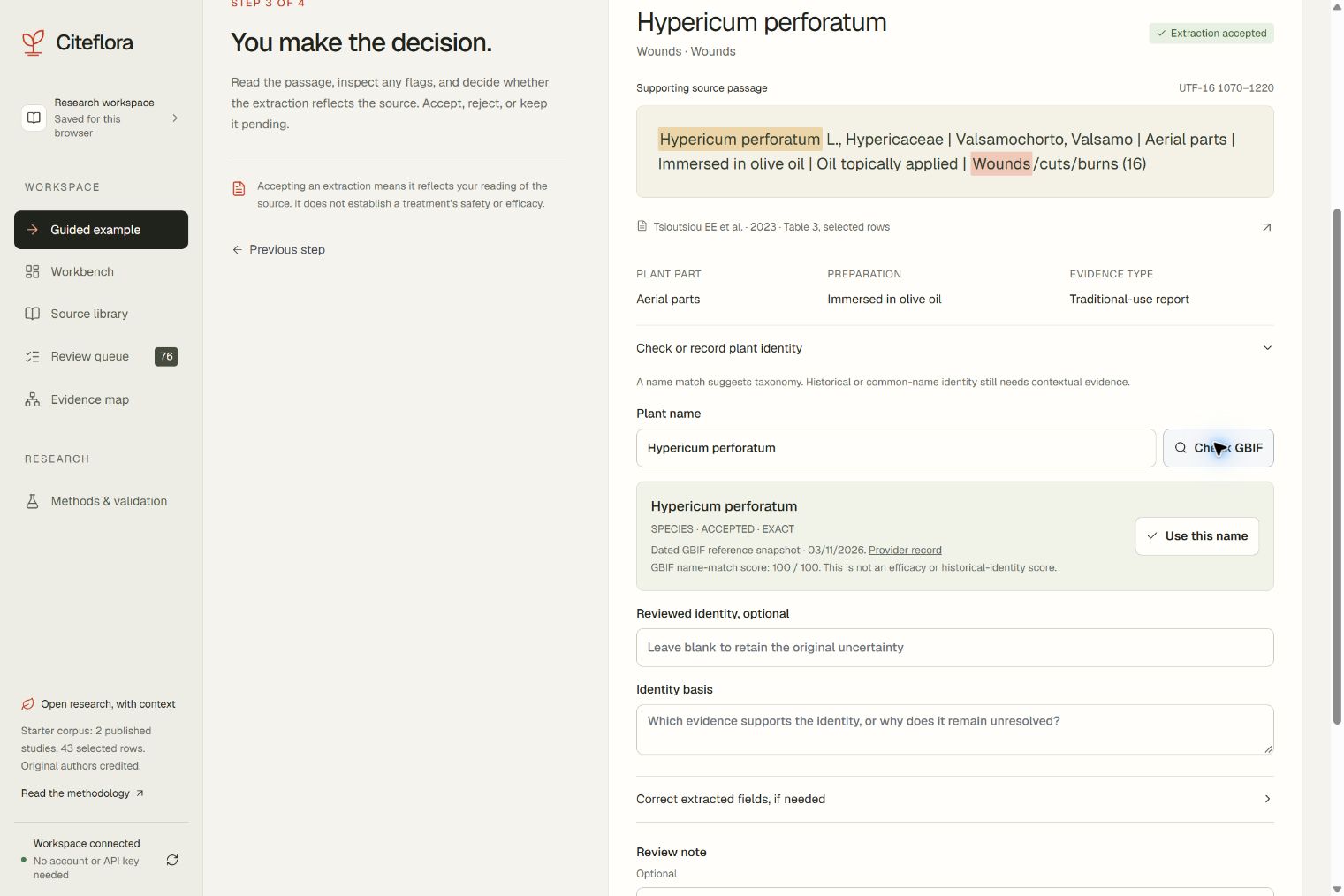
04. Exact UTF-16 offsets connect the extracted plant name and Wounds use to highlighted words in the published source snapshot.
-
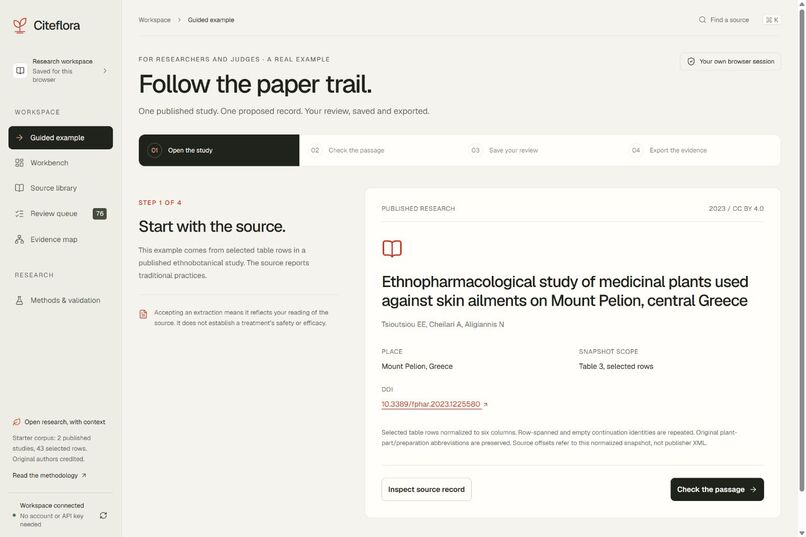
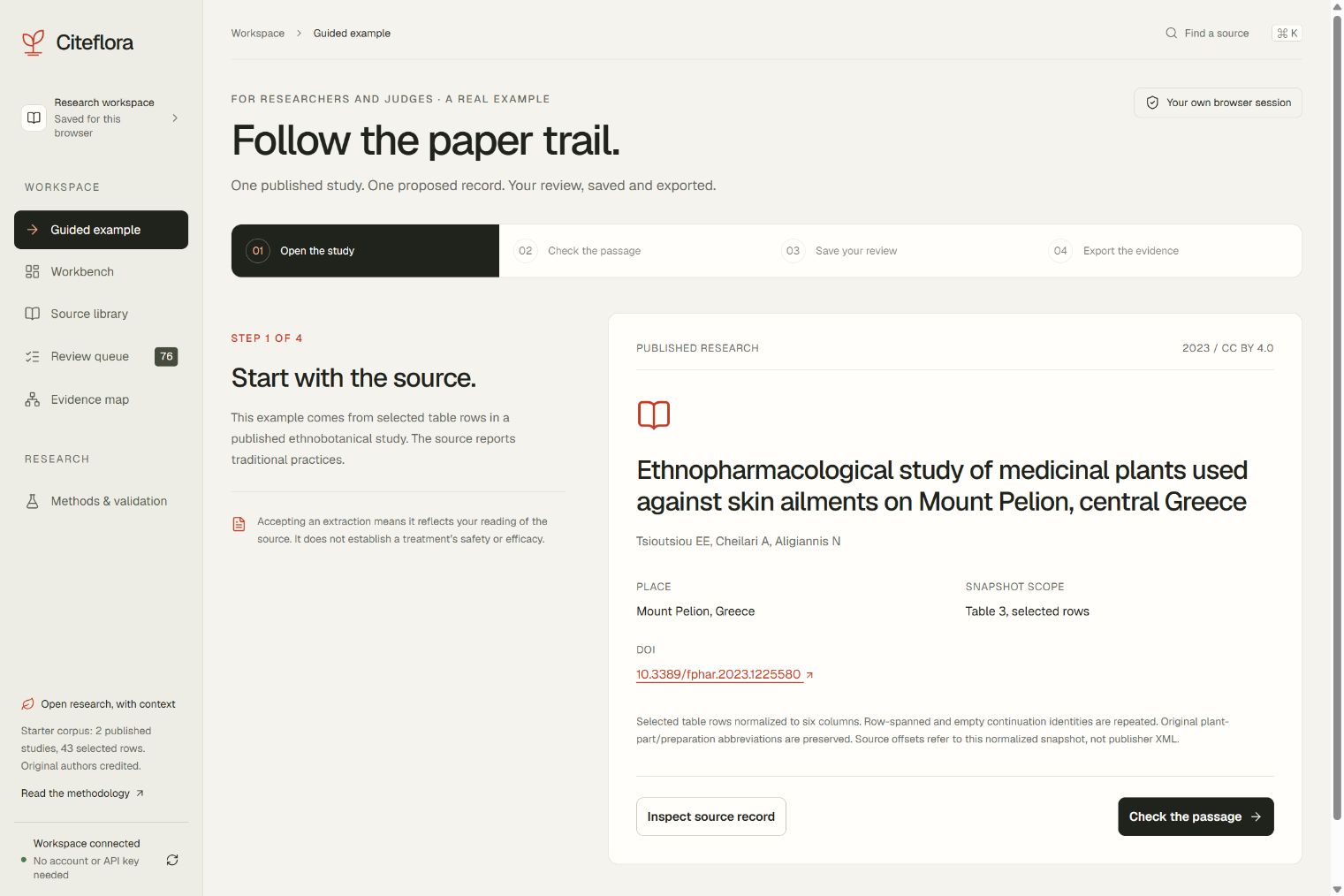
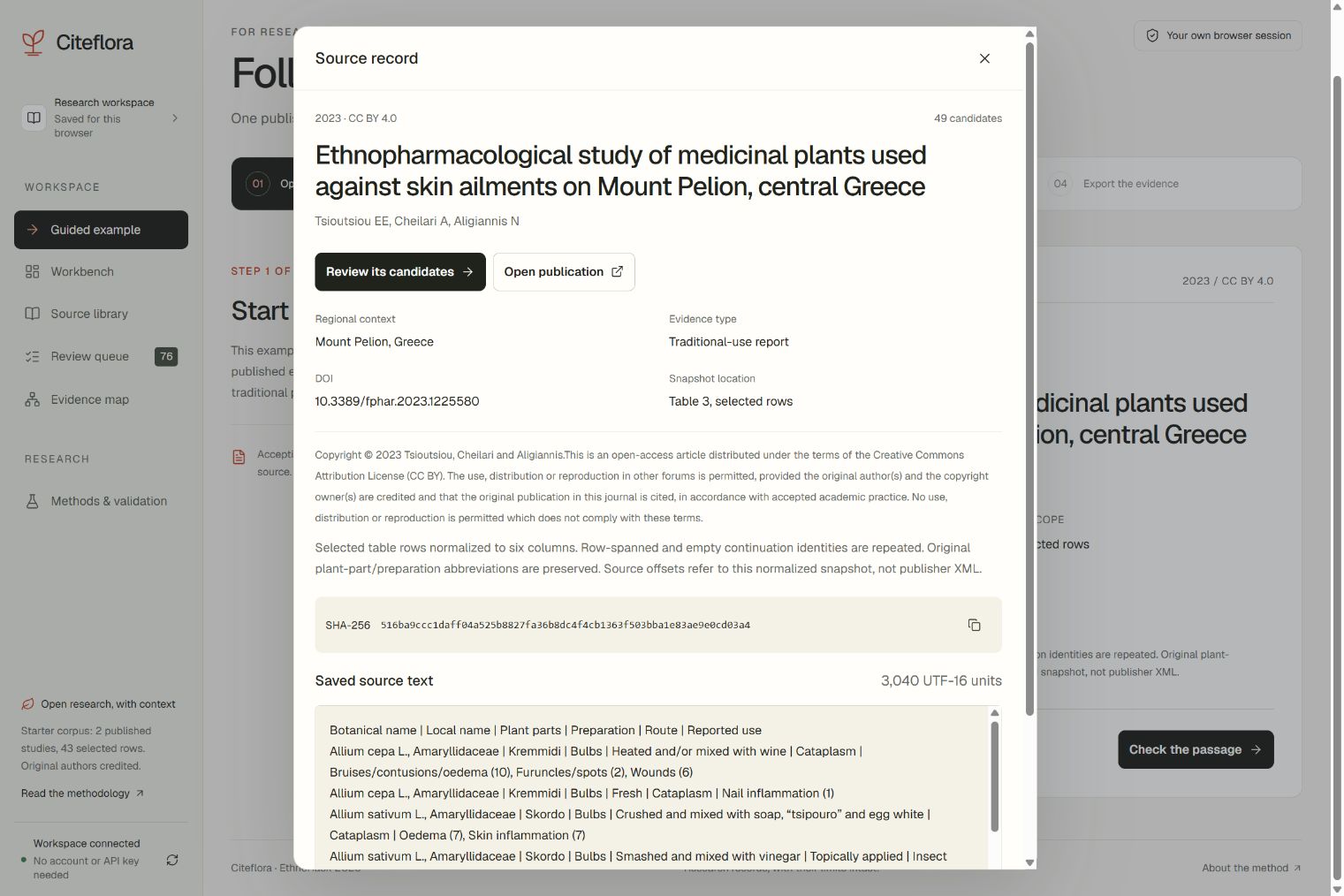
02. A guided route for researchers and judges begins with a published study, citation, region, licence and selected-table scope.
-
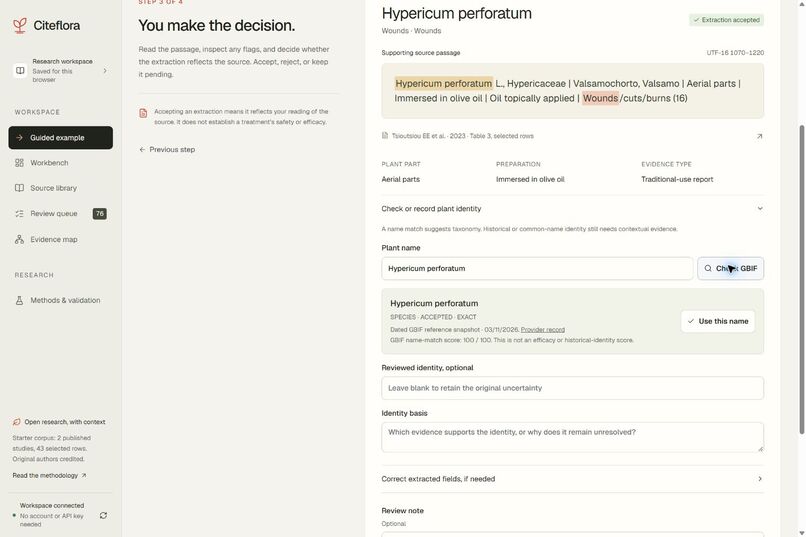
05. Dated GBIF taxonomy lookup offers a labelled reference suggestion. Its match score does not measure efficacy or historical identity.
-
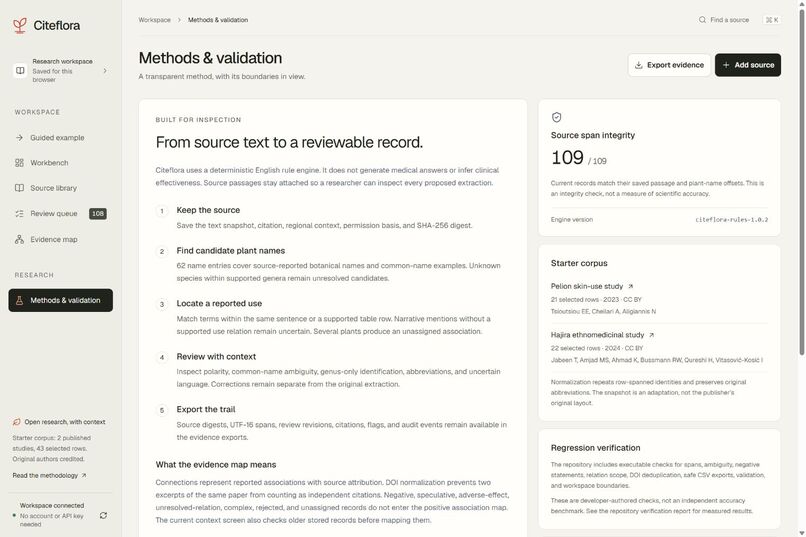
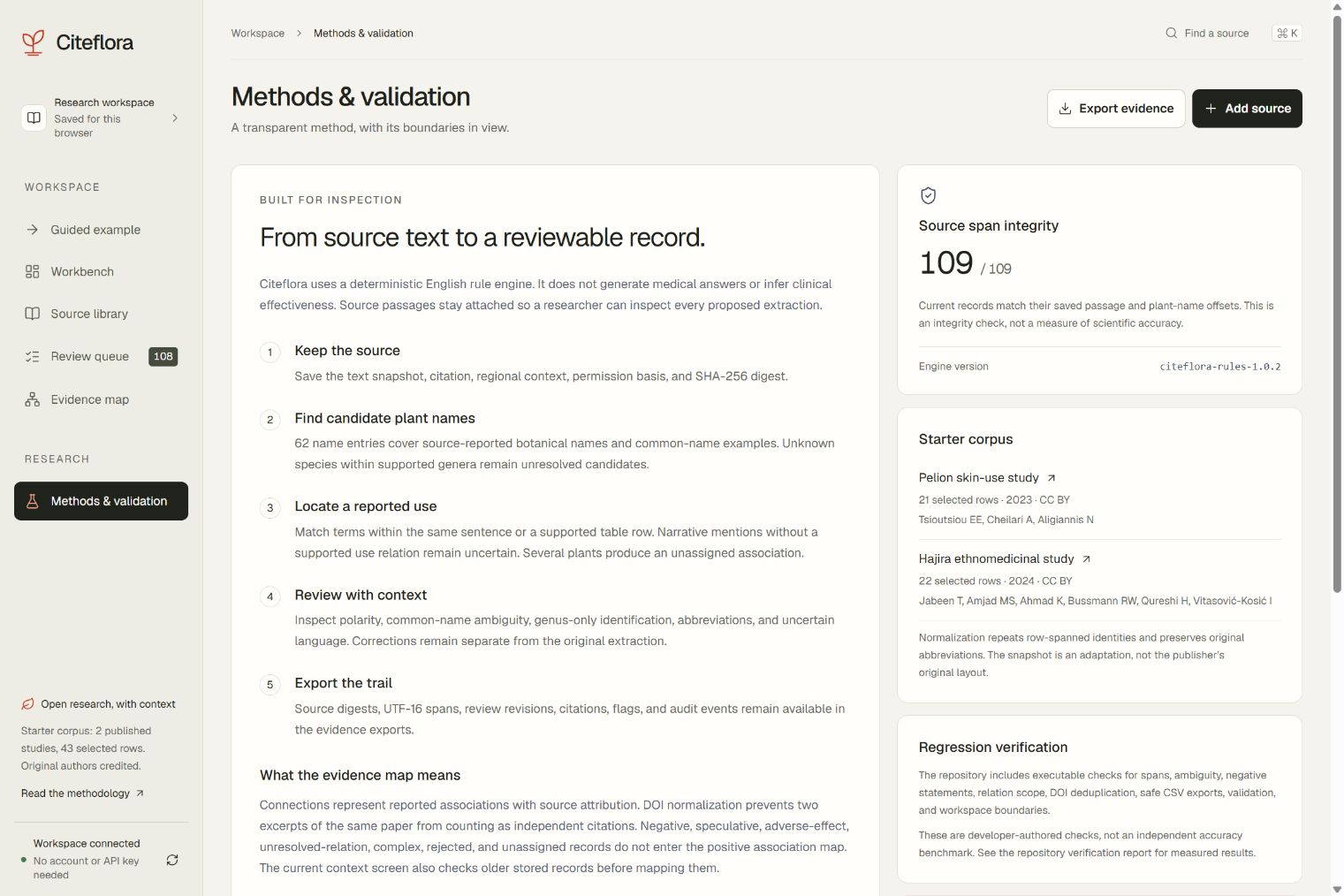
14. Methods disclose bounded English rules, vocabulary and source-span checks. Integrity counts are not scientific accuracy scores.
-
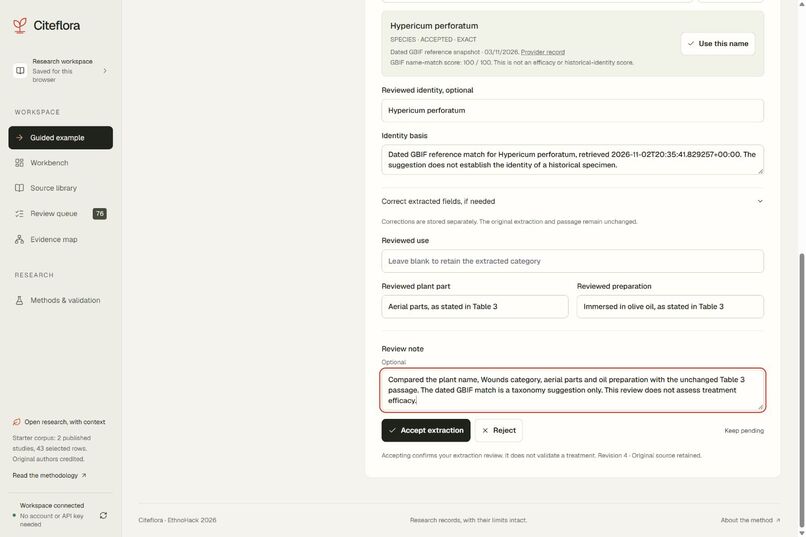
06. Reviewed identity, plant part, preparation and notes are stored separately from the original extraction and unchanged source text.
-
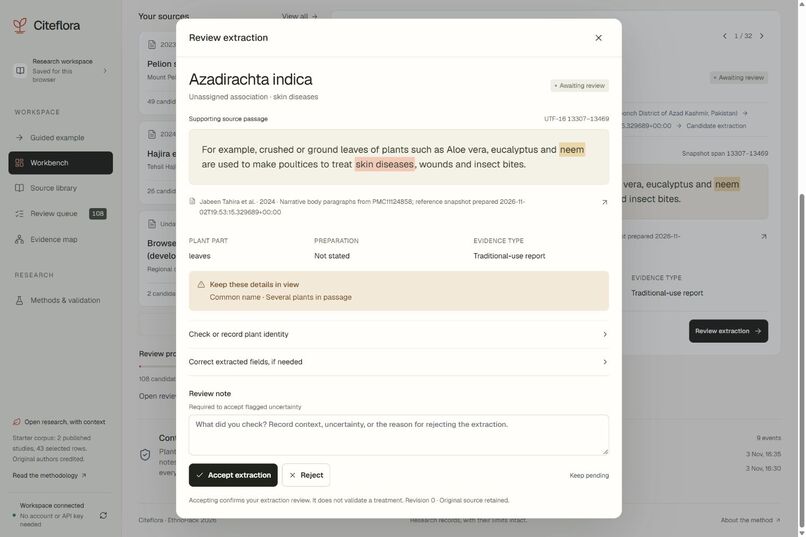
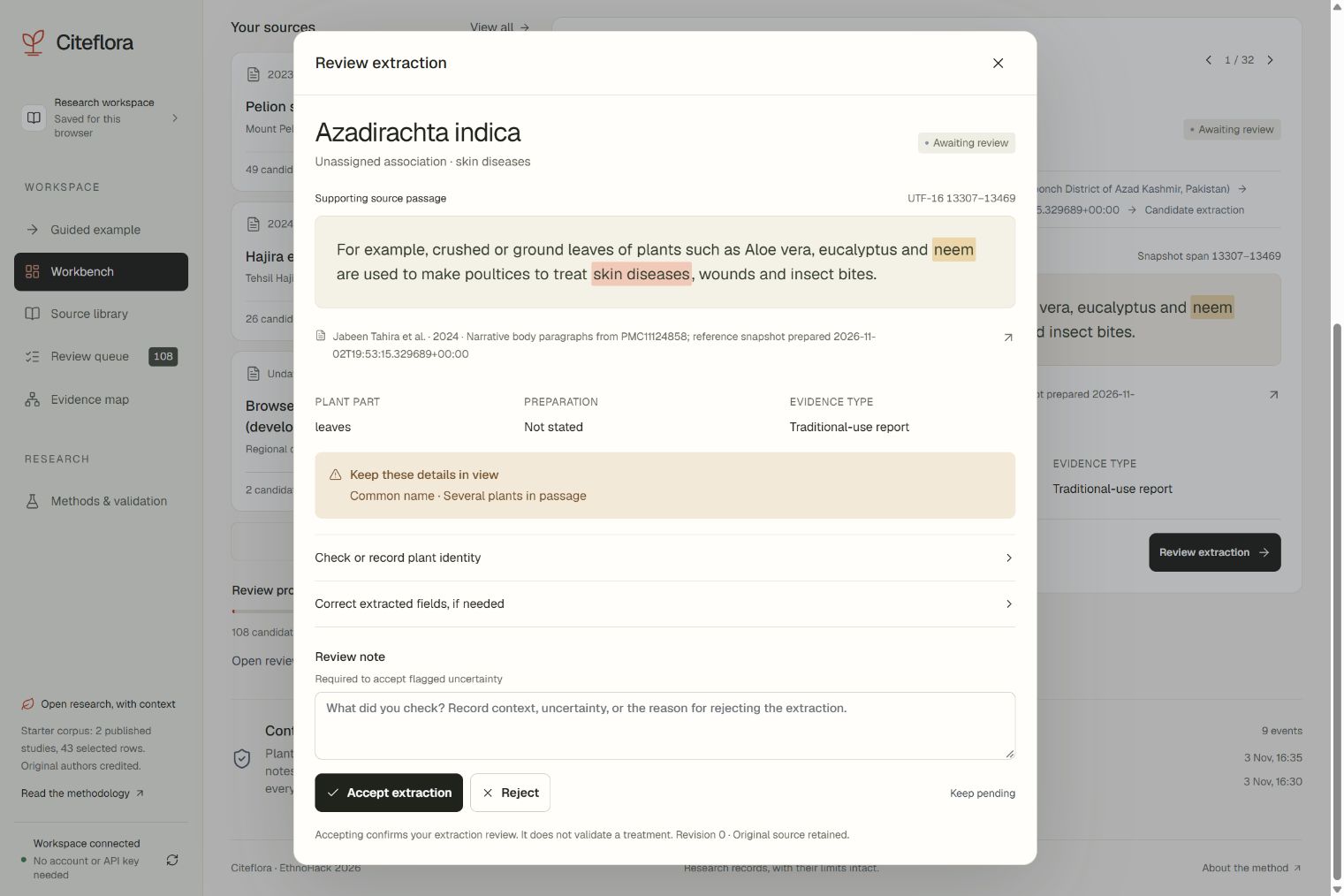
12. A real multi-plant passage stays uncertain, with unassigned association, common-name and multiple-plant flags visible for review.
-
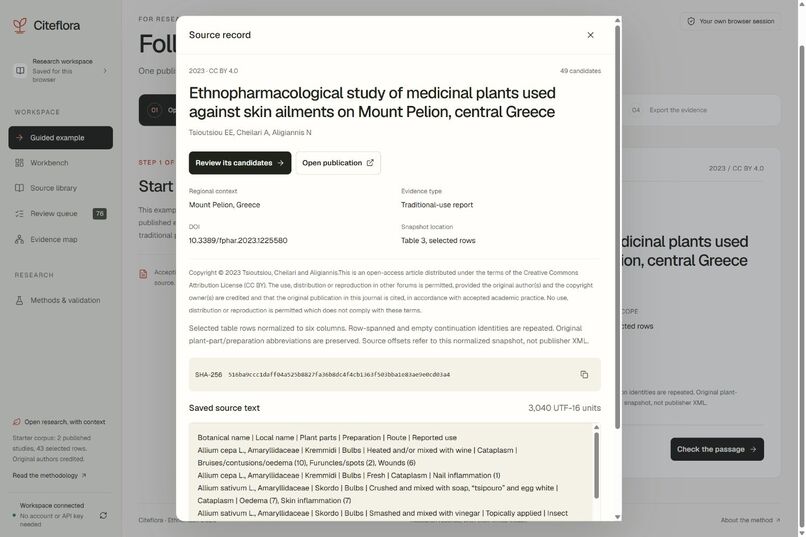
03. Source provenance preserves author credit, DOI, licence, unchanged normalized text and a verifiable SHA-256 snapshot digest.
-
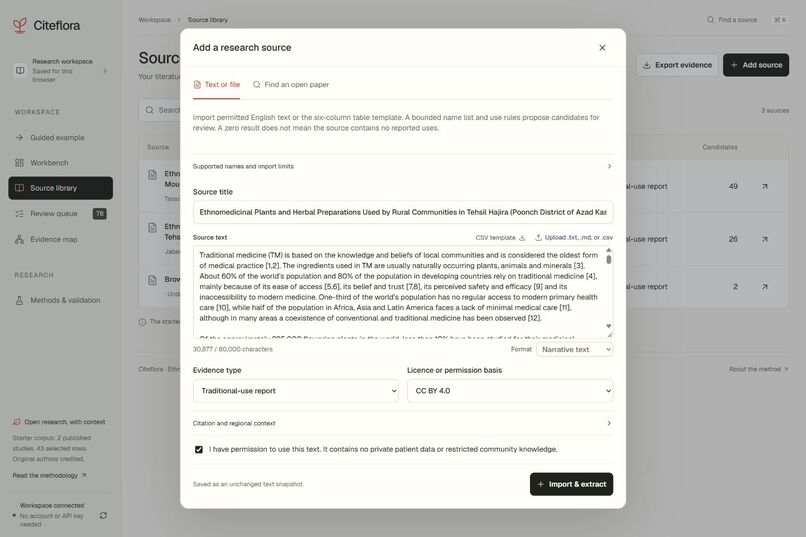
11. Licence-checked import prepares 30,877 narrative characters from the Hajira paper. This excerpt is not a new independent study.
Inspiration
Traditional knowledge research often starts with a table, a vernacular name and a passage in a paper. Moving those fragments into a spreadsheet can lose the citation, confuse plant identity or make a reported use look like established clinical evidence. Citeflora keeps that context attached through extraction, review and export.
What it does
Citeflora is a research workspace for EthnoHack Track 1, Traditional Knowledge Mining. Researchers can start with two attributed open-access studies or import permitted English text and supported files. A deterministic rule engine proposes plant-use records and highlights their exact passages. Users inspect uncertainty, consult GBIF taxonomy suggestions, correct fields separately from the original extraction, and save an accepted, rejected or pending decision.
The evidence map groups positive reported associations and counts duplicate DOIs once. Negative, speculative, adverse-effect, unresolved-relation, complex, rejected and unassigned multi-plant records stay out of that positive map. CSV, JSON and printable HTML exports preserve citations, spans, uncertainty and review status. Acceptance records an extraction review. It does not validate a treatment.
How users and judges try it
Open citeflora.vercel.app and choose Try the guided example. No end-user account or API key is needed.
- Open the Pelion study record and inspect its citation, CC BY licence and selected-table scope.
- Check the proposed Hypericum perforatum and wounds record against the unchanged, highlighted passage.
- Save a decision and any note or correction. The application persists a new revision and audit event before advancing.
- Generate an evidence export containing that saved decision and the original source trail.
Researchers can choose Add a research source for their own permitted material. The guide uses the actual application and database, rather than a simulated result.
How we built it
The interface uses standard Next.js 16, React 19 and TypeScript on Vercel. Its same-origin server proxy validates requests and authenticates to a standalone Cloudflare Worker. D1 persists isolated browser workspaces, immutable snapshots, candidates, revisions and audit events. A random HttpOnly cookie identifies the workspace. The shared operator secret stays on the two servers and is never supplied to visitors.
The rule engine uses sentence and table-row scope, a bounded botanical-name list, known-genus fallback, conservative relation and polarity cues, and explicit uncertainty flags. It saves exact UTF-16 offsets and SHA-256 digests instead of generating unsupported answers. GBIF supplies current-taxonomy suggestions. Europe PMC supplies literature search and licence-checked narrative preparation. A labelled one-paper catalogue and 24 dated taxonomy records support reproducible references when live services are unavailable.
The design uses a research fieldbook approach, with warm surfaces, strong typography and an attributed passage as the main visual. The entry point explains the product before opening the workbench, and the guide provides a complete first-use path.
Challenges and accomplishments
Common-name ambiguity, several plants in one sentence, inherited table cells and abbreviations can create misleading records. Citeflora preserves these uncertainties instead of silently resolving them. Corrections remain separate from the source and original extraction. Expected-revision checks prevent a stale review from overwriting a newer decision.
The starter contains 43 selected rows from two CC BY studies, 18 source-reported taxa and 75 candidates. All 75 passage spans match their snapshots and both digests reproduce. These are integrity results, not a scientific accuracy benchmark.
The current local suite passes 59 regression and API checks, TypeScript checking, ESLint and both production builds. A real hosted check through Vercel verified a three-candidate import, ambiguity and negation flags, a saved correction, source hashing, a dated taxonomy reference, licensed narrative preparation and all three exports. It also verified workspace isolation, stale-review rejection and cross-origin write rejection. The audit also verified taxonomy provenance after a note edit, ordinary/adverse/negative context screening, honest zero counts, passage bounds and author attribution. A browser run completed a saved review and JSON export, followed by a real Europe PMC search and a 32-candidate licensed narrative import. Mobile navigation was checked at 390 CSS px. Final-release browser and scientific-validation limits are recorded in the verification report.
What we learned
A plausible plant name does not establish identity, and a reported use is not clinical evidence. Reproducibility improves when the passage, source terms and review reasons remain part of the record. A guided task explains the product more clearly than an unexplained dashboard. Live results and dated references need distinct labels when network availability changes.
What's next
Independent evaluation with ethnobotany and pharmacognosy researchers; broader multilingual and historical-name coverage; community-governed permissions; interoperable schemas; and accounts for collaboration. These are future work, not current capabilities.
Sources and assistance
Starter studies: Tsioutsiou, Cheilari and Aligiannis (2023), DOI 10.3389/fphar.2023.1225580; Jabeen and colleagues (2024), DOI 10.3390/plants13101379. Each source retains author credit, licence, adaptation notes and a publication link. New code is MIT-licensed. Excerpts and third-party software retain their own terms.
The maintained Sites/Vinext starter predates the hackathon. The extraction engine, corpus workflow, API, schema, proxy boundary, guided review interface, exports and checks were developed for Citeflora.
Live app: citeflora.vercel.app
Built With
- cloudflare
- next.js
- react
- sqlite
- typescript
- vercel
