-
-
title
-
flowchart
-
physic_render
-
ER diagram
-
sample1
-
sample2
-
sample3

💡 Inspiration
Traditional Electronic Design Automation (EDA) tools and circuit simulators are incredibly powerful, but they suffer from a notoriously steep learning curve. Designing a simple circuit requires manual component placement, tedious wire routing, and calculating Ohm's law by hand to ensure you don't fry a microchip.
We asked ourselves: What if you could build a hardware prototype at the speed of thought? What if you had a "God-Mode" AI assistant that didn't just tell you how to build a circuit, but actually built the 3D Digital Twin for you? That is how CircuitSight was born.
⚙️ What it does
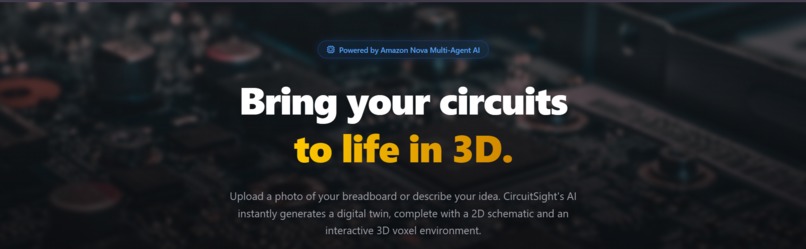
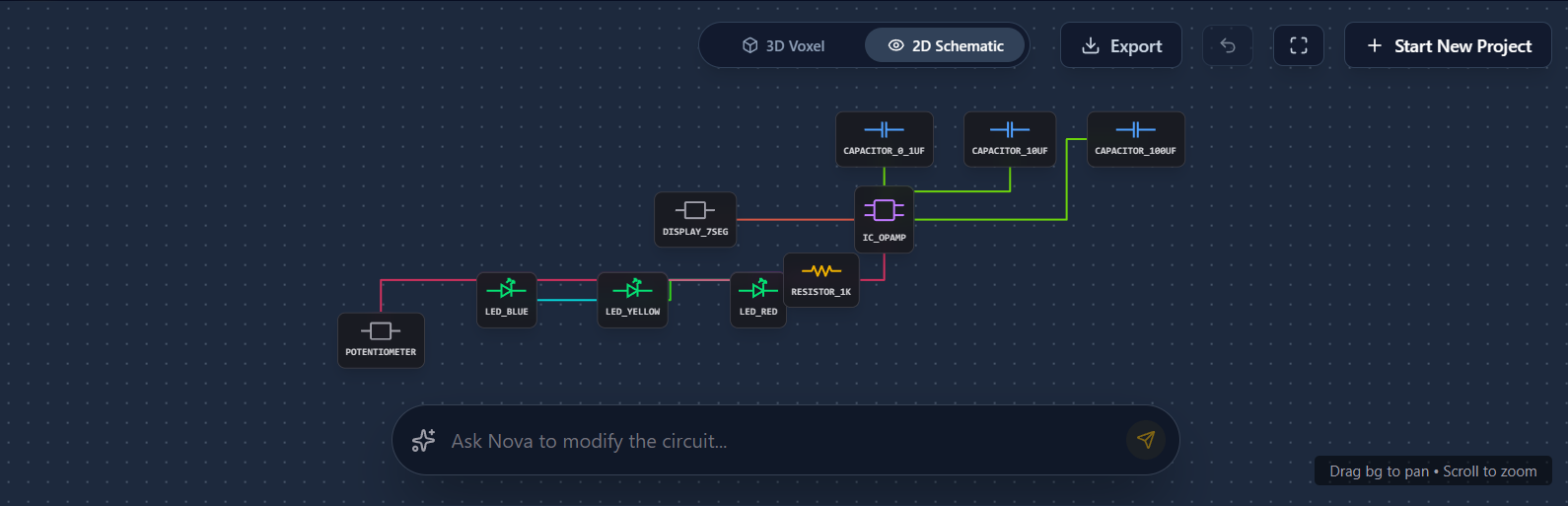
CircuitSight is an AI-native 3D circuit visualizer and simulator. Instead of a complex drag-and-drop GUI, users interact via a sleek, Spotlight-style command bar.
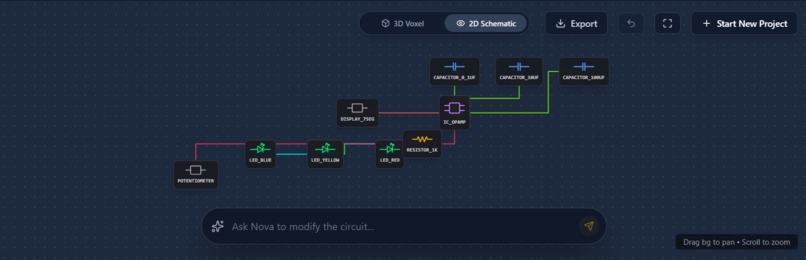
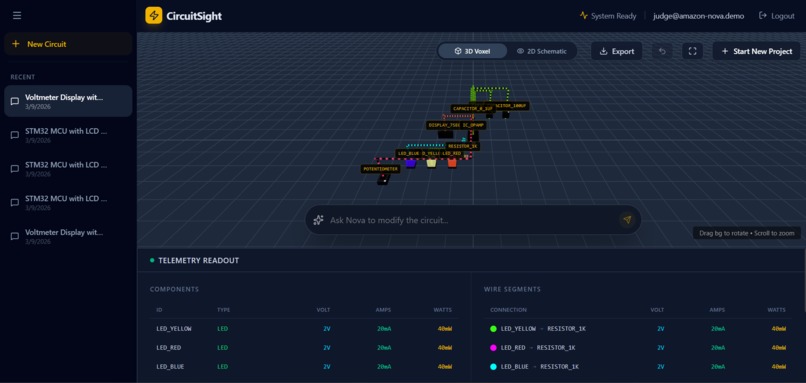
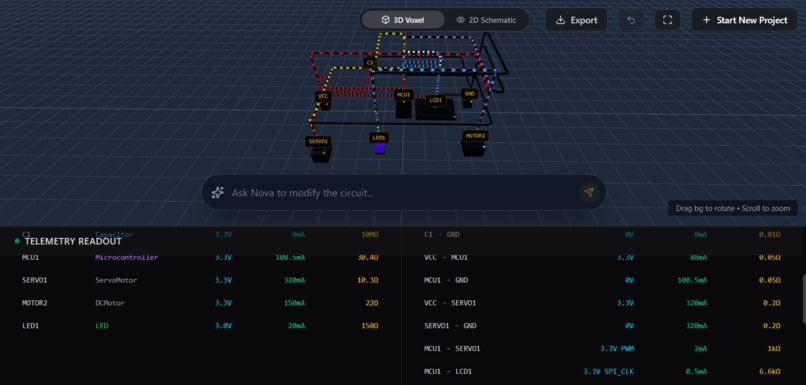
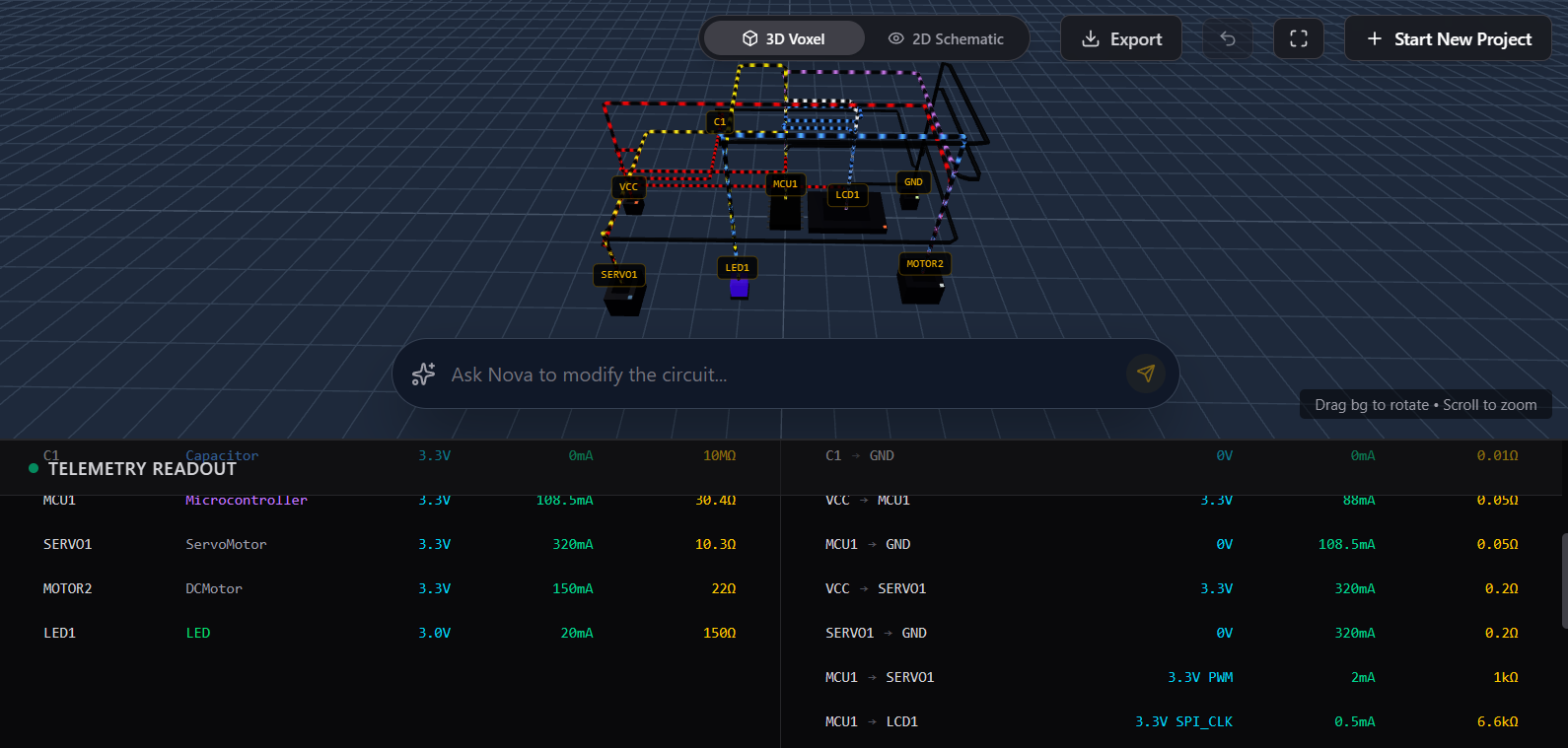
If a user types, "Build a 555 Timer LED flasher circuit, but swap the standard LED for a high-power blue one," the app instantly generates a complete 3D digital twin. The components are placed on a professional "Dark CAD" grid, the wires are orthogonally routed, and the electrical current is visually simulated in real-time. You can click on any component to view its real-time telemetry (Voltage, Amperage, Resistance) or read an AI-generated educational breakdown of its purpose.
🛠️ How we built it: The Amazon Nova Integration
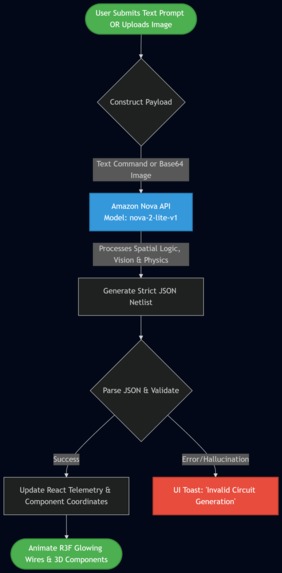
The core architecture of CircuitSight relies entirely on Amazon Nova (nova-2-lite-v1), which we utilized not just as a text generator, but as a dual-purpose Spatial Reasoning Engine and Physics Calculator.
Here is exactly how we integrated the Amazon Nova ecosystem:
1. The Serverless Architecture
We built a completely serverless React frontend. To interface with the model, we configured the standard OpenAI SDK wrapper to point directly to our custom Amazon Nova API endpoint (https://api.nova.amazon.com/v1). This allowed for ultra-fast, direct client-to-LLM communication without the bottleneck of a traditional backend.
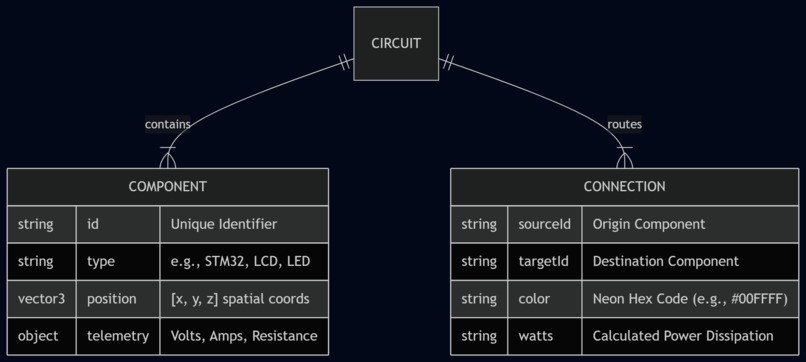
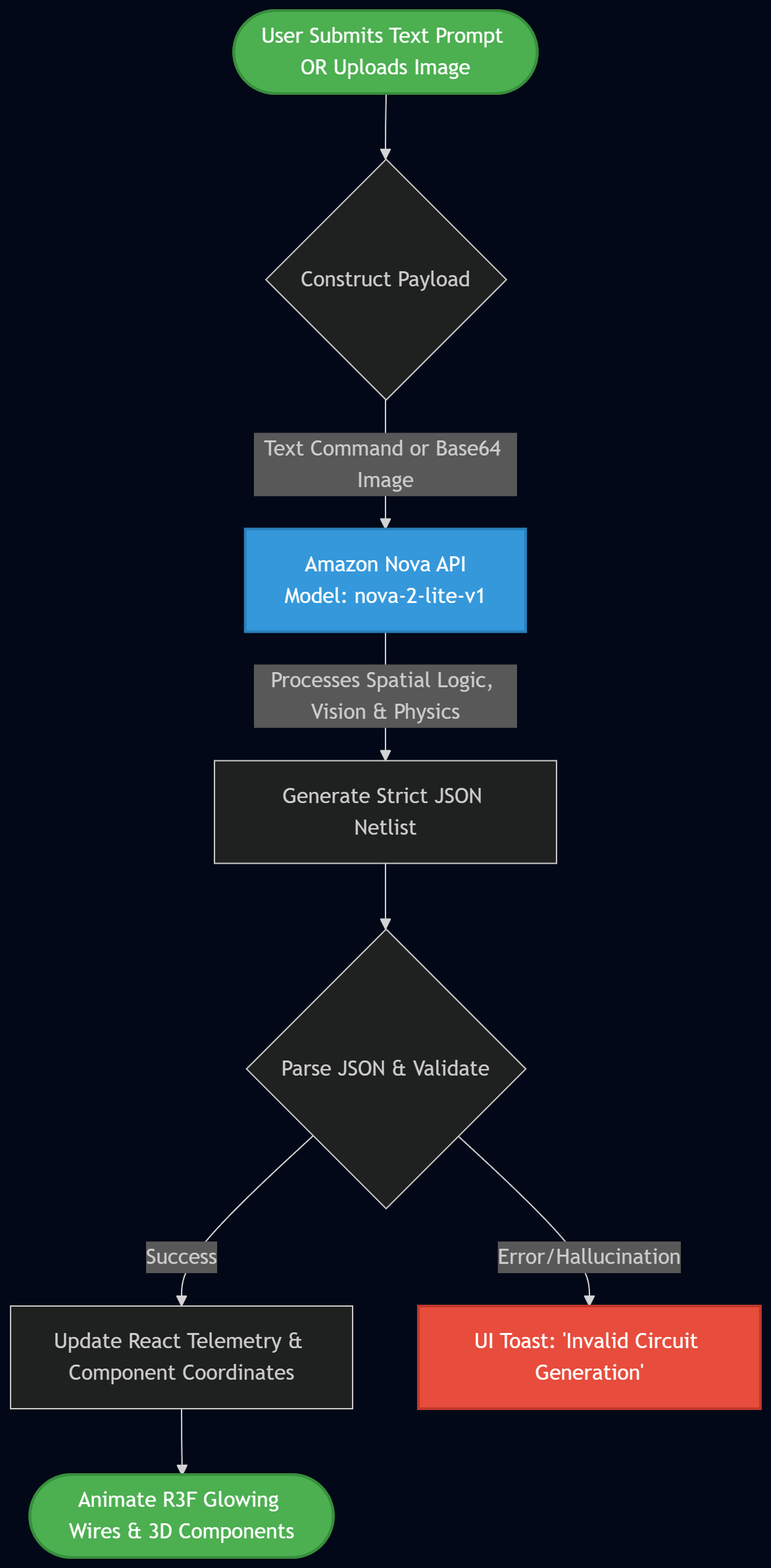
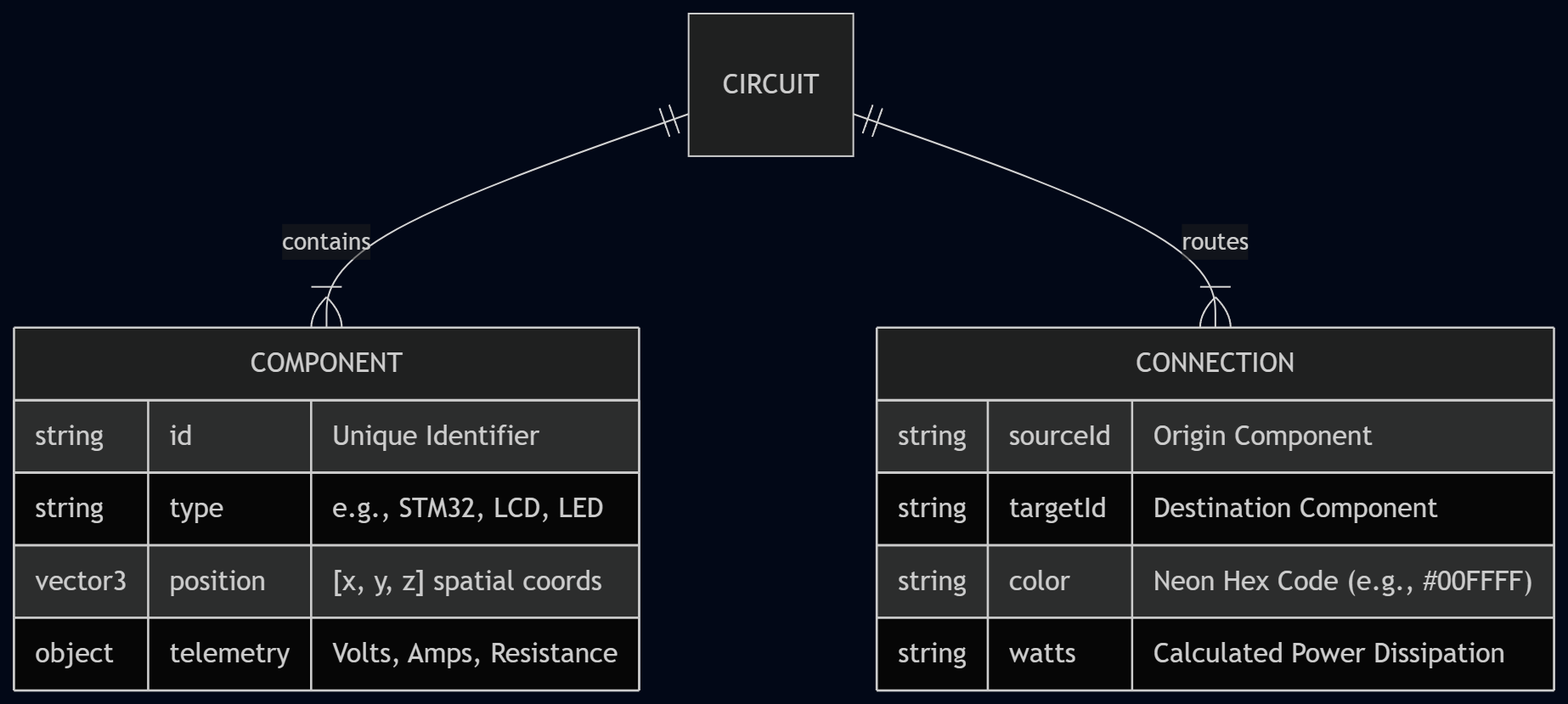
2. Nova as a Spatial Routing Engine Drawing 3D wires in WebGL usually requires heavy pathfinding algorithms (like A*). We offloaded this entirely to Nova. Through heavy system prompt engineering, we instructed Nova to map components to a strict X/Y/Z coordinate system and generate a JSON netlist. When a user asks to move a component, Nova updates the coordinates in the JSON and mathematically recalculates the Manhattan-style routing paths for the wires so they don't clip through components.
3. Nova as a Physics Engine
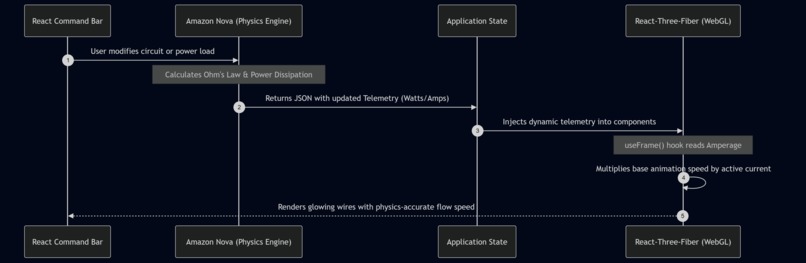
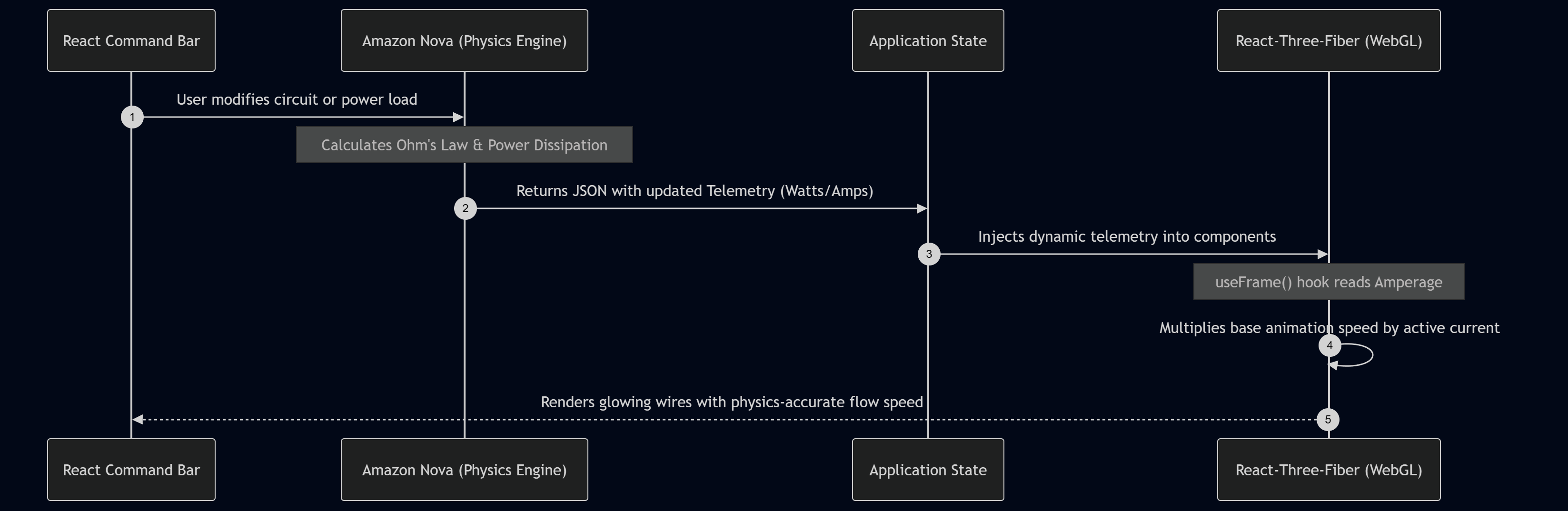
We tasked Nova with running real-time Ohm's Law and Kirchhoff's Circuit Laws ($V = I \cdot R$) in the background. Every time the circuit is modified, Nova recalculates the telemetry payload for the entire board.
- The Magic: We bound this Nova-generated telemetry directly to our React-Three-Fiber animation loop. If Nova calculates a high Amperage on a specific wire segment, the glowing particles on that 3D wire physically move faster on the screen to represent the current flow.
4. Strict LLM Guardrails Because the command bar is exposed, we engineered strict prompt guardrails. If a user attempts a prompt injection (e.g., "Write me a poem"), Nova acts as a strict EDA bouncer, rejecting the prompt and returning a specific JSON error payload that triggers a UI toast notification: "I can only assist with circuit design."
🚧 Challenges we ran into
Syncing a 3D WebGL canvas (React-Three-Fiber) with 2D React state driven by AI outputs was a massive hurdle. Initially, our 3D wires would refuse to update their geometry when Nova changed their coordinates. We had to implement a dynamic React key system tied directly to Nova's coordinate output to force the 3D engine to completely rebuild the meshes upon every AI modification.
Additionally, getting an LLM to consistently output mathematically sound circuit physics without hallucinating required dozens of iterations on the system prompt schema.
🏆 Accomplishments that we're proud of
We are incredibly proud of the "Predictive Telemetry" feature. Seeing the visual speed of a 3D glowing wire physically react to the math generated by Amazon Nova creates a truly immersive "Digital Twin" experience that feels like magic.
📚 What we learned
We learned that LLMs (specifically the Nova family) possess incredible spatial reasoning capabilities if you structure your JSON schemas strictly enough. You can push AI far beyond just generating chat text; you can use it as a headless physics and rendering engine.
🚀 What's next for CircuitSight
We want to integrate Gerber file exporting so that a circuit designed by Amazon Nova can be sent directly to a PCB manufacturer like JLCPCB with a single click. We also plan to support multi-layer PCB routing simulations in the 3D viewer.
Built With
- amazon
- amazon-nova
- node.js
- react
- three.js
- typescript
- vite

Log in or sign up for Devpost to join the conversation.