-
-
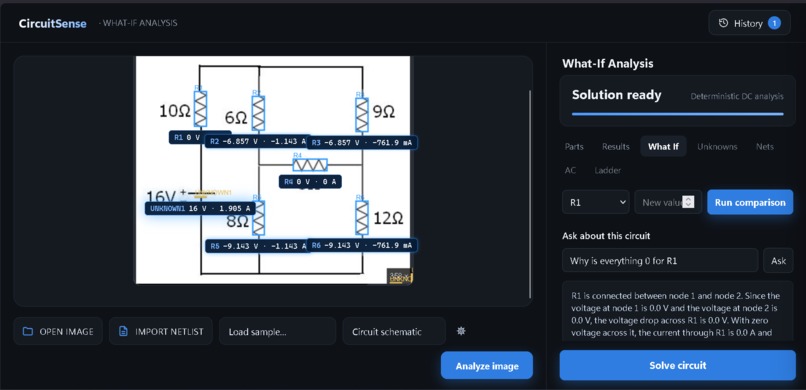
DC Analysis
-
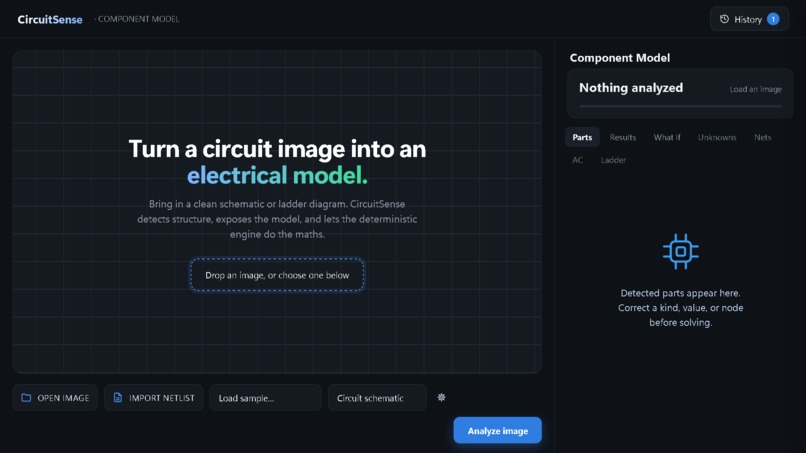
CircuitSense Home
-
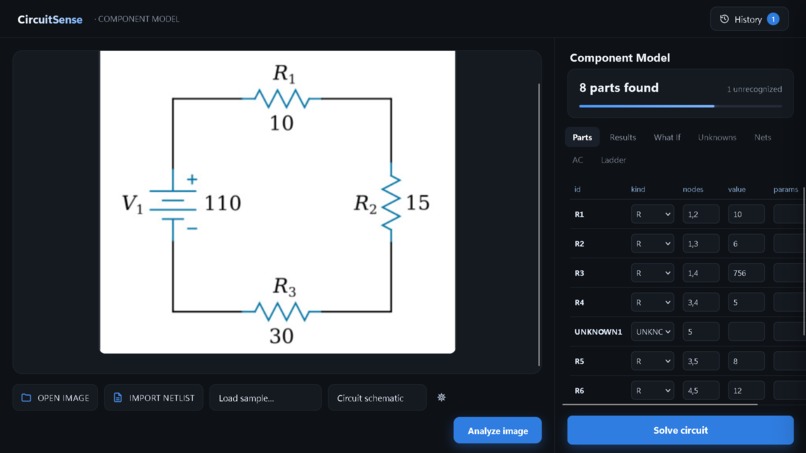
Circuit Uploaded
-
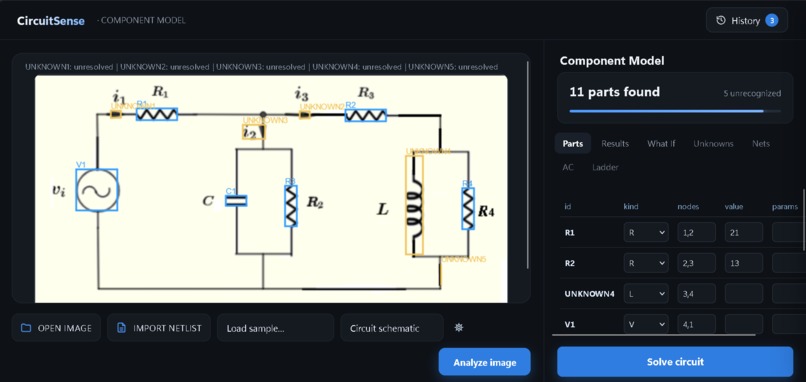
AC Analysis
-
Ladder Logic
Inspiration
As an electrical engineering student, I kept running into the same problem: when I wanted help understanding or analyzing a circuit, the most capable tools I could turn to were general-purpose LLMs. They can reason about circuits, but they were never really designed around the way electrical engineers work.
I wanted to build something different.
Instead of treating a circuit as just another image or asking a general AI to "figure it out," I wanted a tool that understands the circuit as an engineering model. CircuitSense was born from that idea: a circuit-focused workbench that can take circuit diagrams and turn them into structured electrical models that can actually be inspected and solved.
What it does
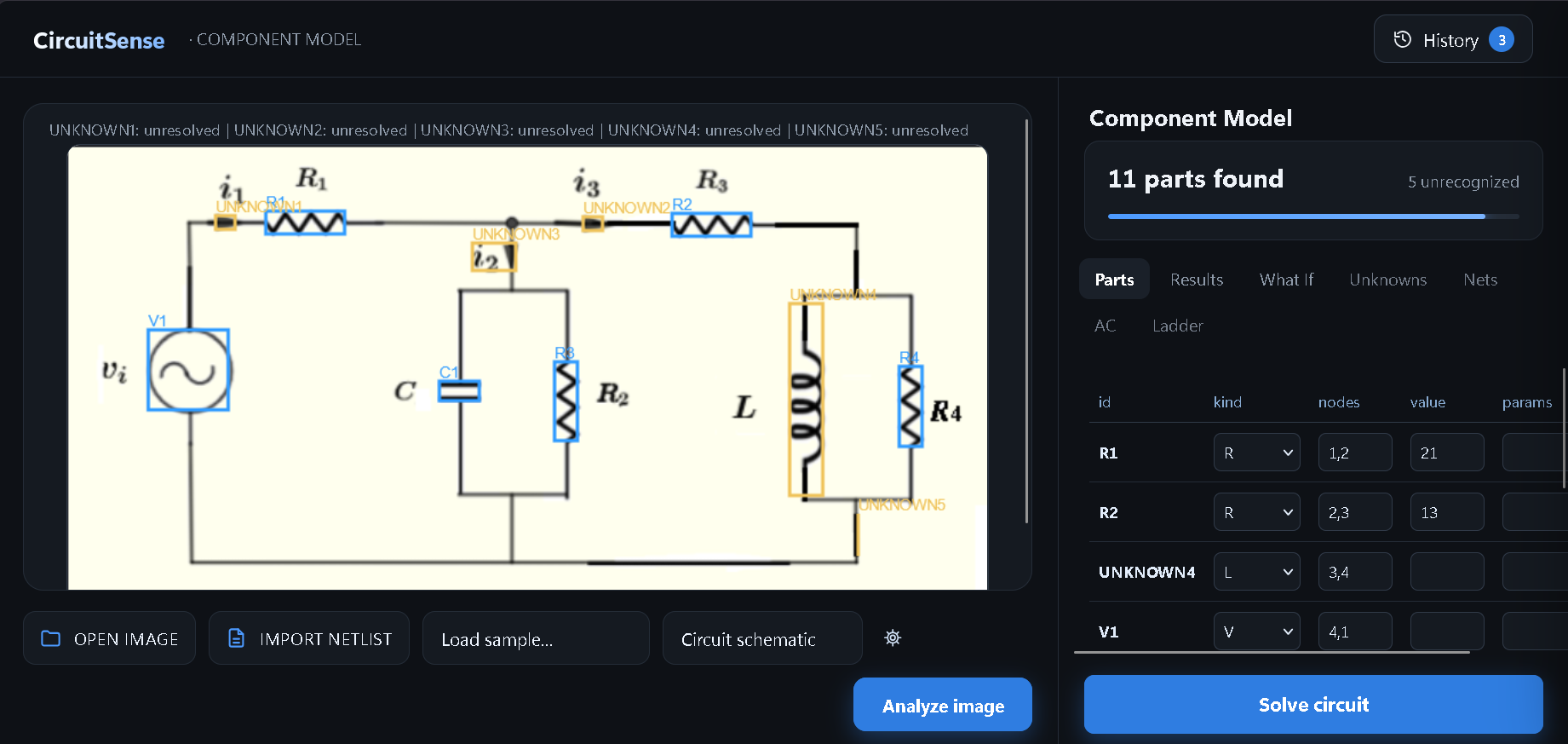
CircuitSense turns circuit diagrams into structured electrical models and provides an engineering workspace for analyzing them.
It is designed to:
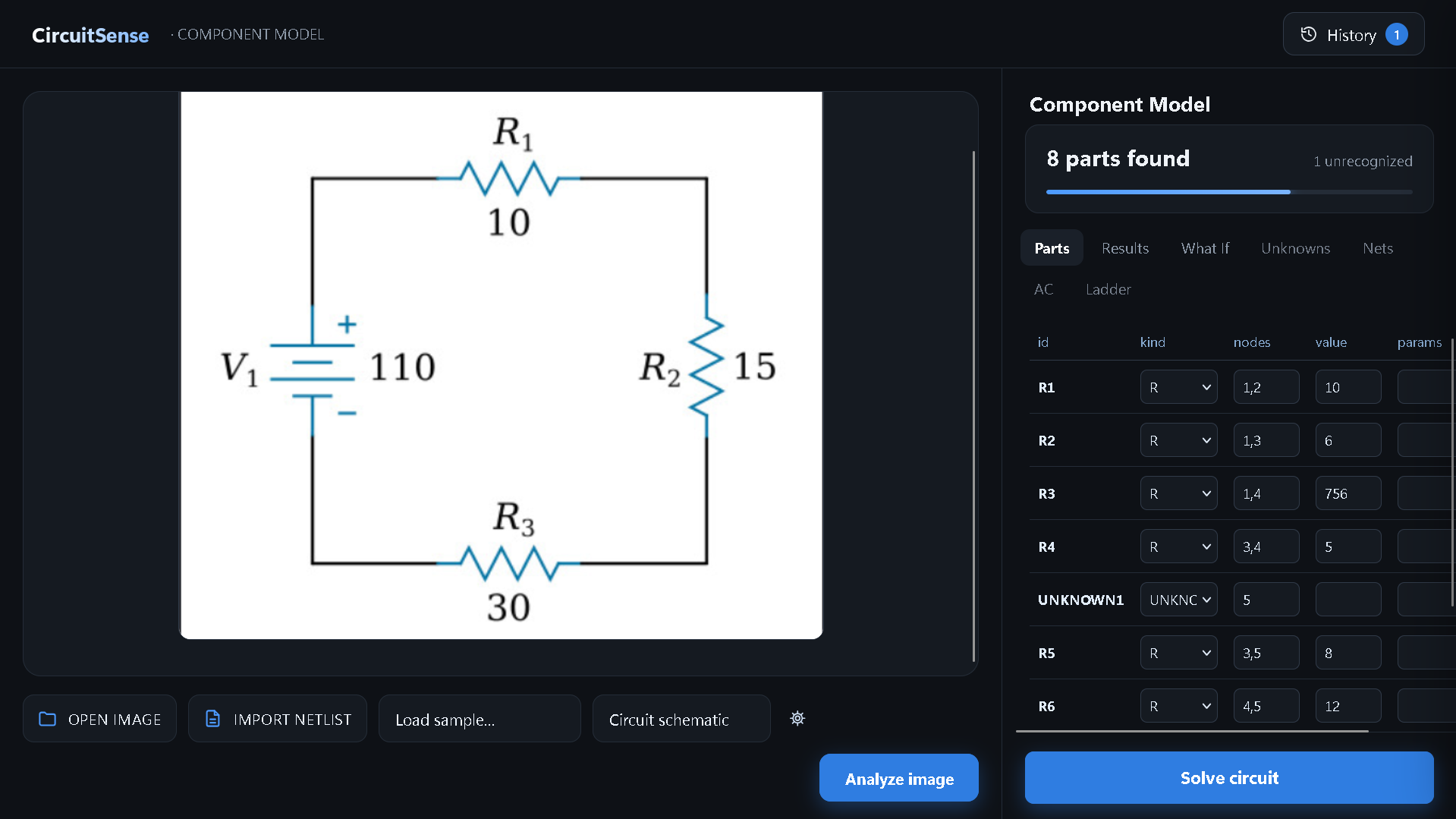
- Detect components and circuit structure from schematic images.
- Expose the detected electrical model so it can be inspected and corrected.
- Represent component values, nodes, connections, and nets explicitly.
- Perform deterministic circuit analysis rather than relying on an LLM to produce numerical answers.
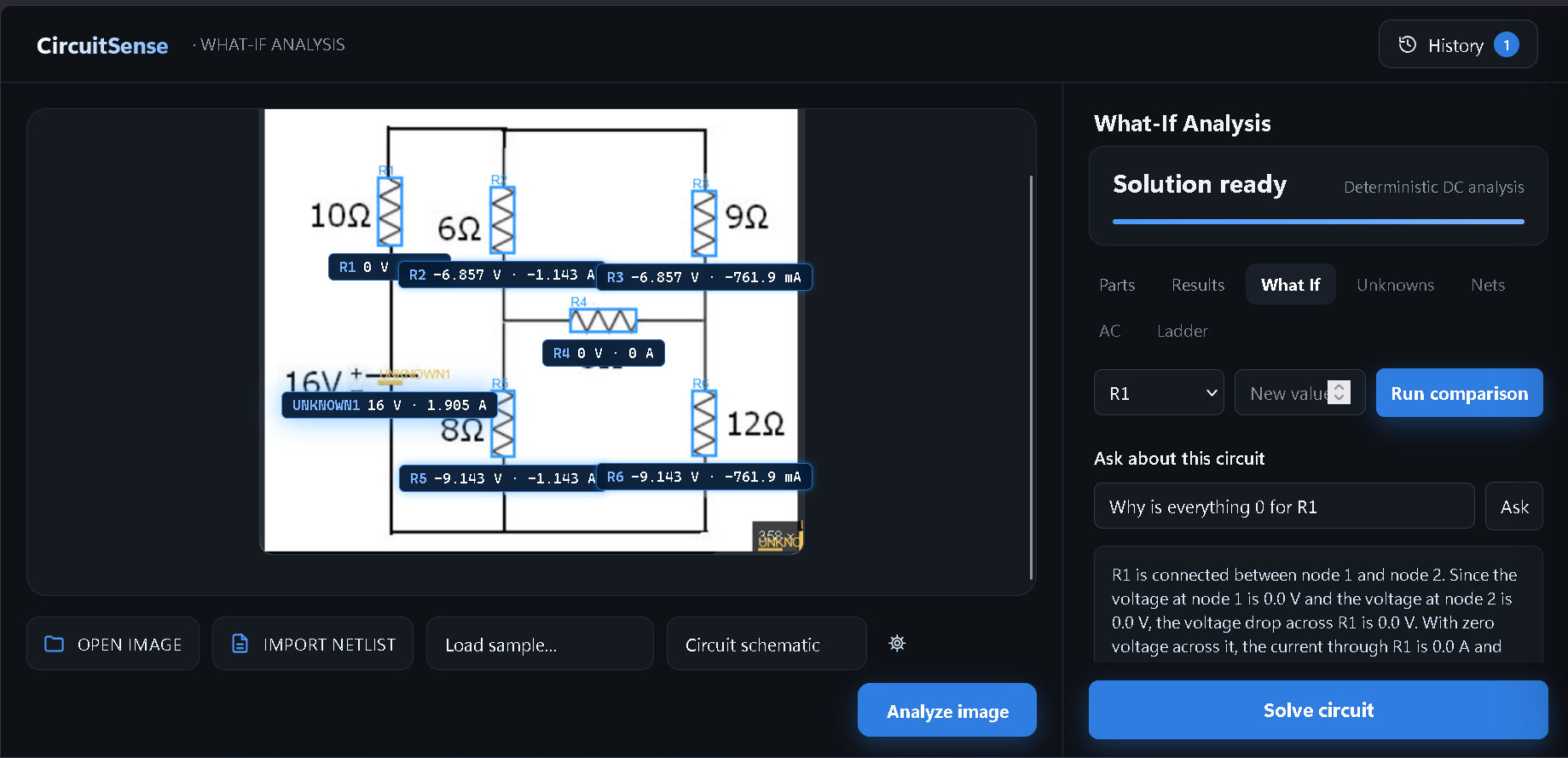
- Solve DC circuits and provide circuit results that can be inspected.
- Explore "what-if" changes to circuit parameters.
- Identify unknown or incomplete values that need to be resolved before solving.
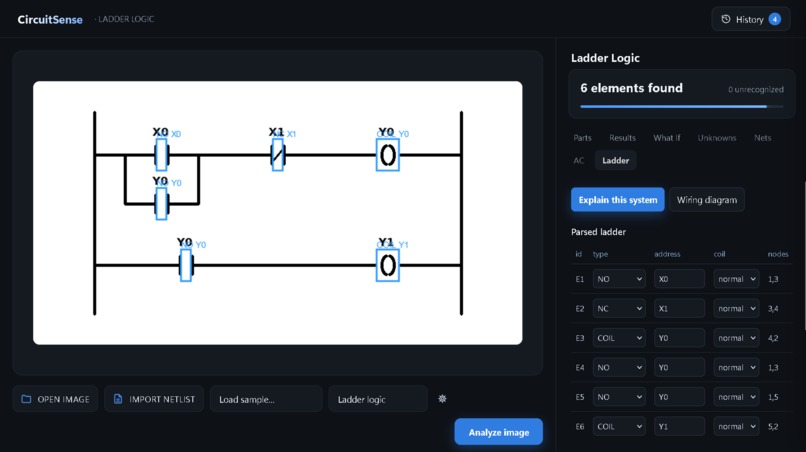
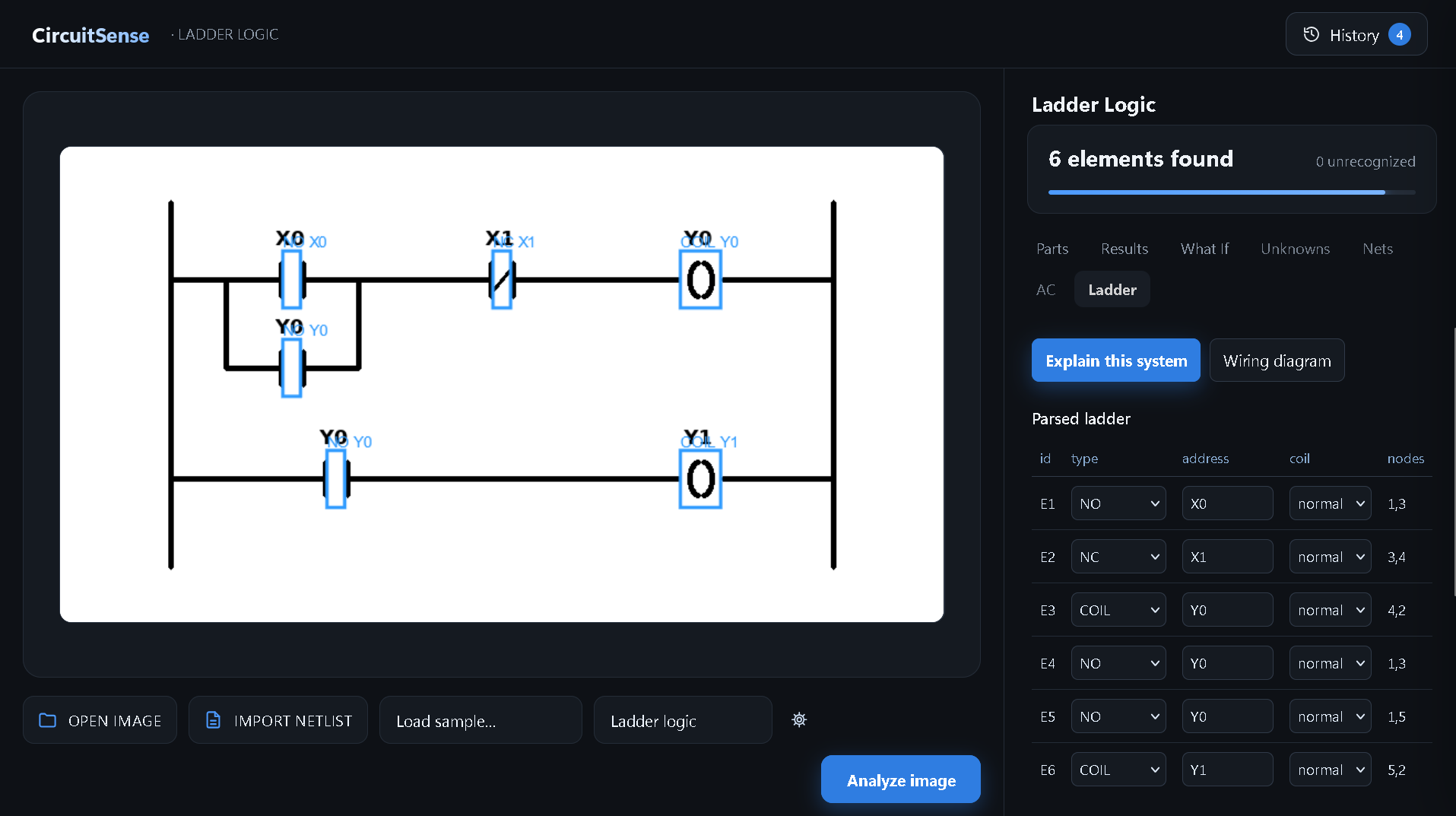
- Work with different electrical diagram types, including schematics and ladder logic.
- Support AC analysis and more advanced engineering workflows.
The goal is not simply to answer questions about circuits. It is to give engineers a tool that understands the circuit, exposes its model, and then does the engineering mathematics on that model.
How I built it
I built CircuitSense as a local engineering workbench with a separation between visual interpretation and deterministic analysis.
The image-processing side uses computer vision and OCR to extract useful information from circuit diagrams. That information is converted into a structured representation of components, nodes, connections, and circuit relationships.
The analysis side then operates on that structured model using deterministic electrical-engineering calculations rather than asking a language model to guess the result.
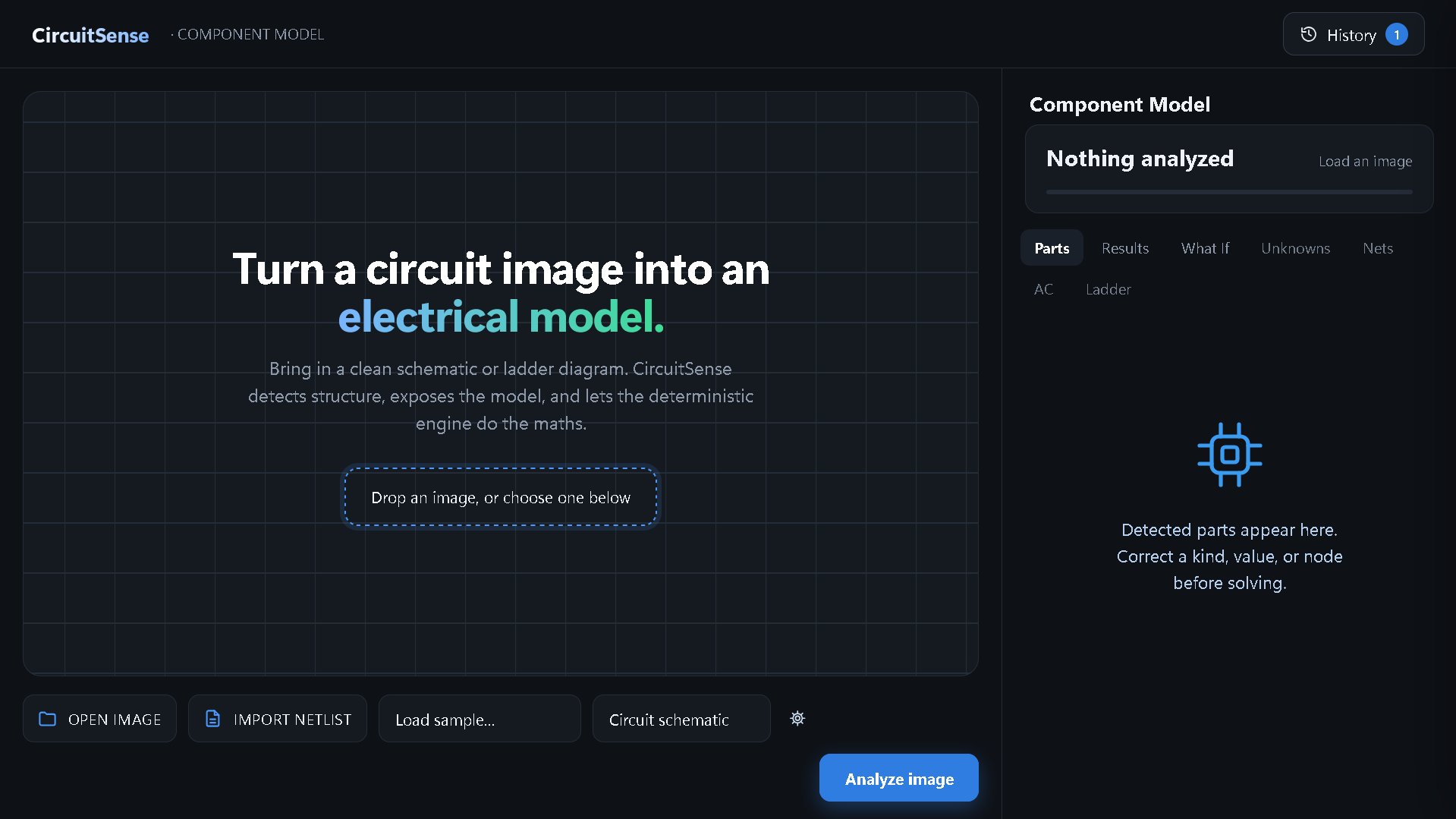
I designed the frontend as an engineering workbench where users can inspect detected components, examine connectivity and nets, investigate unknown values, run analysis, and explore different circuit conditions.
This architecture also leaves room for AI to be added later where it is genuinely useful—for example, improving difficult images or helping engineers interpret ambiguous information—without making AI responsible for the actual circuit mathematics.
Challenges I ran into
The biggest challenge was realizing that recognizing a circuit image is fundamentally different from solving a circuit.
A circuit diagram is a visual representation of an electrical system. Before any meaningful calculation can happen, the software has to determine what the symbols represent, where components are connected, which nodes belong together, and what values are available.
I also had to deal with incomplete or ambiguous diagrams, unknown component values, image quality, and the difficulty of turning visual information into a representation that a deterministic solver can use reliably.
Another challenge was resisting the temptation to make the entire system depend on an LLM. A language model can be useful for reasoning and interpretation, but numerical circuit analysis needs predictable, reproducible results.
Accomplishments that I'm proud of
I am proud that CircuitSense is more than a chatbot with a circuit prompt.
I built an actual engineering workbench around the circuit itself.
The system can take a circuit representation, expose its underlying electrical model, identify components and connectivity, and pass that structured model into a deterministic analysis workflow.
I am particularly proud of the separation between understanding the circuit and solving the circuit. This makes the results more transparent and gives the engineer an opportunity to inspect and correct the model instead of blindly trusting an AI-generated answer.
Most importantly, CircuitSense represents the beginning of a tool designed specifically around the workflow of an electrical engineer.
What I learned
I learned that circuit analysis is not just a problem of applying equations. Before Ohm's law, Kirchhoff's laws, or any solver can be useful, the software needs a reliable representation of the physical and logical relationships in the circuit.
I also learned that AI does not have to replace deterministic engineering software. In many cases, the strongest architecture is to use AI or computer vision where interpretation is difficult, then hand the resulting model to deterministic engineering algorithms where correctness matters.
Building CircuitSense also taught me how much complexity is hidden behind something that looks as simple as a circuit diagram.
What's next for CircuitSense
I intend to grow CircuitSense into a more complete electrical-engineering analysis environment.
Next, I want to improve diagram recognition and robustness, expand circuit-solving capabilities, strengthen AC analysis, improve support for ladder and control diagrams, and make the model-editing and verification workflow more powerful.
I also want to introduce AI selectively—not as the source of truth for circuit calculations, but as an engineering assistant that can help clarify ambiguous diagrams, explain results, improve difficult inputs, and answer questions about an already-structured circuit model.
The long-term vision is simple:
Give engineers a tool that can see a circuit, understand its structure, solve it, and help explain what that circuit is capable of doing.


Log in or sign up for Devpost to join the conversation.