
Inspiration
Learning circuits is easy when everything works. The harder part is understanding why something does not.
A reversed LED, an open connection, or a missing resistor can leave a beginner staring at a breadboard without knowing where to start. I wanted CircuitLens to make circuit debugging more visual and explainable by connecting the physical arrangement of a circuit to its electrical structure and the evidence behind a diagnosis.
What it does
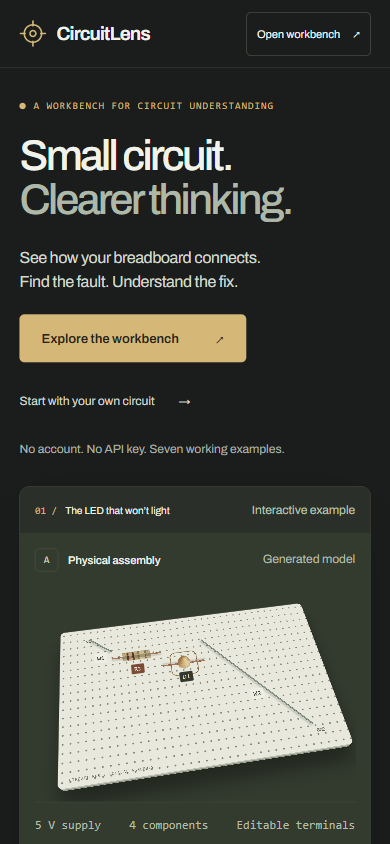
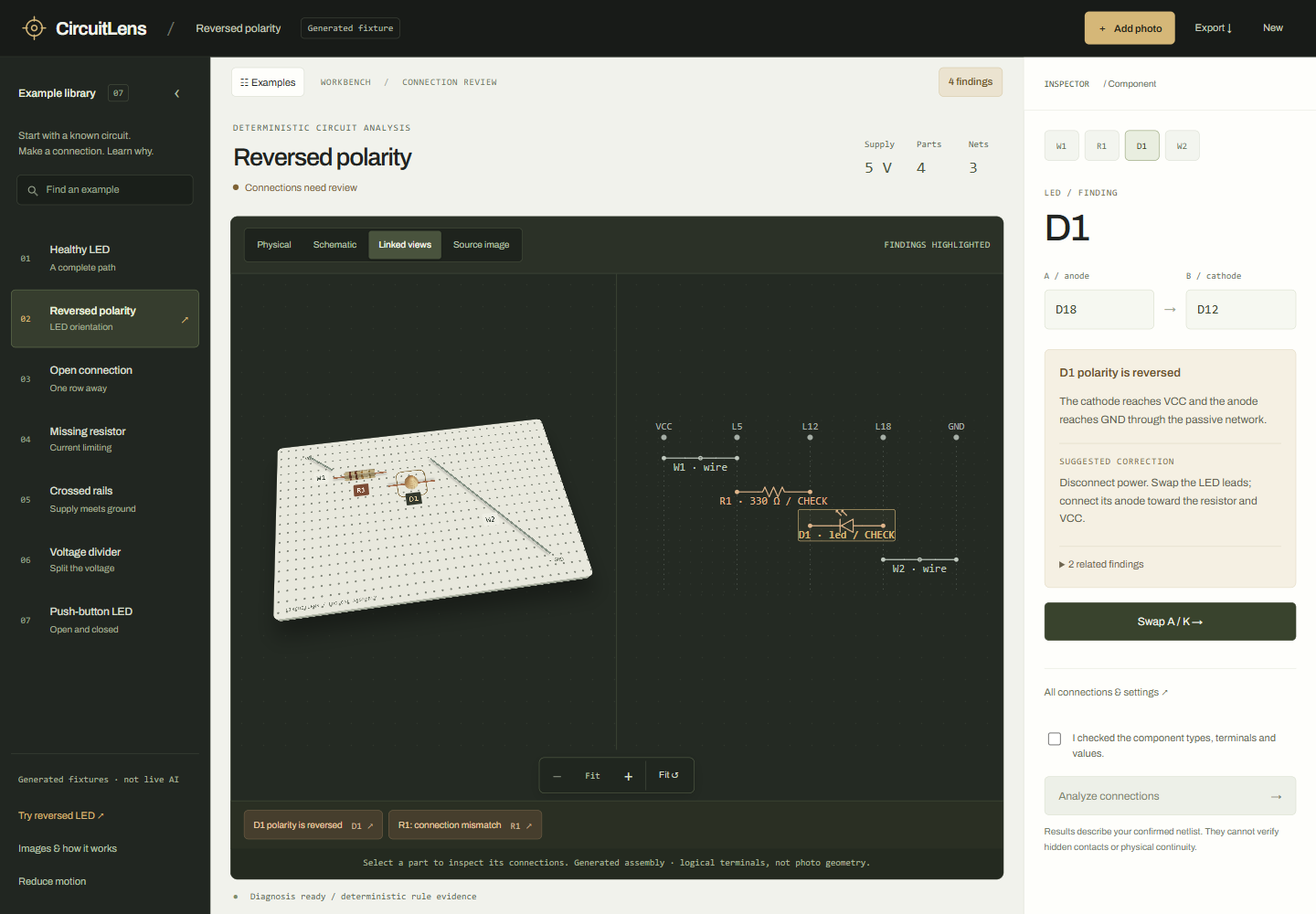
CircuitLens is an interactive circuit-analysis workbench that helps users trace connections, identify common faults, and understand how to correct them.
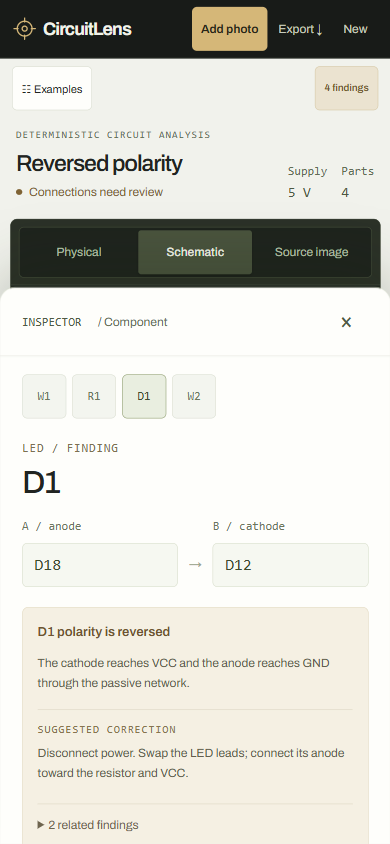
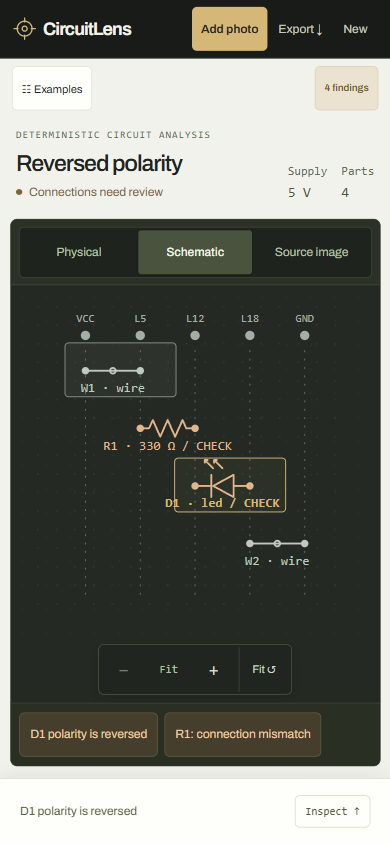
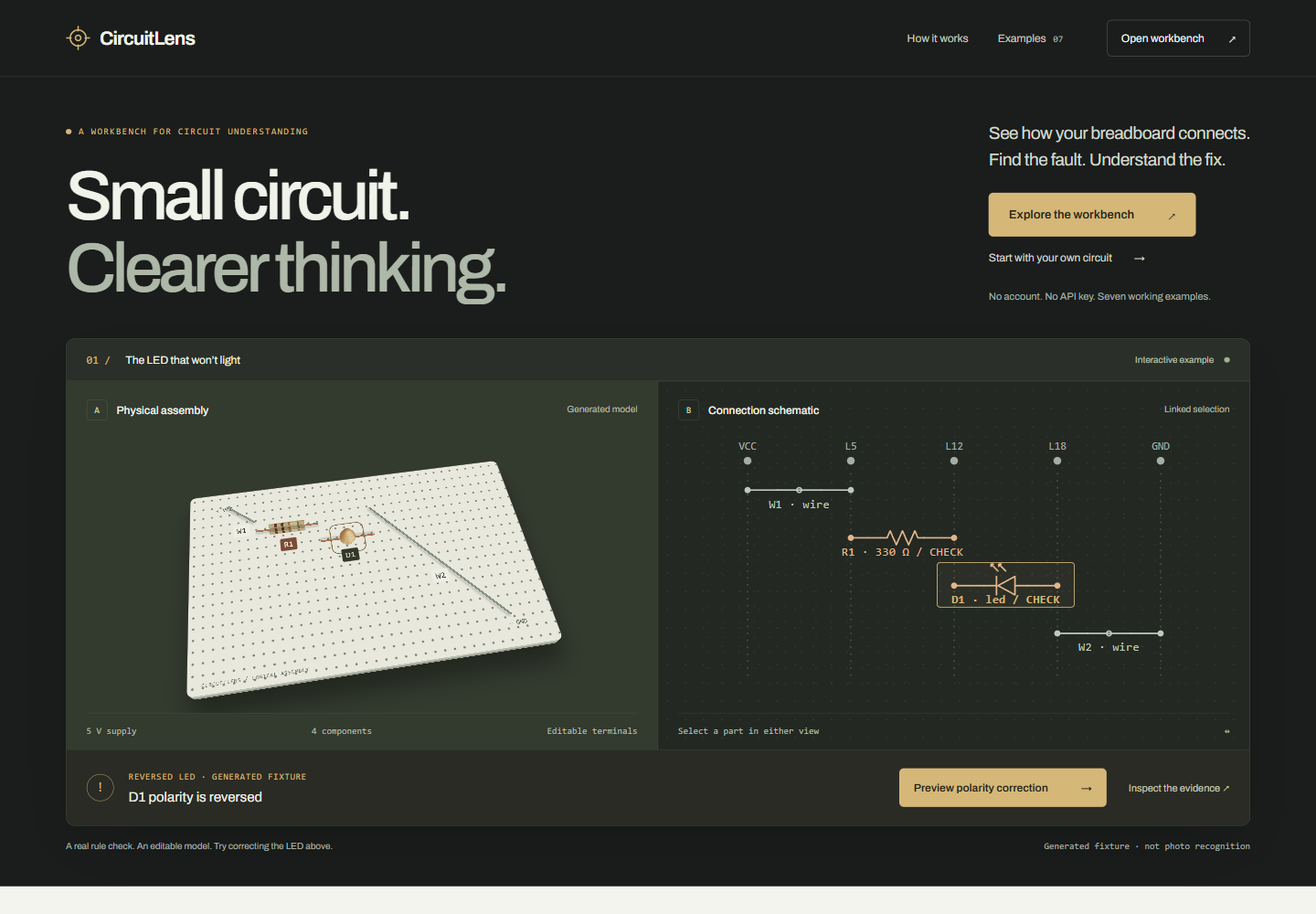
The application presents circuits through synchronized physical and schematic views. Selecting a component in one representation links it to the same component in the other, while the inspector explains its terminals, connectivity, and relevant diagnostic evidence.
CircuitLens currently includes seven verified circuit demonstrations:
- Healthy LED
- Reversed polarity
- Open connection
- Missing resistor
- Crossed rails
- Voltage divider
- Push-button LED
The analysis distinguishes passing circuits from circuits that require review or contain critical faults. For example, CircuitLens can identify a reversed LED, explain how its anode and cathode are connected, and show the corrective action before reanalyzing the circuit.
Users can also edit circuit information, inspect individual components, switch representations, zoom through the workspace, and export circuit data.
How I built it
CircuitLens was built as a browser-based engineering application using JavaScript, HTML, CSS, Node.js, and SVG-based circuit visualization.
The system separates the visual interface from a deterministic circuit-analysis engine. Rather than asking an AI model to invent a diagnosis, the verified demonstrations are analyzed using known circuit topology and explicit diagnostic rules.
The interface was designed around three ideas:
- See the circuit physically
- Trace the electrical connections
- Understand the evidence behind each finding
I also built responsive desktop and mobile workspaces, linked component selection, an inspector for diagnostic evidence, import/export tools, fault-correction interactions, and a seven-example library.
The production application is deployed on Render and the source is available publicly on GitHub.
Challenges
One of the hardest problems was translating a circuit into a representation that is both technically meaningful and understandable to someone still learning electronics.
Another challenge was photographic circuit recognition. I experimented with vision-model integration, including Gemini, but real breadboard photographs proved much harder than simple component recognition because reconstructing exact electrical connectivity requires identifying terminals, breadboard rows, hidden contacts, and ambiguous wires.
Testing on real photographs did not produce sufficiently reliable full reconstructions, so I chose not to present that experimental feature as production-ready. The public version instead focuses on the deterministic circuit-analysis workflow that can be verified.
Responsive design was another challenge because circuit diagrams that are readable on a desktop become extremely small on a phone. The mobile workbench therefore uses adapted layouts and a dedicated inspector rather than simply shrinking the desktop interface.
Accomplishments that I'm proud of
- Built seven working circuit-analysis demonstrations with deterministic diagnostic evidence
- Created synchronized physical and schematic circuit representations
- Added interactive component selection and fault correction
- Built a responsive engineering workbench for desktop and mobile
- Implemented circuit import/export and editable circuit data
- Deployed a working public version
- Reached 67/67 passing automated tests
- Completed production smoke testing across all seven demonstrations
- Maintained a $0 deployment and development-service budget for the public application
I am especially proud that CircuitLens clearly distinguishes what it can verify from what it cannot. The application does not pretend that generated examples are live AI measurements or that uncertain photographic connections are known.
What I learned
CircuitLens taught me that good engineering software is not just about producing an answer. It is about making the reasoning inspectable.
I learned a lot about representing electrical topology, designing interfaces around evidence instead of outputs, building synchronized visualizations, responsive interaction design, deployment, testing, and validating AI features before claiming that they work.
The failed photographic-recognition experiments were also useful. They showed me that recognizing visible objects and reconstructing an electrical circuit are very different problems.
What's next for CircuitLens
The next major step is improving real-circuit input.
Rather than asking one vision model to reconstruct an entire circuit in a single step, I want to separate the process into component detection, breadboard geometry recognition, connection reconstruction, electrical validation, and user confirmation.
I also want to expand the deterministic analysis engine to support more components, larger circuits, measurements, and additional educational explanations.
The long-term goal is for CircuitLens to become an interactive bridge between the circuit someone physically builds and the electrical model they need to understand.
Built With
- css3
- github
- html5
- javascript
- node.js
- render
- svg
Log in or sign up for Devpost to join the conversation.