Inspiration
What it does
How we built it
Challenges we ran into
Accomplishments that we're proud of
What we learned
What's next for CircuitFlow
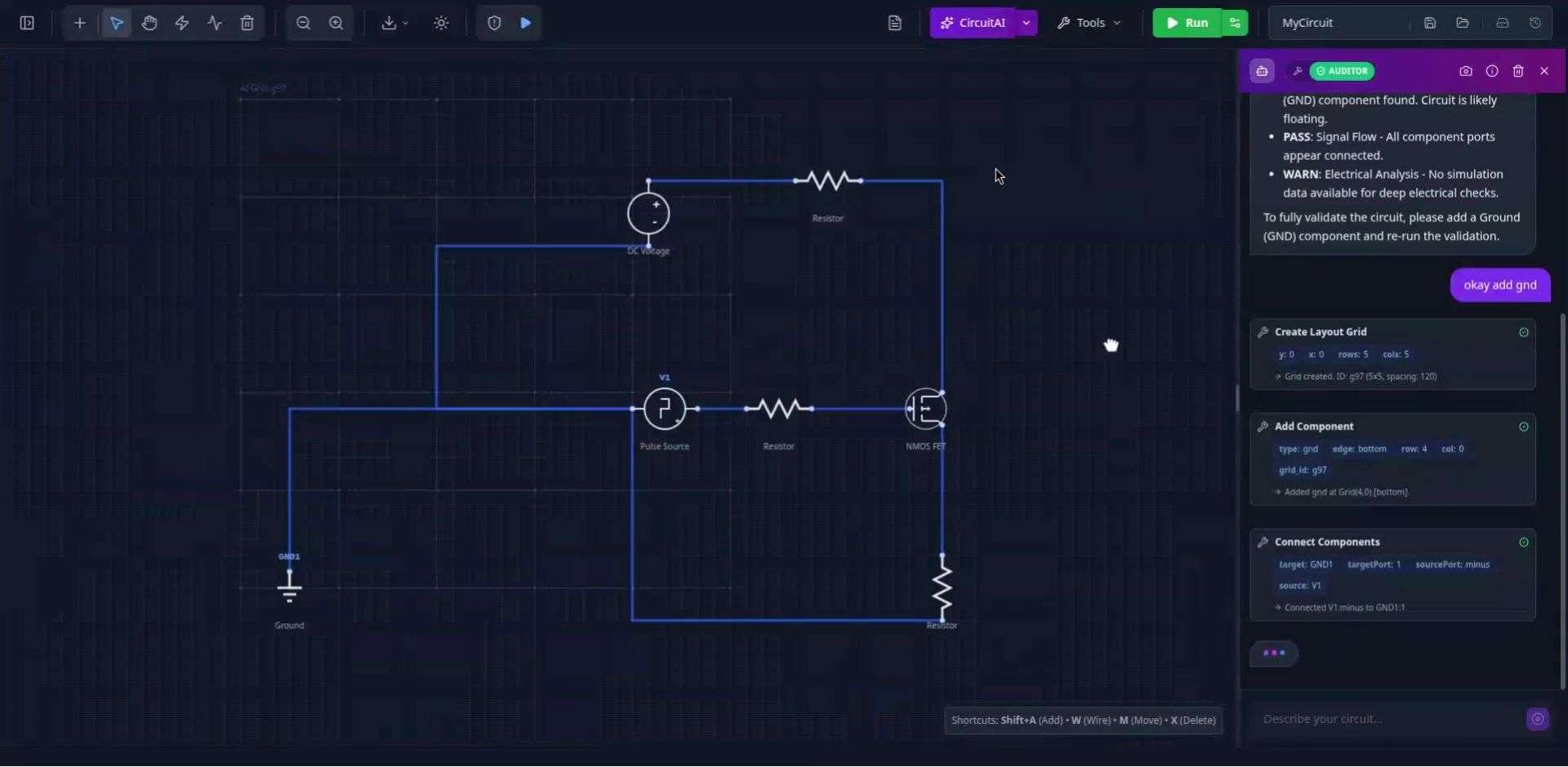
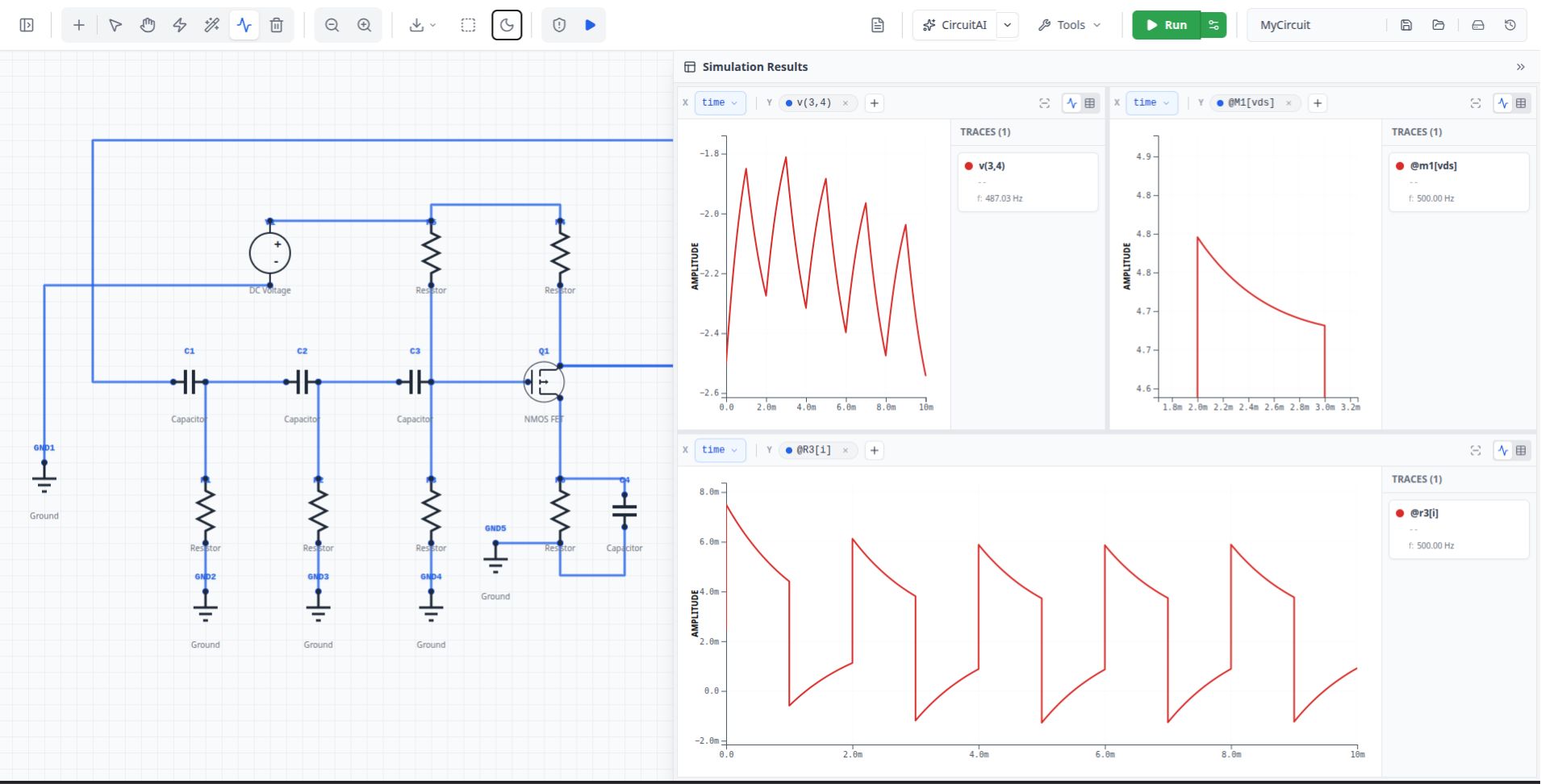
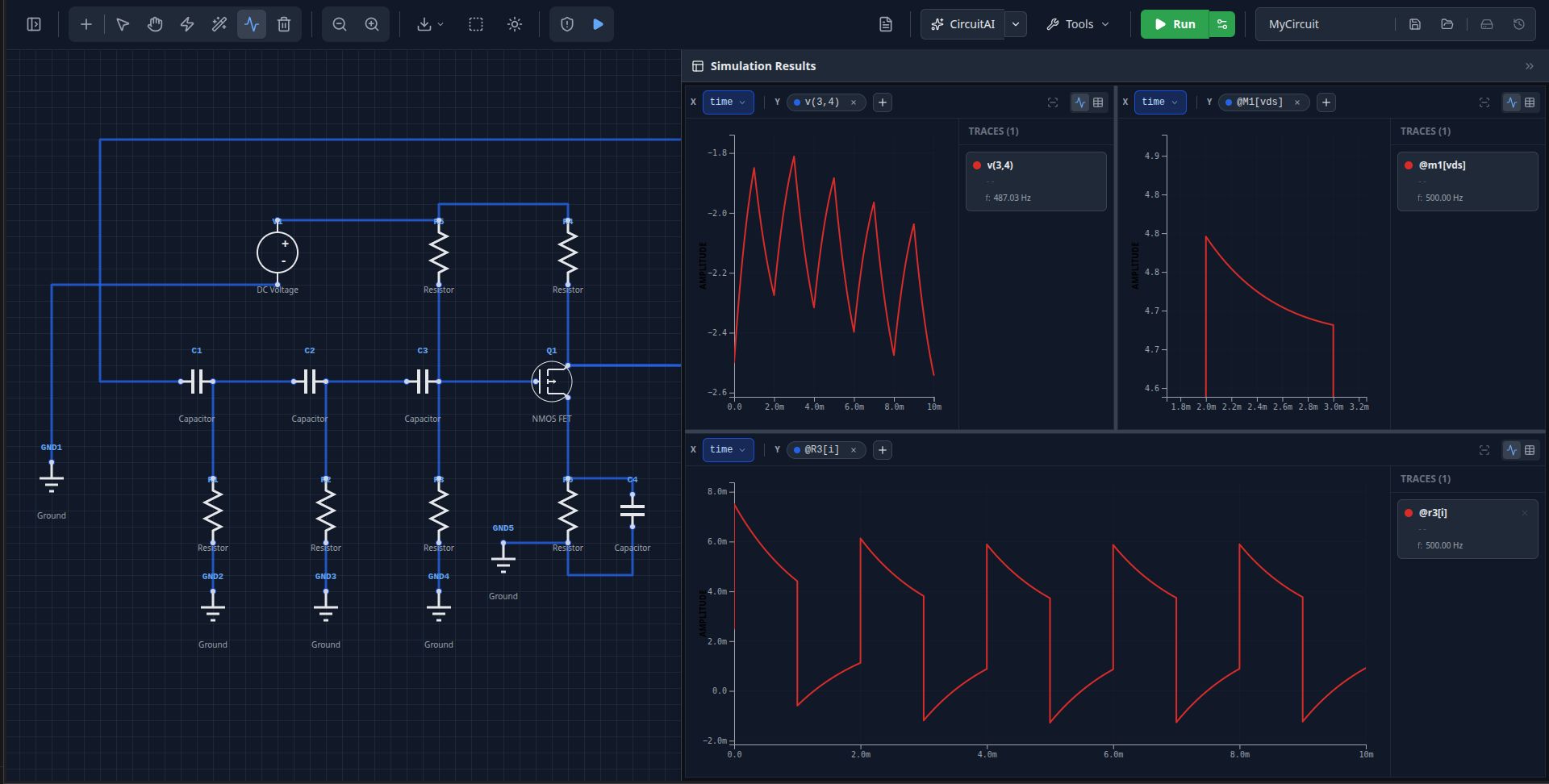
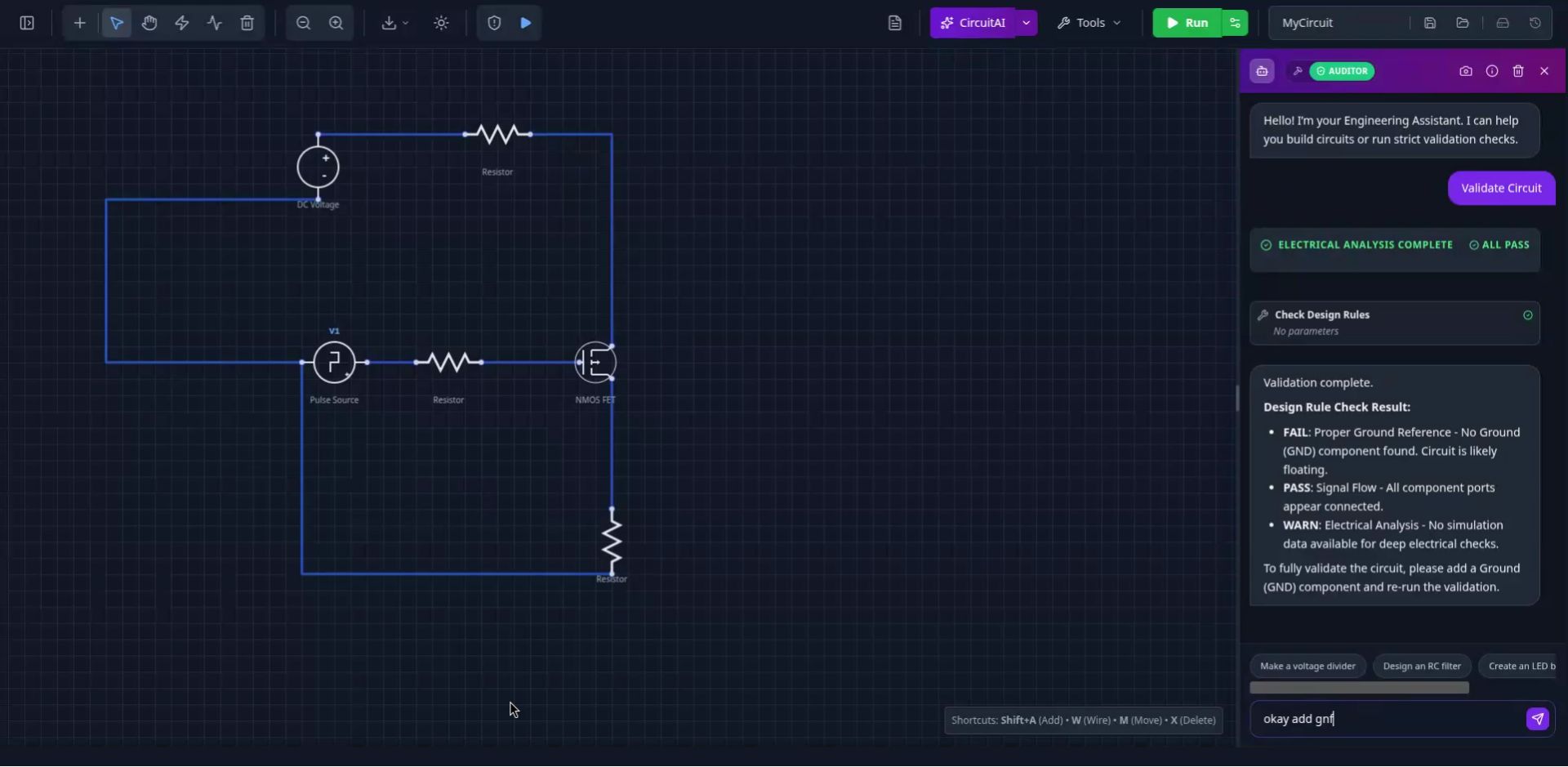
CircuitFlow: Project Story Team CircuitFlow February 1, 2026 Project Story Inspiration Hardware engineering is inherently unforgiving. Unlike software, there is no simple undo button—only costly mistakes and, at times, literal “magic smoke.” Traditional electronics workflows involve slow and rigid iteration cycles: design, assemble, test, and repeat. We were inspired by the rapid feedback loops present in software development and sought to bring that experience to electronics. Our goal was to create a platform where engineers could experiment freely, validate designs instantly, and gain confidence before building physical hardware. This motivation led to the creation of CircuitFlow, a browser-based, AI-assisted circuit simulator designed to make hardware design feel as safe and iterative as writing software. What it does CircuitFlow is a modern, web-based electronic circuit simulator and schematic capture tool. It combines: • An infinite schematic canvas, • Orthogonal auto-wiring, • A SPICE simulation engine compiled to WebAssembly, • And an integrated AI Engineering Agent. The platform enables users to: • Construct circuits using visual placement or natural language instructions, • Automatically route clean Manhattan-style interconnections, • Run realistic electrical simulations directly in the browser, • Analyze results using a virtual oscilloscope and data tables, • Validate and debug designs with AI-based reasoning. This transforms the workflow from: “Hope it works” → “I know it works.” 1 How we built it CircuitFlow is implemented as a full in-browser Electronic Design Automation (EDA) platform. Schematic Editor • Infinite Canvas: Supports unlimited panning and zooming for large-scale designs. • Orthogonal Auto-Wiring: Utilizes an A* pathfinding algorithm with Manhattan geometry to route wires around obstacles. • Smart Component Library: Includes passive components (R, L, C), sources (DC, Pulse, Current), and semiconductor devices (BJT, MOSFET, Diodes, Operational Am- plifiers). • Keyboard Shortcuts: Quick-add (Shift+A), Wire (W), Move (M), and Probe (P). SPICE Simulation • Browser-Based Engine: Runs ngspice directly in the browser using WebAssembly, requiring no backend server for simulation. • Analysis Modes: – Transient Analysis (.TRAN): Time-domain behavior. – DC Sweep (.DC): Parameter variation and response. – Operating Point (.OP): Static bias calculation. • Lab Workbench: Includes a virtual oscilloscope and data tables for waveform and numerical analysis. • Visual Probing: Interactive selection of nodes for voltage plots and components for current or power visualization. AI Co-Pilot (CircuitAI) • Powered by Google Gemini 3.0. • Translates natural language specifications into structured circuit topologies. • Performs Electrical Rule Checks (ERC) and Design Rule Checks (DRC). • Generates automated Markdown reports including pass/fail criteria, efficiency metrics, and datasheet references. • Employs multimodal vision by capturing canvas snapshots to detect layout and orien- tation issues. All computation is executed locally, ensuring low latency, privacy, and offline oper- ability. 2 Challenges we ran into • Porting a mature C-based SPICE simulator to WebAssembly while preserving numer- ical stability. • Designing a real-time auto-routing system capable of maintaining interactive frame rates. • Enforcing physical and electrical constraints on AI-generated circuit designs. • Balancing simulation accuracy with browser performance. • Integrating multimodal reasoning into circuit validation workflows. Accomplishments that we’re proud of • Successfully executing true SPICE physics inside a web browser. • Achieving real-time orthogonal wire routing. • Creating an AI assistant that understands electrical connectivity and topology. • Delivering an integrated design, simulation, and validation environment. • Publishing the platform as fully open-source. What we learned • Hardware workflows can benefit significantly from software-style iteration loops. • Browser-based engineering tools can reach near-desktop performance levels. • AI systems become reliable when constrained by domain-specific physical laws. • Usability is as important as numerical correctness in engineering tools. • Innovation emerges from the intersection of physics, artificial intelligence, and user experience. What’s next for CircuitFlow • Integration of AC and noise analysis modes. • AI-driven circuit optimization and fault injection. • PCB layout export and manufacturing pipeline support. • Real-time collaborative circuit editing. • Expansion of virtual laboratory instruments (logic analyzers and spectrum analyzers). CircuitFlow aims to become the VS Code of Hardware Engineering.
Built With
- c
- css
- frameworks
- javascript
- ngspice
- react
- state
- tailwind
- typescript
- vite
- wasm)
- web
- webassembly
- zustand

Log in or sign up for Devpost to join the conversation.