

The Story of CircuitMind
The Spark of Inspiration
As a Computer Engineering student at the University of Lagos, I spent countless hours in the lab squinting at breadboards and cross-referencing datasheets. The "Aha!" moment came during a particularly frustrating session with a BJT amplifier circuit. I realized that while software developers have AI pair programmers, hardware enthusiasts are often left to debug complex physical layouts manually. I wanted to build a "Lab Partner" that could see what I see and understand the physics behind the wires—moving from abstract theory to embodied hardware reasoning.
How I Built It
The architecture of CircuitMind is designed to bridge the gap between visual input and technical execution by leveraging the Google AI stack:
- The Brain: I utilized Google AI Studio to leverage multimodal LLMs, enabling the app to "read" circuit diagrams and analyze video feeds of physical hardware.
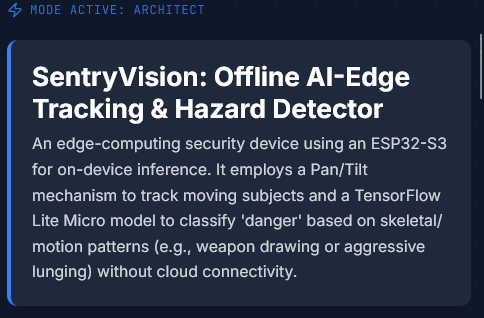
- Edge-AI Integration: In my latest iteration, I expanded the scope to include Edge-AI Autonomous Tracking. The system generates roadmaps for an ESP32-S3 with PSRAM to run TinyML models (TFLite Micro) for real-time person detection.
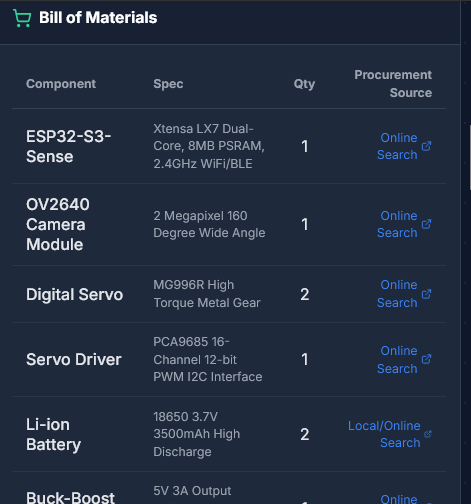
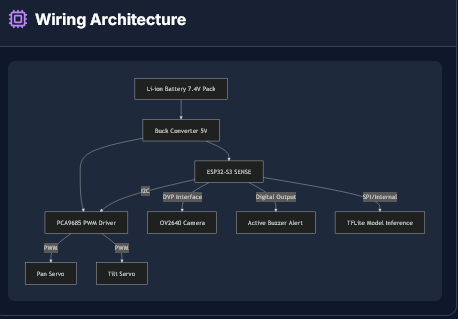
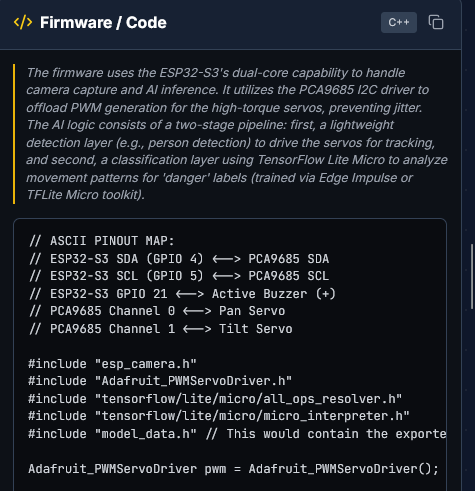
- The Interface: CircuitMind generates a complete engineering roadmap, including a Bill of Materials, wiring architectures for components like the OV2640 camera, and C++ firmware utilizing hardware interrupts for power efficiency.
Challenges Faced
The most significant hurdle was Multimodal Accuracy in "messy" real-world environments. Teaching an AI to distinguish between a jumper wire and a trace in low-light breadboard photos required precise "Chain-of-Visual-Thought" prompting.
Additionally, ensuring mathematical rigor was essential so the AI wouldn't "hallucinate" engineering values. For instance, when designing a Chebyshev filter for signal conditioning, the system must validate the transfer function:
$$|H(j\Omega)| = \frac{1}{\sqrt{1 + \epsilon^2 C_n^2(\Omega/\Omega_c)}}$$
Similarly, for the BJT-based alert triggers in the threat detection system, it must accurately calculate the voltage gain $A_v$:
$$A_v = - \frac{h_{fe} R_C}{h_{ie} + (1 + h_{fe}) R_E}$$
What I Learned: From LLM to LWM
This project represents a critical evolution in my understanding of Artificial Intelligence. I have moved beyond the paradigm of Large Language Models (LLMs), which operate primarily on linguistic probability, to Large World Models (LWMs). Unlike traditional models, an LWM requires a "visual nervous system" to perceive, reason, and validate physical reality in real-time.
By deploying TinyML on the edge—specifically utilizing the ESP32-S3 to run TFLite Micro—I learned how to ground AI in the physical world. CircuitMind demonstrates that when AI is given the capacity for embodied reasoning, it transforms from a text generator into a powerful laboratory assistant that understands the spatial and electrical context of a circuit. This shift is essential for the future of Embodied AI, where the model must navigate the complexities of hardware design and real-world physics.


Log in or sign up for Devpost to join the conversation.