-
-
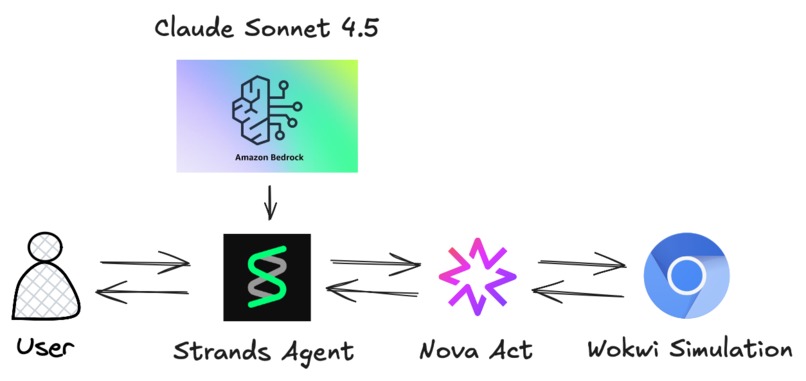
Architecture Diagram
Inspiration
Watching beginners stall on the first mile—IDE installs, wiring guesswork, wrong resistor values. We wanted “describe it → get working code + circuit” so more people actually build and learn electronics
What it does
Turns plain-English prompts into Arduino code and a Wokwi-ready diagram.json, with basic safety checks (polarity, resistor sizing) and an optional live run in the browser.
How I built it
Stack & architecture
- AWS Bedrock (Claude family) for planning, code gen, and diagram synthesis.
- Strands Agents to orchestrate two specialists:
- Circuit Designer → structured diagram.json
- Arduino Programmer → sketch.ino
- AWS Bedrock AgentCore to package and deploy the agent runtime.
- Nova Act for live browser actions (useful for Wokwi/Tinkercad flows and verification).
- Wokwi as the simulation target for instant feedback.
Workflow
- Natural-language prompt → planning step (components, pins, safety checks).
- Circuit Designer emits diagram.json (schema-validated).
- Arduino Programmer emits Arduino code (compiles & runs in Wokwi).
- Nova Act opens Wokwi, pastes artifacts, and runs the sim.
- Return artifacts + whether the simulation works or not.
Challenges I ran into
- Getting deterministic, correct pin mappings and grounds in
diagram.json - Handling browser automation quirks (logins, timing, copy & paste)
- Live View for web deployment
Accomplishments that I'm proud of
- Able to use AI for creating and simulating electronic circuit
What I learned
- Structured output formatting is crucial for agentic workflow
- Human-in-the-loop helps in agentic AI use cases
What’s Next
- Web application with live view of circuit building and simulation
- Fine-tune the model to enable the creation of more complex circuits
- Work with other simulation software such as circuitjs and fritzing
Built With
- agaentcore
- amazon-web-services
- bedrock
- nova
- playwright
- python
- strands-agent
- wokwi

Log in or sign up for Devpost to join the conversation.