-
-
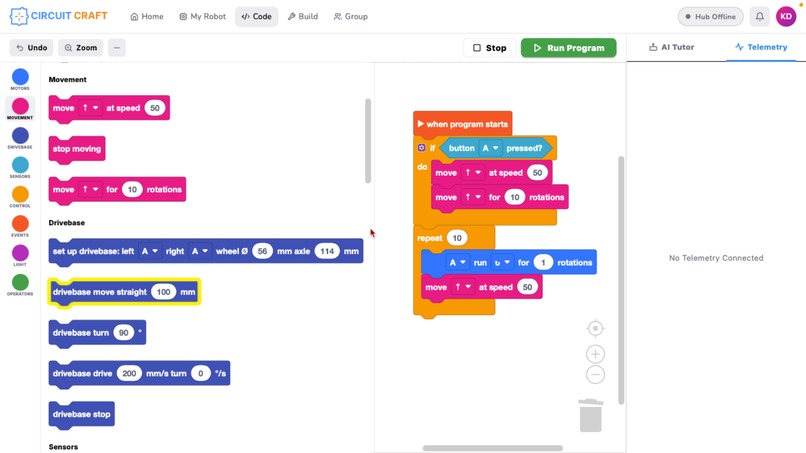
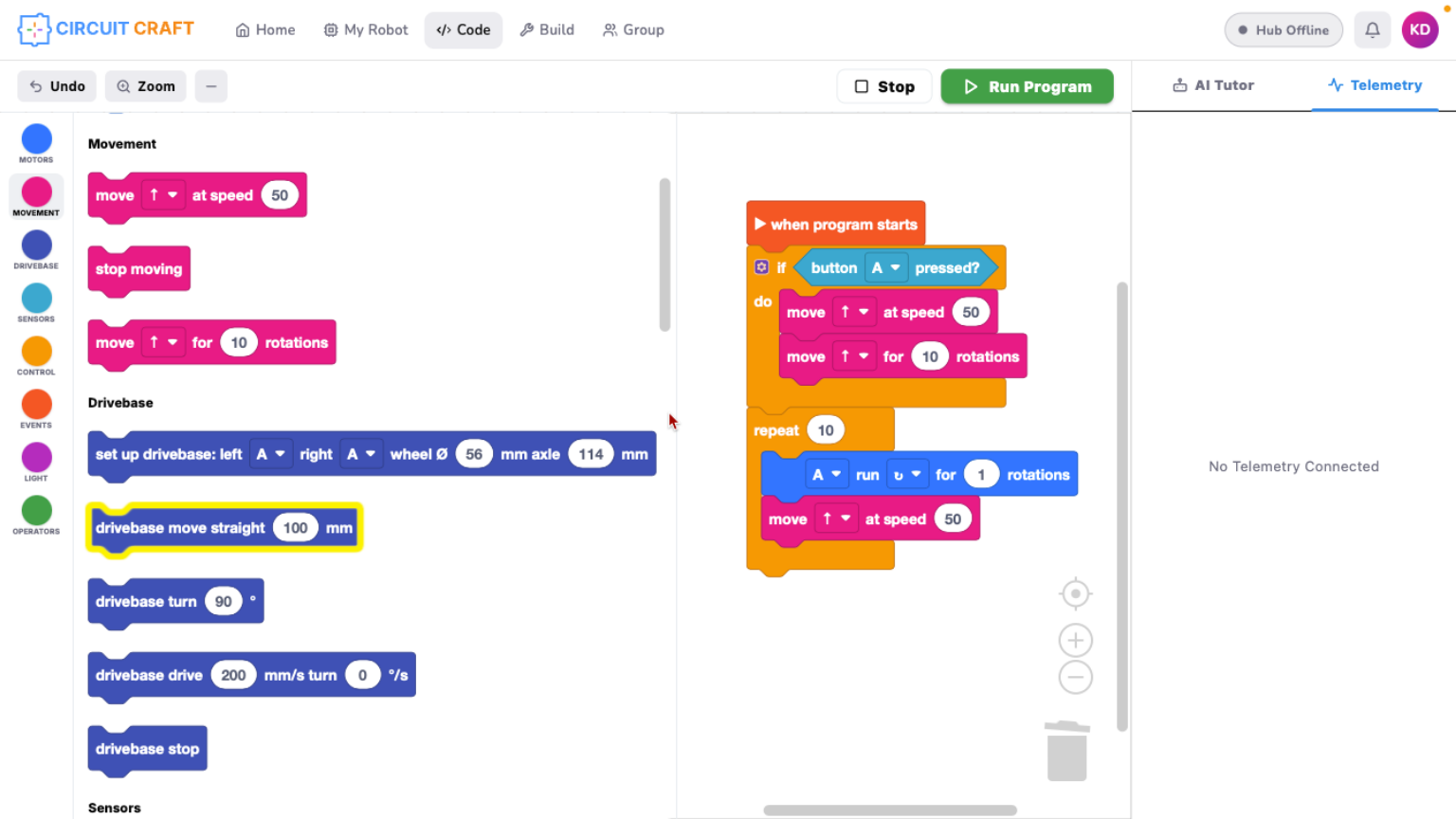
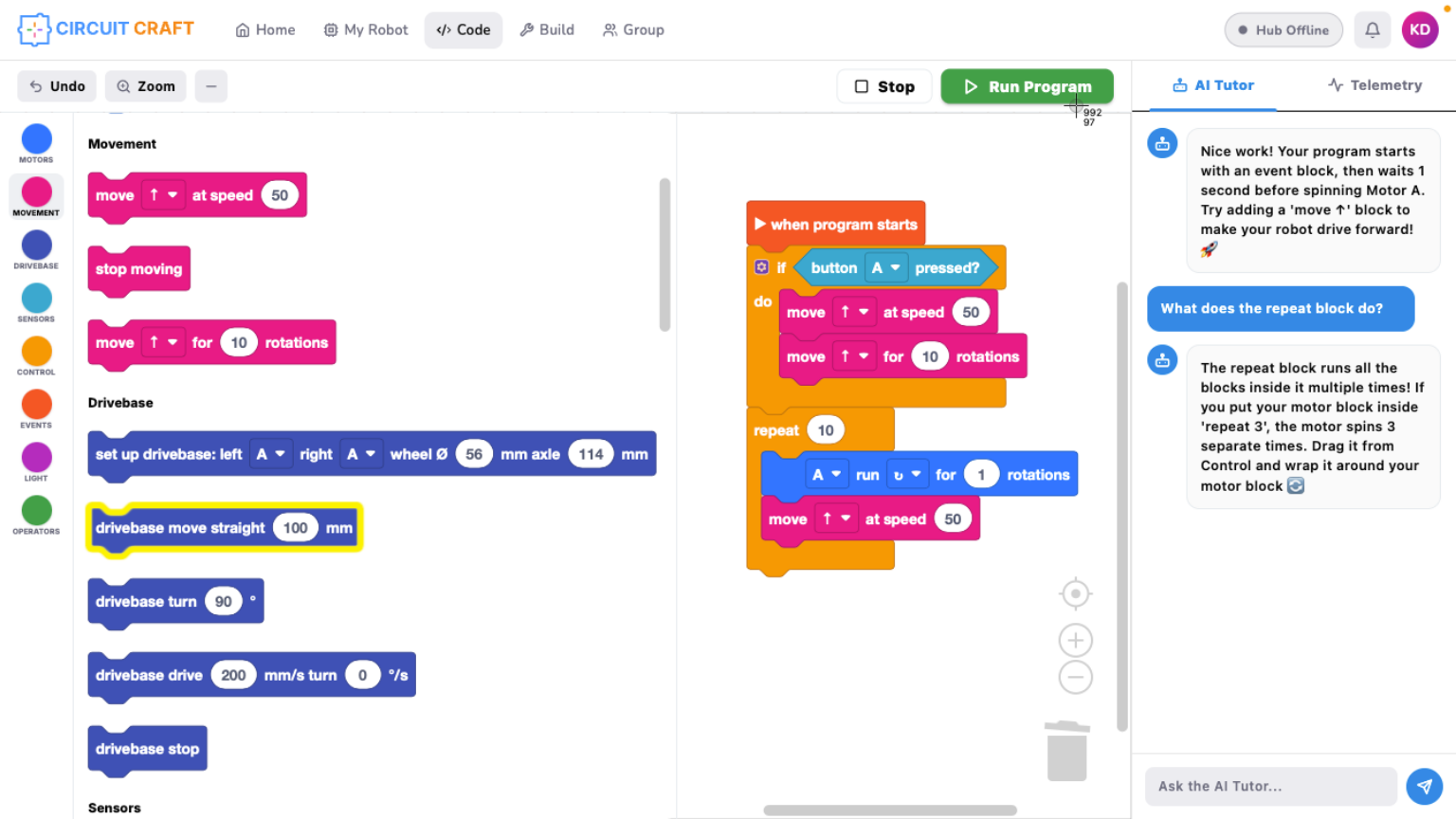
A build-and-code IDE
-
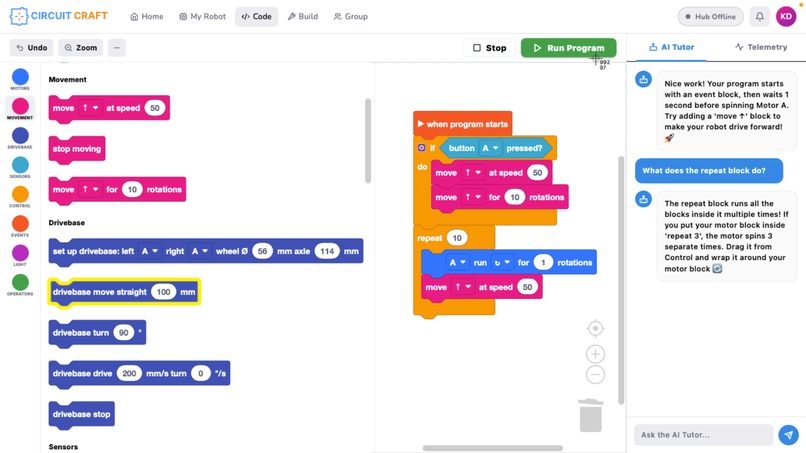
A local AI tutor
-
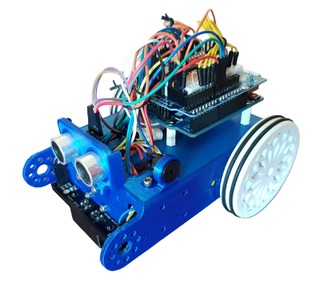
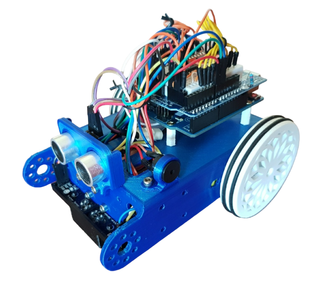
CircuitBot_Prototype
Inspiration
Robotics education in Nigeria is priced for a market that doesn't exist here. Kits like LEGO SPIKE Prime and VEX cost roughly six to eight times what most Nigerian schools, or even STEAM-focused nonprofits, can justify per unit. That means the students who'd benefit most from hands-on hardware learning never touch a real robot: they get slides, or at best a simulator. Working at Coderina Education & Technology Foundation put that gap right in front of us. Coderina's mission is to teach STEAM to Nigerian students, but there was no affordable, locally-buildable hardware to teach it on. CircuitCraft started as a question: what would robotics education look like if the hardware cost was Africa-appropriate from day one, instead of an imported product with a local price tag stapled on?
What it does
CircuitCraft is an AI-powered hardware IDE for beginner electronics builders. Students drag and snap blocks together in a visual coding editor, and that same block set runs on two different kinds of hardware: a widely available LEGO robotics kit, and our own robot, CircuitBot. An onboard AI tutor reads live sensor and motor data streamed back from the robot, so students get real-time feedback on their code while it's actually running on physical hardware, not just in a simulator.
How we built it
The app was built on Flutter to run on desktop, web, and tablet, with a shared design system so it looks and behaves consistently everywhere.
CircuitBot is the hardware half of the answer to the cost problem. Instead of designing a robot chassis from zero, we built on an existing open-source robot design and wrote our own firmware for it, so it can stream real sensor and motor data back to the AI tutor while it runs. Every component choice, down to the motor driver and power wiring, got filtered through one question: can this be bought or fabricated in Lagos? Where 3D-printed parts are needed, we're also pursuing a recycled-plastic-to-filament pipeline, turning plastic waste into the print material for the robot's own housings.
Challenges we ran into
The one thing that was genuinely difficult was getting the software to reliably talk to the robot's onboard ESP32 chip over Bluetooth. Our first approach kept dropping connections and behaved inconsistently across devices. We ended up switching to the universal_ble package, which gave us a much more stable and consistent Bluetooth connection across platforms, and that fix ended up being the thing that made live, real-time feedback from the robot actually usable in the classroom.
Accomplishments that we're proud of
We're proud of getting a single codebase to run cleanly across desktop, web, and tablet while still talking to real hardware over Bluetooth. We're proud of designing CircuitBot so that every part of it, from components to fabrication, can actually be sourced or made in Lagos. And we're proud of pressure-testing our own pitch: rather than assuming AI added value, we checked whether the block-coding tools schools already use let students test code without physically connecting a robot. They don't. That finding gave us a real, defensible reason for the AI tutor to exist.
What we learned
Getting an app to talk to real hardware is a lot harder than building a normal app. We had to handle Bluetooth connections, flashing programs onto the robot, and reading live sensor data back, and every device behaved a little differently. That taught us that "it just works everywhere" mostly holds for screens and interfaces, not for physical hardware.
We also learned that running AI fully offline, on the device itself with no internet connection, is a different discipline from calling an AI service online. We had to think carefully about how much a small offline model can actually handle, since reliable internet can't be assumed in a lot of Nigerian school environments.
Judges want justification, not just novelty. We found out that we hadn't clearly proven why AI added value over the block-coding tools schools already use. That pushed us to actually check: do those existing tools let students test their code without physically connecting a robot? They don't. That single finding changed how we explained the AI tutor's value.
What's next for Circuit Craft
Building a full curriculum around CircuitCraft so schools can teach robotics affordably end-to-end, not just hand students a cheaper kit.
Built With
- ble
- blockly
- dart
- esp32
- flutter
- javascript
- micropython
- python


Log in or sign up for Devpost to join the conversation.