-
-
Mainpage
-
Inspiration
Community savings groups help millions of people save together, access small loans, and support one another. But running a group meeting still creates a surprising amount of administrative work.
During a single meeting, someone may need to record attendance, contributions, loan repayments, new loan requests, fines, expenses, corrections, decisions, and action items. Afterward, the secretary or treasurer still has to reconcile the records, prepare minutes, update balances, and remember who needs to do what next.
Most digital savings-group tools focus on digitizing the ledger.
CircleScribe starts one step earlier:
What if the meeting itself could become the input to the system?
Instead of requiring a secretary to reconstruct everything manually after the meeting, CircleScribe listens to what happened and turns the conversation into structured, verified work.
The idea is simple:
Record the meeting once. Let the agent handle the administrative work that follows.
What it does
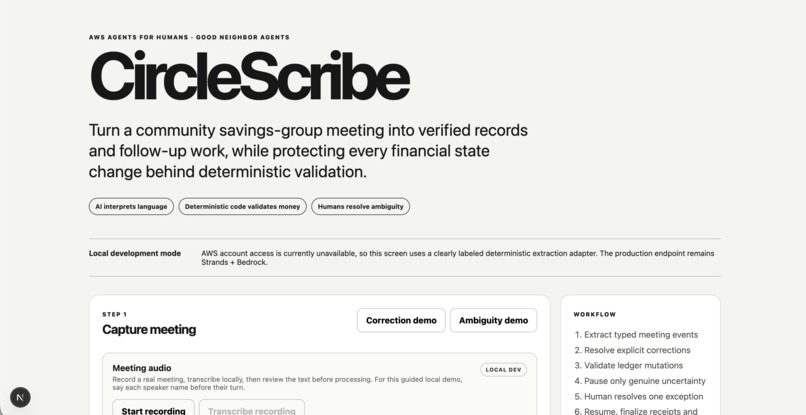
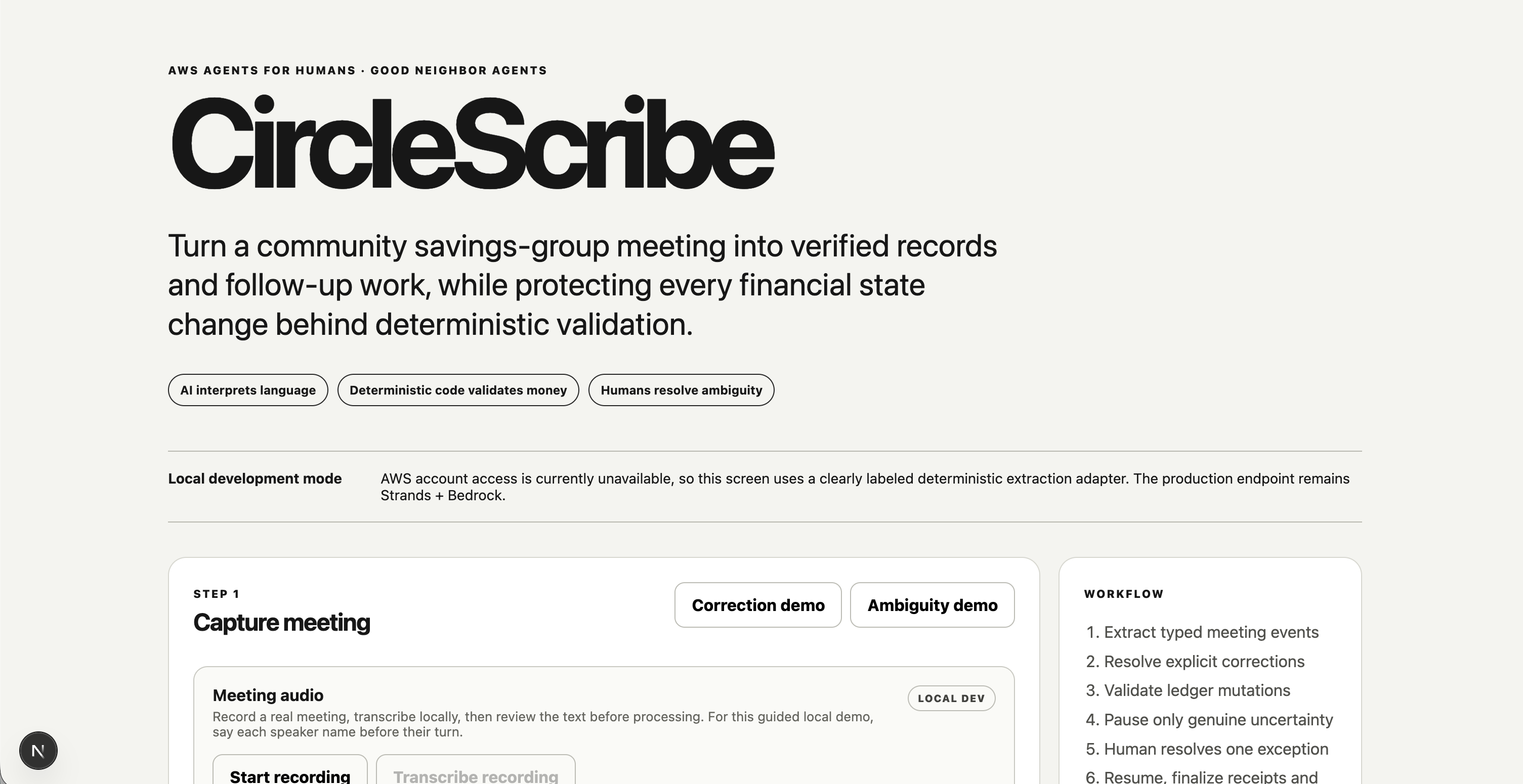
CircleScribe is an AI-powered autonomous meeting secretary for community savings groups.
A group records its meeting, and CircleScribe processes the conversation end-to-end.
It can identify and structure events such as:
- attendance
- member savings contributions
- loan repayments
- new loan requests
- fines
- group expenses
- corrections
- decisions
- action items
CircleScribe then checks those extracted events against the group's existing records.
Routine events can move through the workflow automatically.
Potential contradictions, duplicate transactions, uncertain member identities, or ambiguous amounts are surfaced for human review instead of being guessed.
For example, a member might initially say:
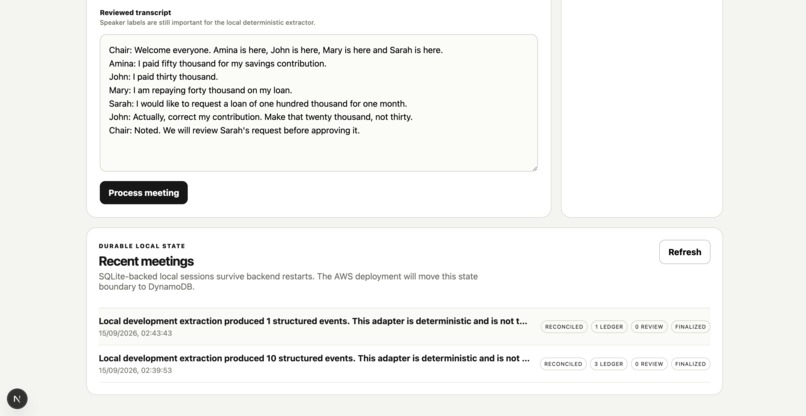
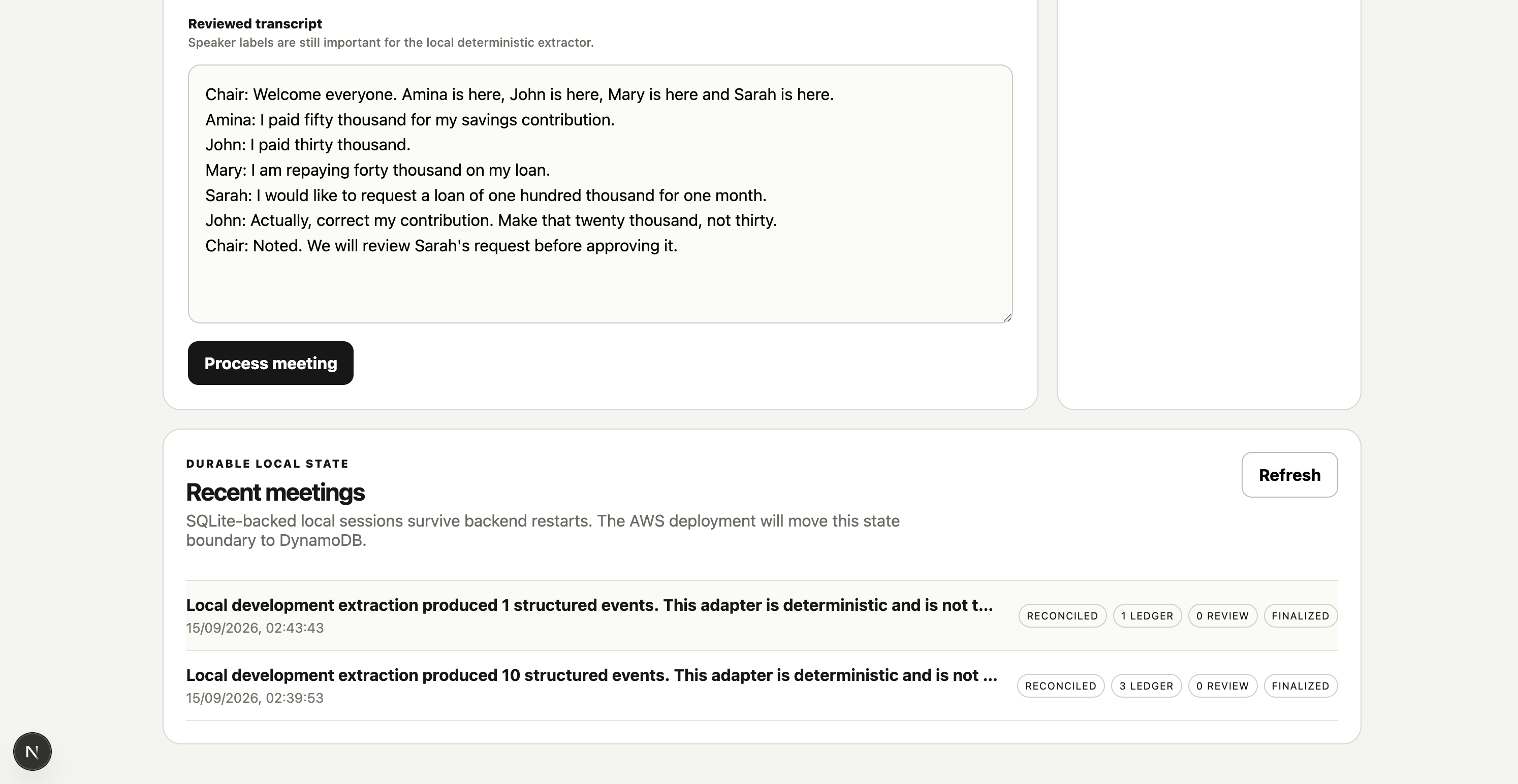
“I paid thirty thousand.”
Then later correct themselves:
“Actually, make that twenty thousand.”
CircleScribe should recognize that the second statement corrects the first rather than creating two separate transactions.
If the evidence is still unclear, the agent pauses only that decision and asks the group secretary to confirm the correct amount.
Once resolved, CircleScribe can continue automatically and:
- update the meeting ledger
- reconcile balances
- generate meeting minutes
- prepare member receipts
- calculate upcoming obligations
- create repayment reminders
- record group decisions
- create follow-up actions for the next meeting
The central design principle is:
AI understands the conversation. Deterministic code protects the money. Humans retain authority over judgment calls.
CircleScribe does not lend money, custody funds, or make financial decisions for the group.
The group remains the authority.
The agent handles the busywork.
How we built it
CircleScribe is being built around AWS Strands Agents as the agent orchestration layer.
Rather than creating a general-purpose chatbot, the agent works through narrowly defined tools and structured workflows.
The architecture is designed around several stages:
- meeting audio ingestion
- transcription and speaker identification
- structured financial and operational event extraction
- member and event resolution
- deterministic ledger validation
- contradiction and ambiguity detection
- human-in-the-loop approval when necessary
- ledger updates
- minute and receipt generation
- follow-up action creation
AWS services are used throughout the workflow.
Amazon Transcribe handles meeting speech transcription.
Amazon S3 stores meeting audio and generated artifacts.
AWS Strands Agents coordinates reasoning and tool execution.
Amazon Bedrock provides the foundation-model capabilities used by the agent.
We are also designing the agent for deployment with Amazon Bedrock AgentCore, allowing the project to demonstrate production-style agent runtime, memory, tool access, and observability.
The application separates probabilistic AI reasoning from deterministic financial logic.
The language model can determine that a sentence likely represents a loan repayment or contribution, but it does not directly decide whether the ledger balances.
Those calculations and integrity checks are handled by normal application code.
The user interface is designed around a transparent workflow:
What was said → What the agent understood → What was verified → What needs a human decision → What was completed
Challenges we ran into
One of the hardest parts of the problem is that real conversations are messy.
People interrupt one another, correct themselves, use informal language, refer to members by nicknames, mention amounts without repeating the full context, and change decisions during the same conversation.
Financial records cannot simply accept every extracted sentence as a transaction.
That created an important architectural challenge:
How much should the AI be allowed to decide?
Our solution is to deliberately separate understanding from authority.
The agent can interpret speech and propose structured events, while deterministic rules validate financial state.
When confidence is insufficient or two pieces of evidence conflict, the system escalates the decision instead of silently guessing.
Another challenge is preserving the complete context of a meeting while avoiding duplicate events. A correction should modify an earlier event rather than become another payment, and a discussion about a possible loan should not automatically become an approved loan.
Designing the agent around those distinctions has been one of the most important parts of the project.
Accomplishments that we're proud of
The part of CircleScribe we are most proud of is the agent design itself.
Instead of treating AI as a replacement for the group's secretary or treasurer, CircleScribe is designed around a more useful division of responsibility:
- AI handles interpretation
- deterministic software handles financial integrity
- humans handle consequential judgment
That creates an agent that can do meaningful work autonomously without pretending that an LLM should have unrestricted authority over community financial records.
We are also proud that the product starts from an existing human behavior rather than requiring communities to completely change how they operate.
People can continue holding their meetings.
CircleScribe works around the meeting and converts the conversation into useful administrative output.
The goal is not another dashboard that people must constantly maintain.
The goal is to remove work.
What we learned
Building CircleScribe reinforced an important lesson about AI agents:
The most useful agent is not necessarily the one that makes the most decisions.
In workflows involving money and community trust, knowing when not to act is just as important as autonomous execution.
We also learned that language understanding and financial correctness should be treated as separate engineering problems.
LLMs are useful for interpreting messy human conversations, but accounting-style calculations, reconciliation, duplicate prevention, and state transitions are much better handled by deterministic systems.
Another lesson was that human-in-the-loop design does not have to mean asking users to approve everything.
A better model is:
Automate the obvious. Escalate the ambiguous.
That keeps the agent useful without turning every step into another confirmation dialog.
What's next for CircleScribe
The immediate goal is to complete and demonstrate the full meeting-to-action workflow:
record → transcribe → understand → reconcile → resolve exceptions → complete the administrative work
Beyond the hackathon, CircleScribe could support additional meeting formats, languages, group constitutions, contribution models, and communication channels.
Future capabilities could include:
- multilingual meetings
- local-language financial terminology
- offline-first meeting capture
- WhatsApp or SMS delivery of receipts and reminders
- recurring group rules
- configurable approval policies
- group-level audit histories
- meeting-to-meeting memory
- voice-based retrieval of historical decisions
- integrations with existing savings-group management platforms
But the core vision would remain the same:
Community groups should spend their meetings making decisions together — not spend hours afterward turning those decisions into paperwork.
Built With
- agentcore
- amazon
- amazon-bedrock
- amazon-transcribe
- aws-strands-agents
- fastapi
- next.js
- python
- s3
- typescript


Log in or sign up for Devpost to join the conversation.