-
-
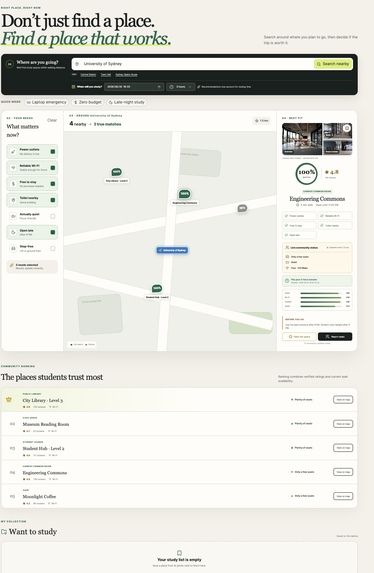
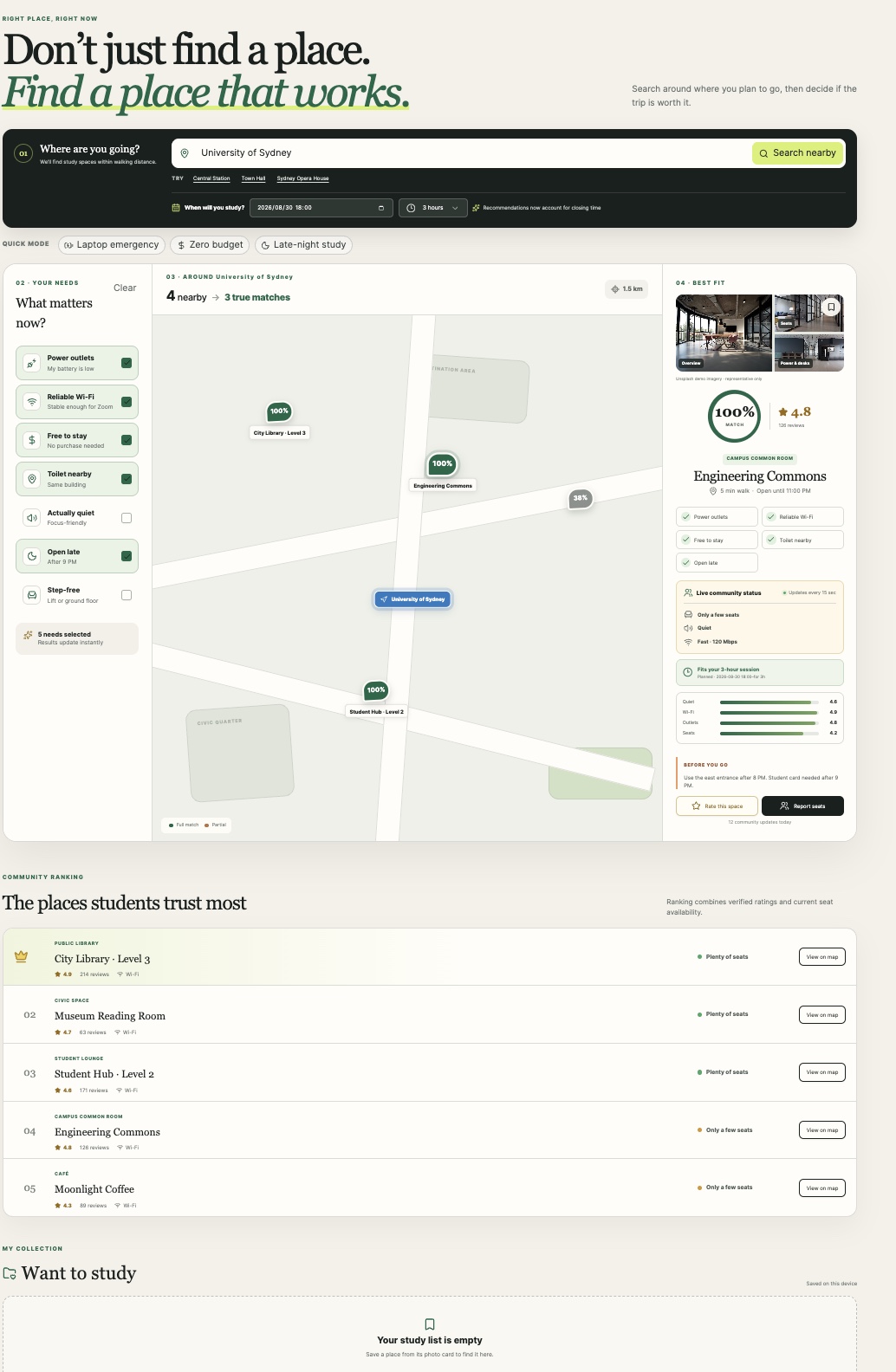
studyblock_homepage
Inspiration
During finals, finding a place to study can become surprisingly difficult.
Campus libraries fill up quickly, and even when another space is nearby, it is hard to know whether it is actually suitable. A café might look convenient on a map, but only after arriving do you realise there are no power outlets, no Wi-Fi, nowhere to sit, or that staying for several hours is not really practical.
That frustration made us rethink the problem.
Students are not really searching for a library or a café. They are searching for a space that fits their situation — somewhere quiet, free, open late, accessible, with power and available seats.
That idea became StudyBlocks:
The space already exists. We make it visible.
What it does
StudyBlocks helps students find study spaces based on what they need right now, rather than simply searching by place type.
Students can filter nearby locations by requirements such as:
- Power outlets
- Free entry
- Toilets
- Quiet environment
- Late opening hours
- Step-free access
- How long they plan to stay
StudyBlocks then ranks suitable locations using a match score and explains why each space fits the student's needs.
It also surfaces important details that are often hidden in traditional map searches. A library might be ideal but require student-card access after 9 PM. A café might have power outlets but expect customers to make a purchase.
To make recommendations more useful in real time, we added a community reporting system. Students can quickly report whether a space has plenty of seats, only a few remaining, or is already full.
The interface can also switch between English and Chinese, making StudyBlocks easier to use for international students and users from different language backgrounds.
How we built it
We designed StudyBlocks around one key shift:
Instead of asking "Where do you want to study?", we ask "What do you need from the space?"
We built the prototype as an interactive web application using HTML, CSS, and JavaScript.
Each study location is represented using structured attributes such as power availability, cost, toilets, quietness, accessibility, opening hours, suitable stay duration, and current occupancy.
When a user changes their requirements, StudyBlocks filters and re-ranks the available locations immediately.
Our matching system combines these attributes into a score while treating certain needs as stronger constraints. For example, if a student's laptop is almost out of battery, a location without power should not rank highly simply because it is nearby and quiet.
We also built an interactive map that updates together with the recommendation list, so users can quickly see which spaces remain suitable.
For the demo, we created an 8 PM scenario:
Low laptop battery, no desire to spend money, and three hours of studying left to do.
With a few selections, StudyBlocks narrows the nearby options down to spaces that genuinely work for that situation.
Challenges we ran into
One of the hardest parts was deciding what actually makes a study space useful.
Distance and opening hours are relatively simple. Factors such as whether long stays are acceptable, whether power outlets are available, whether access rules change at night, or whether there are currently any seats left are much harder to represent.
We also had to distinguish between preferences and requirements.
For one student, quietness might be a preference. For another student with 15% battery remaining, access to power is essential. Treating every attribute equally would produce poor recommendations.
Another challenge was live information. Seat availability can change within minutes, so static data alone is not enough. This led us to add lightweight community reporting.
Finally, we had to balance useful detail with simplicity. There are many factors that affect whether a space is suitable, but the interface still needs to feel quick and easy to use.
Accomplishments that we're proud of
We are proud that StudyBlocks goes beyond being another map of libraries and cafés.
It changes the question from:
"What study places are nearby?"
to:
"Which nearby places actually work for me right now?"
Our prototype responds immediately as the user's needs change, updating both the map and recommendation ranking.
We are also proud of the community reporting system, bilingual interface, and the way StudyBlocks exposes small but important details such as purchase expectations and after-hours access restrictions.
Most importantly, StudyBlocks shows how existing and underused spaces can become useful study infrastructure without building anything new.
What we learned
We learned that useful recommendations depend heavily on context.
Two locations that appear almost identical on a normal map can be completely different from the perspective of someone trying to study for several hours.
We also learned that different types of information need different approaches.
Opening hours and accessibility may remain stable for long periods, while seat availability can become outdated almost immediately. A useful system therefore needs to combine static place information with live community information.
Technically, we learned how to model real-world requirements as structured data, dynamically filter and rank locations, update an interactive interface, and incorporate community-generated reports into recommendations.
The project also changed how we thought about accessibility: a place being nearby does not automatically make it accessible or usable.
What's next for StudyBlocks
The next step is to connect StudyBlocks to real location and campus data.
We would like to integrate real mapping data, university opening hours, and a backend for storing community reports.
We also want to introduce a confidence and recency system, so users can tell the difference between a seat report submitted two minutes ago and one submitted two hours ago.
Future versions could include:
- Real campus and public study-space data
- Walking distance and travel-time ranking
- User-submitted study locations
- Trust and reputation for community reports
- Occupancy trends by time of day
- Personalised study preferences
- More languages
- Community-contributed accessibility information
- Notifications when a suitable nearby space becomes available
Ultimately, we want StudyBlocks to become an information layer over the spaces that already exist around us — making them easier to discover, understand, and use.
The space already exists. We make it visible.

Log in or sign up for Devpost to join the conversation.