Here is your answer rewritten using your actual Circl’d README context and tech stack:
Inspiration
The inspiration behind Circl’d came from the growing problem of usable items being thrown away while others still need them. Many people have unused objects at home that eventually become waste, contributing to landfill overflow and environmental harm. I wanted to create a platform that encourages reuse instead of disposal by making it easy and intuitive for people to trade items. The idea was inspired by the concept of a circular economy, where resources remain in continuous use instead of following a linear path toward disposal.
What it does
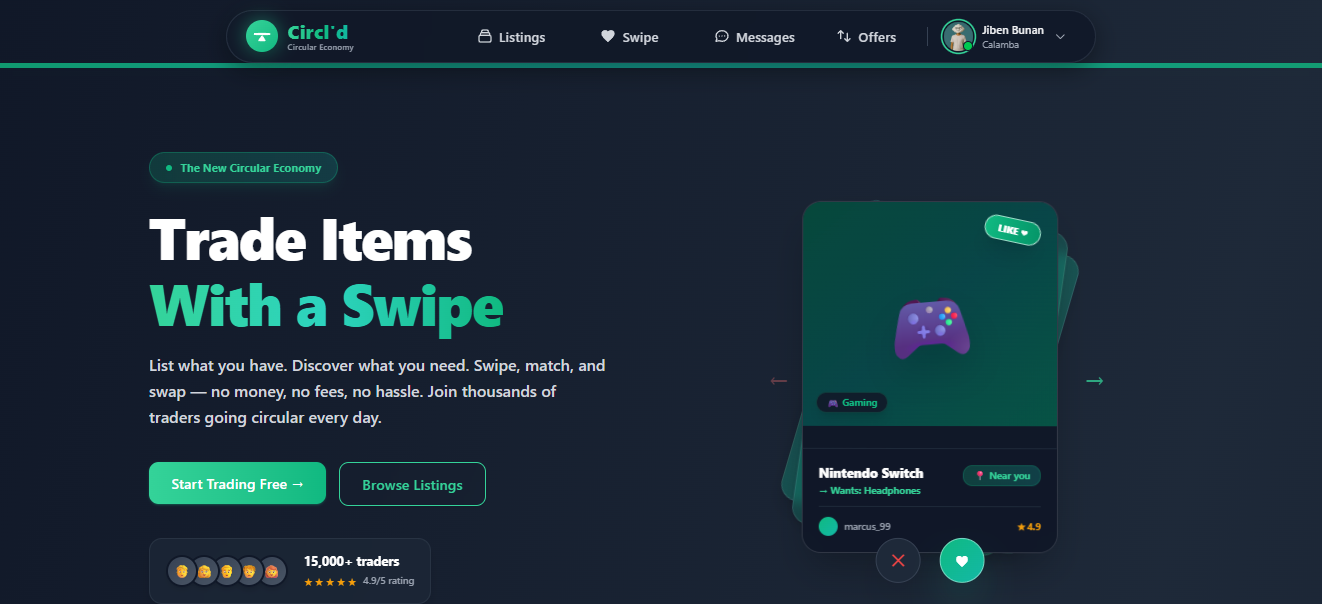
Circl’d is a modern swipe-based trading platform that allows users to discover and trade unused items through an intuitive interface. Users can list their items, select a trade anchor, and swipe through other available items to find potential trades. When two users are interested, they can send and accept trade offers and communicate through real-time messaging. The platform also includes location-based discovery, item management, notifications, and trade tracking. Circl’d helps reduce waste by extending the lifespan of items and promoting reuse.
How we built it
We built Circl’d using React and TypeScript for a scalable and type-safe frontend, with Vite as the build tool and Tailwind CSS for responsive and modern styling. Firebase was used as the backend service, including Firebase Authentication for secure user login, Firestore for real-time database functionality, and Firebase Storage for managing files. Cloudinary was integrated for image uploads and optimization, and Leaflet was used for location-based item discovery. The swipe interface, trade offer system, and messaging features were implemented using modular components, services, and custom hooks to ensure maintainability and scalability.
Challenges we ran into
One of the main challenges was implementing the swipe-based trading system and ensuring smooth and responsive interactions across devices. Managing real-time data such as trade offers and messaging required careful integration with Firebase to ensure synchronization and security. Another challenge was structuring the application to be scalable while keeping the code modular and maintainable. We also faced challenges in ensuring secure authentication, protecting user data, and designing an intuitive user experience that encourages engagement.
Accomplishments that we're proud of
We are proud of successfully building a fully functional trading platform with real-time features such as swipe trading, messaging, and offer management. We created a clean and modern user interface that is responsive across mobile, tablet, and desktop devices. We also successfully integrated multiple technologies including Firebase, Cloudinary, and location services. Most importantly, we built a platform that directly contributes to reducing waste and promoting environmental sustainability.
What we learned
Through building Circl’d, we learned how to design and develop a full-stack application using modern technologies such as React, TypeScript, and Firebase. We improved our skills in real-time database management, authentication, UI/UX design, and application architecture. We also learned how to structure scalable systems using modular components and services. Beyond technical skills, we gained a deeper understanding of how software can help solve environmental problems by encouraging sustainable behavior.
What's next for Circl’d
Next, we plan to improve Circl’d by adding more advanced features such as smarter matching algorithms, enhanced recommendation systems, and improved environmental impact tracking to show users how much waste they helped reduce. We also plan to optimize performance, enhance security, and expand mobile support. In the future, Circl’d can grow into a larger platform that promotes sustainable trading communities and helps reduce environmental waste on a larger scale.
Built With
- cloudinary
- eslint
- firebase
- firestore
- javascript
- netlify
- react
- tailwind-css
- typescript
- vite


Log in or sign up for Devpost to join the conversation.