-

lanch
-
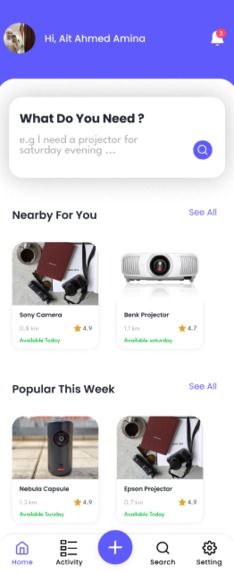
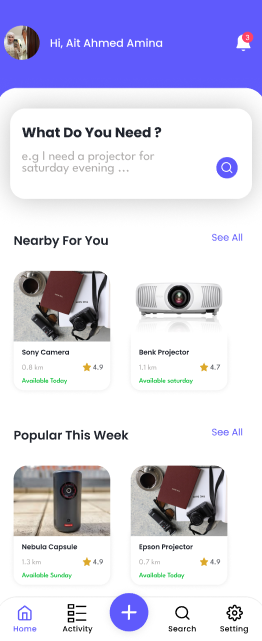
home page
-
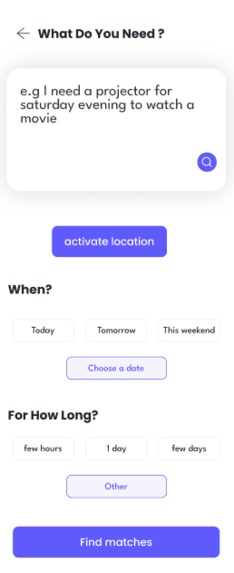
share item
-
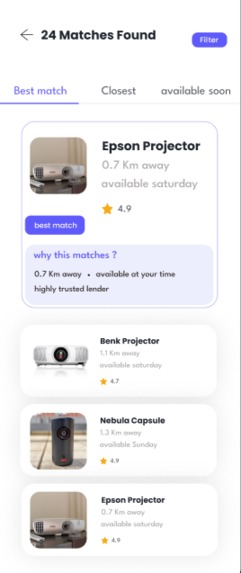
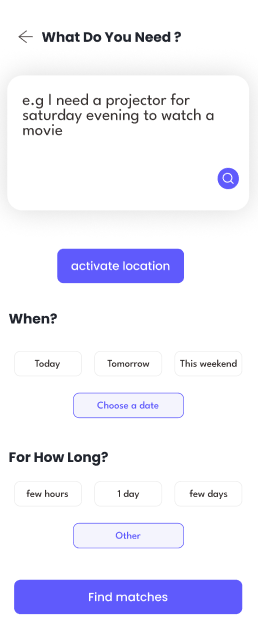
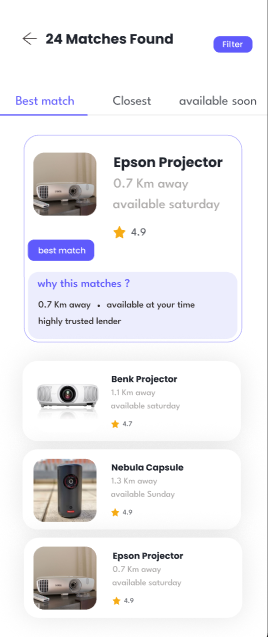
finding page
-
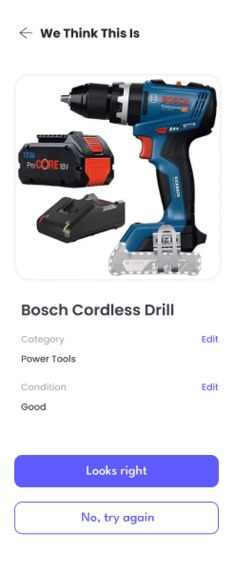
recognition page by the ai
-
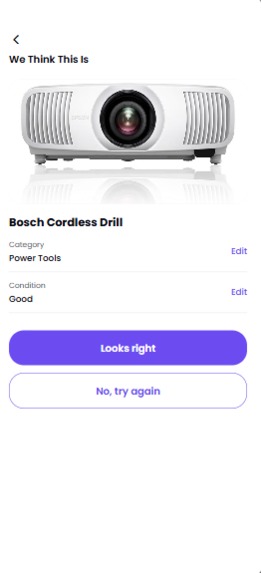
recognition

Inspiration
We started with a simple question: Why do we buy things we only need for a few hours, days, or occasions? A projector for one movie night, a camera for one event. a drill for one repair. camping equipment for one weekend etc... The objects already exist. Often, someone nearby owns exactly what we need and barely uses it. and the default solution is still: Need-Buy-Use-Store-Forget. We wanted to explore a different model: Need-Discover-Access-Return-Circulate. That idea became Circae. Our vision isn't simply to create another marketplace. We want to make access more convenient and affordable than ownership for things people don't use often. We were particularly interested in the gap between how humans express needs and how digital platforms expect us to search. People don't usually think in product categories and database filters. They say: "I'm going camping this weekend and need a tent for two people." We wanted technology to understand that sentence and turn it into an actionable search. That's where AI became central to the idea.
What it does
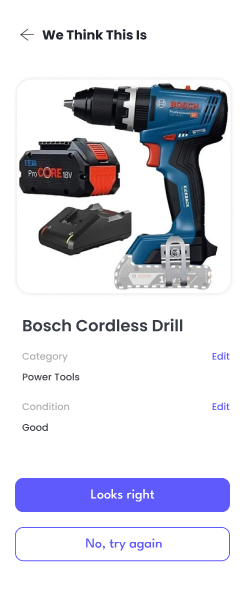
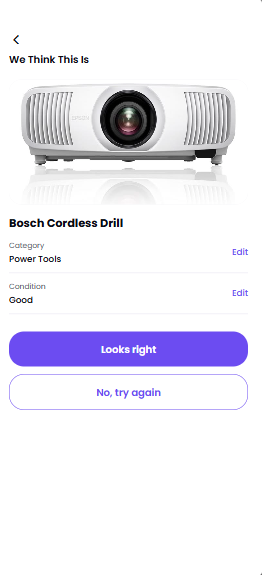
Circae is an AI-powered resource-sharing network that connects people with nearby underused resources. Instead of browsing endless listings, users can simply describe what they need in natural language. For example: "I need a projector for Saturday evening for a small movie night." Circae understands the request and identifies relevant requirements such as the object, timing, and location. It then searches available resources nearby and ranks them using factors such as: Relevance , Availability , Distance , Condition , Trust , Lending terms A user might discover: Epson Projector , 0.8 km away , Available Saturday , €5/day ,96 Trust Resources can be shared for free or for a fee, depending on the owner's preferences. Circae also makes sharing easy. A user can photograph an object and use AI to help identify it, generate its description, and categorize it before publishing. Every successful exchange can contribute to a user's reputation, creating a trust layer for future interactions.
How we built it
We designed Circae as a mobile-first application with a modular architecture. Frontend we use: React Native , Expo , TypeScript , Expo Router This allows us to build a single mobile experience while maintaining a strong typed codebase. Backend Our backend is built around: Supabase , PostgreSQL , Supabase Auth , Supabase Storage PostgreSQL acts as the core resource database, storing users, items, availability, borrowing requests, exchanges, reviews, and trust events. AI AI is used where it provides the most value: understanding human intent. A natural-language request is transformed into structured information that can then be processed by our deterministic matching layer. For example: "I need a camera for a wedding this weekend." ↓ AI understanding ↓ Object: Camera Time: Weekend Purpose: Wedding ↓ Database filtering ↓ Availability + Distance ↓ Trust + Condition ↓ Ranked matches
We deliberately separate AI understanding from the actual matching logic. AI interprets what the user means and the database determines what actually exists and what is available. This makes the system more reliable and explainable than simply asking an AI model to choose an item. Location Geospatial information allows Circae to prioritize resources that are realistically accessible nearby. Trust Rather than treating reputation as a simple star rating, Circae is designed around behavioral signals such as successful exchanges, timely returns, reviews, and verification. Together, these components create the foundation for a resource network rather than a traditional buy-and-sell marketplace.
Challenges we ran into
One of our biggest challenges was connecting unstructured human language with structured physical-world data. A person might say: "I need something to record good-quality audio for a podcast this weekend." The system needs to understand that this could correspond to a microphone or audio recorder, determine the relevant time period, and then search actual resources. We therefore had to think carefully about where AI should be used and where traditional software should remain responsible for the decision. Another challenge was trust. When physical objects move between people who may not know each other, simply finding a nearby item isn't enough. We needed to think about questions such as: Can I trust this person? Will the item be returned? Is the item actually available? Is its condition accurately represented? What happens if something goes wrong?
This pushed us to make trust a fundamental part of the architecture instead of an optional profile feature. We also had to balance ambition with hackathon constraints. Circae could eventually include payments, deposits, identity verification, dispute resolution, insurance, and much more. For the MVP, we focused on the smallest complete experience that proves the core idea.
Accomplishments that we're proud of
We're particularly proud that Circae goes beyond the basic idea of: "People can list things and other people can borrow them." We designed a complete access loop: Need → AI understanding → Local discovery → Matching → Trust → Exchange → Return → Reputation We're also proud of the decision to treat the database as an important part of the intelligence of the system. The AI doesn't need to know every available object in the world. It understands the user's intent, while our structured data handles real constraints such as: What exists?Where is it? When is it available? Who owns it? How trustworthy is the exchange? We believe this separation makes the architecture both more practical and more scalable. Most importantly, we are proud that Circae started from a simple human problem and evolved into a system that combines AI, databases, geospatial discovery, and trust around one clear idea: Access, not ownership.
What we learned
One of our biggest lessons was that AI doesn't have to replace traditional software to be powerful. AI is particularly good at understanding ambiguity and human language. Databases are good at storing and querying structured facts. Geospatial systems are good at reasoning about physical proximity. Trust systems are good at representing behavioral history. The real opportunity comes from connecting these pieces. We also learned that designing a good product means asking not only: "What technology can we use?" but: "Where does technology actually remove friction for the user?" For Circae, that friction was the gap between what people need and how marketplaces make them search. Instead of making users adapt to the database, we wanted the system to adapt to the way people naturally communicate.
What's next for Circae
The MVP is only the beginning. Our next steps are focused on turning Circae from a prototype into a reliable access network. Secure transactions that Allow users to safely handle borrowing fees, deposits, and refunds. Identity & safety Introduce stronger identity verification and safety mechanisms for real-world exchanges. Smarter condition verification and the Use computer vision to help document an item's condition before and after borrowing. Better matching Improve recommendations using historical behavior, preferences, availability patterns, distance, trust, and context. Community-based sharing Enable trusted circles such as neighborhoods, universities, residential communities, and local organizations. Global expansion Start locally, but design the system so that the same concept can work across cities and countries. Ultimately, we don't want Circae to become just another platform where people exchange products. We want it to become a global network for accessing underused resources. Because the future doesn't necessarily have to be about owning everything we need. It can be about making the things that already exist more accessible, more affordable, and more useful to more people. Circae Access, not ownership.
Built With
- expo.io
- native
- openai
- postgresql
- postgresql/postgis
- react
- react-native
- supabase
- typescript

Log in or sign up for Devpost to join the conversation.