Inspiration
I always seemed to have an issue with facing procrastination. I needed an app that helped me stop fighting against my own internal clock. Standard calendars treat every hour the same, forcing you to be productive when you're completely drained. I realized the secret wasn't more willpower; it was working with my natural biology. I wanted to build an app that takes the guesswork out of planning by automatically mapping high-focus tasks to peak energy windows and protecting rest times when a crash is inevitable.
What it does
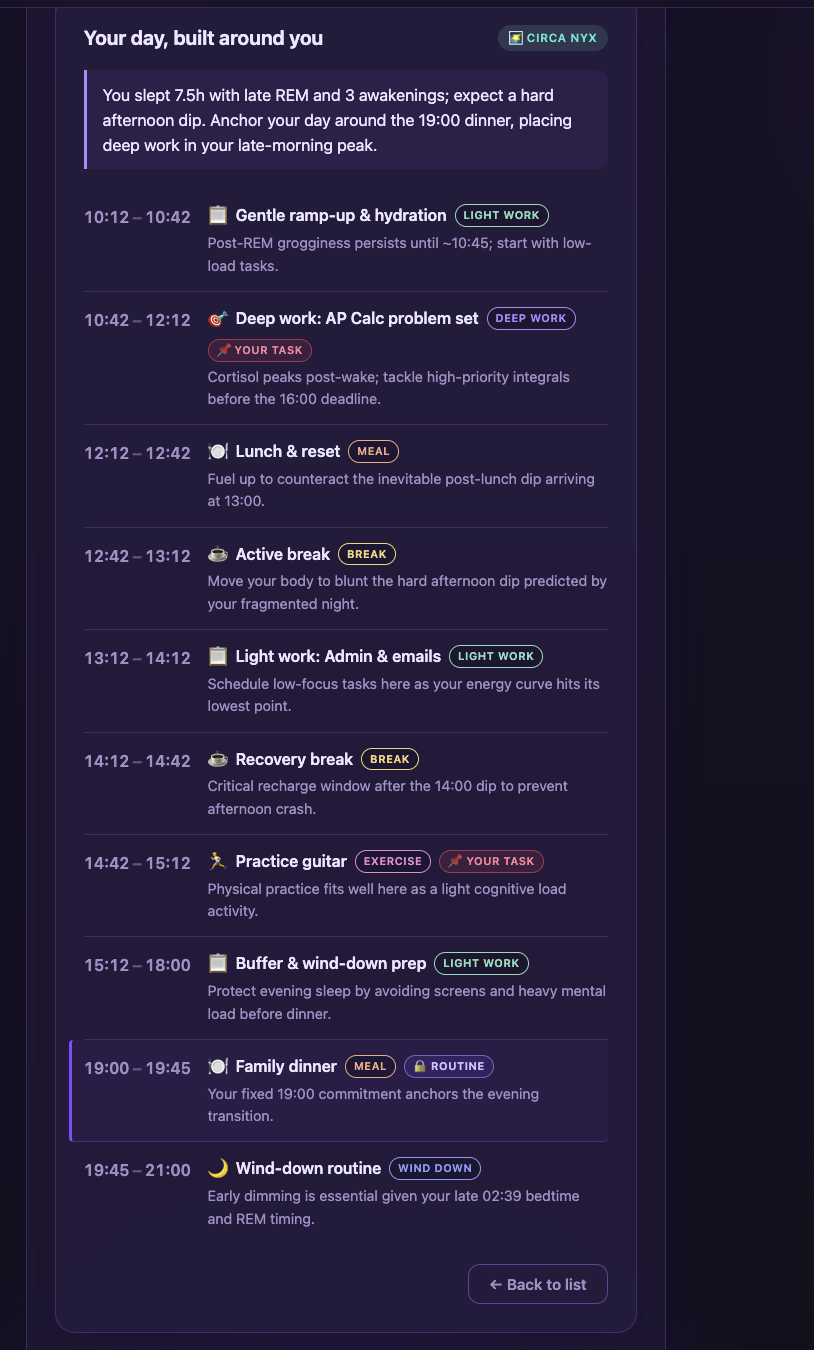
Circa transforms a user's biometric sleep signals into a dynamic, personalized daily schedule. A user uploads a screenshot of their sleep data from any health tracker (like Apple Health, Google Fit, or Fitbit). Circa’s AI parses the sleep stages, bedtime, and sleep quality to infer their specific chronotype and daily energy curves. It then automatically generates an optimal schedule, placing high-priority deep-work tasks during peak focus windows, locking down fixed commitments, and scheduling critical recovery breaks during the classic post-lunch or sleep-deprived dips.
How we built it
The platform is designed around a split-trust architecture to keep biometric data private:
Frontend: A clean, responsive web dashboard hosted on Firebase for rapid deployment and rendering.
Vision & Reasoning Pipeline: An AI pipeline that reads sleep data screenshots and uses advanced LLM prompting to generate contiguous, structured schedule blocks with personalized "why" explanations.
Secure Storage Engine: The raw, sensitive health data is encrypted at rest and stored locally on a custom home server named "Greg".
Key Management: The decryption key is stored completely separately in the cloud via Firebase, ensuring an attacker can never compromise user data from a single breach.
Challenges we ran into
The absolute biggest hurdle was handling latency and API limitations under crunch time. While building the "Circa Rhythm" mode using deep reasoning models, the model repeatedly exhausted its maximum token budget because it spent thousands of tokens "second-guessing" itself and over-analyzing its internal schedule deductions. Managing the complex constraints—keeping tasks aligned with strict deadlines, accommodating fixed anchor routines (like a school bus), and forcing the model to output strictly raw JSON without markdown fences—required intensive prompt engineering, few-shot structural context, and aggressive regex sanitization on the backend to prevent the UI from crashing right before submission.
Accomplishments that we're proud of
The Data Privacy Split: Successfully engineering a functioning prototype where the decryption key and the encrypted biometric payload never sit on the same server.
Biometric-to-Schedule Translation: Writing a comprehensive system prompt that accurately translates micro-signals (like low deep sleep or fragmented sleep timelines) into actionable schedule changes, rather than spitting out generic "filler" productivity advice.
The Ultimate Hackathon Pivot: Refusing to quit when the reasoning API hit token limits 30 minutes before the deadline, successfully refactoring the input payload, and shipping a functional, hard-coded MVP backstop right as the clock ran out!
What we learned
We learned that extended thinking AI models are incredibly powerful for nuanced tasks like scheduling, but they require strict guardrails, low-token boundaries, and structured structural examples to prevent them from hitting length limits. We also learned the immense value of the hackathon mindset: when everything is breaking simultaneously, perfection is the enemy of the ship. Bypassing the reasoning lag to protect the frontend user experience taught us how to build reliable fail-safes into AI-driven applications.
What's next for Circa
Native OAuth Integration: Moving away from static screenshot uploads and integrating official Google Health Connect and Apple HealthKit APIs for seamless background syncing.
Dynamic Calendar Syncing: Building active integrations with Google Calendar and Outlook so Circa can write schedules directly to a user's existing daily toolset.
Interactive Feedback Loops: Implementing session memory so the AI learns from a user's feedback when a specific schedule window feels too intense or mismatched with their actual energy levels.
Built With
- csharp
- javascript

Log in or sign up for Devpost to join the conversation.