-
-
forented
Inspiration
What it does
How we built it
Challenges we ran into
Accomplishments that we're proud of
What we learned
What's next for cipher vault ai
Inspiration
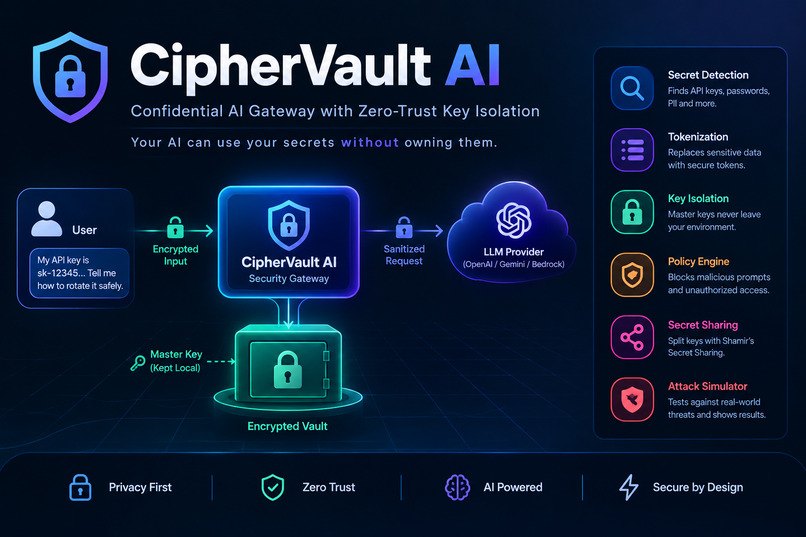
AI systems are becoming powerful enough to process highly sensitive information, but using an AI API often means sending that information to an external service. This creates a fundamental privacy problem: how can we use AI without exposing sensitive inputs or master secrets to the AI provider?
CipherVault AI was inspired by this challenge. We wanted to explore how cryptography and AI could work together to create a more privacy-preserving architecture where sensitive information can remain protected while still enabling useful AI-powered computation.
The goal was to build a system that treats privacy as a core part of the architecture rather than something added afterward.
What it does
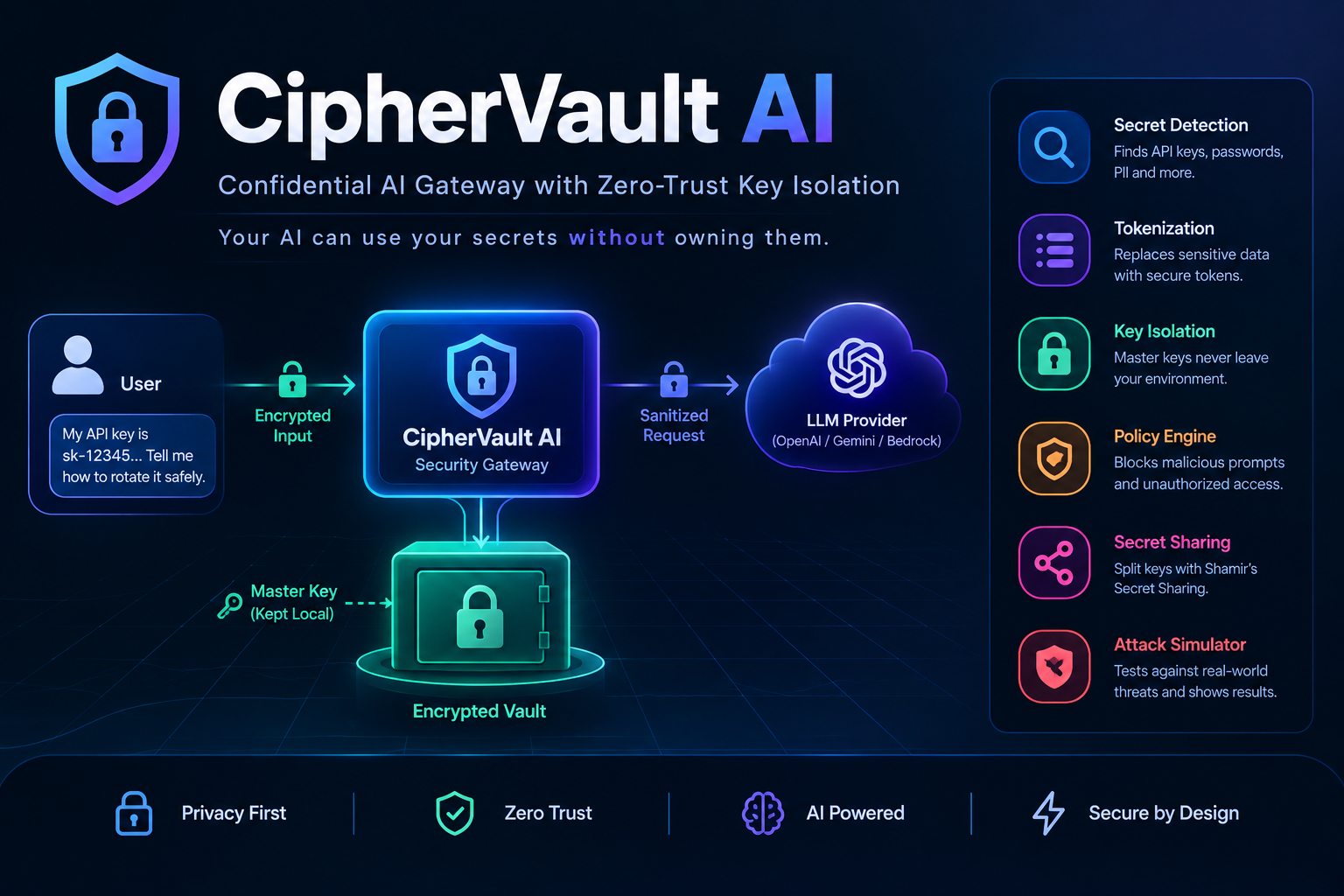
CipherVault AI is a privacy-focused AI system designed around the idea of cryptographically protecting sensitive inputs before they interact with an external AI service.
Instead of treating an AI API as a trusted environment for sensitive information, CipherVault AI explores a model where:
- Sensitive information is protected before leaving the trusted environment.
- Cryptographic mechanisms are used to protect secrets and sensitive data.
- The AI service does not need direct access to the user's master secret.
- The architecture separates sensitive key material from the AI processing layer.
- The system demonstrates how cryptography can be used to reduce trust requirements when working with AI APIs.
The result is a security-focused approach to AI interaction where the AI can be useful without requiring the same level of trust in the external service.
How we built it
We designed CipherVault AI around the separation of data, cryptographic secrets, and AI processing.
The project combines application logic with cryptographic techniques to create a secure workflow for handling sensitive information. The architecture focuses on ensuring that secret material is not unnecessarily exposed to external AI services.
We built the project iteratively, starting with the security model and threat assumptions and then implementing the application workflow around those principles.
The key design idea was simple:
Protect the secret first, then decide what the AI actually needs to know.
This approach allowed us to think about AI privacy from a systems-security perspective rather than simply adding encryption as an afterthought.
Challenges we ran into
The biggest challenge was balancing security, usability, and AI functionality.
Encryption can protect information, but encrypted data is not automatically useful to a conventional AI model. This creates an important systems problem: protecting information too aggressively can make computation impossible, while exposing too much information defeats the purpose of the security layer.
We also had to reason carefully about the trust boundaries in the system:
- What information should remain private?
- Which component should have access to cryptographic keys?
- What happens if the external AI provider is compromised?
- How can sensitive information be minimized before reaching the AI?
- How can the system remain practical instead of becoming purely theoretical?
These challenges pushed us to think beyond simply implementing cryptographic primitives and instead consider the entire security architecture.
Accomplishments that we're proud of
We are proud of turning a theoretical privacy problem into a working security-focused project.
Our biggest accomplishment is the architectural idea behind CipherVault AI: AI services should not automatically be trusted with the secrets required to process sensitive information.
We are also proud that the project combines two rapidly evolving areas—cryptography and AI privacy—into a single system-security concept.
Most importantly, CipherVault AI helped us demonstrate that privacy can be treated as a fundamental design constraint for AI systems rather than an optional feature.
What we learned
We learned that building secure AI systems requires much more than encrypting data.
The most important lesson was that trust boundaries matter. Even strong cryptography cannot solve a system-design problem if secrets are eventually exposed to an untrusted component.
We also learned how difficult it is to balance confidentiality with computation. Traditional encryption protects information extremely well, but AI workloads require data to be processed in meaningful ways.
This project gave us a deeper understanding of:
- Cryptographic trust models
- Secret protection and key management
- AI privacy architectures
- Threat modeling
- Security boundaries between systems
- The practical limitations of encrypted computation
Most importantly, we learned to ask a different question when designing AI systems:
"What does the AI actually need to know?"
What's next for CipherVault AI
CipherVault AI is only the beginning.
Our next goal is to make the system more robust and practical for real-world privacy-sensitive AI applications.
Future work could include stronger cryptographic protocols, improved protection of key material, more advanced privacy-preserving computation, stronger threat modeling, and support for additional AI workloads.
We also want to explore how techniques such as secure multi-party computation, trusted execution environments, homomorphic encryption, and zero-knowledge proofs could complement the current architecture.
Ultimately, our vision is to move toward an AI ecosystem where users can benefit from powerful models without having to blindly trust external AI providers with their most sensitive information.
CipherVault AI — bringing cryptographic thinking to private AI.
Built With
- ai
- api
- artificial
- computing
- cryptography
- cybersecurity
- data
- encryption
- information
- intelligence
- learning
- machine
- privacy
- privacy-preserving
- python
- secure
- security
