Inspiration
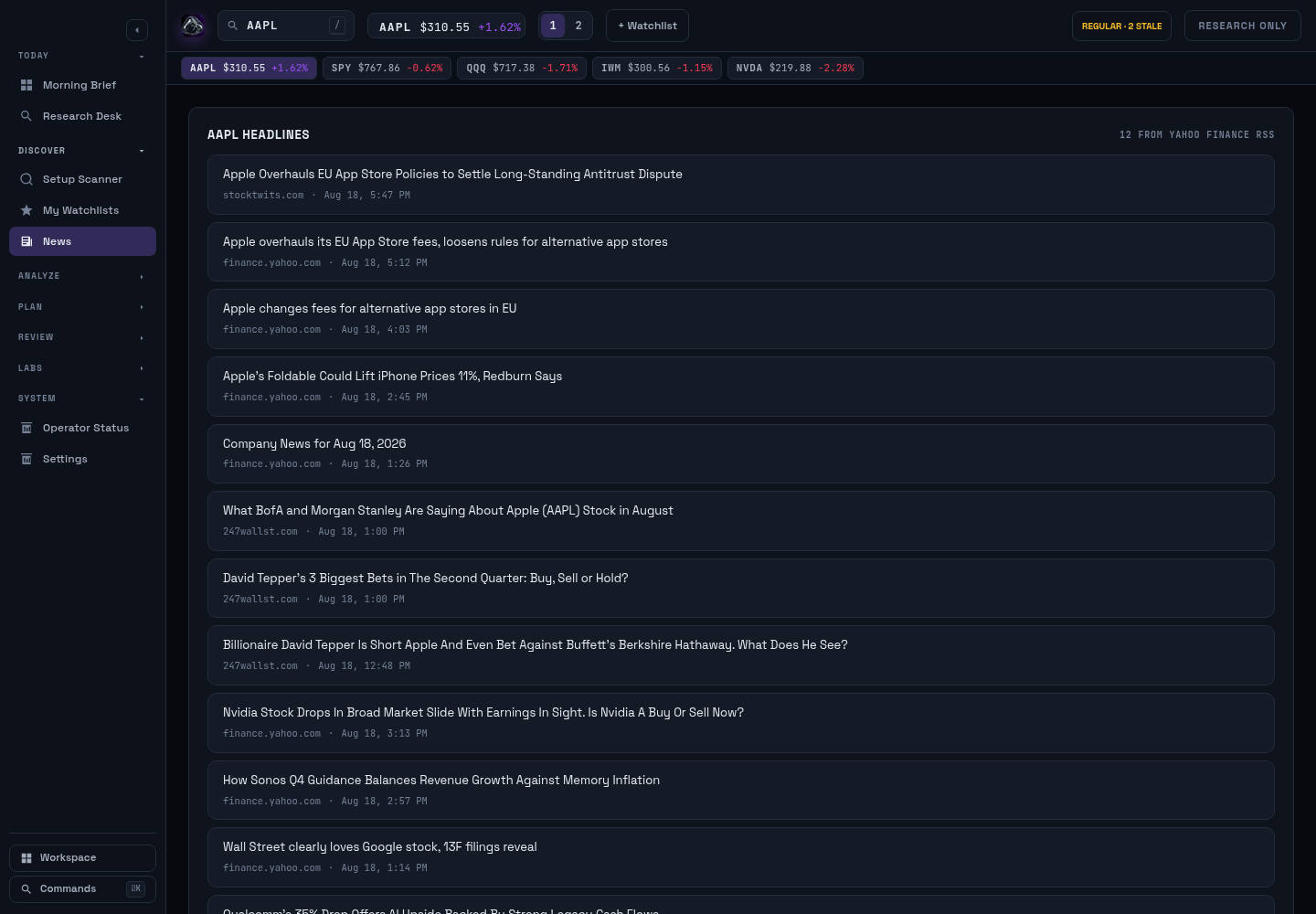
Individual options traders assemble every decision from disconnected tools: a screener, a chart, an option chain, news, an exposure model, a spreadsheet, and an AI chat. Those tools disagree about timestamps and data coverage. Missing options data can look like zero. A backtest can silently hide the candidates it rejected. An AI answer can sound certain without showing what evidence was actually available at the moment of the call.
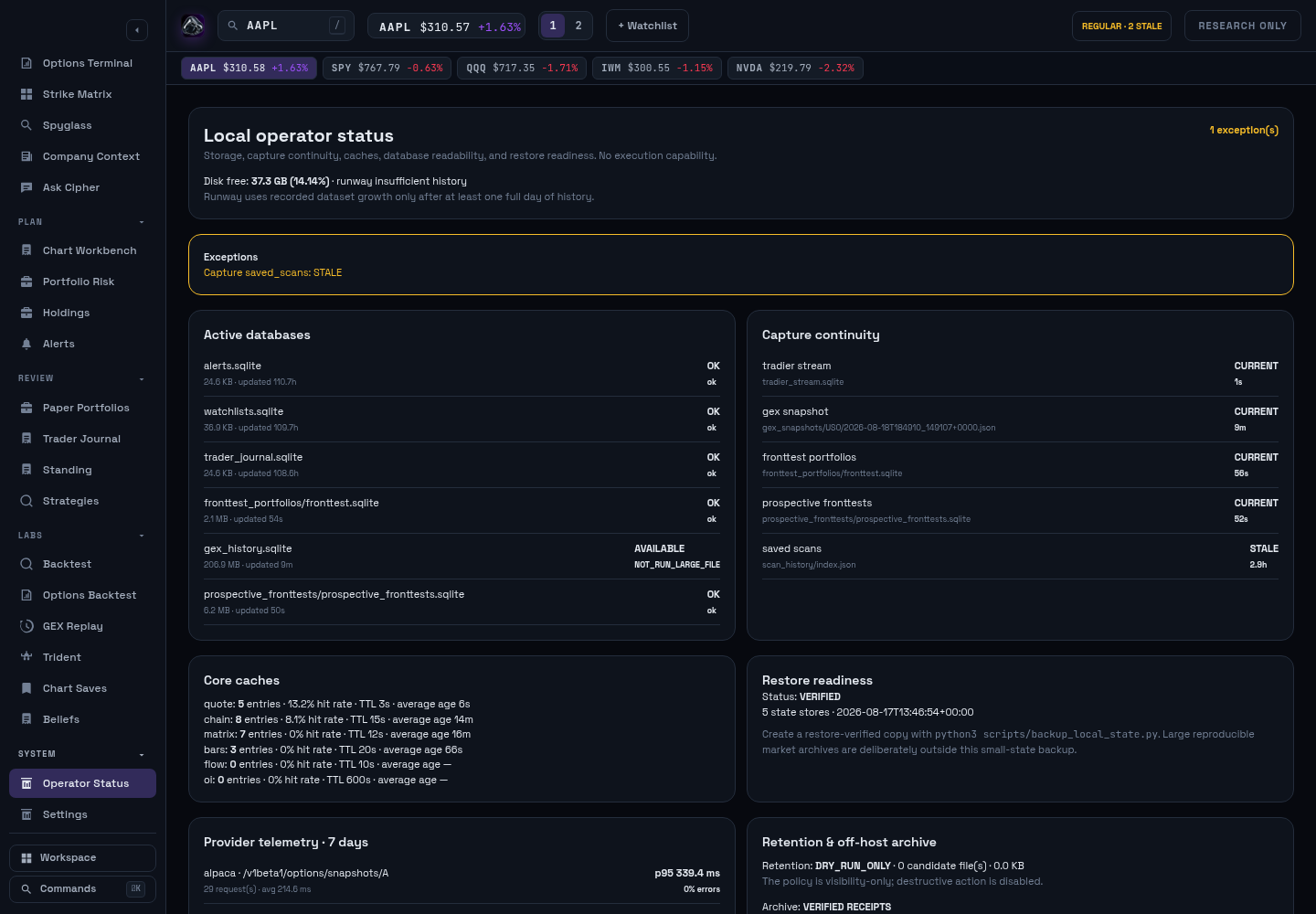
The dangerous failure is not a missing feature — it is false confidence. We wanted to build the research terminal we wished existed: one that treats data quality, provenance, and uncertainty as first-class citizens instead of footnotes.
What it does
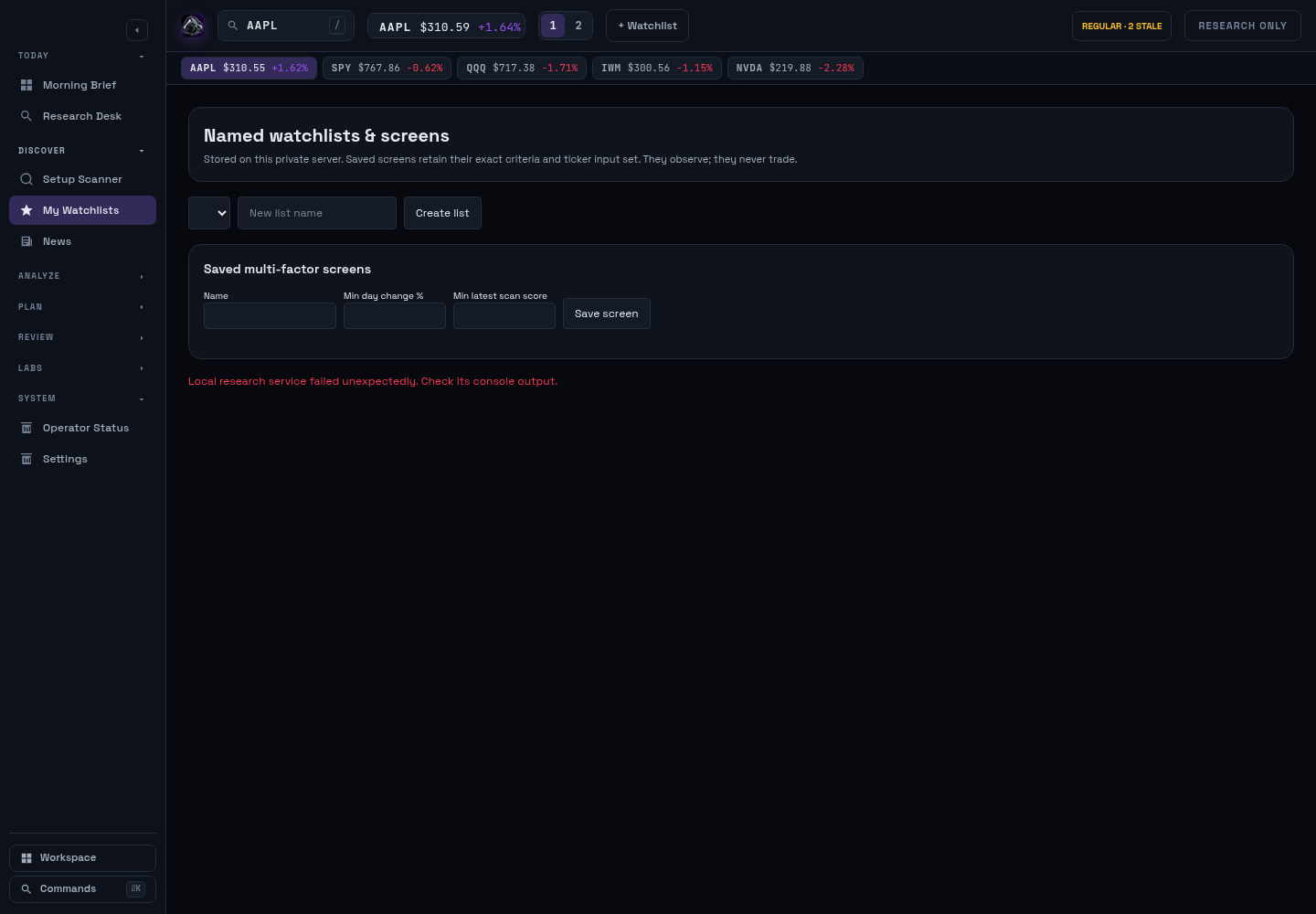
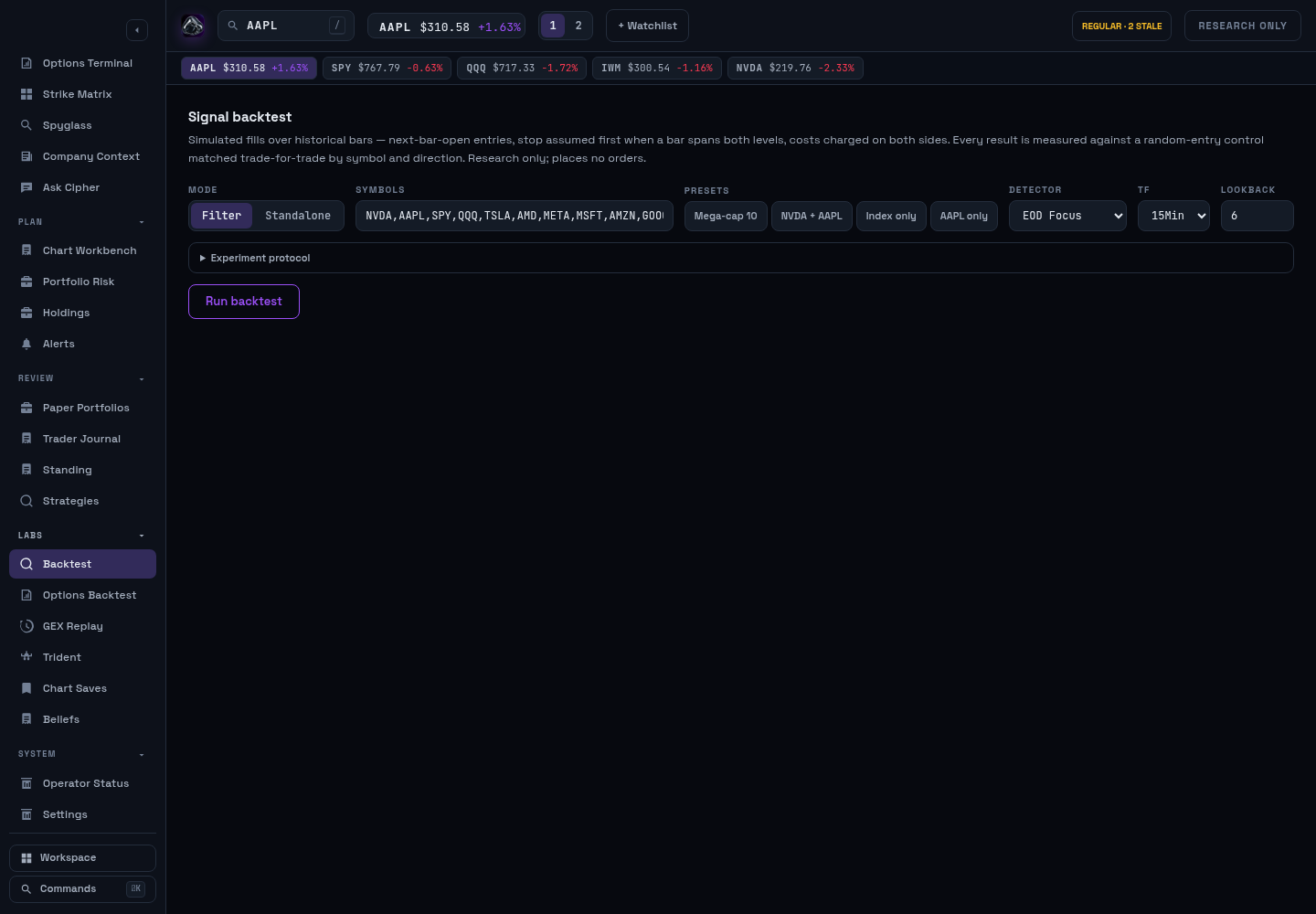
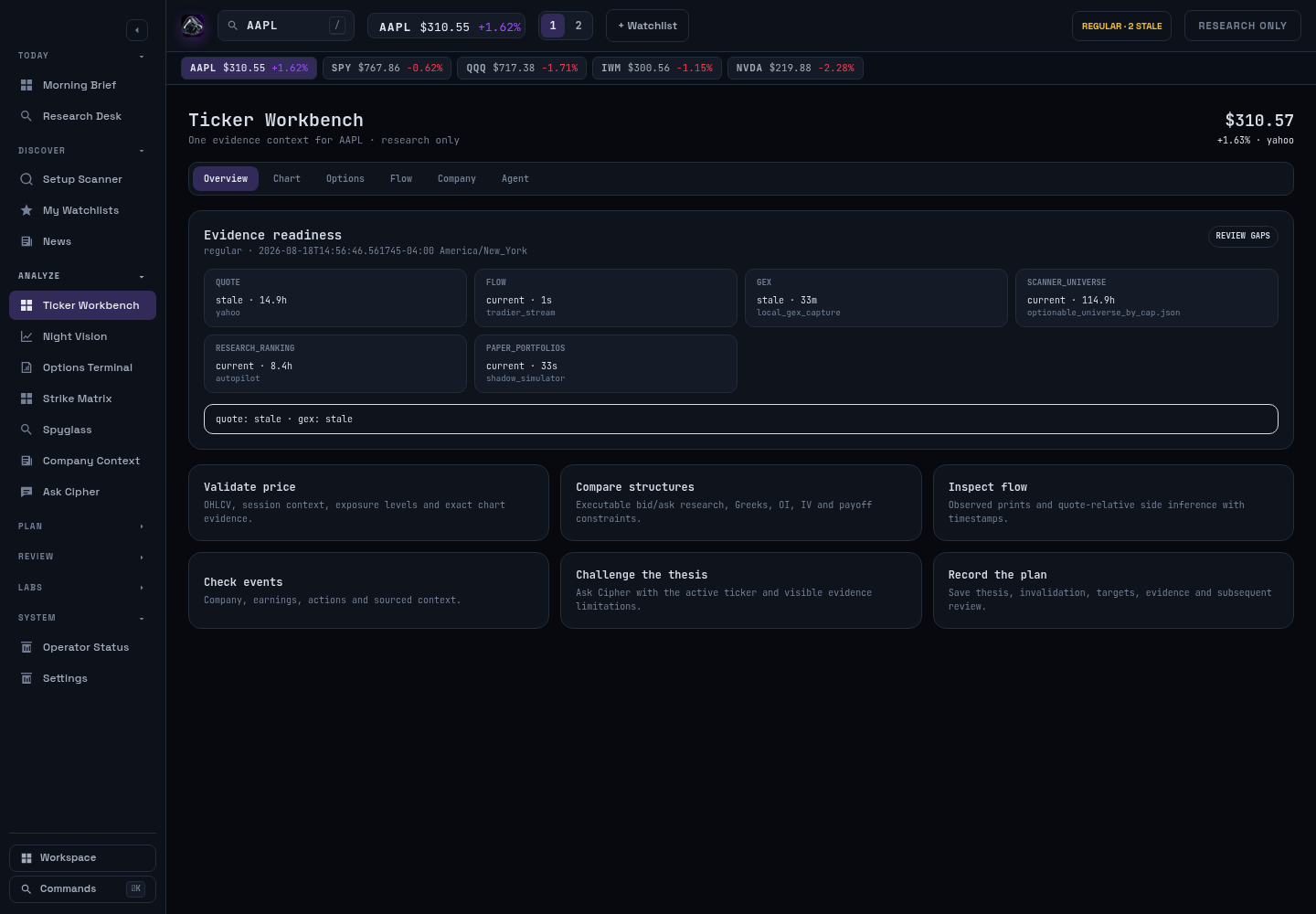
Cipher is a read-only AI research copilot for stock and options traders. It runs the whole research loop as one calm, traceable workflow:
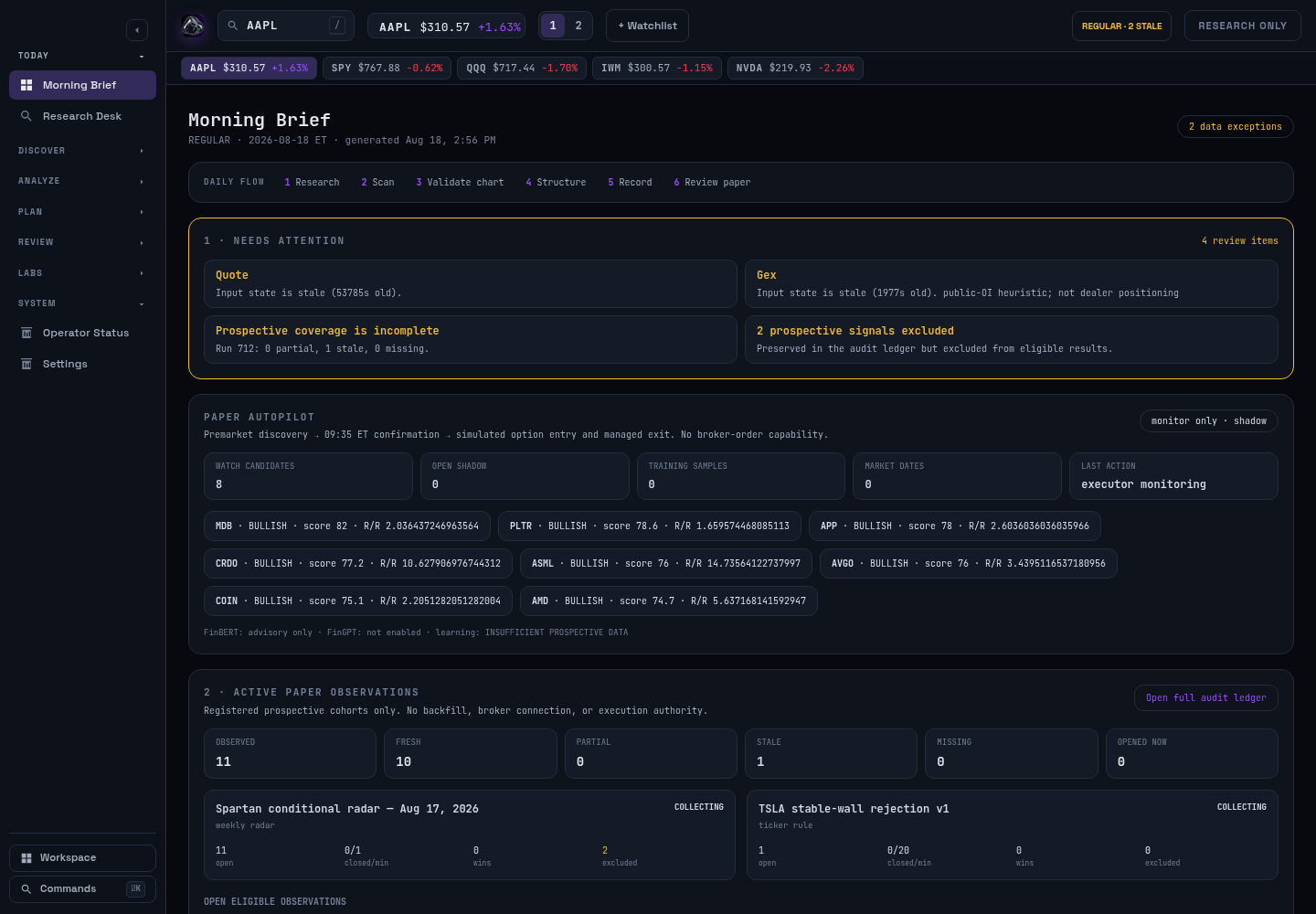
- Morning Brief — surfaces session state and freshness before anything else, flagging stale or unavailable inputs instead of hiding them.
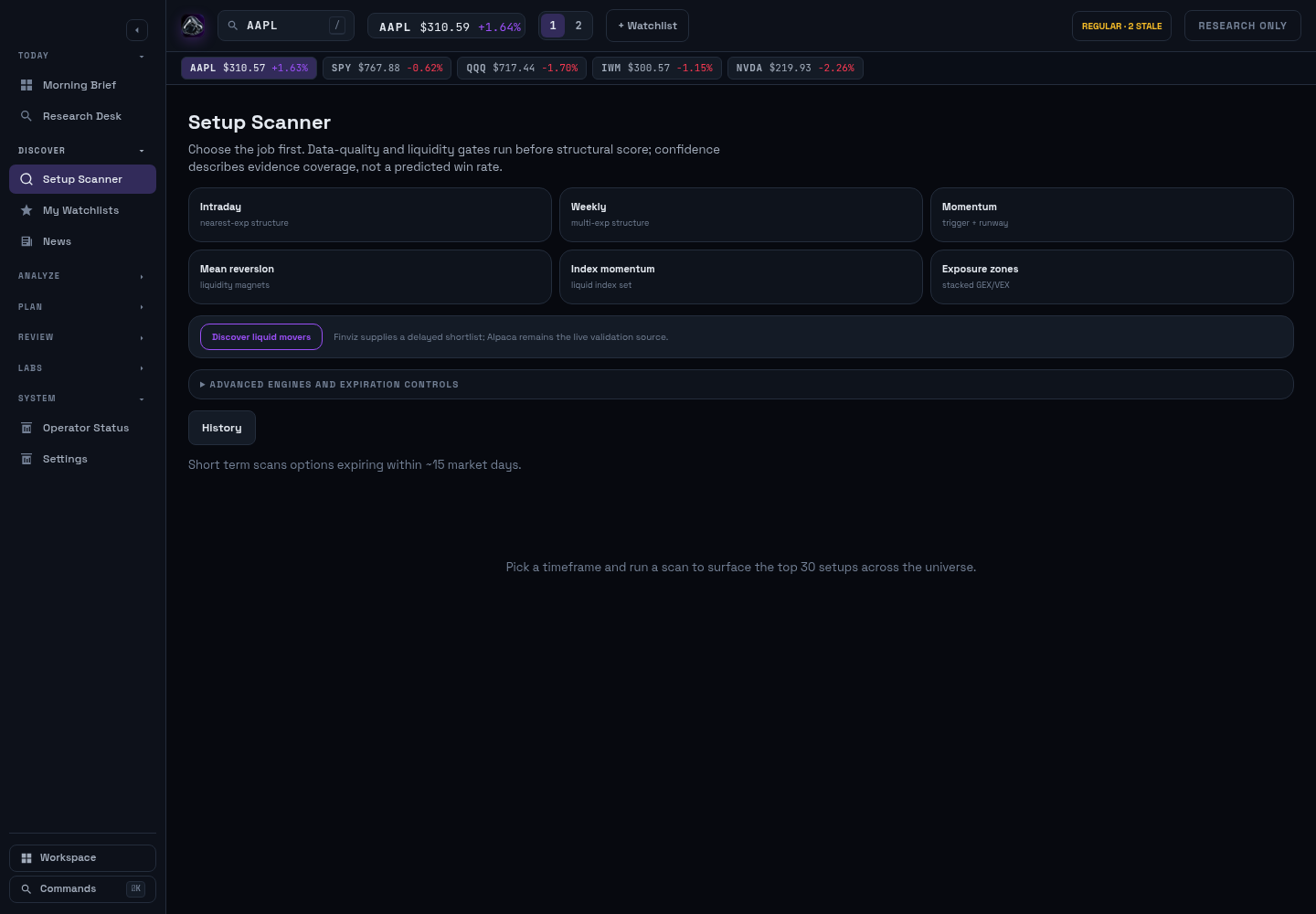
- Setup Scanner — ranks candidates only when the evidence is fresh and sufficient, and preserves every rejection reason in the audit trail.
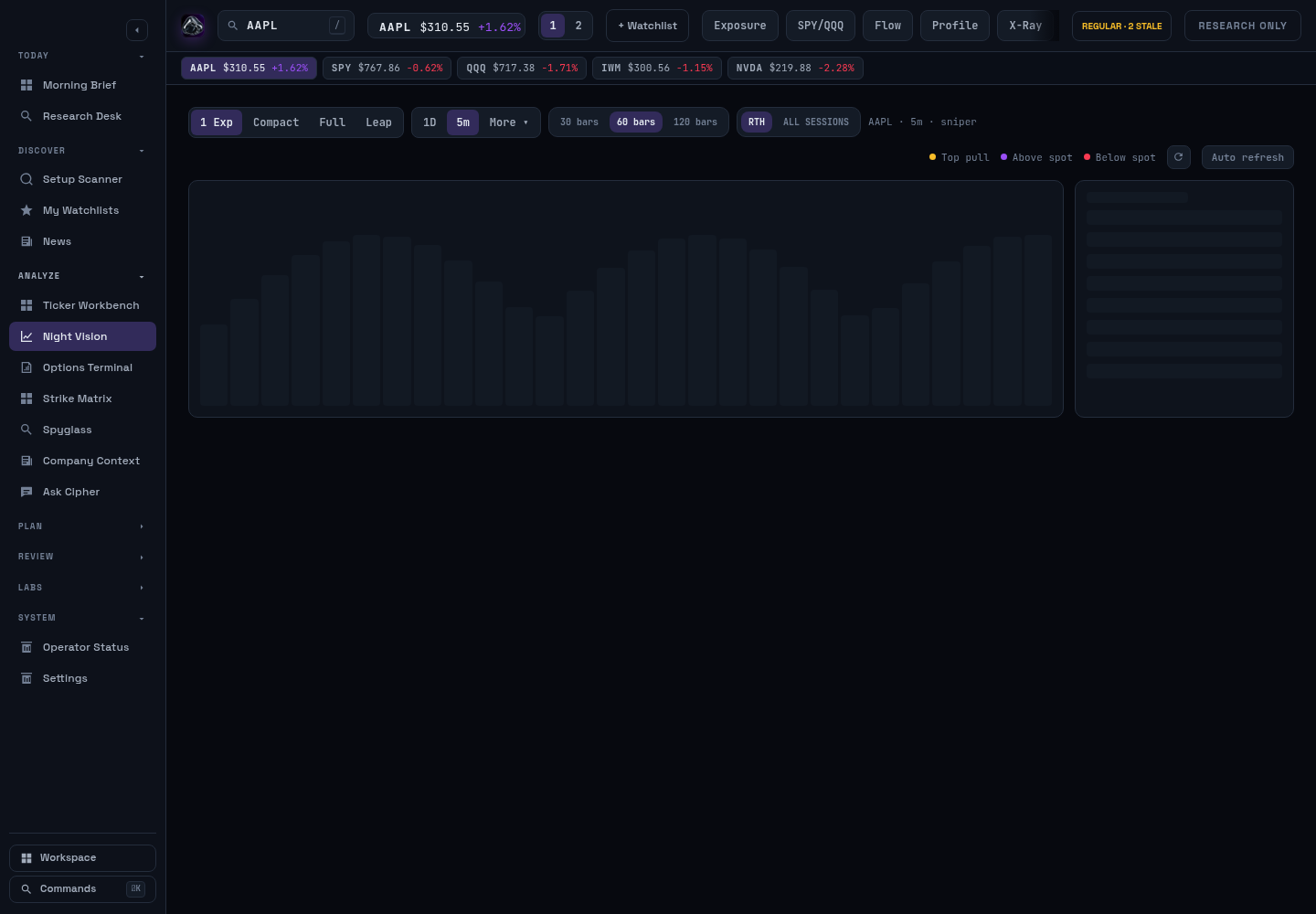
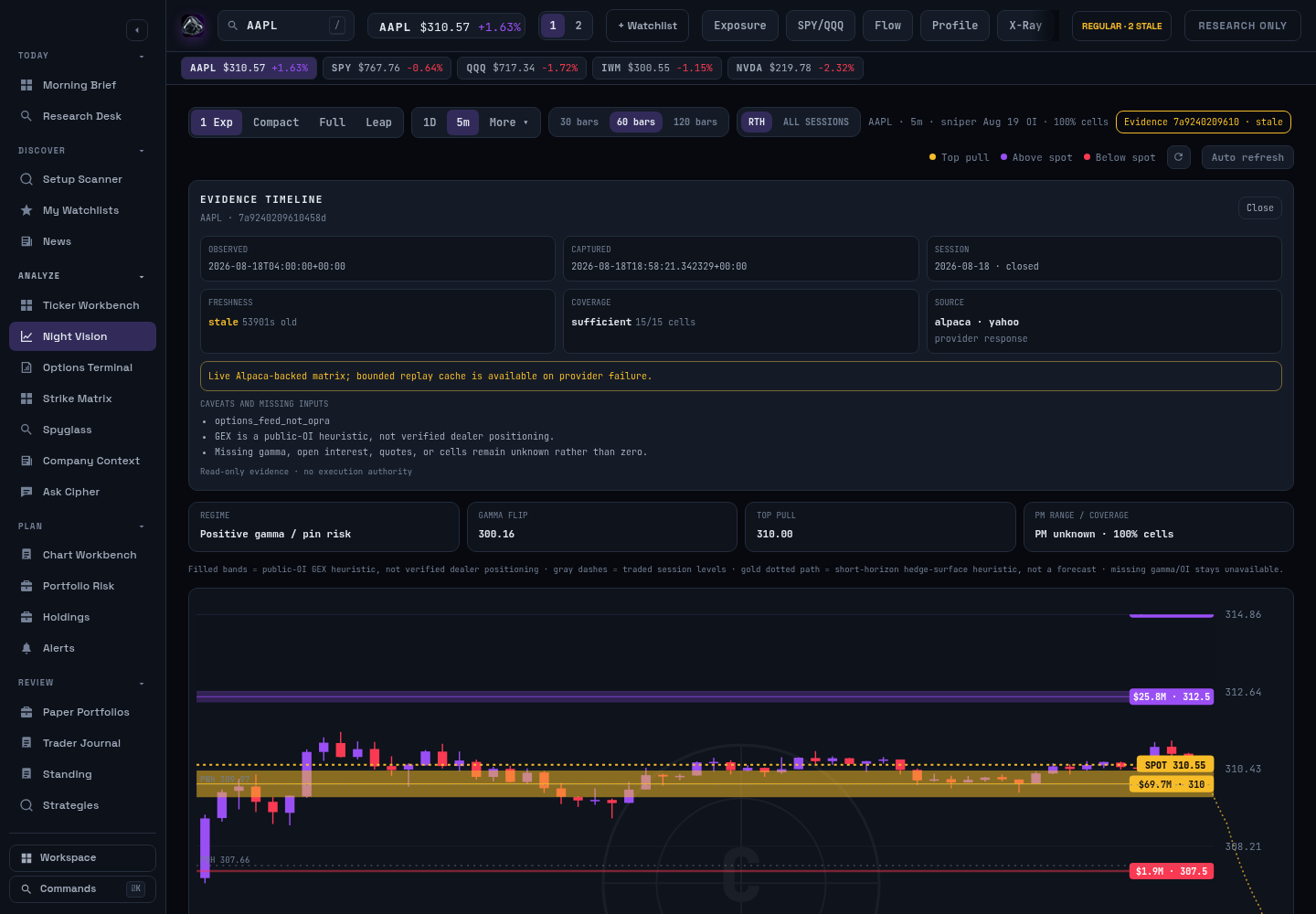
- Night Vision — combines price, session levels, and public-OI exposure, and lets you replay the exact evidence snapshot behind a scan, verified by a snapshot identity checksum.
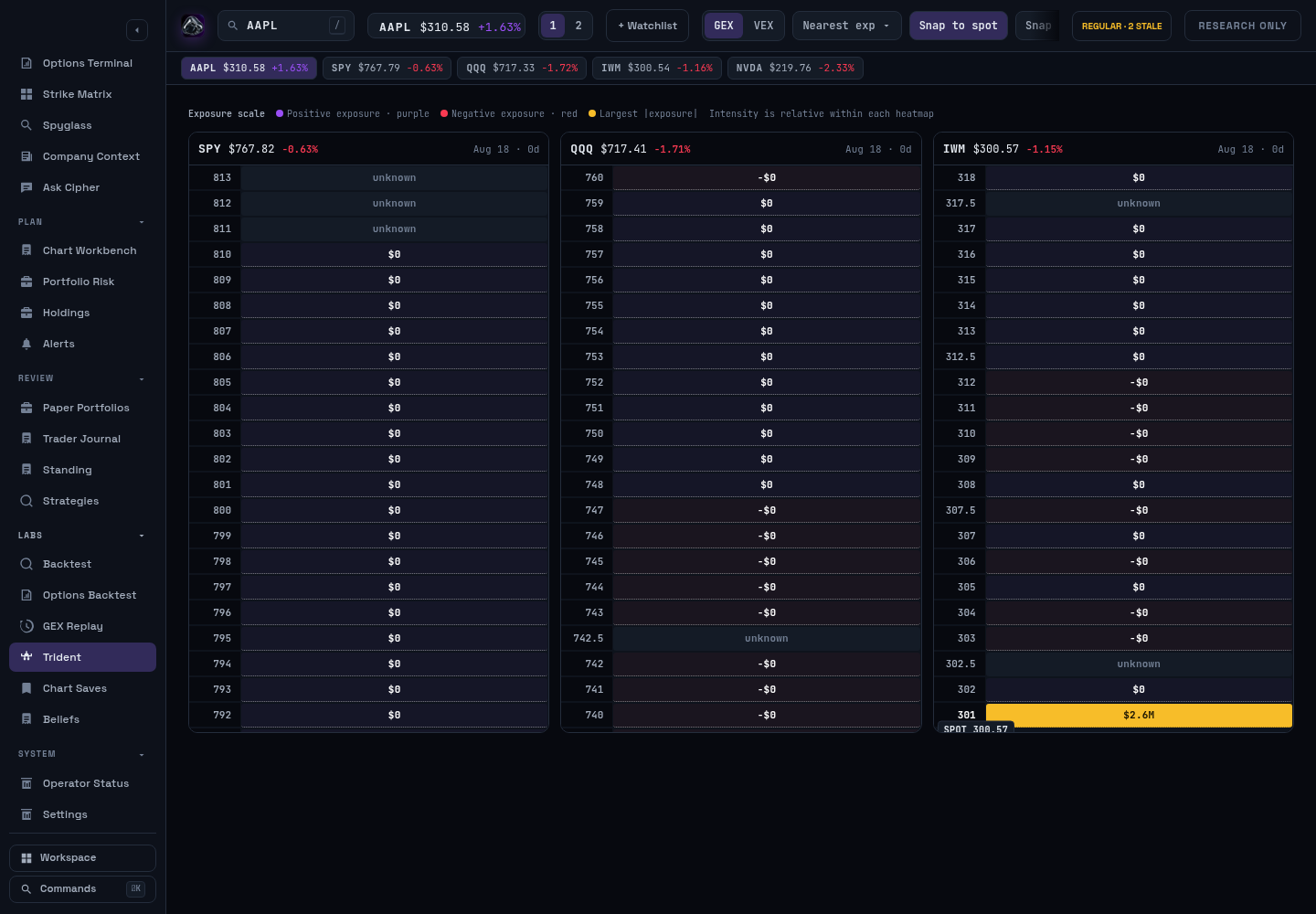
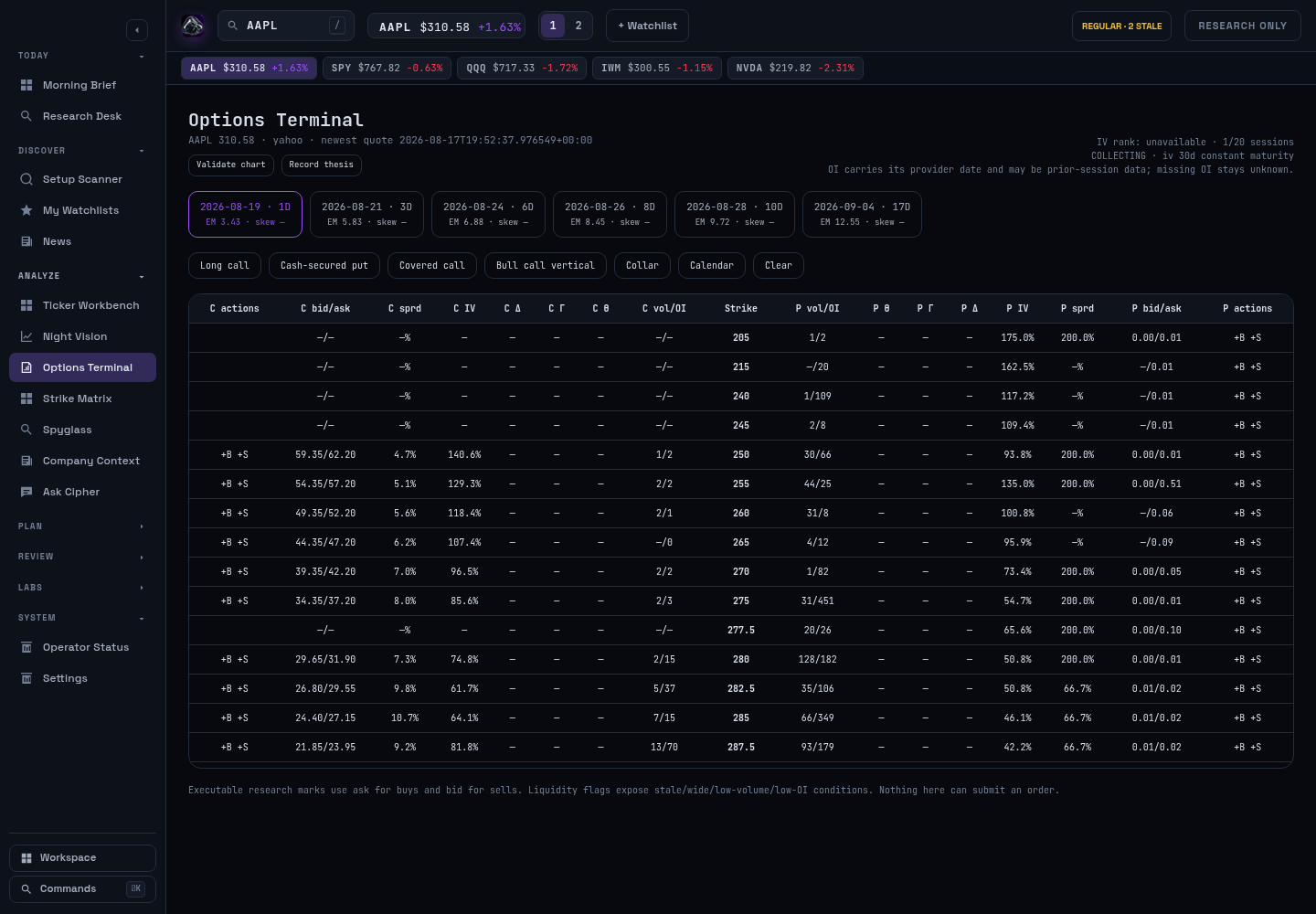
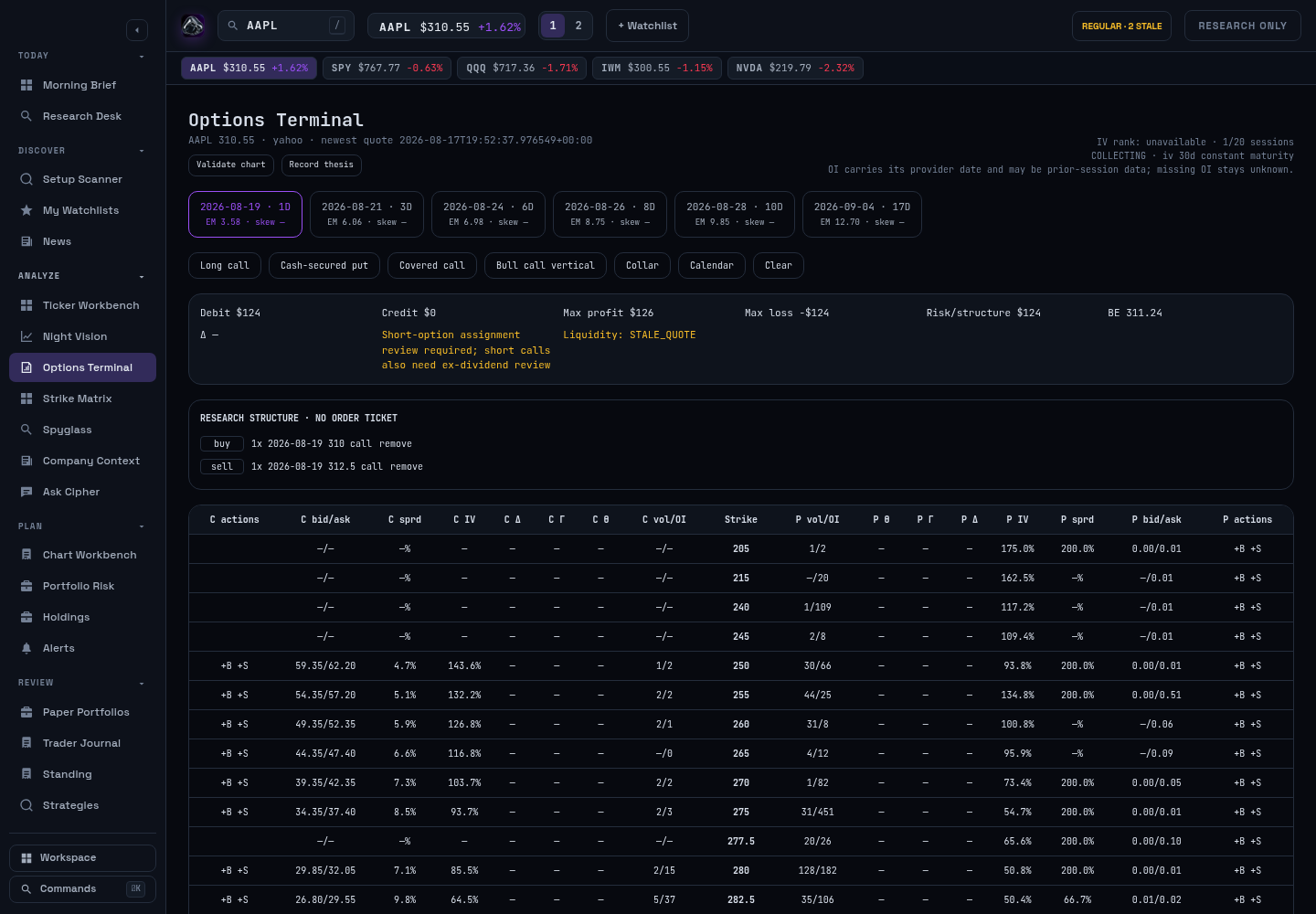
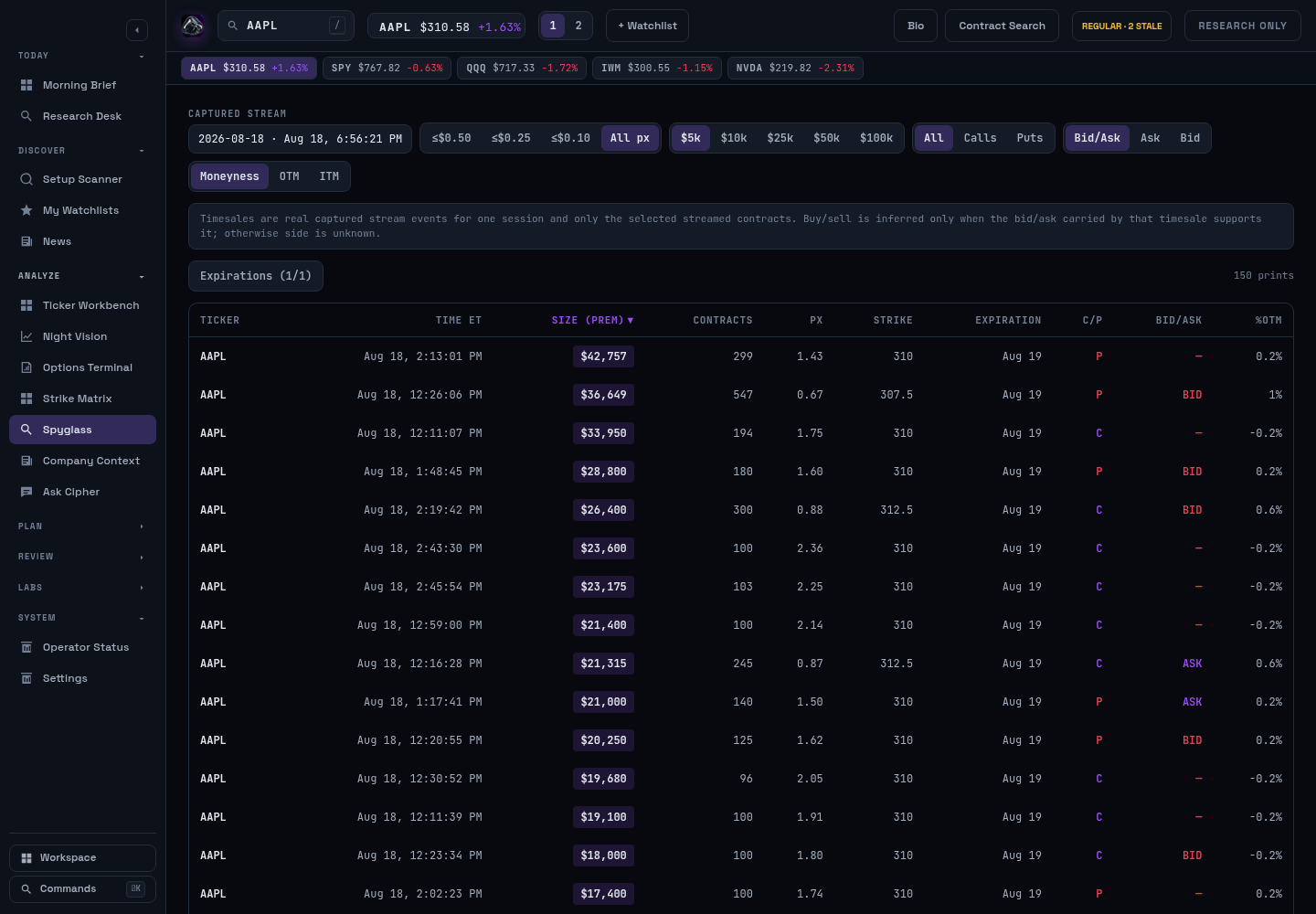
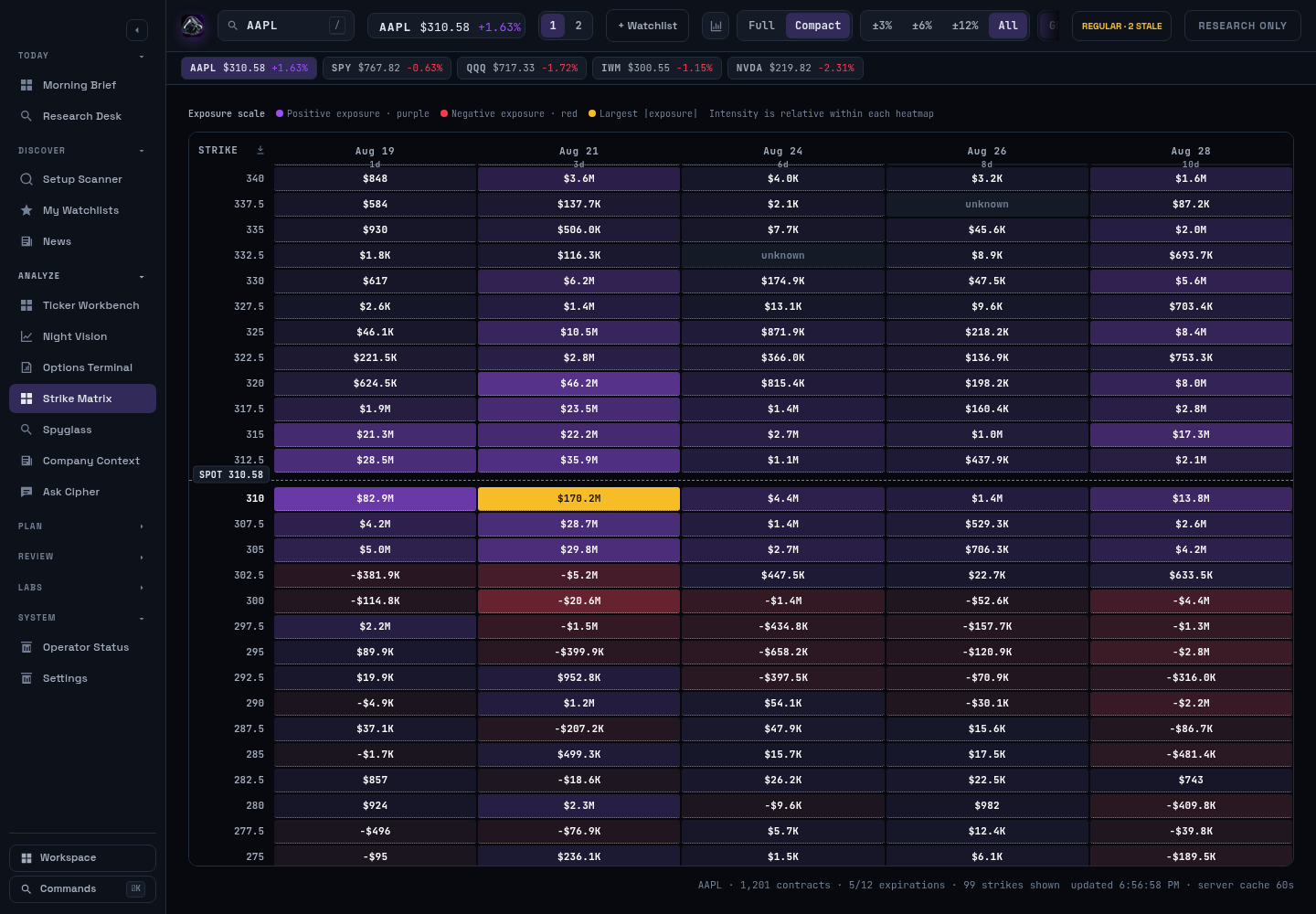
- Options Terminal & Strike Matrix — evaluate expirations, strikes, bid/ask, OI, volume, Greeks, and IV using only fields the feed actually provided. Unavailable data stays visibly unknown — never converted to zero.
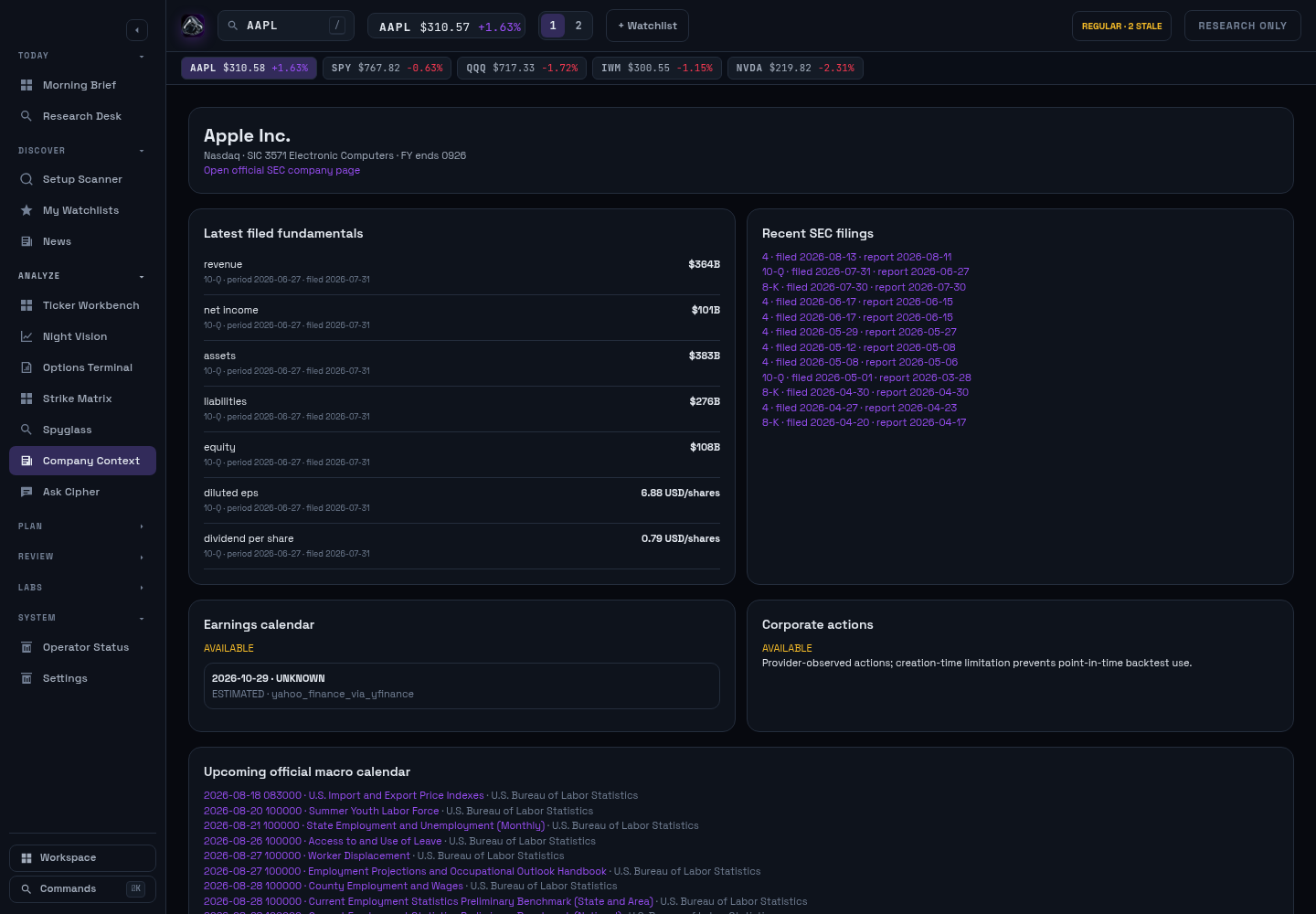
- Research Desk — a bounded agent writes evidence-backed memos on large, liquid, volatile names, citing provider, feed, event time, and coverage.
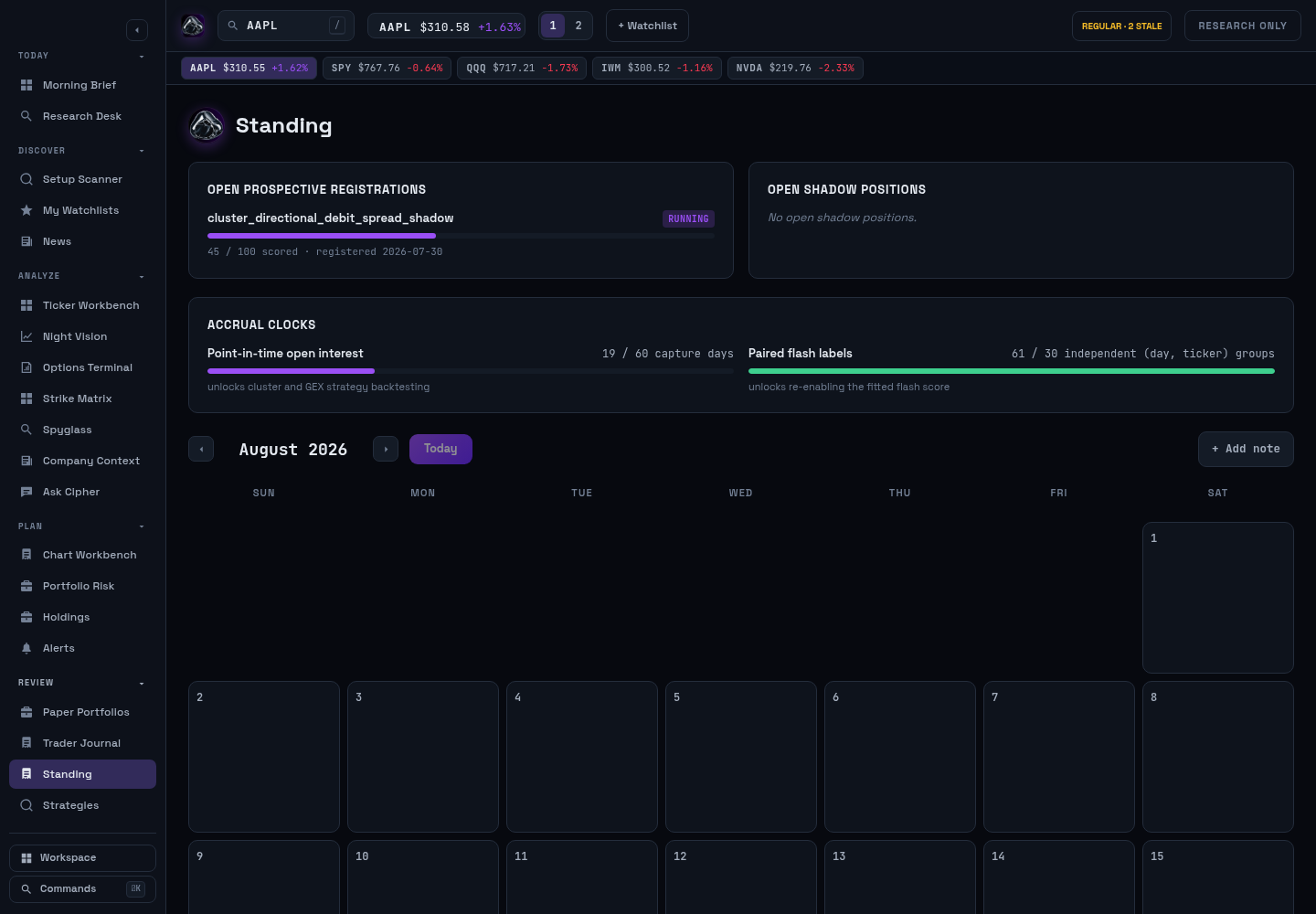
- Paper Portfolios & Autopilot — six isolated simulation portfolios with realized, midpoint-marked, and conservative liquidation equity. The autopilot discovers before the open, waits for a closed-bar confirmation, applies hard loss/position/time limits, and writes a replayable decision trace. It has no order authority — there is no broker client anywhere in the product.
How we built it
- Backend: a Python standard-library HTTP API with explicit response budgets, bounded background refreshes, and SQLite/WAL ledgers for events, experiments, GEX history, journals, and paper portfolios.
- Data: Alpaca OPRA options and SIP/IEX stock data as the primary feed. When no Alpaca session exists, an anonymous yfinance fallback still serves delayed quotes, bars, chains, and a degraded strike matrix — clearly labeled, never passed off as live OPRA.
- Frontend: Next.js/React/TypeScript terminal served as a static export, with a Node.js same-origin authenticated proxy.
- Hosting: Vercel (public frontend) + Supabase Auth with row-level
security for per-user isolation + a backend VM. Login uses a secure
HttpOnlycookie; the Supabase token lives only in backend memory. A guest mode lets anyone explore delayed market data without an account or any keys. - Security by construction: Alpaca keys are session-only in memory, never persisted to Supabase, Vercel, browser storage, logs, or cookies. The autonomous components trade only the simulator.
The GEX model follows a fixed public convention — call gamma × OI × 100 × spot² × 0.01 — and is always labeled as a public-open-interest heuristic, not verified dealer positioning:
$$ \text{call_gex} = \gamma_c \cdot OI_c \cdot 100 \cdot S^2 \cdot 0.01 $$
Challenges we faced
- Response budgets. Live flow refreshes could take seconds; we bounded
them to ~2.5 s with deduplication and explicit
unavailablestates instead of timeouts disguised as data. - Replay integrity. Night Vision replays had to show exactly what the scanner saw. We gave every snapshot a SHA-256 identity and recomputed all 104 legacy evidence artifacts so a tampered matrix is rejected, not silently replayed.
- No-fake-data discipline. When yfinance or degraded feeds can't provide OPRA trades, Greeks, or flow, the UI says so explicitly — it never manufactures zeros.
- Hosted deployment without key exposure. Standing up multitenant auth (Supabase RLS + cookie sessions + guest mode) while keeping Alpaca and service secrets out of the browser and the frontend host.
- One clean repository. We consolidated weeks of research, an earnings model, EOD strategy code, and diagnostics from scattered local checkouts into a single public repository with bulk data gitignored.
What we learned
Honesty is a feature. Labeling a source as delayed, a Greek as unavailable, or an experiment as not-yet-rankable builds more trust than a confident number ever could. We also learned that read-only is a product decision, not a limitation: every "missing" datapoint became a UI state to design for, and every refusal to auto-execute became a story about giving the human the final decision.
What's next
- A stable public HTTPS API hostname so the live demo works for everyone.
- Additional read-only provider adapters (normalized, degraded-mode aware).
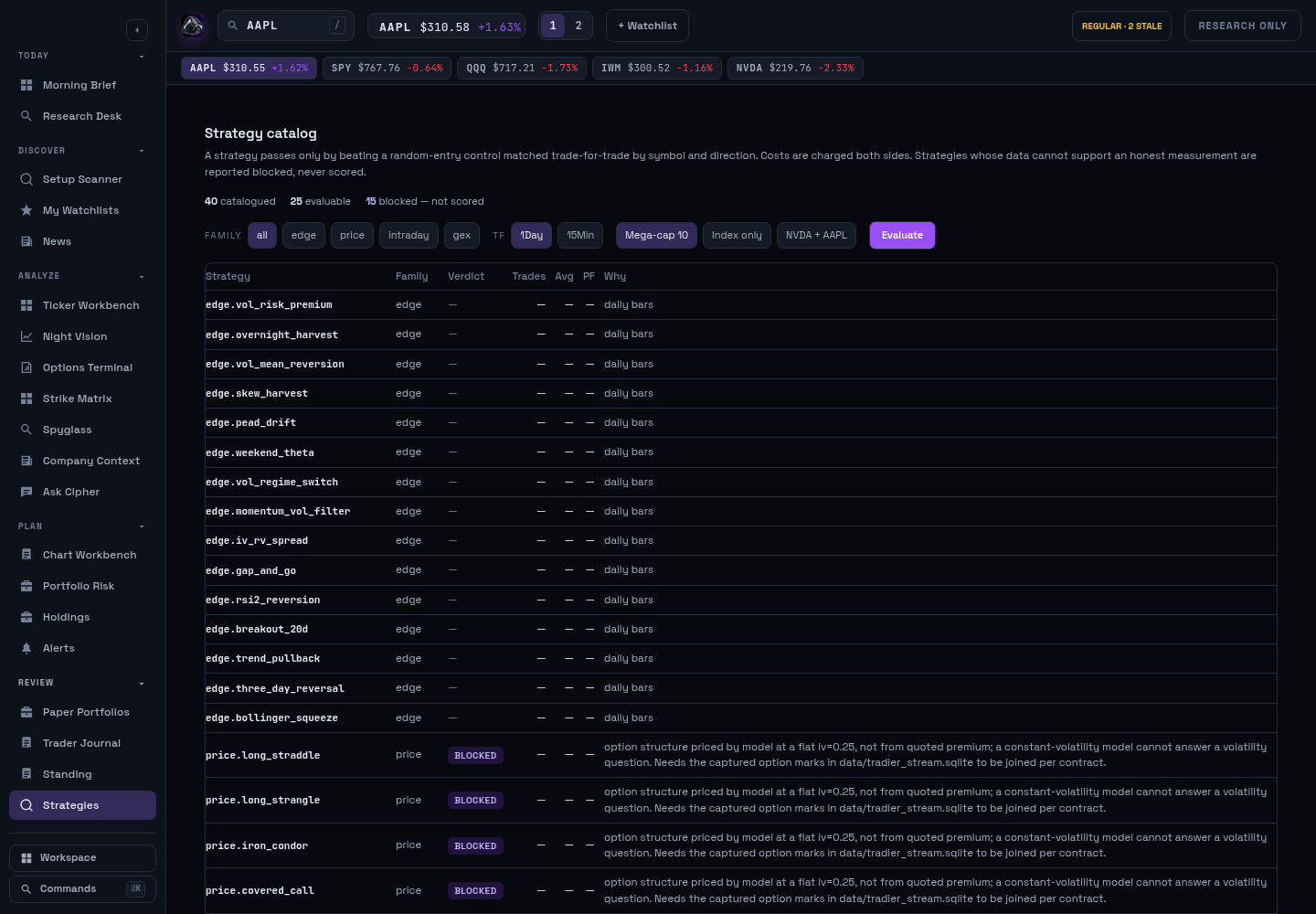
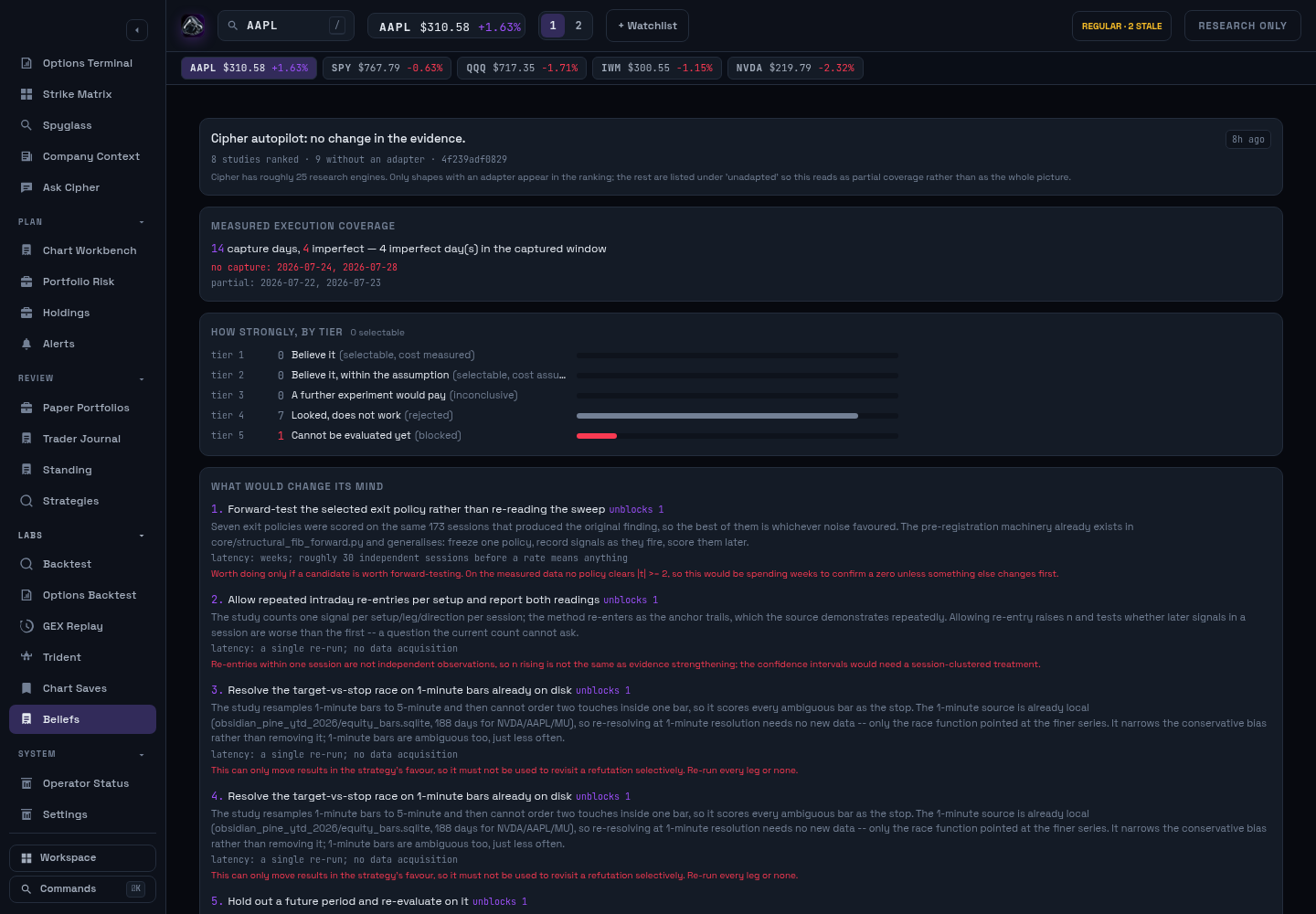
- More prospective-validation cohorts so strategies earn rankability the slow, honest way.
Built With
- alpaca
- cloud
- css
- face
- finbert
- hugging
- market
- next.js
- node.js
- options
- playwright
- pytest
- python
- react
- sqlite
- supabase
- systemd
- tailscale
- tailwind
- trading
- typescript
- vercel
- websockets
- yfinance


Log in or sign up for Devpost to join the conversation.