
Inspiration
In the fast-paced legal landscape of British Columbia, laws aren't just rules—they are moving targets. Between 2024 and 2026, the province overhauled everything from housing registries to labor standards, leaving residents lost in a maze of outdated PDFs and dead links. As a Computer Science student with a passion for logic and mathematics, I saw a "data gap" where people needed a "truth engine." I built Cipher BC to act as a high-tech decryption key, turning dense government statutes into instant, actionable clarity.
What it does
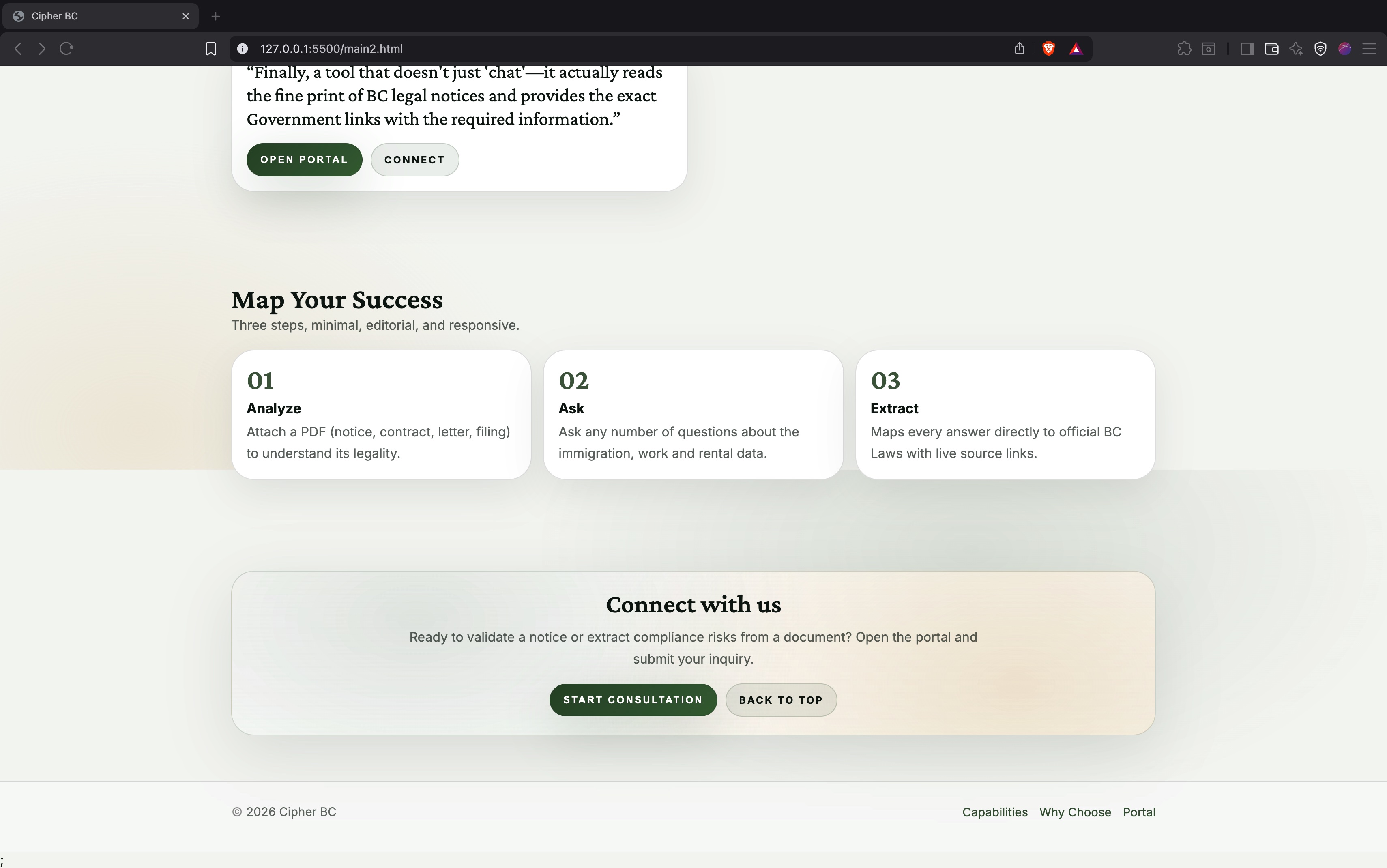
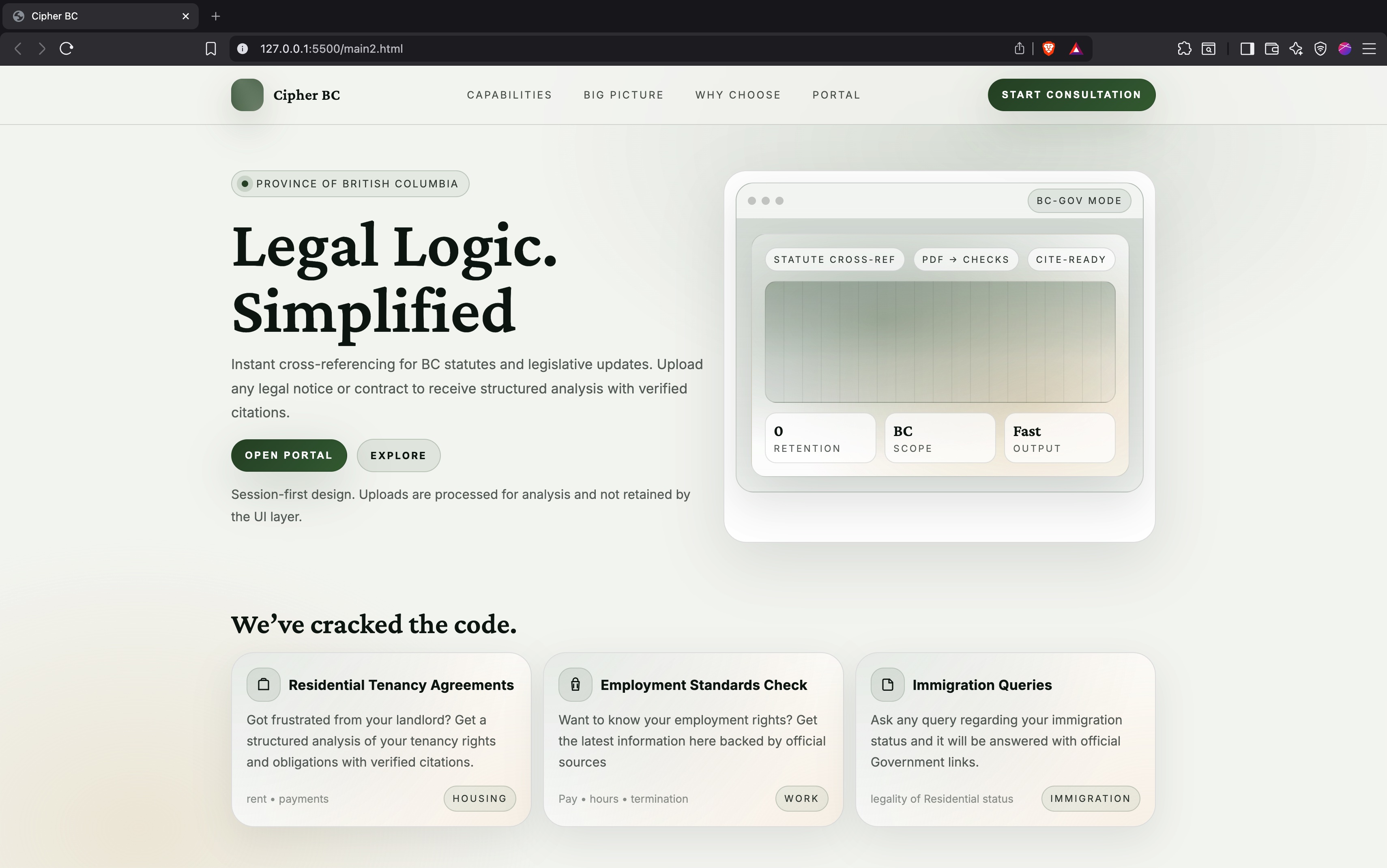
Cipher BC is a precision legal navigation portal that functions like a GPS for your rights.
The Truth Engine: It bypasses third-party noise to surface absolute, current rules on Rental Law, Labor Standards, and Immigration.
Document Intelligence: Users can drop a legal notice (PDF) into the terminal, and the system instantly validates it against the latest BC statutes.
Source Anchoring: It doesn't just give answers; it provides a direct bridge to the official record with mandatory government source links.
How we built it
The project is engineered with a "Zero-Trust" architecture for legal data:
The Brain: GPT-4o handles complex intent classification and legal interpretation.
The Scout: The Tavily API performs deep-sea searches across official gov.bc.ca and canada.ca domains, ensuring we only pull from the source of truth.
The Logic: A custom "Global Recency" prompt directive overrides the AI’s internal memory, forcing it to prioritize live "Last Updated" metadata from 2026.
The UI: A bold, cyberpunk-inspired interface featuring an interactive particle canvas, reflecting the high-tech nature of modern LawTech.
Challenges we ran into
The biggest hurdle was "Temporal Hallucination"—AI's tendency to confidently quote old laws from its training data. To solve this, I had to build a strict Retrieval-Augmented Generation (RAG) pipeline. This logic acts as a filter, forcing the system to ignore everything it "thinks" it knows and rely exclusively on the live, verified context retrieved from the web.
Accomplishments that we're proud of
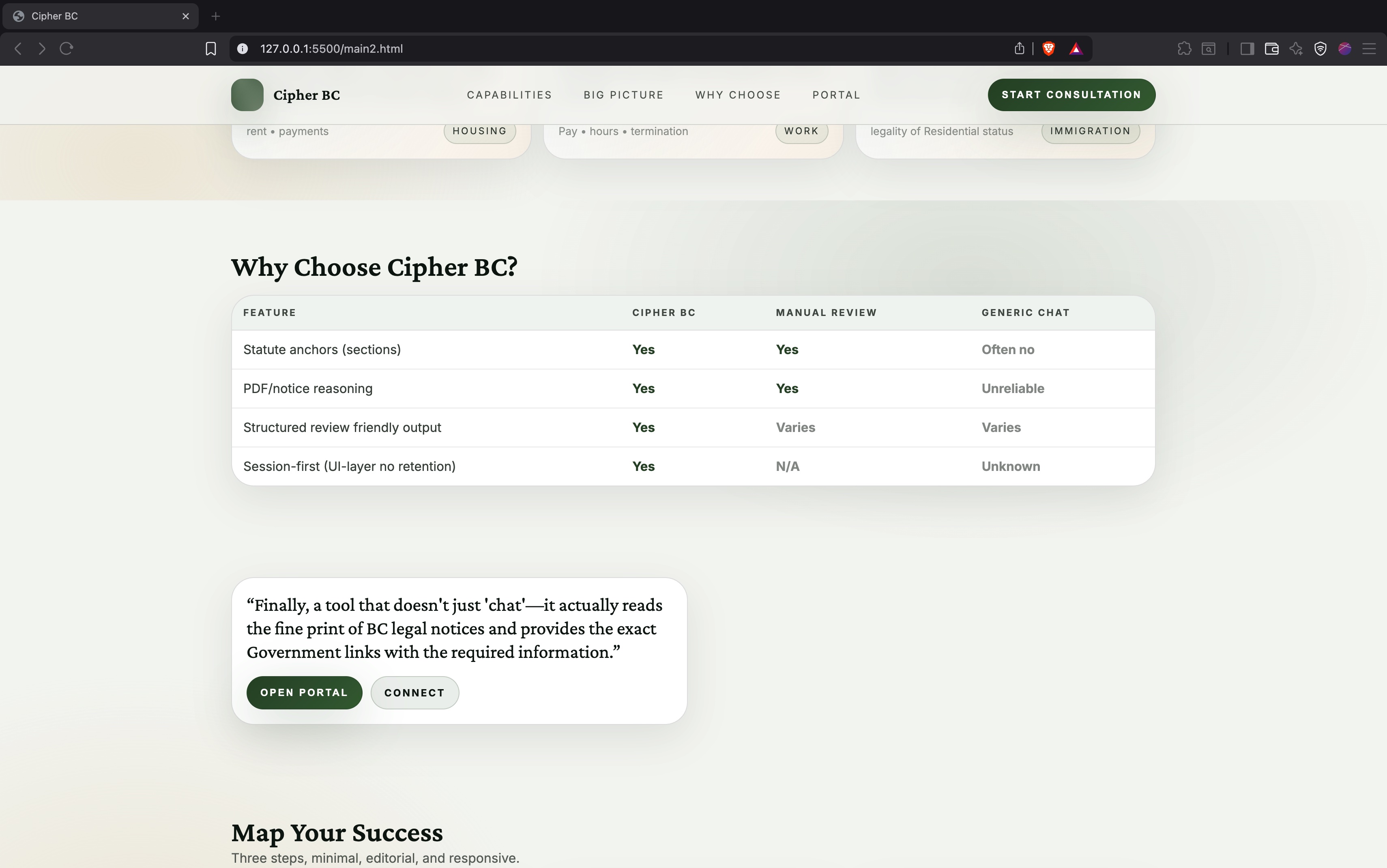
Zero-Fluff Protocol: We successfully stripped away the "AI chatter," creating a tool that provides immediate, hard facts with surgical precision.
Real-Time Sync: The system successfully identifies and applies the 2026 legal caps and thresholds that standard search engines haven't indexed clearly yet.
Seamless Integration: Merging a complex Python backend with a high-performance React frontend to create a smooth, "portal-like" experience.
What we learned
Building Cipher BC taught me that in the world of Legal Technology, Data Hierarchy is everything. I learned that a developer's job isn't just to write code, but to build a reliable bridge between a citizen and their rights. I sharpened my skills in prompt engineering, RAG architectures, and the art of building "human-in-the-loop" verification systems.
What's next for Cipher-BC
The future of Cipher BC is visual. We are developing an OCR-Vision pipeline to allow users to snap a photo of a physical eviction notice and get an instant validity check. We also aim to expand into municipal-level bylaws, ensuring that whether you're in Vancouver or Victoria, your legal "Cipher" is always up to date.
Built With
- api
- css
- flask
- html5
- javascript
- openai
- pypdf
- python
- rag

Log in or sign up for Devpost to join the conversation.