
Inspiration
Why do so many promising ideas never become real projects?
Over the years, I have seen communities, NGOs, researchers, municipalities, and entrepreneurs struggle not because they lacked good ideas, but because project formation is fragmented. Knowledge lives across documents, conversations, spreadsheets, emails, funding portals, and increasingly across different AI tools. Every new funding application often starts almost from scratch, even when much of the required knowledge already exists.
I wanted to build something different: an operating system that remembers, coordinates, and helps transform ideas into funded, accountable, and execution-ready projects.
That became CIOS — Collective Intelligence Operating System.
What it does
CIOS is an AI-assisted coordination platform that transforms ideas into structured, execution-ready projects.
Starting from a simple intention, CIOS guides users through project formation by generating clarifying questions, creating reusable project briefs, identifying stakeholders, connecting knowledge, discovering funding opportunities, building action plans, and preparing funding applications.
CIOS is not another general-purpose chatbot. It is a coordination layer that combines structured workflows with bounded AI assistance while preserving project context, authority, provenance, and human oversight.
During OpenAI Build Week, CIOS evolved into a working funding application and official-source intelligence system.
The deployed workflow now supports:
official document
→ immutable version
→ opportunity-scoped deterministic extracts
→ AI-assisted requirement proposals
→ human review
→ activated requirements
→ exact citations
Reviewed requirements can then support structured application sections, evidence mapping, and AI-assisted drafting in the funding application workspace.
How I built it
CIOS combines deterministic workflows with governed AI generation.
The platform is built with Next.js, FastAPI, PostgreSQL, SQLAlchemy, Alembic, Docker, Google Cloud Run, and a modular AI architecture with guarded Gemini support.
Deterministic extraction is used before AI interpretation. AI outputs are validated, auditable, and non-authoritative until a human explicitly reviews and accepts them.
Throughout OpenAI Build Week, Codex became an integral engineering partner. Together, we inspected the existing codebase, designed bounded implementation slices, implemented backend and frontend changes, added regression tests, reviewed failures, deployed production revisions, and refined the product while keeping architecture and product decisions human-led.
The main Build Week work included:
- Project identity, organisations, memberships, representation, and project-scoped authority
- Funding Application Workspace with requirements, answers, evidence mapping, and AI-assisted drafting
- Official document registration and immutable versioning
- Shared immutable document versions across multiple funding opportunities
- Deterministic opportunity-scoped extraction
- Parser-run history and preserved failed attempts
- Read-only inspection of exact source extracts and technical provenance
- AI-assisted official requirement interpretation
- Human review, editing, acceptance, rejection, and activation
- Exact extract-to-proposal-to-requirement citation lineage
- Shared AI generation controls, task allowlisting, usage guardrails, and revision provenance
- Durable Action Plan commitments with ownership, due dates, origin, and immutable revisions
- Artifact and reusable knowledge governance
- Production hardening, deployment, rollback, documentation, and repository publication
Challenges I ran into
The biggest challenge was not integrating AI. It was deciding where AI should not be used.
Many workflows benefit more from deterministic systems, structured data, and human review than from unrestricted text generation. Building trustworthy coordination required balancing automation with transparency and ensuring every AI-generated result remained reviewable, traceable, and reversible.
A second challenge was safely reusing one official document across multiple funding opportunities. CIOS had to prevent extracts from one topic leaking into another, even when both opportunities referenced the same immutable source file.
Another challenge was maintaining architectural consistency while rapidly extending an existing production platform. Every new capability had to strengthen the overall coordination system rather than become another isolated AI feature.
Accomplishments that I am proud of
CIOS is much more than an AI demo.
During Build Week, I transformed an existing project-formation platform into a substantially more complete coordination system with production-proven official-source intelligence, governed AI interpretation, and evidence-aware application workflows.
I am especially proud of:
- An end-to-end project formation workflow
- A structured funding application workspace
- AI drafting grounded in project context and evidence
- Immutable official document versions and exact source provenance
- Deterministic opportunity-scoped extraction without cross-topic leakage
- Real Gemini-generated requirement proposals with strict validation
- Human review before any requirement becomes authoritative
- Exact citations linking accepted requirements back to source extracts
- Durable commitments connected to project origin, ownership, and responsibility
- Production deployment with health checks, rollback checkpoints, and guarded AI usage
- Public product and architecture briefings, with a privately distributed full handbook
What I learned
One lesson became very clear:
People do not need another chatbot. They need better coordination.
Large language models are powerful, but lasting value comes from combining them with structured workflows, persistent project memory, provenance, clear authority, and thoughtful user experience.
I also learned that deterministic extraction and human governance should come before AI automation. AI is most valuable when it helps interpret evidence, propose options, and accelerate drafting without silently becoming the authority.
Using Codex also demonstrated how valuable AI pair programming can be. It allowed me to move faster across product design, backend architecture, frontend implementation, testing, debugging, deployment, and documentation while preserving human review and decision-making.
What is next for CIOS
The immediate next step is connecting official application templates, annexes, and portal forms to the existing funding application workspace.
The target workflow is:
official application document
→ extracted candidate fields
→ human-reviewed submission schema
→ generated application requirements
→ evidence-grounded drafting
→ completeness checks and export
This would allow CIOS to move from interpreting what a funding opportunity expects to generating the actual structured application experience required for submission.
Beyond funding, the vision is broader.
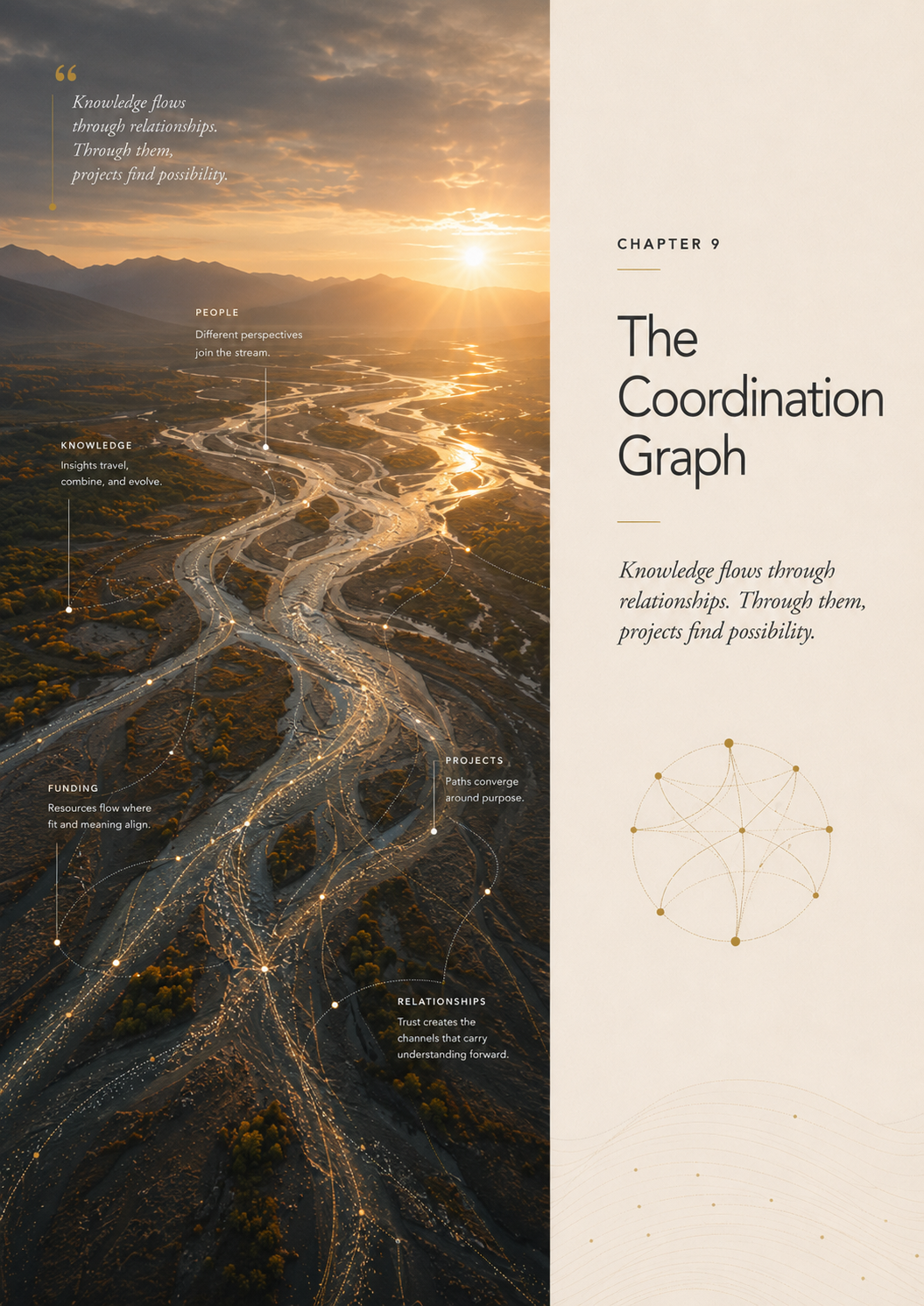
CIOS aims to become persistent coordination infrastructure for organisations: connecting people, knowledge, funding, documents, decisions, commitments, evidence, and AI into a shared operational memory that helps communities turn more good ideas into accountable collective action.
This is only the beginning.
Built With
- alembic
- docker
- fastapi
- gemini
- github
- google-cloud
- google-cloud-run
- google-cloud-sql
- gpt-5.6
- next.js
- openai-codex
- postgresql
- pydantic
- python
- react
- rest-api
- sqlalchemy
- tailwind-css
- typescript

Log in or sign up for Devpost to join the conversation.