





Inspiration
Good projects rarely fail because people lack ideas. They fail because turning an idea into something fundable and executable requires navigating fragmented funding calls, eligibility rules, partner requirements, evidence, documents, deadlines, and institutional knowledge.
CIOS started as a coordination system for turning an early project idea into a structured project brief, stakeholder map, funding pathways, knowledge, and an action plan. For this hackathon, we pushed that concept further: what if the funding and partnership layer itself became agentic?
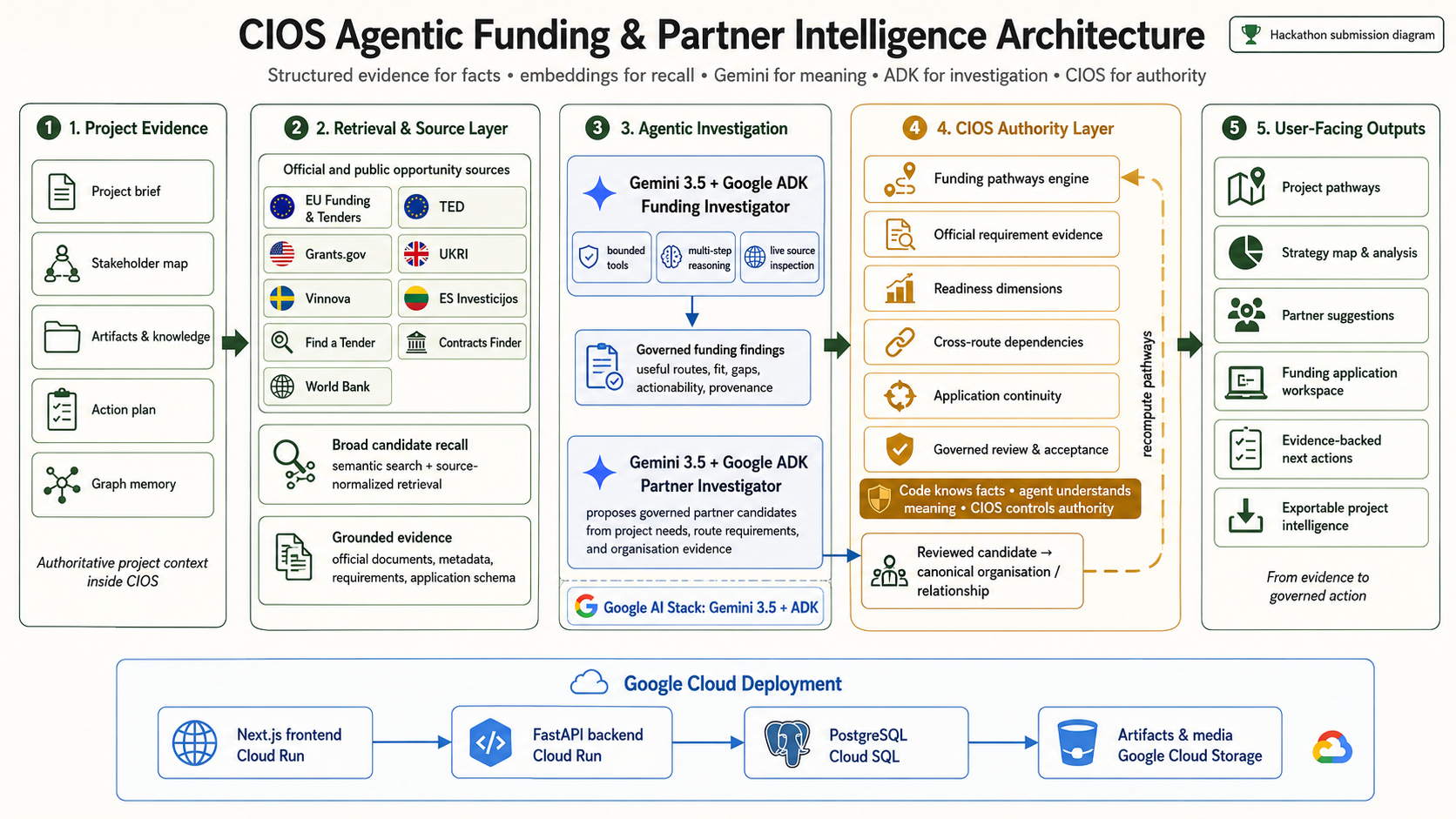
Instead of asking a model for a generic list of grants, CIOS coordinates specialised investigators that search across real funding and organisational sources, preserve provenance, reason over project state, and return governed next actions.
What it does
CIOS — Agentic Funding & Partner Intelligence turns a project into a continuously inspectable strategy.
A user can:
- Build a structured project context from an initial idea.
- Ask Funding Investigator to search beyond the existing opportunity catalogue.
- Combine deterministic project evidence with agent-discovered funding routes.
- Inspect why a route is relevant, what evidence is missing, and what must happen before it becomes actionable.
- Ask Partner Investigator to search for organisations that can satisfy missing consortium, capability, geography, or eligibility requirements.
- Save investigator findings back into the governed project workspace for review.
- Continue from a funding pathway into application preparation, evidence mapping, requirements, action planning, and execution.
The important distinction is that agent output is not treated as authoritative project truth.
CIOS separates:
- deterministic facts and persisted project evidence;
- external source evidence;
- agent-generated recommendations;
- human-reviewed or accepted state.
This lets agents explore aggressively without silently rewriting the project.
Agentic architecture
The system uses specialised agent workflows rather than one general-purpose prompt.
Funding Investigator
The Funding Investigator searches external funding sources and produces structured candidate pathways grounded in source evidence.
The current system supports multiple source families, including:
- EU Funding & Tenders
- Grants.gov
- Vinnova
- TED / European procurement sources
- UK Contracts Finder / Find a Tender
- World Bank procurement evidence
Candidate routes are analysed against the project and returned with provenance, evidence gaps, readiness, and recommended next actions.
Partner Investigator
When a route depends on a missing partner, consortium role, geography, capability, or organisation type, Partner Investigator can investigate organisations and return grounded candidates.
The handoff is contextual: the agent receives the project, the funding route, and the unresolved requirement rather than performing an unrelated organisation search.
Governance layer
Agent findings remain proposals until explicitly persisted or reviewed.
CIOS keeps source lineage, generation metadata, application continuity, project relationships, and accepted state separate from AI-assisted estimates.
This means the product can answer not only:
“What should we pursue?”
but also:
“Why?”
“Based on which evidence?”
“What is still uncertain?”
“What must happen next?”
“Which partner or capability would unlock it?”
Project pathways
The Pathways workspace connects agent investigation to execution.
Instead of presenting funding opportunities as a flat recommendation list, CIOS models them as routes through the current project state:
- routes that are actionable now;
- routes that become available after specific milestones;
- routes blocked by missing evidence;
- routes requiring partner or consortium development;
- longer-term funding or growth options;
- existing applications already in motion.
The same project can therefore move from exploration → investigation → evidence → partner discovery → application → execution without losing provenance.
Example: Project Aether
Our current demonstration project is Project Aether, a wearable edge-compute and secure-signing device.
CIOS contains its project brief, stakeholders, artifacts, action plan, graph memory, generated identity, funding evidence, investigator findings, partner relationships, and application state.
Funding Investigator can analyse the project against external opportunities, while Partner Investigator can investigate organisations needed to satisfy specific route requirements.
This gives us a realistic end-to-end environment rather than a static hackathon mockup.
How we built it
CIOS uses:
- Gemini 3.5 for agentic investigation and structured AI workflows
- Google ADK for agent orchestration
- FastAPI backend
- Next.js / TypeScript frontend
- PostgreSQL for governed project state and provenance
- Google Cloud Run for deployment
- Cloud SQL for persisted application data
- Google Cloud Storage for project artifacts
- deterministic matching and readiness logic alongside AI-assisted investigation
We deliberately use deterministic systems for hard facts such as project state, existing applications, source identifiers, accepted relationships, structured requirements, and persisted evidence.
Agents are used where semantic investigation and synthesis add value.
Challenges
The hardest problem was not simply calling an LLM.
It was defining the boundary between agent reasoning and authoritative system state.
Funding and partnership data is messy. Sources differ dramatically in structure, terminology, geography, application mechanics, and available evidence. A useful agent must be able to search broadly, but the product cannot allow speculative model output to become accepted project truth.
We therefore spent significant effort on:
- source authority boundaries;
- provenance and evidence lineage;
- structured investigator outputs;
- explicit save-for-review transitions;
- deterministic versus AI responsibility;
- application continuity;
- cross-source normalisation without erasing source meaning;
- preserving uncertainty instead of fabricating missing facts.
Another challenge was turning this into an interface that shows the decision path, not merely a ranked list.
What we learned
Agentic systems become significantly more useful when they operate inside a governed domain model.
The model does not need to own the truth.
It can instead:
- investigate;
- gather evidence;
- identify uncertainty;
- propose a next action;
- hand control back to deterministic rules or a human decision.
That makes the system more explainable, more reusable, and much easier to extend.
The same architecture can eventually support more than funding: partner development, stakeholder investigation, knowledge discovery, procurement, institutional coordination, and other project formation workflows.
What's next
The next step is to generalise the investigator architecture further so CIOS can coordinate a larger ecosystem of specialised agents around the same governed project memory.
Our goal is not another chatbot.
It is a coordination layer where agents, evidence, people, organisations, opportunities, and commitments can become an executable project together.
Built With
- adk
- agentic
- cloud
- fastapi
- gemini
- multi-agent
- next.js
- postgresql
- python
- react
- run
- sql
- storage
- typescript

Log in or sign up for Devpost to join the conversation.