-
-
CineSupervisor Agent
Inspiration
Film production involves constantly connecting information from different stages: what the screenplay requires, what was actually captured on camera, whether coverage is complete, and which takes should ultimately be used in the edit. I wanted to build an AI system that could act as a production supervisor, connecting these pieces together instead of treating screenplay analysis, footage analysis, and editorial decisions as separate AI tasks. My goal was to explore how agentic AI and multimodal models could solve a real production workflow, rather than simply building another AI chatbot.
What it does
CineSupervisor is an agentic AI production supervisor for independent filmmakers. It can: Turn a screenplay into a structured scene and production breakdown. Analyze video and audio takes against screenplay requirements using Gemini's multimodal capabilities. Track scene coverage and identify missing or failed shots. Answer production questions through a central supervisor agent. Determine whether a scene is ready to wrap. Compare takes and recommend the best available take for editing. Search production footage and generate an Edit Decision List (EDL) when sufficient evidence is available. Persist production intelligence in ClickHouse so agents can reason over the same production state. The overall workflow is: Screenplay → Planned Shots → Captured Takes → Coverage Decision → Editorial Decision
How we built it
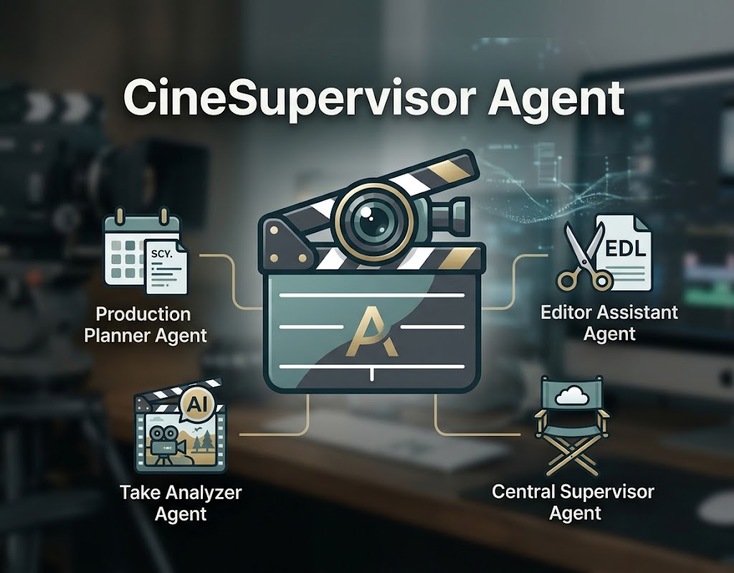
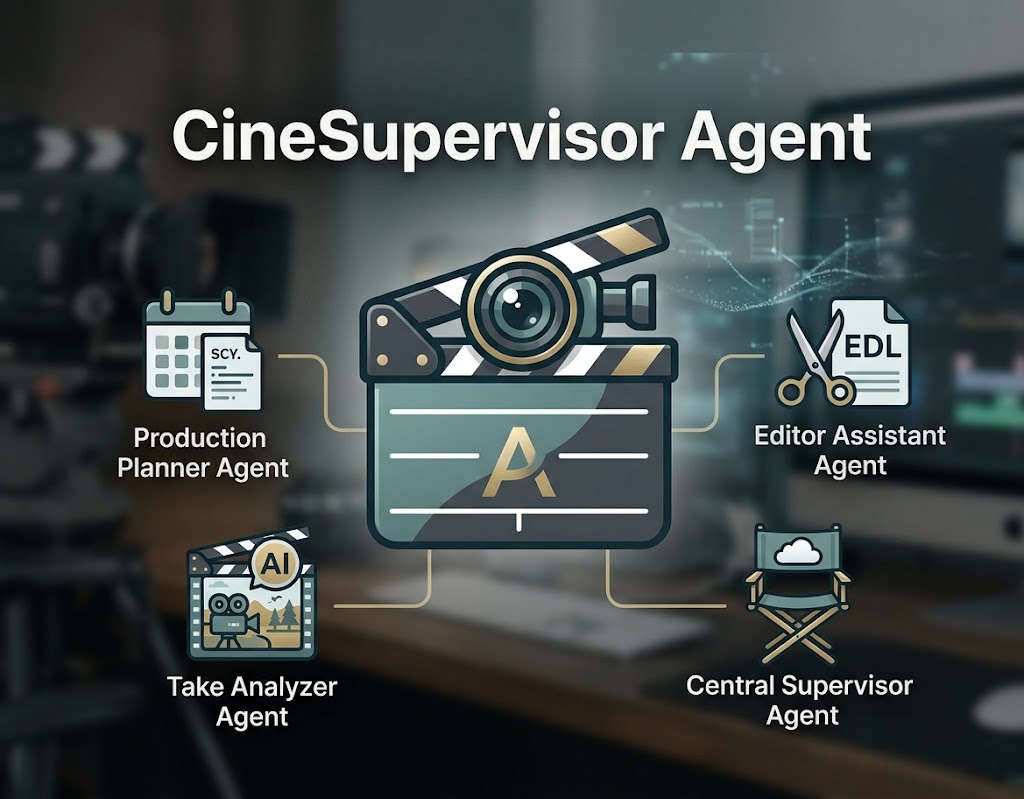
CineSupervisor uses a multi-agent architecture built with Google's Agent Development Kit (ADK) and ClickHouse. A central CineSupervisor agent coordinates specialized agents including: Production Planner Agent — analyzes screenplays and creates structured scene requirements. Take Analyzer Agent — uses Gemini's multimodal capabilities to evaluate captured takes. Editor Assistant Agent — compares takes, searches production data, and supports EDL generation. Production records and take analyses are persisted in ClickHouse, giving the agents a shared source of truth across the workflow. The application is exposed through a Streamlit interface, with the backend designed for deployment on Google Cloud Run / Agent Runtime.
Challenges we ran into
One of the biggest challenges was getting the complete agentic application deployed reliably on Google Cloud Run while connecting the Streamlit frontend, agent backend, environment configuration, and persistent ClickHouse data. I also had to work through the challenges of designing a multi-agent architecture where each agent had a clear responsibility while still sharing enough production context to make grounded decisions. Another challenge was making multimodal analysis useful in an actual workflow. It wasn't enough for Gemini to describe a video—I needed to connect that analysis back to the screenplay requirements and turn it into actionable decisions such as pass, needs review, missing coverage, or recommended take. During development, I also ran into Antigravity quota limitations, which forced me to be more deliberate about how I approached implementation and iteration. These challenges taught me to think beyond individual AI prompts and focus on architecture, state management, agent coordination, deployment, and reliability.
Accomplishments that we're proud of
I'm proud that CineSupervisor goes beyond a single AI interaction and creates a continuous production workflow. The same production context can flow from a screenplay into shot requirements, from those requirements into multimodal take analysis, and then into wrap and editorial decisions. I'm particularly proud of building an agentic system where the user can ask a high-level question like: "Can Scene 7 be wrapped?" and the supervisor can reason over the actual production state rather than simply generating a generic response. I'm also proud of implementing persistent production intelligence with ClickHouse, allowing screenplay requirements, analyzed takes, coverage information, and production decisions to remain available across different stages of the workflow. Most importantly, I built the entire system end-to-end—from the agent architecture and multimodal analysis to the production database, Streamlit interface, and cloud deployment.
What we learned
I learned that building an agentic application is much more than connecting an LLM to a few tools. The biggest lesson was learning how to design clear responsibilities between agents, determine what information needs to persist, and make sure agent decisions are grounded in real application state. I also learned the importance of thinking about deployment and architecture early. An application that works locally can require significant changes when moving to cloud infrastructure, particularly around authentication, environment variables, networking, and service boundaries. Working with Gemini's multimodal capabilities also showed me that multimodal AI becomes much more powerful when it is connected to structured context and real workflows, rather than being used as an isolated chatbot.
What's next for CineSupervisor Agent
My next goal is to make CineSupervisor useful throughout the entire filmmaking lifecycle, from pre-production through post-production. Plan to add: 🎬 Live on-set assistance — analyze a current take and immediately determine whether it satisfies the planned shot. 📋 Smarter production planning — automatically track actors, props, locations, equipment, and continuity requirements. 🎥 Real-time coverage tracking — continuously update what has been captured and identify production gaps. ✂️ Deeper editorial assistance — provide stronger take recommendations, continuity awareness, and automated EDL generation. 🎙️ Voice-driven production control — allow filmmakers to search scenes, takes, and production information using natural voice commands. 🤖 More specialized agents — expand the supervisor architecture to support additional production roles while maintaining a shared production state. ☁️ Scalable cloud deployment — make the system easier to deploy for real production teams and larger media libraries. My long-term vision is for CineSupervisor to become an AI production teammate—not just an AI assistant—helping filmmakers move from screenplay to final cut with fewer manual coordination steps.
Built With
- clickhouse
- docker
- gemini-1.5-pro
- git
- github
- google-agent-development-kit
- google-cloud
- google-cloud-run
- python
- streamlit

Log in or sign up for Devpost to join the conversation.