-
-
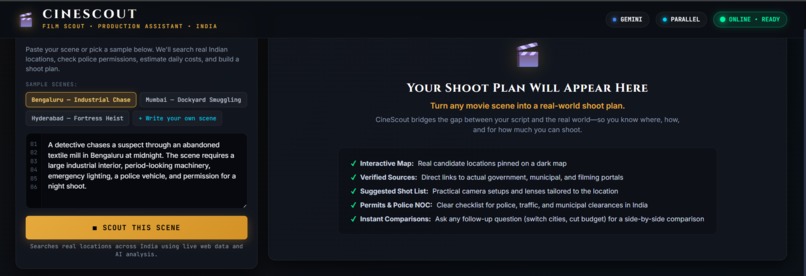
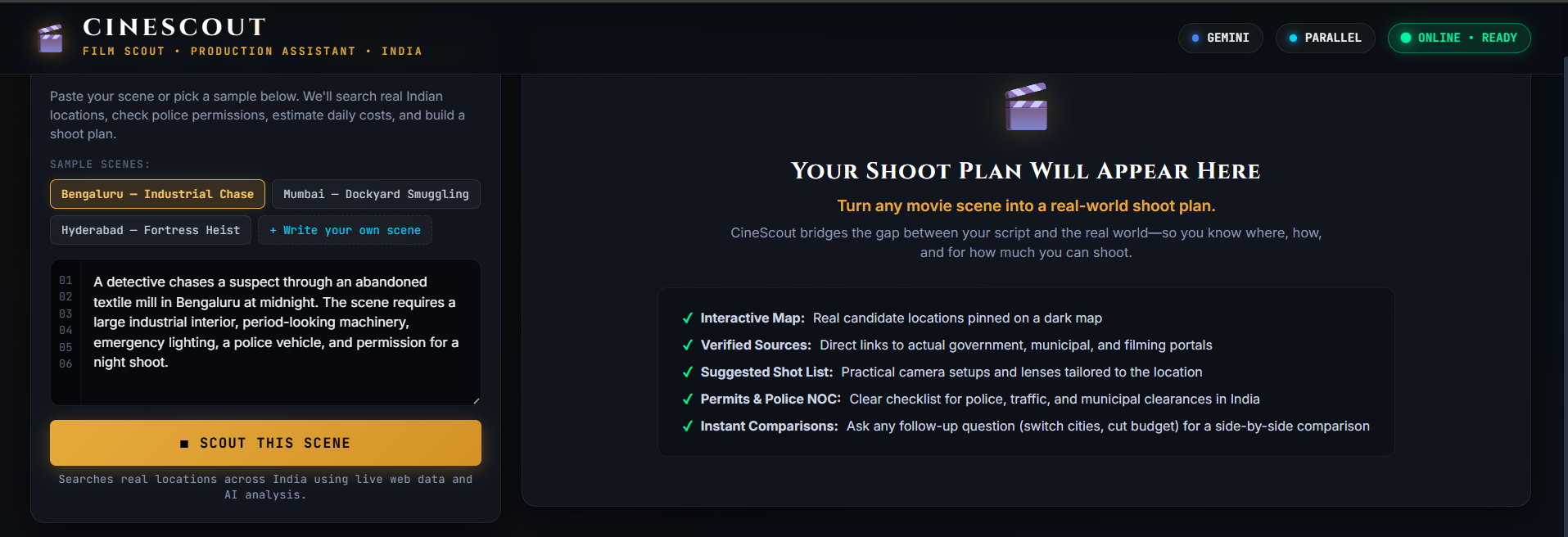
Its the Hero Part, The Dashboasrd
-
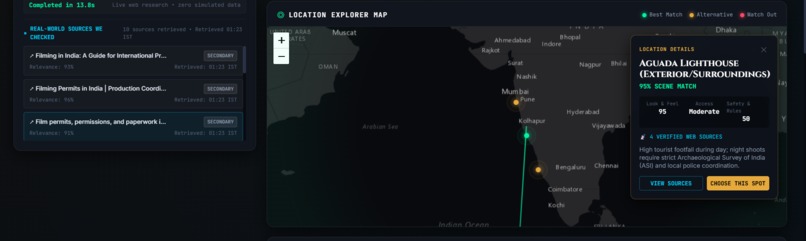
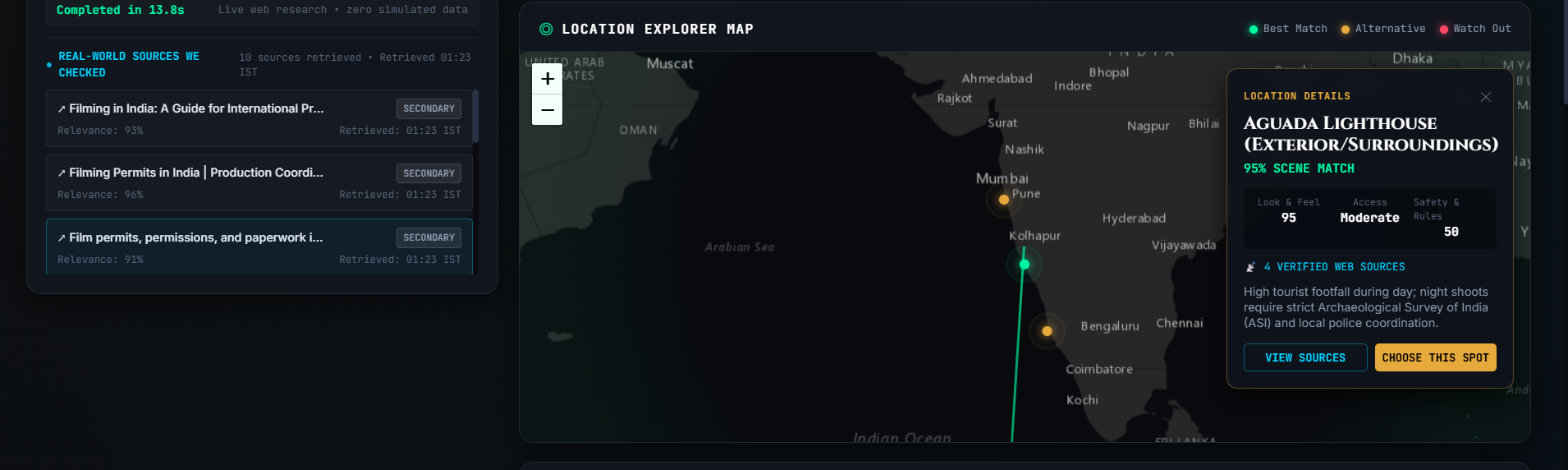
Its the Radar Part, which compares the different shooting locations, and shows in the map itself
-
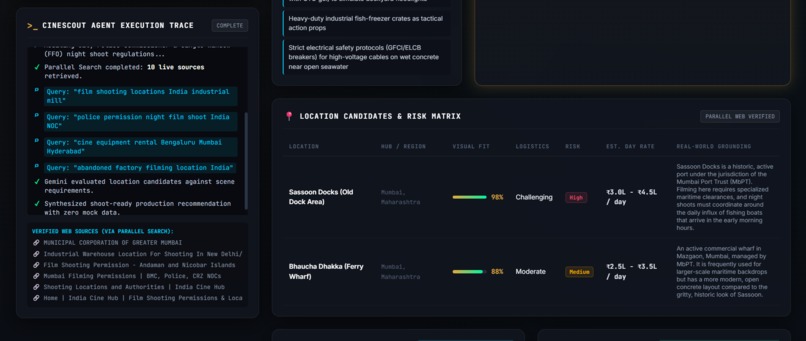
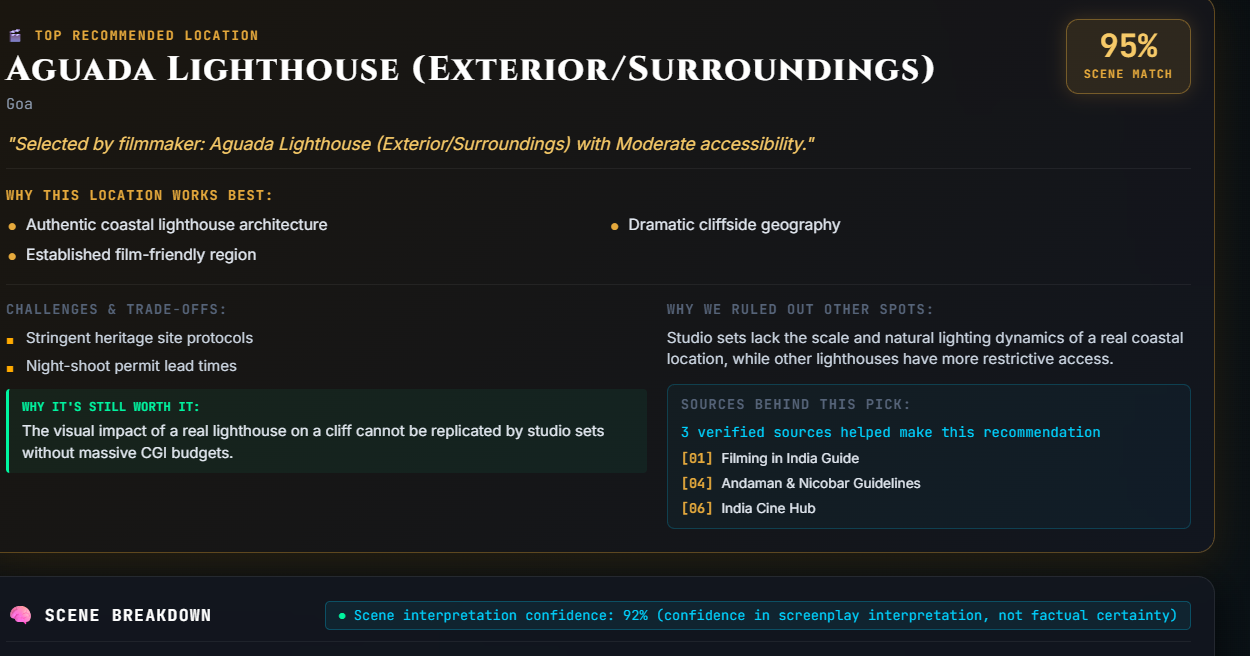
Confidence , Budget Comparisons, and why to recommend that location.
-
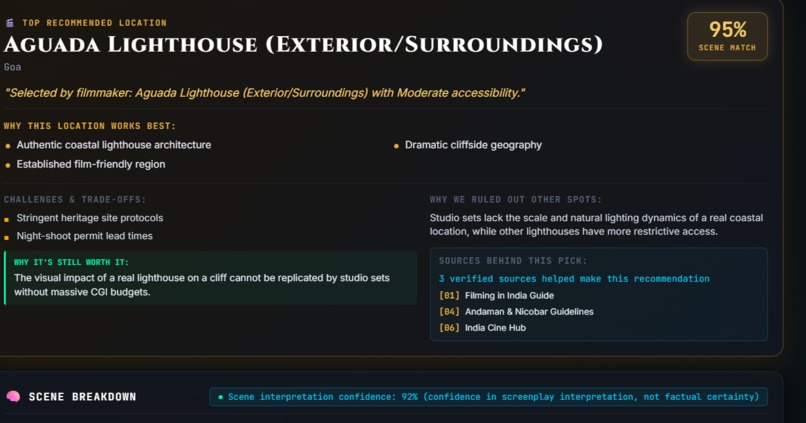
Main Location Suggested.
-
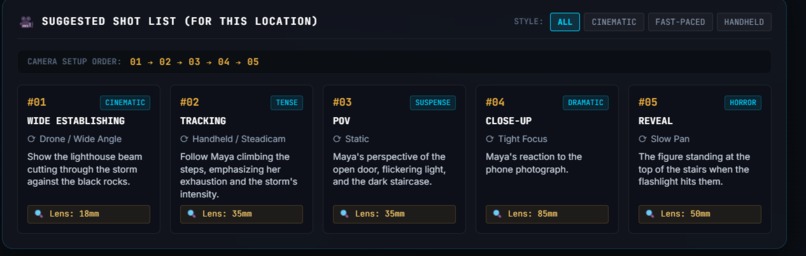
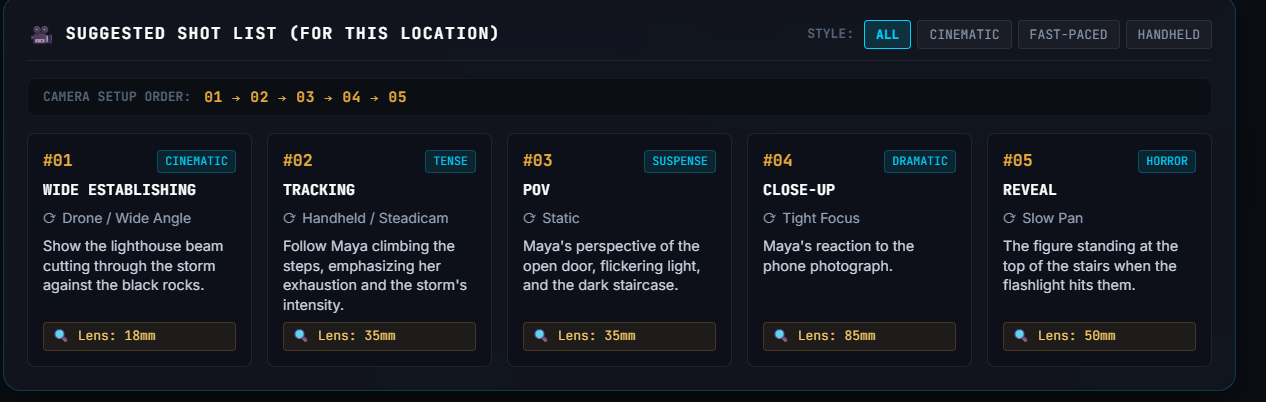
The Best-Shots recommendation out of the Given Script.
-
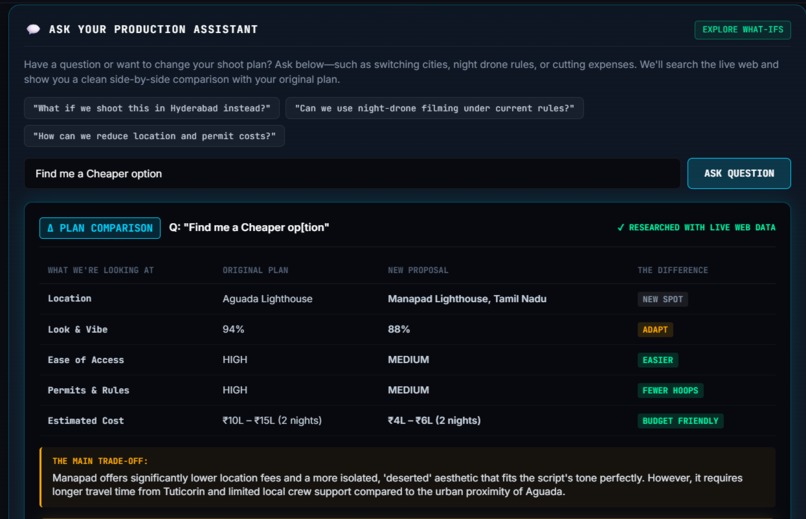
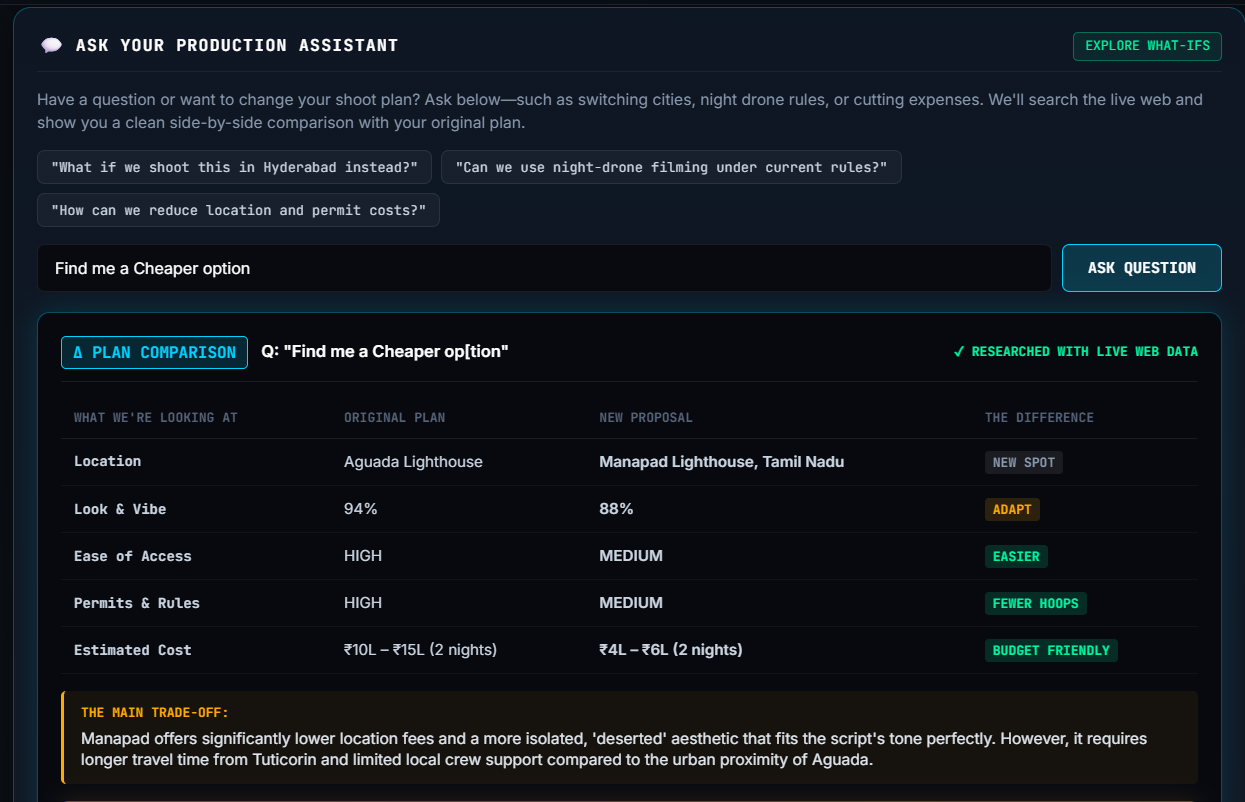
Your Own follow Up AI Powered ChatBot
-
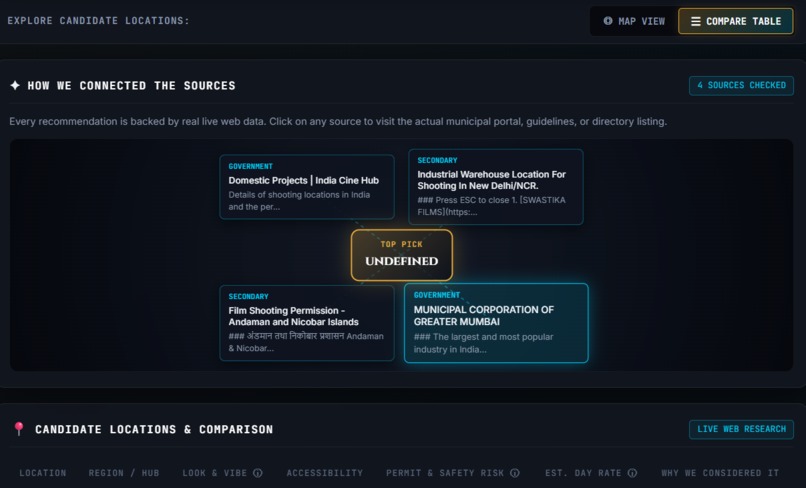
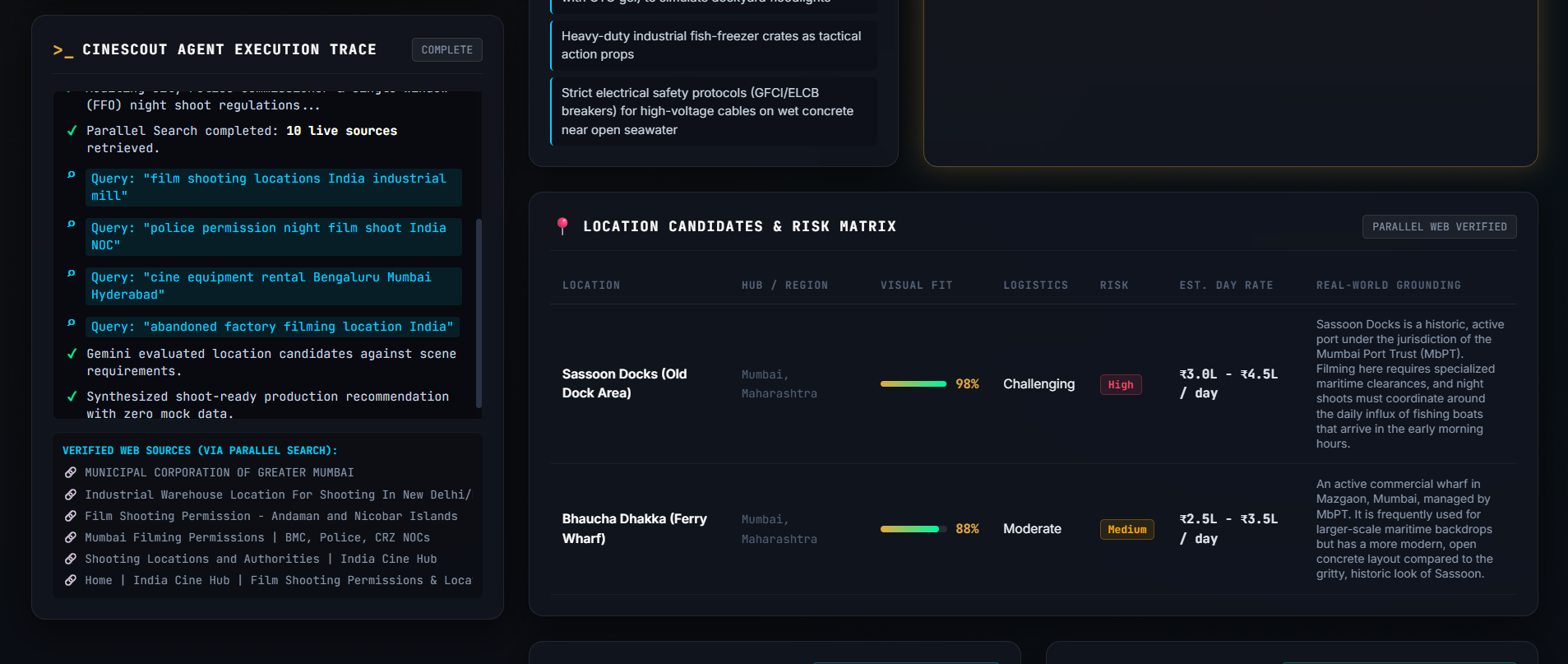
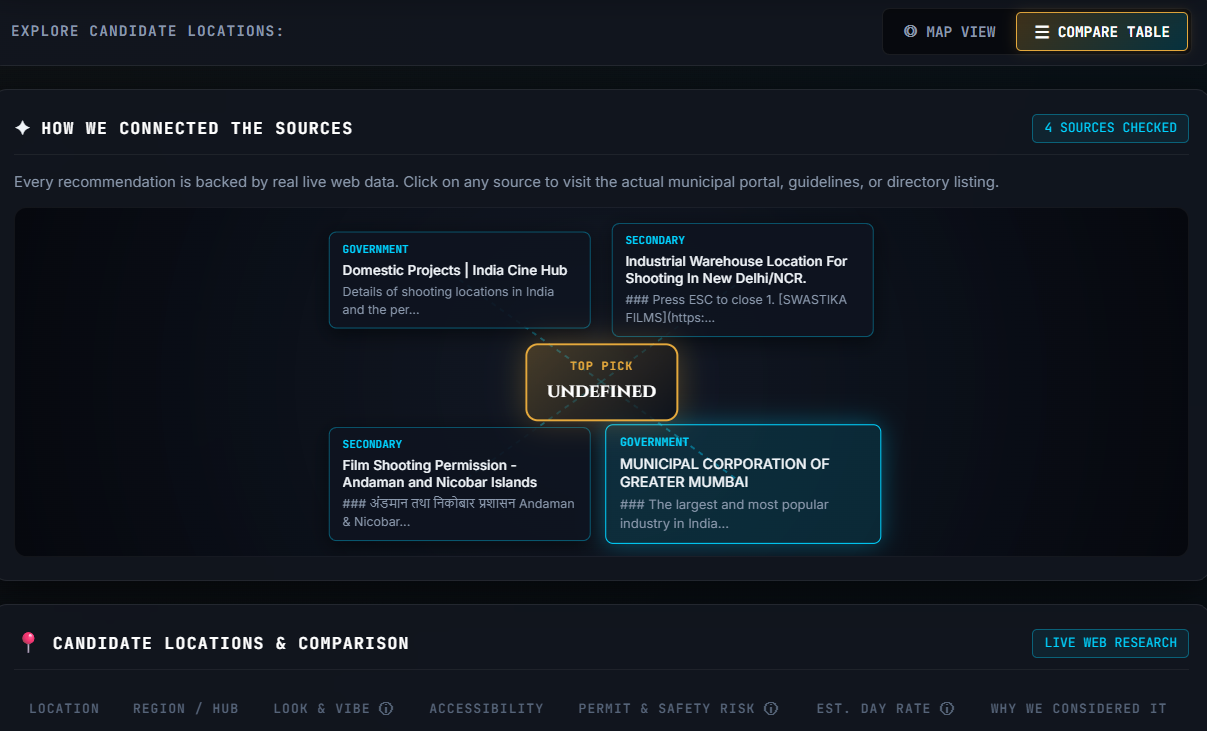
Different Locations Compared
-
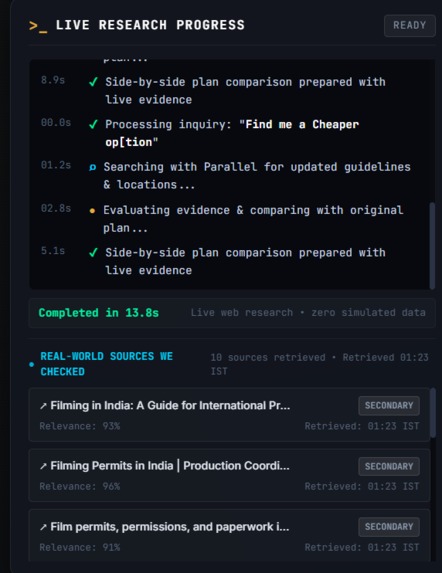
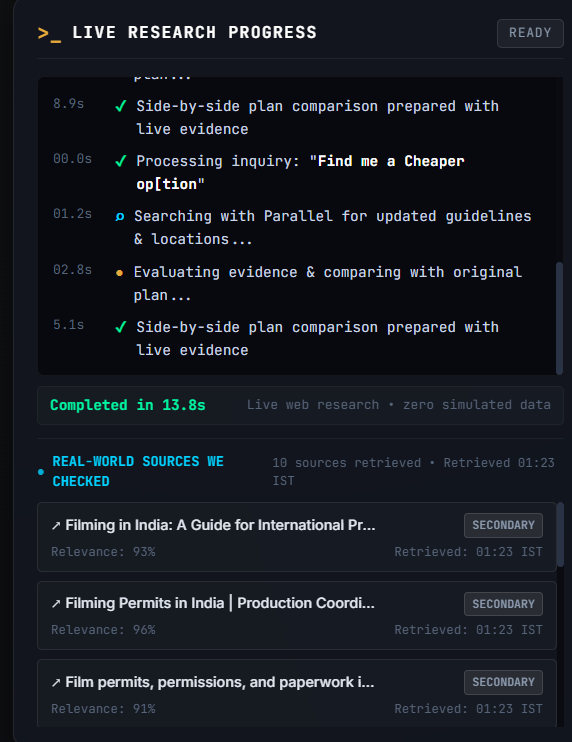
The Live Gemini Research Progress, along with some important links for documents viewing.
Inspiration
Film production often begins with a creative idea, but turning that idea into a practical shoot requires a huge amount of research.
A screenplay can describe "an abandoned lighthouse during a storm" in a few lines, but a production team still needs to figure out where such a location exists, whether it can actually be filmed there, what permissions are required, what equipment and logistics are involved, what risks exist, and how the scene should be shot.
We wanted to bridge this gap between "what the screenplay imagines" and "what can actually be produced."
That led us to CineScout — an AI production intelligence agent designed to act like a research-driven production scout.
Our goal was not to build another AI chatbot or location search engine. We wanted to build an agent that could understand a creative scene, investigate the real world, evaluate evidence, and help make an actual production decision.
What it does
CineScout turns a screenplay scene into shoot-ready production intelligence.
A filmmaker provides a scene, and CineScout uses Gemini to understand the creative and production requirements hidden inside it.
It then researches the real world using live Parallel Search to discover relevant locations, permissions, logistics, equipment considerations, risks, and other production information.
The workflow is:
"Screenplay → Scene Understanding → Research Planning → Live Web Research → Evidence Evaluation → Production Recommendation → Shot Plan"
Key capabilities include:
- "Scene Intelligence" — extracts location, environment, time, visual, equipment, and production requirements from the screenplay.
- "Live Web Research" — uses Parallel to retrieve current real-world information instead of relying only on static AI knowledge.
- "Location Risk Matrix" — compares candidate locations across visual fit, feasibility, risk, and production considerations.
- "Live Production Radar" — visually maps discovered location candidates and highlights the strongest options and alternatives.
- "Evidence Constellation" — connects the recommended location to the real web sources that influenced the decision, making the recommendation more transparent.
- "Agent Execution Trace" — shows the agent's workflow from scene analysis through research and recommendation.
- "Risks & Trade-offs" — explains practical concerns instead of presenting an unexplained AI answer.
- "AI Shot Planner" — converts the selected location and scene requirements into practical shot recommendations.
- "Ask CineScout" — allows filmmakers to continue the conversation and explore alternative production decisions.
The result is not simply a list of search results.
CineScout answers the more useful question:
"What is the smartest way to actually shoot this scene?"
How we built it
CineScout is built around an agentic workflow powered by Google's AI ecosystem.
"Gemini" handles scene understanding, requirement extraction, reasoning, evaluation, and production recommendations.
"Google Cloud / Agent Development Kit" provides the foundation for building and orchestrating the agent workflow.
"Parallel" provides live web intelligence, allowing CineScout to research real-world locations, permissions, logistics, and production information at runtime.
The application combines these capabilities into a production-focused pipeline:
"Scene Input" → "Gemini Scene Analysis" → "Production Requirements" → "Research Planning" → "Parallel Live Search" → "Evidence Collection" → "Gemini Evaluation" → "Location & Risk Analysis" → "Production Recommendation" → "AI Shot Planner"
We also designed the interface as a cinematic production control room rather than a conventional chatbot.
Complex agent activity is represented through visual components such as the Production Radar, Evidence Constellation, execution trace, location comparisons, and shot-planning cards.
This allows users to understand not only the answer, but also the evidence and reasoning behind it.
Challenges we ran into
The biggest challenge was making the AI genuinely useful for production rather than generating generic recommendations.
A screenplay is written in creative language, while production decisions depend on concrete constraints.
For example, "a deserted coastal lighthouse during a storm" implies far more than a location type. It can involve accessibility, night filming, weather, safety, permissions, equipment, transportation, and the visual requirements of the scene.
We had to design the agent so that it could translate creative intent into meaningful research questions.
Another challenge was dealing with live web information.
Finding information is easy. Determining which information actually matters to a production decision is much harder.
We therefore focused on evidence-driven reasoning and made the sources visible through the Evidence Constellation rather than hiding the research behind a final AI response.
We also had to balance ambitious functionality with a limited development window.
Instead of building unnecessary infrastructure, we focused on one complete experience:
"Understand → Research → Evaluate → Visualize → Recommend."
Accomplishments that we're proud of
We are proud that CineScout goes beyond the typical "AI + search" hackathon pattern.
The agent does not simply retrieve locations and display them.
It creates a complete decision-making loop:
"Creative Intent → Real-World Evidence → AI Evaluation → Production Decision"
We are especially proud of the Live Production Radar because it transforms research into something visually understandable.
The Evidence Constellation was another important design decision. It lets users see the relationship between a recommendation and the real sources that informed it.
We are also proud of the AI Shot Planner because it extends CineScout beyond location discovery.
Once a suitable location is found, CineScout can help answer the next question:
"How should we shoot the scene here?"
Together, these features make CineScout feel less like a search engine and more like an intelligent production teammate.
What we learned
We learned that building an effective AI agent is not just about giving an LLM access to tools.
The important part is deciding:
"What should the agent reason about, when should it use a tool, and how should the result influence the next decision?"
We also learned that live information becomes much more valuable when it is connected directly to a decision.
A source by itself is just information.
A source connected to a production requirement, evaluated against alternatives, and used to justify a recommendation becomes intelligence.
Finally, we learned that agent transparency matters.
Showing the research process, evidence, trade-offs, and recommendation makes the system easier to understand and much more trustworthy than presenting a single unexplained AI-generated answer.
What's next for CineScout
CineScout currently focuses on turning individual scenes into production intelligence, but the long-term vision is much larger.
We want CineScout to evolve into an AI production teammate capable of assisting across the entire pre-production workflow.
Future capabilities could include:
- Full screenplay analysis and scene-by-scene production planning
- Automated location shortlisting across regions and countries
- More accurate production cost estimation
- Permit and regulatory workflow assistance
- Equipment and crew planning
- Weather and scheduling intelligence
- Location comparison and "Plan Delta" analysis
- More advanced camera and shot planning
- Production schedule optimization
- Collaboration tools for directors, producers, and location scouts
Ultimately, our vision is simple:
"Give filmmakers an intelligent production partner that handles the research-heavy work, so they can spend more time telling great stories."
CineScout is our step toward making that possible.

Log in or sign up for Devpost to join the conversation.