-
-
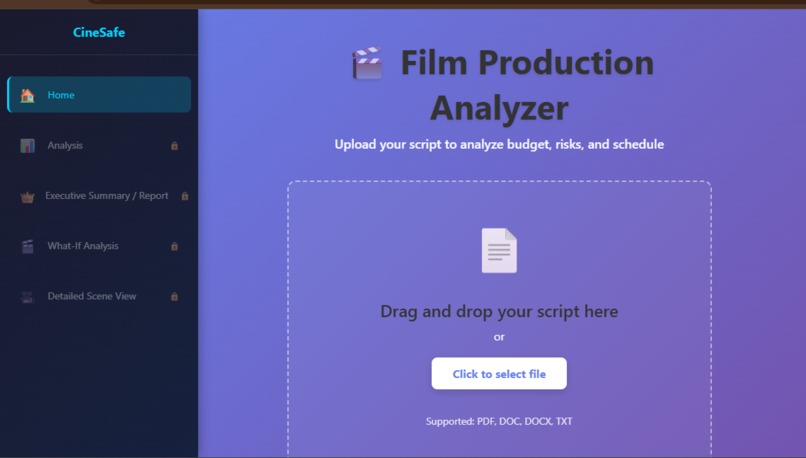
Interface
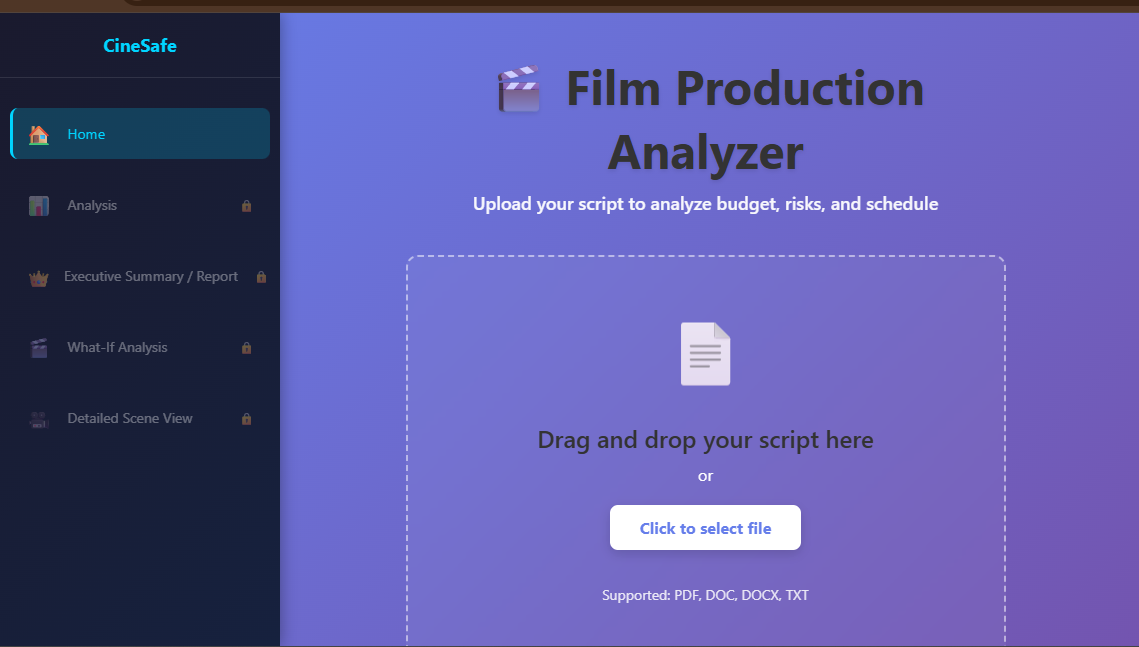
Inspiration
Modern film production is not just creative — it is operationally complex. Scripts must translate into budgets, safety plans, location bookings, and scheduling systems.
Today, this coordination happens manually across disconnected tools: spreadsheets, insurance forms, scheduling software, rate libraries, and production dashboards.
We asked:
What if AI agents could actively orchestrate this workflow across systems — not just analyze a script, but execute production intelligence autonomously?
CineSafe AI is built as an active multi-agent workforce that coordinates across multiple subsystems to transform a screenplay into operational decisions.
What it does
CineSafe AI is an autonomous multi-agent production planning system.
Instead of a single LLM response, CineSafe deploys specialized agents that:
- Gather structured data from uploaded scripts
- Cross-reference grounded datasets (rate cards, risk multipliers, location libraries)
- Perform risk scoring and budget estimation
- Coordinate optimization across scenes
- Generate actionable outputs and production-ready reports
Active Multi-Agent Workflow
- Scene Extractor Agent → Parses and structures raw screenplay data
- Risk Scoring Agent → Quantifies multi-dimensional safety exposure
- Budget Estimation Agent → Computes grounded cost projections
- Cross-Scene Auditor → Identifies dependencies and redundancies
- Optimization Agent → Recommends clustering and scheduling efficiencies
- Mitigation Planner → Generates safety and cost-control actions
Each agent operates independently but is orchestrated through a hierarchical coordination layer.
This is not sequential prompting — it is structured decision delegation.
How we built it
Multi-System Architecture
CineSafe actively orchestrates across:
- Script ingestion system (file parsing layer)
- Risk & cost grounding datasets (CSV rate libraries)
- Multi-agent reasoning layer
- Optimization engine
- Persistent storage layer (SQLite)
- Report generation module (PDF export)
Backend
- FastAPI service
- Multi-agent orchestration engine
- Deterministic grounding pipeline
- Structured persistence
Decision Framework
Each scene ( S_i ) is evaluated using weighted multi-factor scoring:
$$ R_i = \sum_{k=1}^{5} w_k \cdot f_k(S_i) $$
Total projected budget:
$$ B_{total} = \sum_{i=1}^{n} \left( BaseCost_i \times ComplexityMultiplier_i \right) $$
Agents share structured state and adjust outputs based on cross-agent findings.
This enables:
- Autonomous data gathering
- Cross-agent reasoning
- Structured decision execution
- Actionable system output
CineSafe demonstrates orchestration across 2+ systems:
- AI reasoning layer
- Deterministic financial dataset layer
- Report generation system
- Optimization simulation engine
Challenges we ran into
1. True Orchestration vs Prompt Chaining
Naive prompt chaining is fragile. We redesigned the system to allow agents to:
- Pass structured outputs
- Validate each other's assumptions
- Operate under deterministic constraints
2. Preventing AI Drift
Active agents can amplify errors if unchecked.
We introduced:
- Cost caps
- Multiplier boundaries
- Sanity validation steps
3. Cross-System Consistency
Ensuring synchronization between reasoning outputs and grounded financial datasets required explicit data contracts between agents.
Accomplishments that we're proud of
- Functional autonomous multi-agent workflow
- Cross-agent coordination with shared state
- Grounded financial modeling integrated into AI reasoning
- Executable production intelligence pipeline
- End-to-end script → decision → report system
- Demonstrated orchestration across multiple subsystems
We did not build a chatbot.
We built an autonomous production intelligence workforce.
What we learned
- True active agents require structured state sharing
- Deterministic grounding prevents cascading hallucinations
- Orchestration is more about data contracts than prompts
- Autonomy must be constrained to be trusted
Active AI systems must not only think — they must execute responsibly.
What’s next for CineSafe AI
To deepen the “Active Agents” vision:
- Integration with external production management APIs
- Automated insurance risk submission agents
- Real-time scheduling negotiation agents
- Weather and location intelligence API connections
- Enterprise SaaS deployment with collaborative agent supervision
CineSafe is an example of AI agents orchestrating intelligence across systems to perform real operational work.
It represents a step toward the autonomous workforce of tomorrow.
Built With
- crewai
- csv-data-processing
- docker-(if-used)
- fastapi
- gemini3(llm)
- github
- javascript
- mcp
- multi-agent-orchestration-architecture
- openai-api-(llm)
- pandas
- pdf-generation-(reportlab-/-weasyprint-if-used)
- python
- qwen3(llm)
- react.js
- rest-apis
- sqlite
- uvicorn


Log in or sign up for Devpost to join the conversation.