🎬 CinePilot — Your AI Production Crew
Inspiration
Turning a film idea into an actual production plan is much harder than simply writing a good story.
A filmmaker has to think about budgets, shooting schedules, scenes, characters, locations, production risks, and research — often across multiple tools and spreadsheets. For independent filmmakers and small teams, this planning process can be time-consuming and difficult to manage.
We wanted to build something that could act like an intelligent production team rather than just another dashboard.
That idea became CinePilot.
CinePilot is an AI-powered production planning and decision-support platform designed to help filmmakers understand how ready their project is for production and what they should address before shooting begins.
What CinePilot Does
CinePilot brings multiple AI-powered production capabilities together in one workflow.
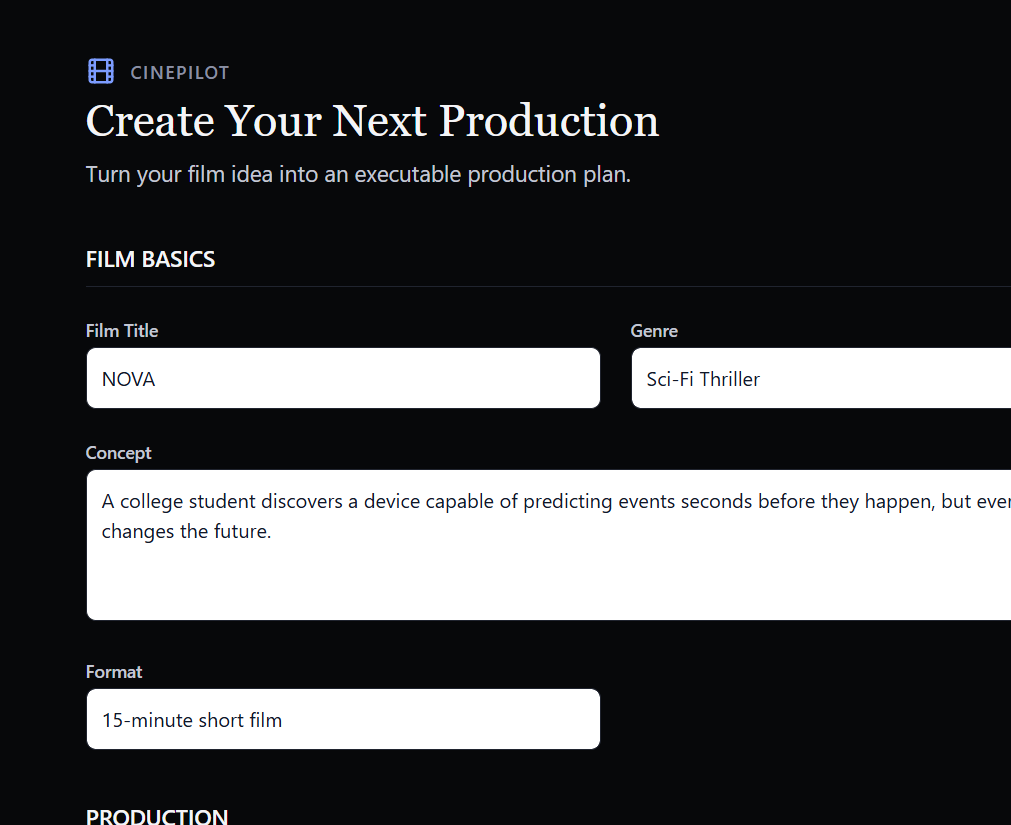
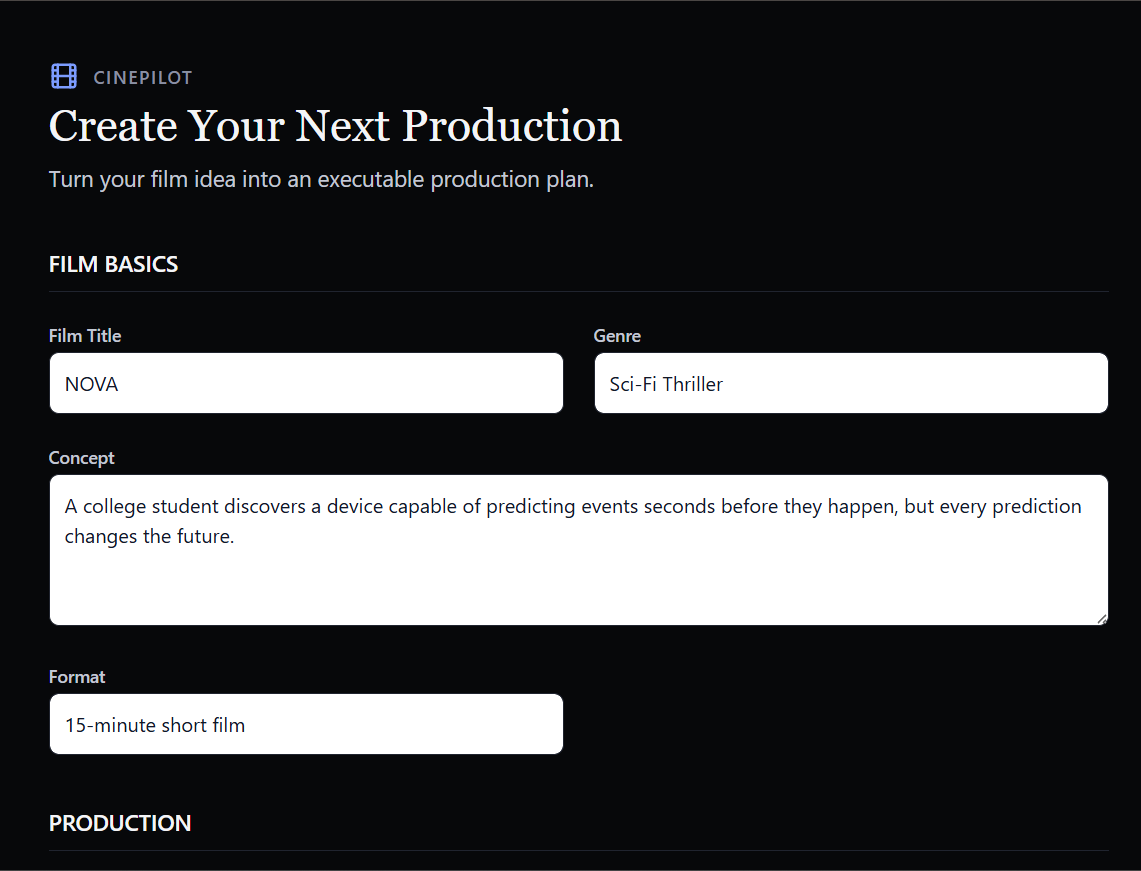
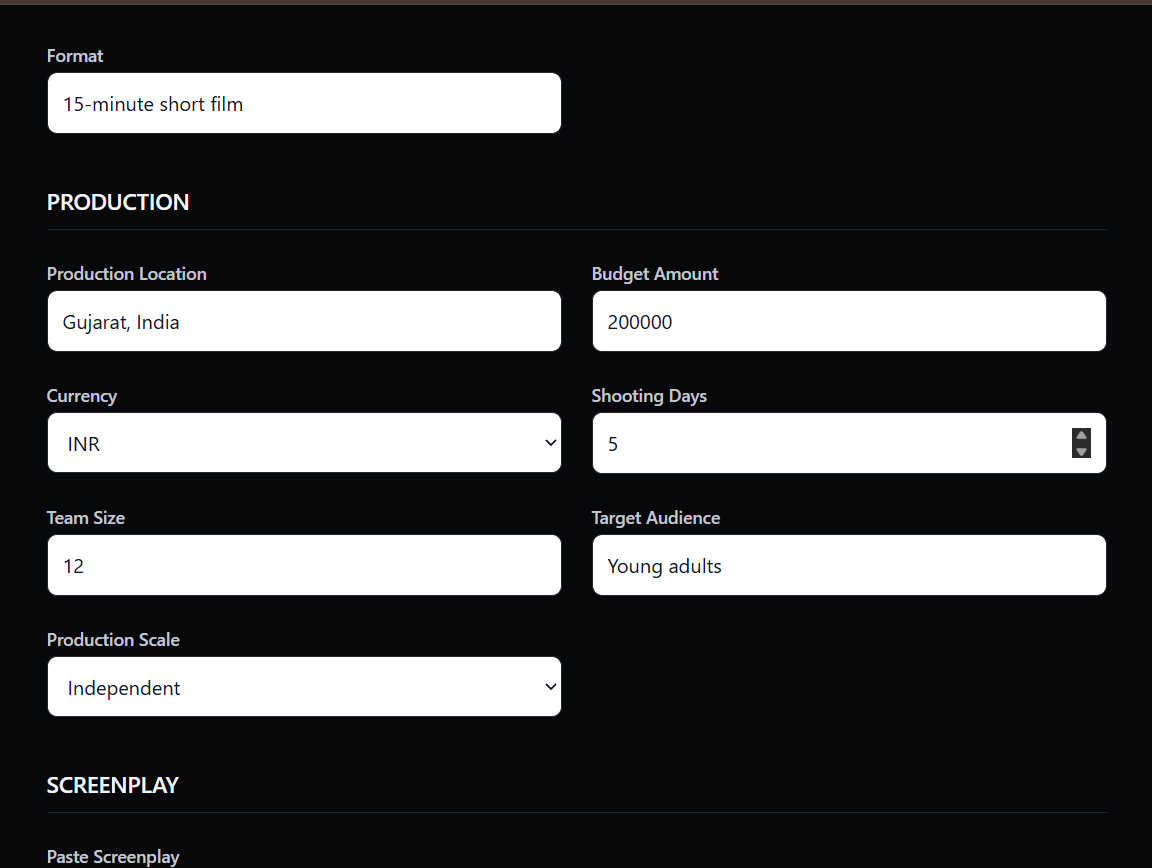
A filmmaker starts by creating a project and providing information such as:
- Film title and concept
- Genre and format
- Production location
- Budget
- Shooting days
- Team size
- Target audience
- Production scale
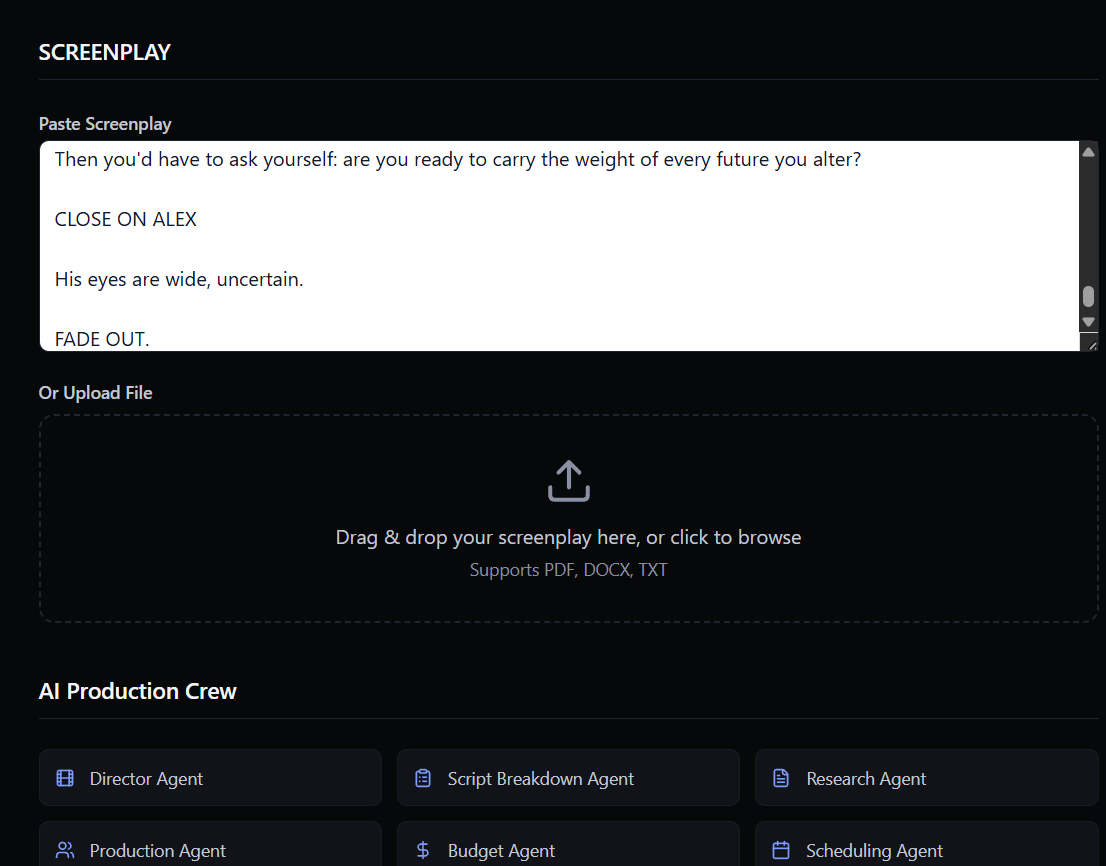
- Optional screenplay
The filmmaker can then run AI Analysis.
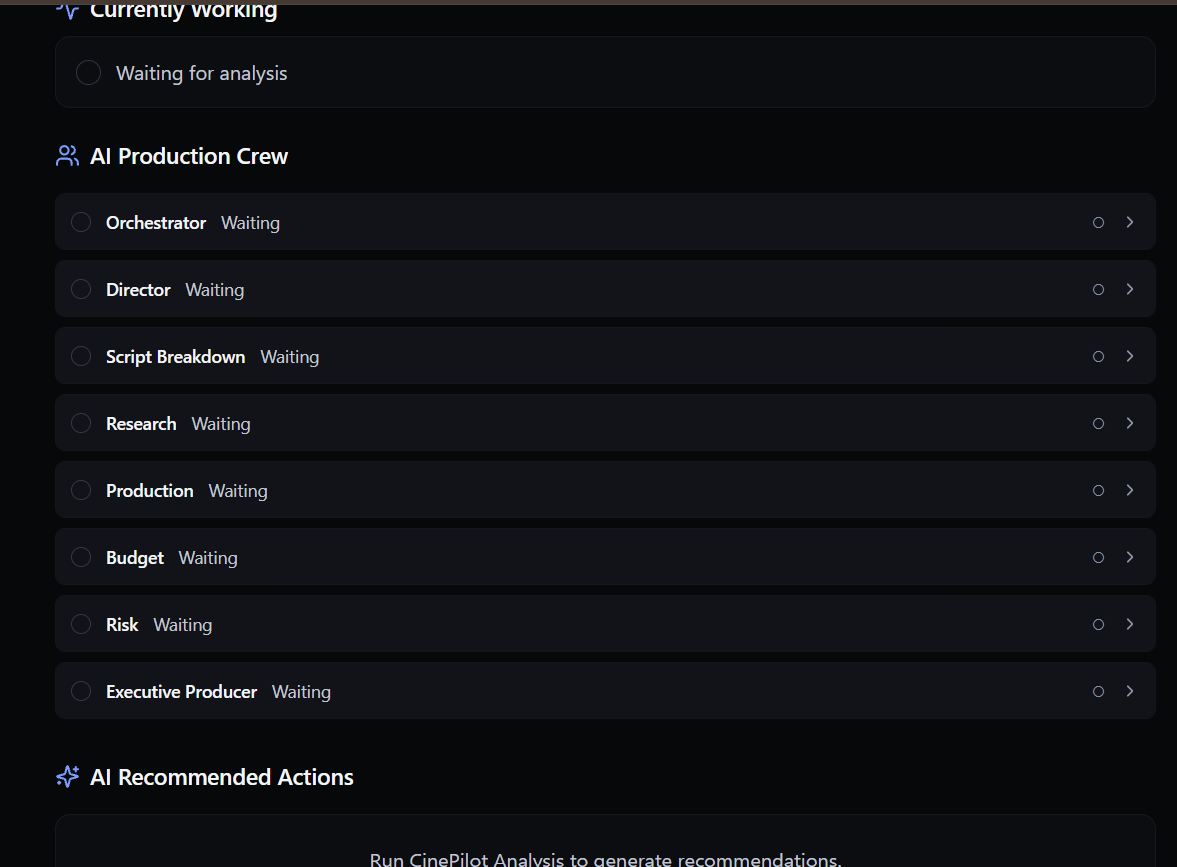
CinePilot coordinates specialized agents that analyze different parts of the production:
🎞️ Script Breakdown Agent
Analyzes an available screenplay to identify production-relevant information such as scenes, characters, and locations.
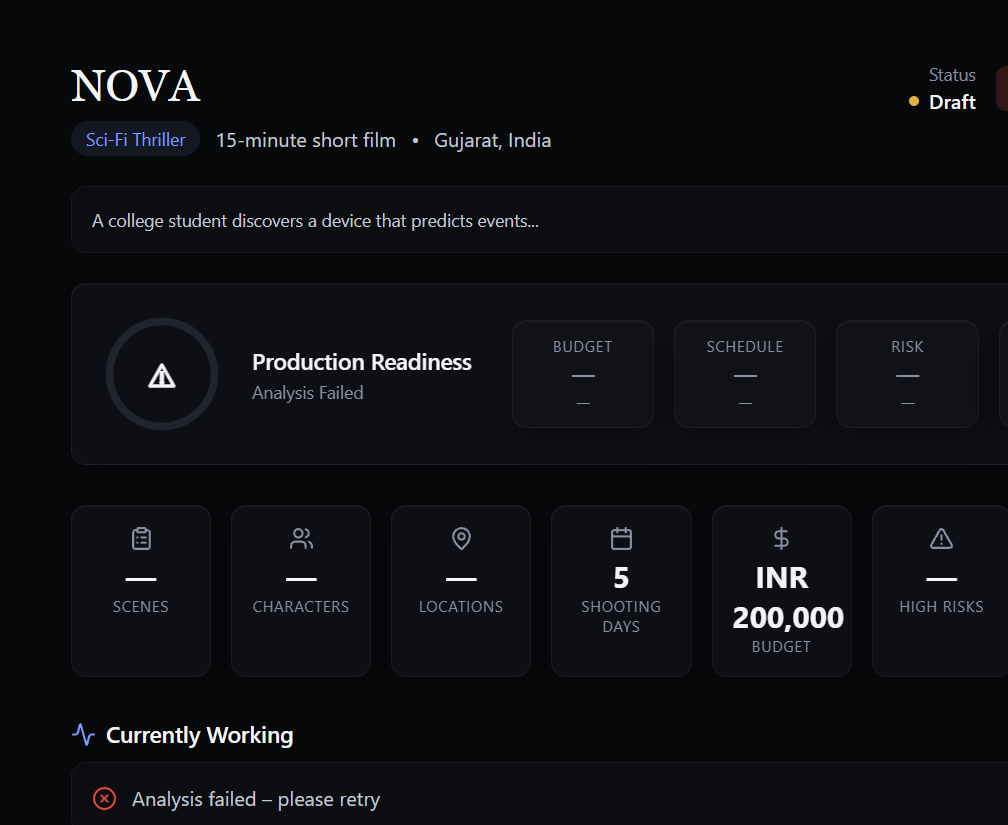
If no screenplay is provided, CinePilot does not invent screenplay-derived information. Instead, screenplay-dependent analysis is skipped and the dashboard clearly indicates unavailable data.
💰 Budget Agent
Analyzes production budget information and provides budget-related insights.
CinePilot compares the estimated production cost with the project's target budget to calculate a Budget Score.
📅 Schedule Agent
Analyzes the relationship between scenes and available shooting days.
One of the key metrics is scene density:
$$ Scene\ Density = \frac{Total\ Scenes}{Shooting\ Days} $$
This helps identify whether the planned schedule appears realistic.
⚠️ Risk Agent
Identifies potential production risks and structures each risk using factors such as probability and impact.
Risk severity is calculated as:
$$ Risk\ Severity = \frac{Probability}{100} \times Impact $$
High-risk items are then surfaced so filmmakers can focus on the most important problems first.
🔎 Research Agent
Researches relevant production topics and collects valid sources that can support planning decisions.
Sources are validated and duplicates are removed before being counted toward research coverage.
Production Readiness
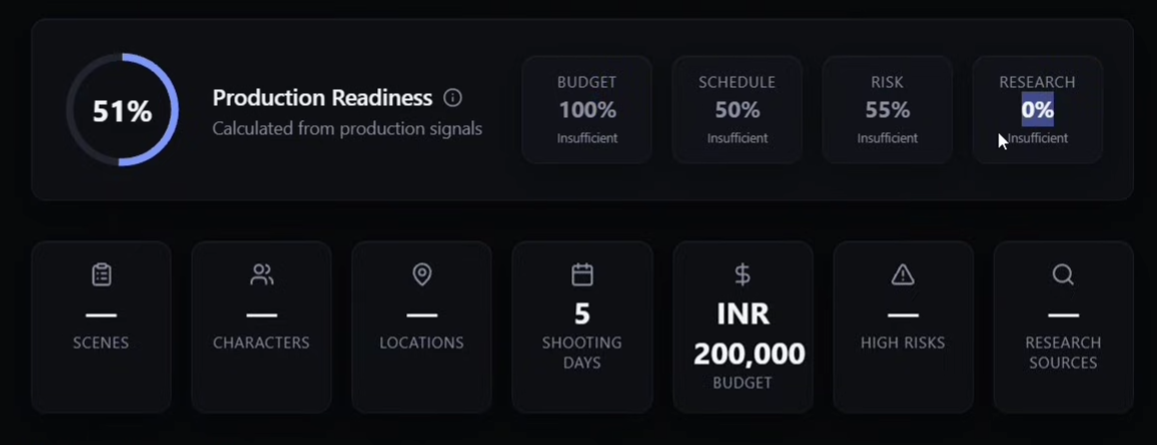
The most important part of CinePilot is its Production Readiness analysis.
CinePilot calculates four independent scores:
- Budget Score
- Schedule Score
- Risk Score
- Research Score
When all four scores are available, the overall readiness is calculated as:
$$ Overall\ Readiness = \frac{Budget + Schedule + Risk + Research}{4} $$
This produces a simple percentage that helps answer a practical question:
How ready is this project for production, and what should I fix before I start?
Rather than hiding the reasoning behind a single AI-generated number, CinePilot also provides explainability through its calculation details.
Why This Approach Matters
One of the important design principles behind CinePilot is trustworthy analysis.
The system does not treat missing information as zero and does not fabricate results simply to make the dashboard look complete.
For example, if a project has no screenplay, CinePilot does not guess the number of scenes or characters. If an analysis component has not completed successfully, the corresponding metric remains unavailable instead of displaying misleading information.
This allows the dashboard to distinguish between:
- Data that is known
- Data that has been analyzed
- Data that is unavailable
- Analysis that is incomplete or failed
This was especially important because production decisions can depend on these numbers.
How We Built It
CinePilot was built as a full-stack application with a modular AI-agent architecture.
The platform consists of:
- A web-based production dashboard
- Backend APIs for project and analysis management
- Specialized AI agents for different production tasks
- Persistent project and analysis data
- Structured risk and research outputs
- Production-readiness calculation logic
- Explainable score calculations
- Support for partial analysis and failure handling
The architecture allows individual agents to focus on a specific responsibility while the overall system combines their outputs into a unified production-planning view.
Challenges We Faced
One of our biggest challenges was making the AI analysis reliable instead of simply impressive-looking.
During development, we encountered situations where missing screenplay data could cause the entire analysis process to fail. We redesigned the workflow so that the absence of an optional screenplay would no longer unnecessarily block the rest of the production analysis.
Another challenge was preventing invalid values such as NaN, Infinity, or misleading zero scores from appearing when information was unavailable.
We also focused on making the results explainable. Instead of only showing a final readiness percentage, CinePilot keeps the individual components visible so users can understand where the score comes from.
Building the system taught us that an effective AI application is not only about generating AI responses — it is also about orchestration, validation, persistence, error handling, and communicating uncertainty clearly.
What We Learned
Building CinePilot taught us several important lessons:
- AI agents work best when responsibilities are clearly separated.
- Missing data should be handled explicitly rather than guessed.
- AI-generated decisions need explainability.
- A good user experience should communicate uncertainty instead of hiding it.
- Production systems need reliable error handling, not just successful-path demos.
Most importantly, we learned how to combine AI reasoning with deterministic business logic.
AI can help analyze complex production information, while clearly defined formulas and rules can make the final metrics consistent and understandable.
What's Next
CinePilot can be expanded into a broader AI production workspace with capabilities such as:
- More detailed screenplay breakdown
- Production task generation
- Crew and equipment planning
- Call-sheet generation
- Location planning
- Shot-list assistance
- More advanced budget forecasting
- Production timeline optimization
- Collaboration between filmmakers and production teams
The long-term vision is to make CinePilot feel like an AI production coordinator that works alongside filmmakers throughout the production lifecycle.
Final Vision
A filmmaker should not have to spend hours switching between spreadsheets, documents, research tabs, and planning tools just to answer one question:
"Am I actually ready to make this film?"
CinePilot brings those planning signals together into one intelligent workflow.
CinePilot — an AI production crew working together to turn a creative idea into a production-ready plan.
Built With
- agents
- api
- docker
- fastapi
- gemini
- postgresql
- python
- react
- rest
- typescript



Log in or sign up for Devpost to join the conversation.