The Inspiration
Creating a film is a complex process. A simple idea must go through story development, scriptwriting, character creation, scene design, visual direction, and production planning before it can become a finished cinematic experience.
We asked ourselves:
What if an AI system could act as a complete creative production team rather than just a chatbot?
This question inspired CinePilot AI, an agentic AI platform designed to transform a simple creative idea into a structured cinematic production.
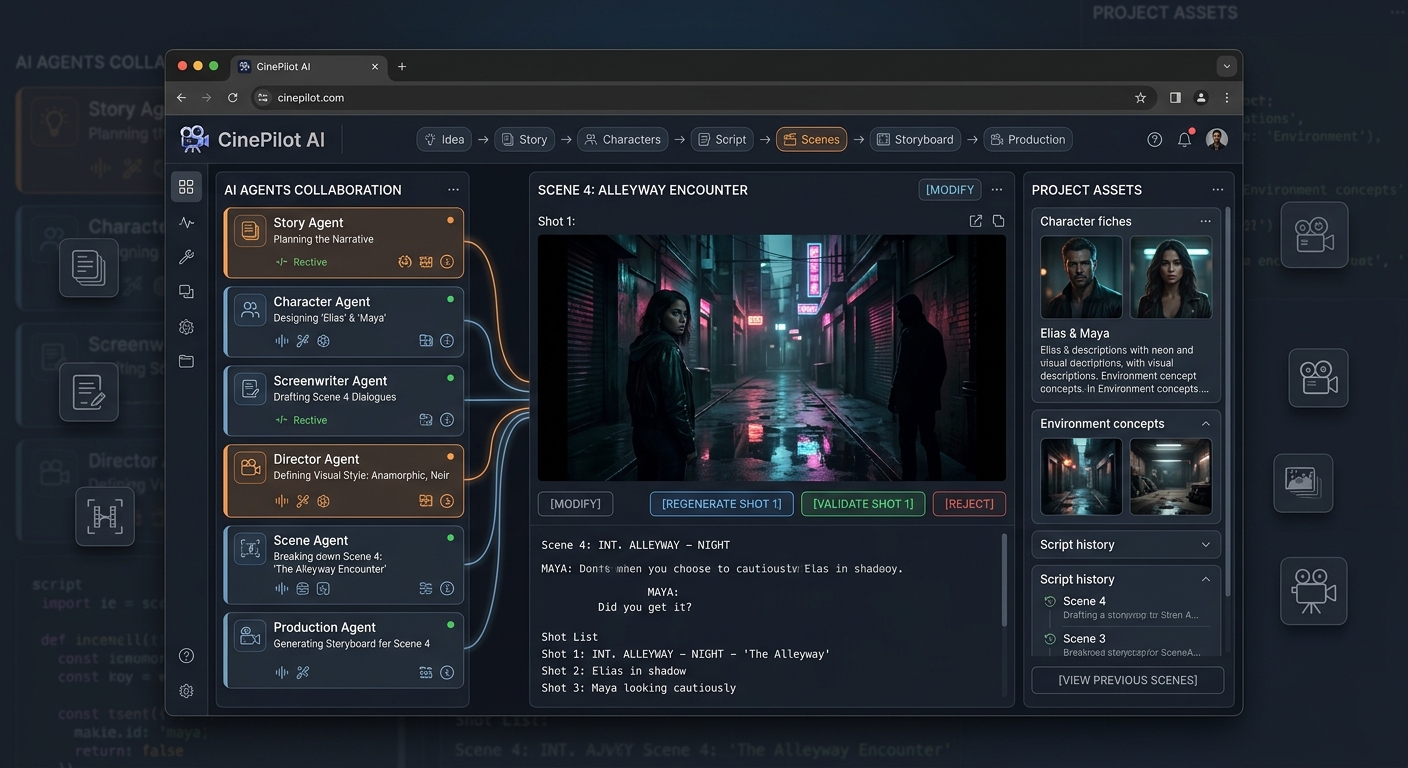
Instead of asking one AI model to do everything, CinePilot uses a team of specialized AI agents that collaborate throughout the filmmaking process.
What CinePilot AI Does
The user starts with a simple idea, such as:
"A detective discovers that an AI system is predicting crimes before they happen."
CinePilot transforms this idea into a complete production workflow.
The platform can coordinate specialized agents for:
- Story Agent — develops the concept and narrative structure.
- Screenwriter Agent — creates and improves the screenplay.
- Character Agent — develops characters, personalities, and relationships.
- Visual Director Agent** — defines the visual style and cinematic direction.
- Scene Agent — transforms the screenplay into structured scenes.
- Audio/Creative Agent — proposes music, atmosphere, and sound direction.
- Production Agent — organizes the generated content into a production-ready plan.
The goal is not simply to generate text or images. CinePilot orchestrates multiple AI capabilities as a collaborative virtual film crew.
Why an Agentic Approach?
Traditional generative AI tools usually operate as isolated assistants: the user gives a prompt and receives an output.
CinePilot takes a different approach.
Each agent has a specific role, receives relevant context, produces an artifact, and passes its output to the next stage of the workflow.
The process can be represented as:
Idea → Story → Characters → Script → Scenes → Visual Direction → Production Plan**
This allows the system to maintain consistency between different parts of the production instead of generating disconnected outputs.
How We Built It
We designed CinePilot as a modular AI workflow where specialized agents collaborate through a central orchestration layer.
The application contains:
- A creative workspace where users introduce and refine their ideas.
- An agent orchestration layer responsible for coordinating the different creative agents.
- Context and memory management to maintain consistency across the project.
- A cinematic generation pipeline that transforms outputs from one stage into inputs for the next.
- A production dashboard that allows creators to review, modify, and organize the generated assets.
We focused on making the system interactive and human-centered. The AI does not replace the filmmaker; instead, it acts as a creative production team that accelerates the filmmaker's workflow.
Challenges We Faced
One of our biggest challenges was maintaining consistency across multiple AI-generated outputs.
For example, if a character is described differently in the screenplay and later in a scene, the cinematic result becomes inconsistent.
We therefore focused on passing structured context between agents and maintaining a shared project state.
Another challenge was designing an interface that could make a complex multi-agent workflow feel simple. Users should not need to understand how every AI agent works internally.
We also had to balance automation and human control. Fully automated generation can produce unexpected creative decisions, so CinePilot keeps the creator involved at important stages of the process.
What We Learned
Building CinePilot taught us that the most powerful use of generative AI is not necessarily a single large model generating everything.
The real opportunity is orchestration.
By giving different agents clear responsibilities and allowing them to collaborate, we can build AI systems that behave more like complete creative teams.
We also learned that context management, workflow design, and human feedback are just as important as the underlying AI models.
What's Next?
CinePilot AI is only the beginning.
Our future roadmap includes:
- automated storyboard generation;
- consistent character and environment generation;
- AI-assisted video generation;
- synchronized music and sound design;
- stronger character memory and emotional continuity;
- real-time collaboration between human creators and AI agents;
- production planning and budget optimization.
Our long-term vision is to build an AI-native cinematic studio where a filmmaker can move from an idea to a complete production with a team of intelligent creative agents working alongside them.
Our Vision
CinePilot AI turns the traditional filmmaking pipeline into an intelligent, collaborative, agentic workflow.
We don't want AI to replace creativity.
We want to give every creator a virtual cinematic team capable of helping transform imagination into stories, scenes, and experiences.
From a spark of an idea to the beginning of a blockbuster CinePilot is your AI film crew.

Log in or sign up for Devpost to join the conversation.