-
-
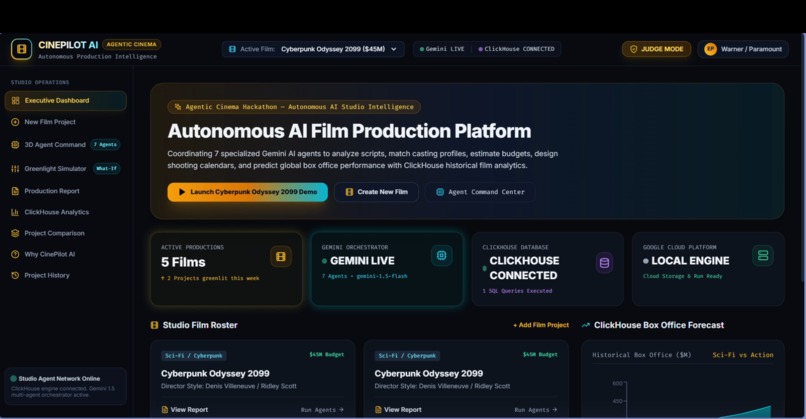
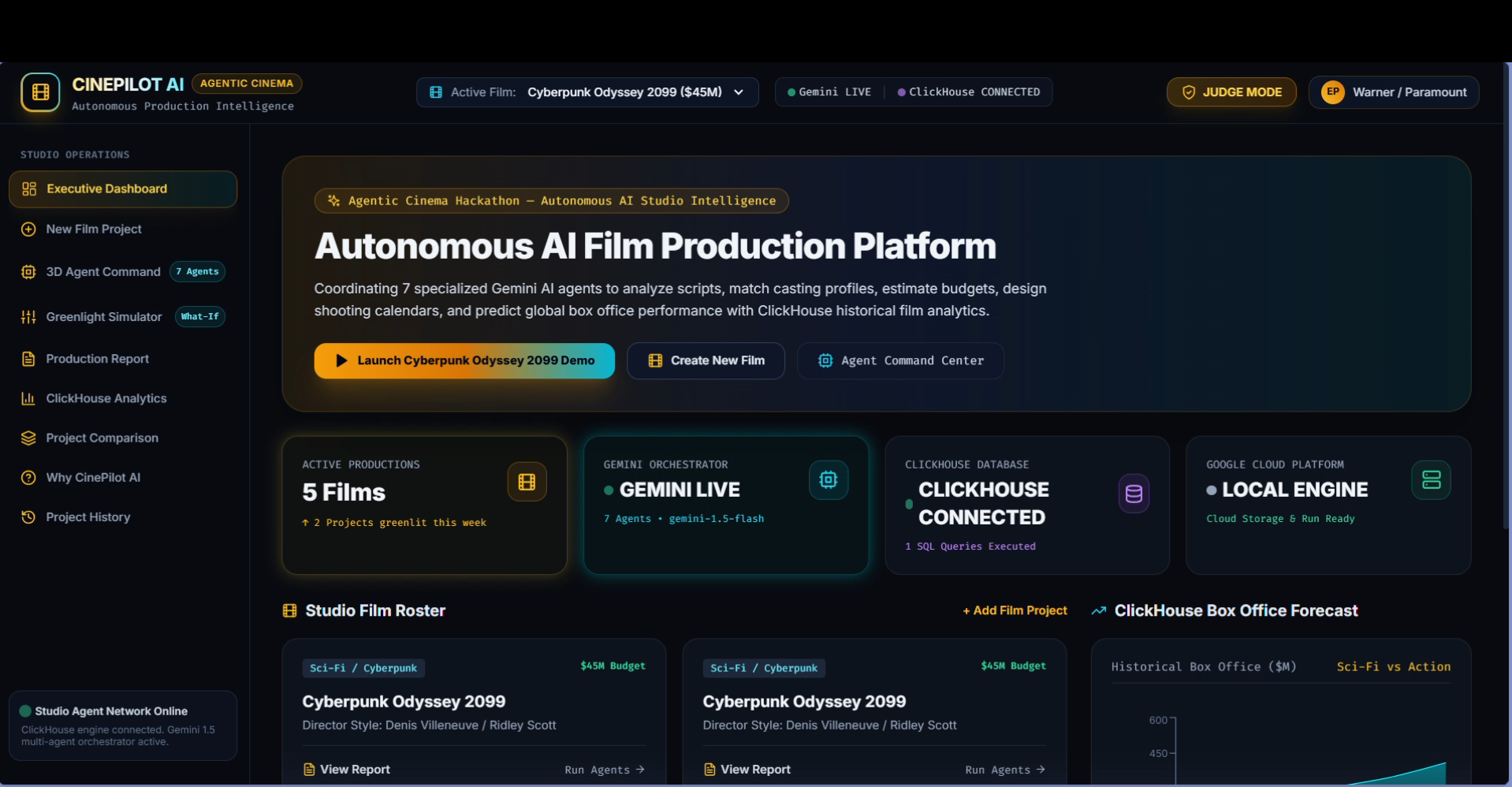
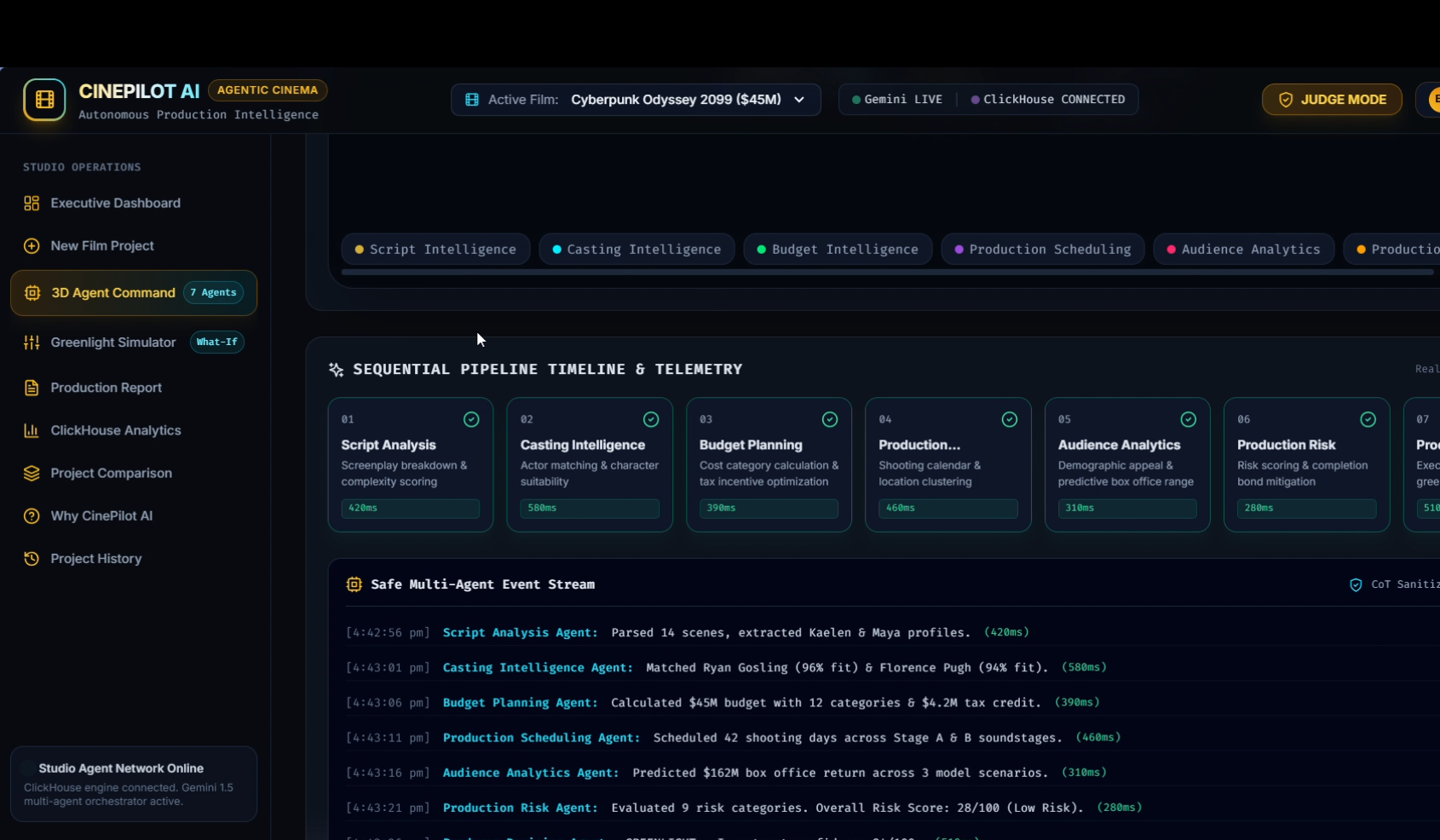
Dashboard
-
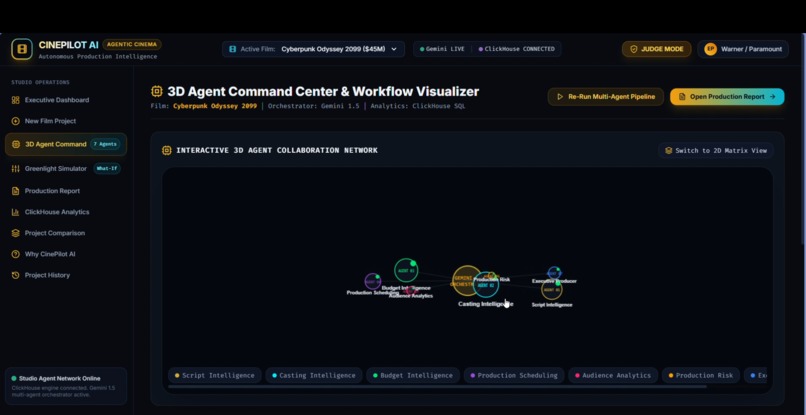
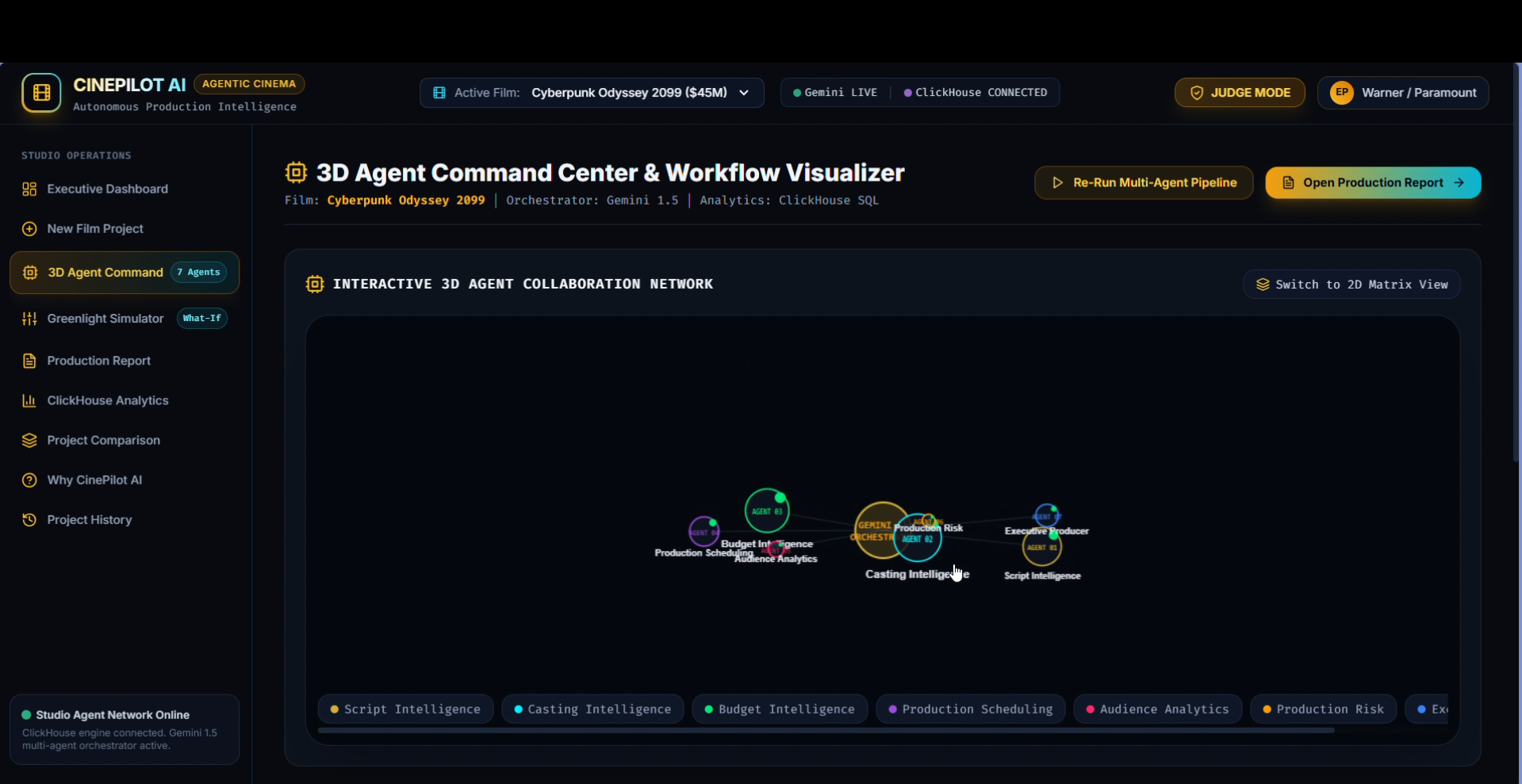
Agent networks 1
-
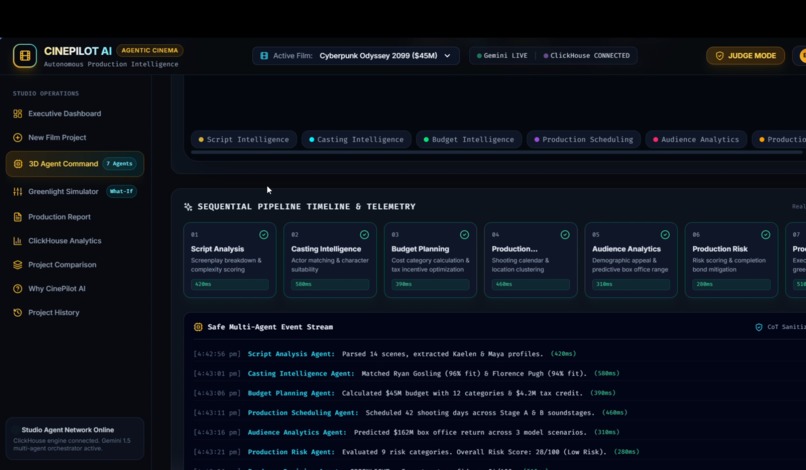
Agent networks 2
-
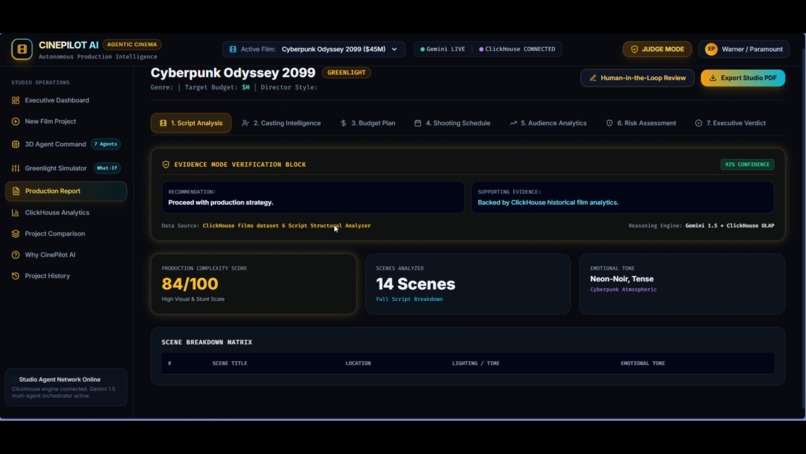
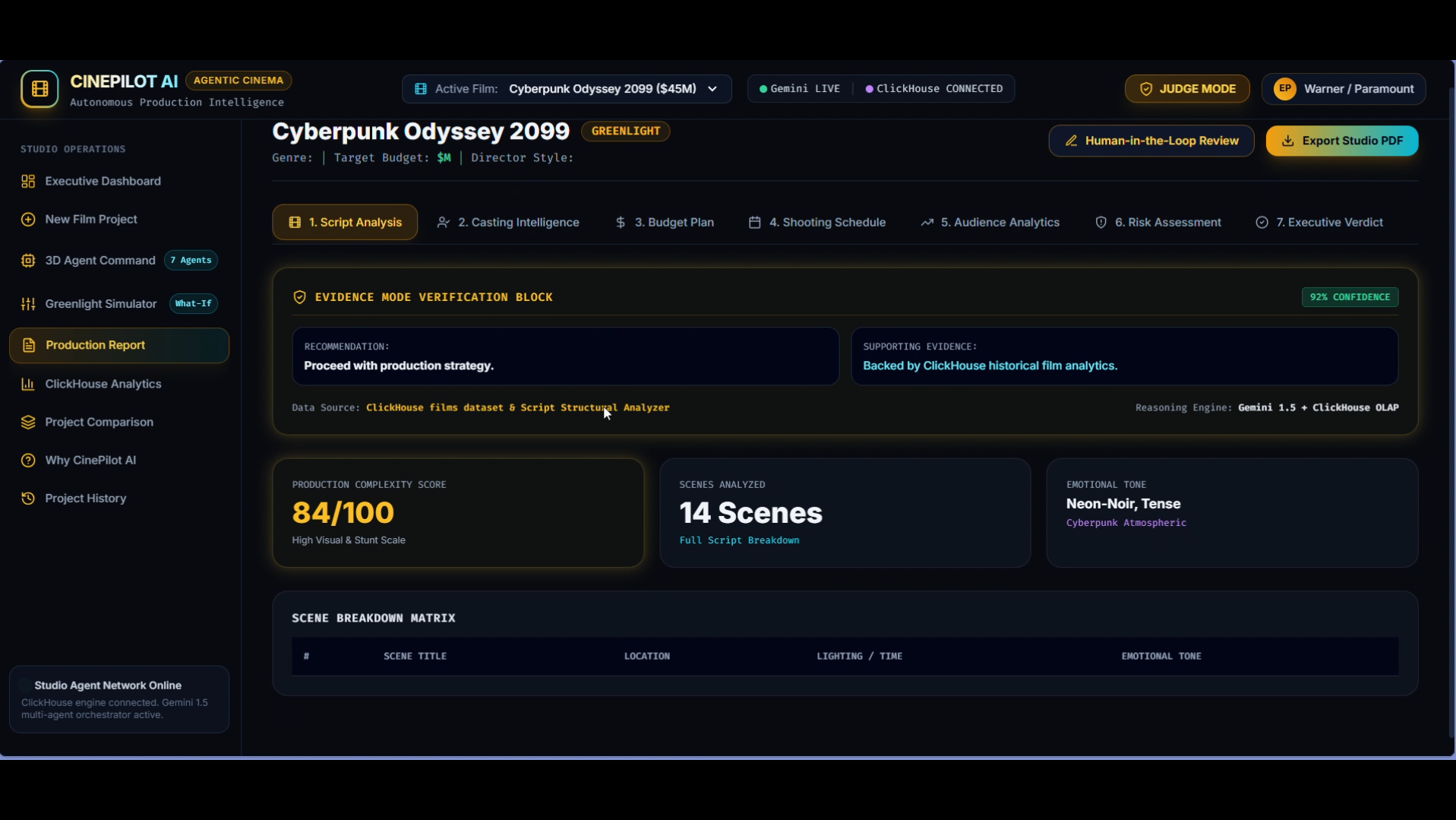
Production Report/Script analysis
-
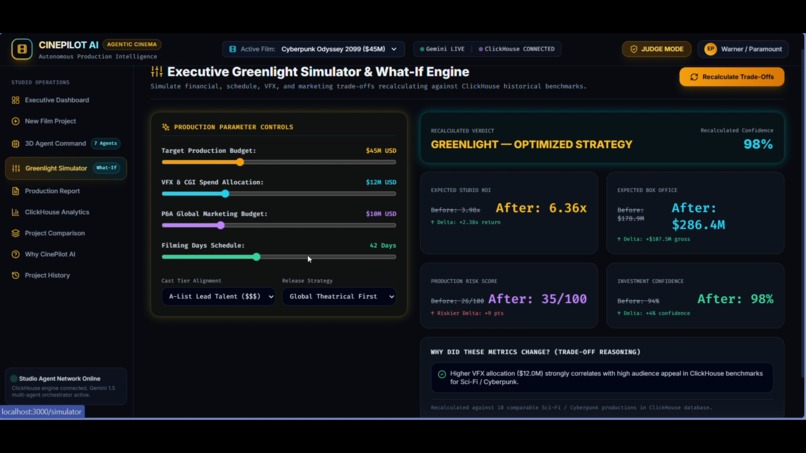
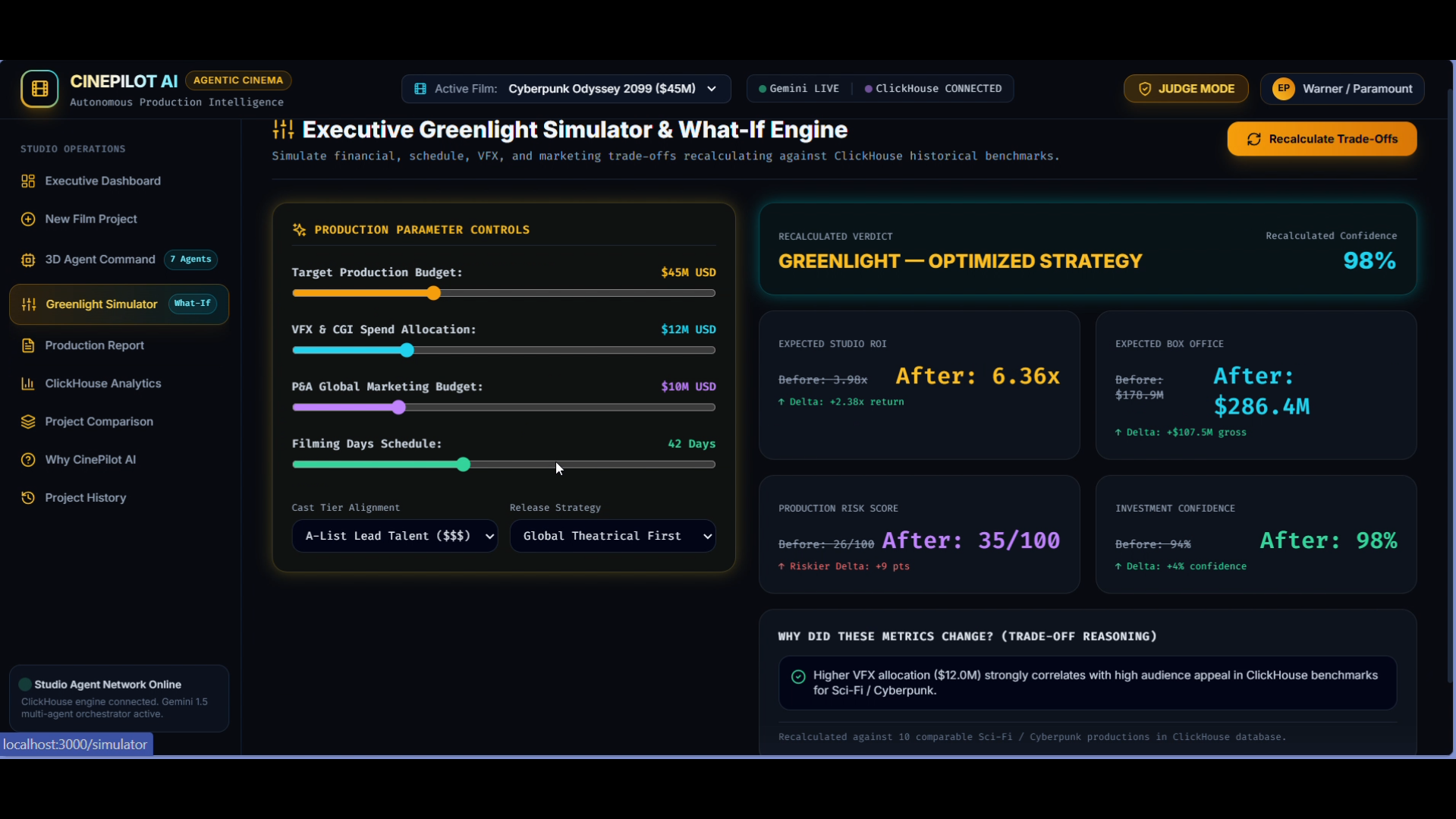
Greenlight Simulater/Budget/scheduling
-
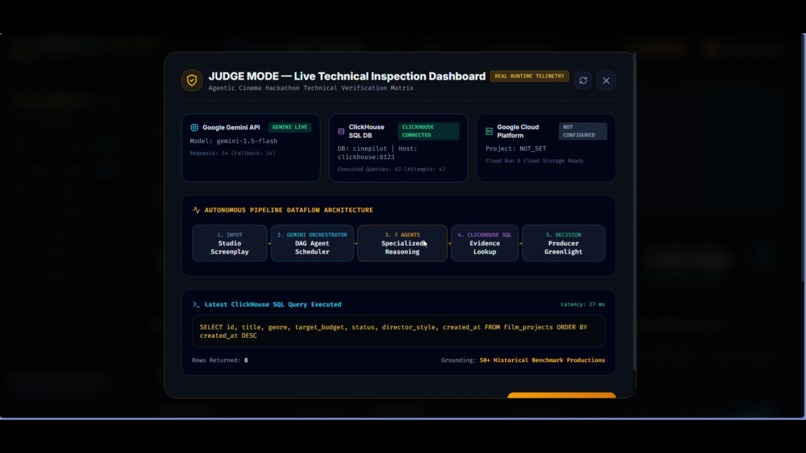
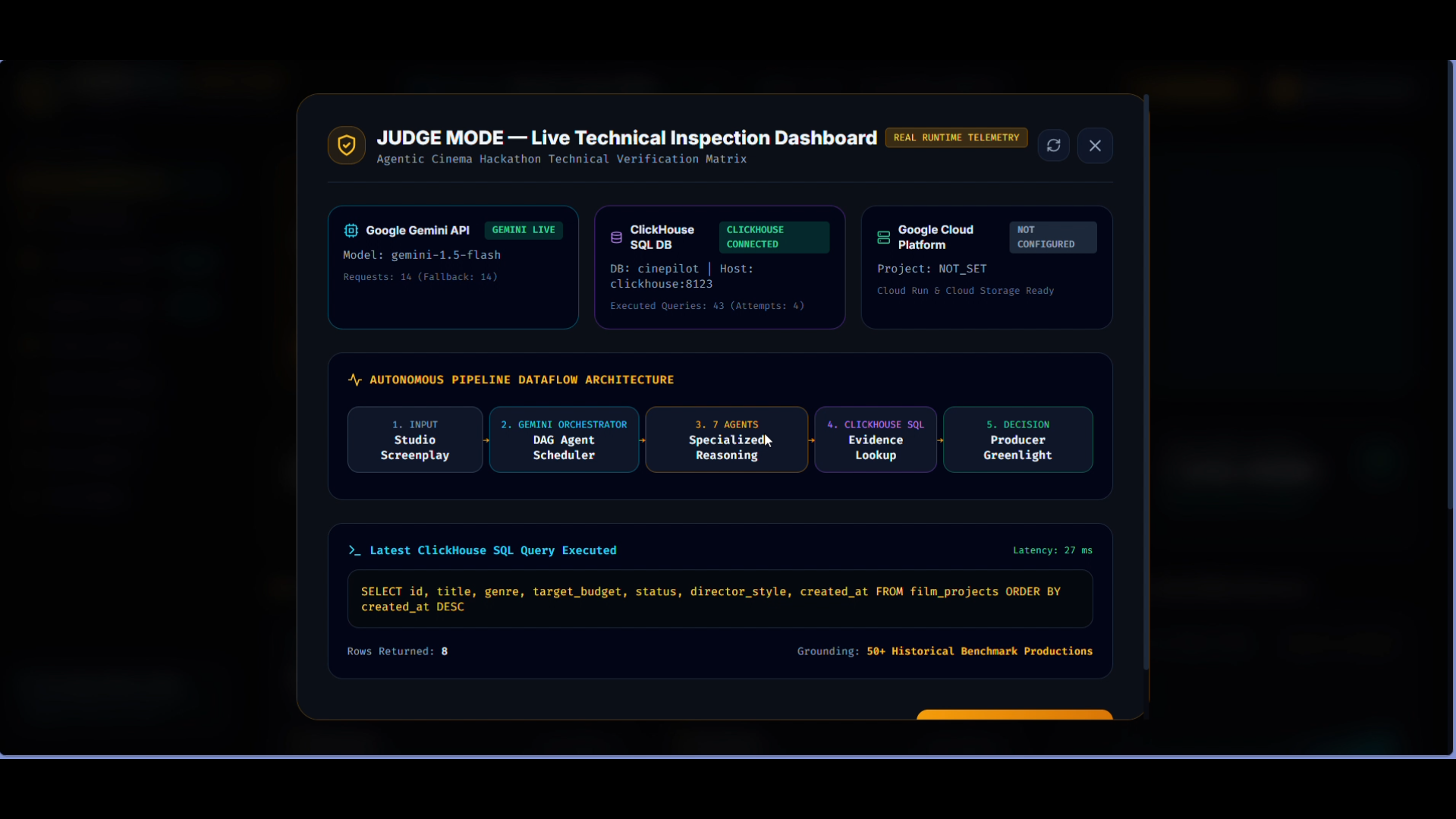
Judge Mode
🎬 Inspiration
Film production involves hundreds of interconnected decisions. A change in the script can affect casting, budget, scheduling, audience expectations, and production risk.
We noticed that these decisions are often handled using disconnected tools and workflows. Producers have to bring together information from different places before making important decisions.
We wanted to explore a different approach:
What if an AI system could act as a coordinated production intelligence team rather than just a single chatbot?
That question led us to build CinePilot AI for the Agentic Cinema: The Blockbuster Hackathon.
💡 What is CinePilot AI?
CinePilot AI is an autonomous film production intelligence platform powered by Google Gemini.
Instead of using one general-purpose AI for every task, CinePilot uses 7 specialized AI agents, each responsible for a different part of the filmmaking workflow.
🤖 The 7-Agent Network
1. Script Analysis Agent Analyzes scripts and identifies characters, scenes, locations, genre, themes, and production complexity.
2. Casting Intelligence Agent Provides casting insights based on character requirements and production considerations.
3. Budget Planning Agent Analyzes production requirements and provides budget estimates and cost insights.
4. Production Scheduling Agent Analyzes production dependencies and generates scheduling intelligence.
5. Audience Analytics Agent Provides audience-oriented insights to help evaluate potential audience response.
6. Production Risk Agent Identifies potential risks related to budget, scheduling, casting, production complexity, and dependencies.
7. Producer Decision Agent Combines the outputs from the other agents and turns them into higher-level recommendations for the producer.
🧠 How It Works
CinePilot follows an agentic workflow where specialized agents contribute to a larger production decision.
Producer Input
      ↓
CinePilot Orchestration
      ↓
┌───────────────────────────────┐
│       Specialized Agents      │
├───────────────────────────────┤
│ Script Analysis               │
│ Casting Intelligence          │
│ Budget Planning               │
│ Production Scheduling         │
│ Audience Analytics            │
│ Production Risk               │
└───────────────┬───────────────┘
                ↓
      Producer Decision Agent
                ↓
     Final Recommendations
The goal is not simply to generate seven separate AI responses. The goal is to connect different production perspectives so that decisions can be evaluated together.
For example:
Casting → Budget → Schedule → Audience → Risk
A decision in one area can influence several other areas, and CinePilot is designed around these relationships.
🏗️ How We Built It
The platform is built as a full-stack AI application.
Frontend
We built an interactive React 18 Studio Dashboard that gives producers a centralized view of the AI-generated production intelligence.
Backend
The backend is implemented using Python and FastAPI, providing APIs for the frontend and connecting the AI and analytics layers.
AI Layer
We integrated Google Gemini to power the reasoning and generation capabilities of the specialized agents.
Agentic Architecture
The application separates film-production responsibilities into specialized agents rather than putting every task into a single AI workflow.
MCP / Tool Layer
A tool-oriented layer connects AI reasoning with application capabilities and data systems, providing a foundation for extending the agents with additional tools.
Analytics
We integrated ClickHouse for analytical workloads and structured production data queries.
For development and demonstration resilience, the application also supports fallback paths when external services are unavailable.
Deployment
The application is containerized using:
- Docker
- Docker Compose
- Environment-based configuration
📊 Technology Stack
AI: Google Gemini, Multi-Agent AI
Frontend: React 18
Backend: Python, FastAPI, Pydantic
Analytics: ClickHouse, SQL
Integration: MCP / Tool Layer
Deployment: Docker, Docker Compose
🧩 Challenges We Faced
Coordinating Multiple Agents
One of the main challenges was designing how multiple specialized agents could contribute to a single production workflow without making the system unnecessarily complicated.
We had to clearly define the responsibility of each agent and determine how their outputs could contribute to the final producer-level recommendation.
Connecting AI With Structured Data
AI-generated insights are more useful when they can work alongside structured analytics.
Integrating the AI layer with ClickHouse and the backend required us to think about how generated insights and structured production data could coexist within the same workflow.
External API Reliability
AI applications depend on external services, which can introduce failures during development and demonstrations.
We therefore designed fallback paths so the application could continue demonstrating its workflow even when external services were unavailable.
Creating a Unified Experience
Seven different AI capabilities could easily become seven disconnected screens.
We focused on creating a centralized dashboard where the producer can understand the overall production situation instead of manually switching between separate tools.
📚 What We Learned
Building CinePilot taught us that an agentic AI application requires more than connecting an LLM to a user interface.
We learned how to:
- Design specialized AI agents
- Structure multi-agent workflows
- Integrate Gemini into an application
- Connect AI systems with structured analytics
- Build APIs using FastAPI
- Create an interactive React dashboard
- Work with ClickHouse for analytical workloads
- Design fallback mechanisms for external services
- Containerize a full-stack application with Docker
- Think about AI as a decision-support system rather than only a text-generation tool
Most importantly, we learned that good agentic systems depend on clear responsibilities, reliable tool integration, and meaningful coordination between agents.
🚀 What's Next?
CinePilot can be expanded into a broader AI-powered film production operating system.
Future versions could include:
- Automated call-sheet generation
- Real-time production monitoring
- Location intelligence
- Advanced financial forecasting
- Talent availability analysis
- Contract and document analysis
- Automated schedule optimization
- Marketing campaign intelligence
- Distribution strategy analysis
- Real-time audience feedback
- Voice-based producer interaction
- Continuous production risk monitoring
The long-term vision is to create an AI production partner that continuously monitors a film project and proactively identifies opportunities, conflicts, and risks.
🏆 Our Vision
Film production is not a collection of independent tasks.
Script, casting, budget, schedule, audience, and risk are interconnected.
CinePilot AI brings these dimensions together through a coordinated multi-agent architecture powered by Gemini.
Our vision is to move from:
AI that answers questions
to
AI that coordinates decisions.
🎬 CinePilot AI — Turning Film Production Data into Intelligent Decisions.

Log in or sign up for Devpost to join the conversation.