-
-
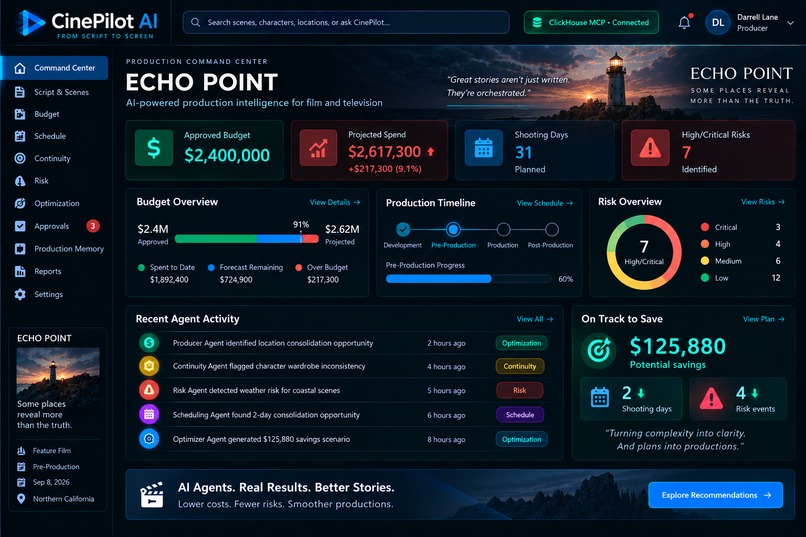
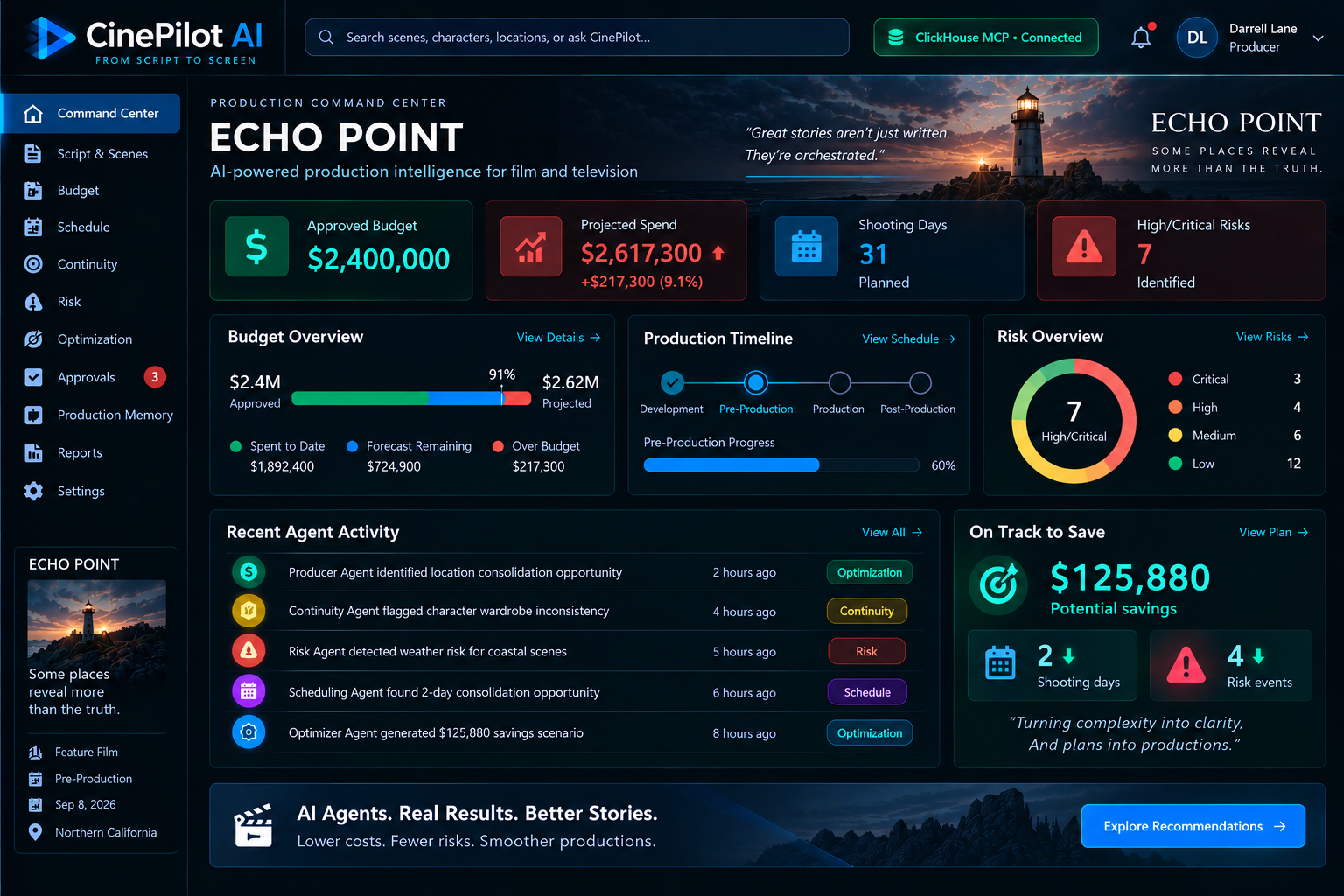
Production Command Center — full ECHO POINT dashboard showing the $2.4M budget, projected spend, 31 shooting days, and 7 risks.
-
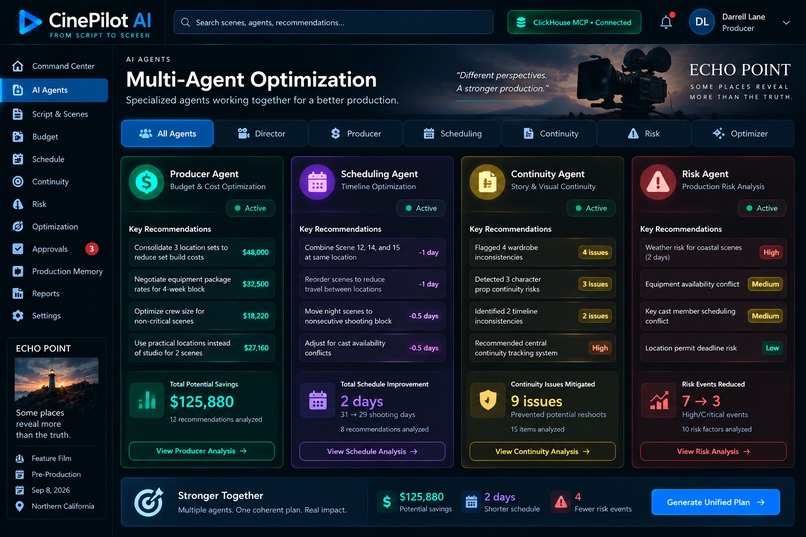
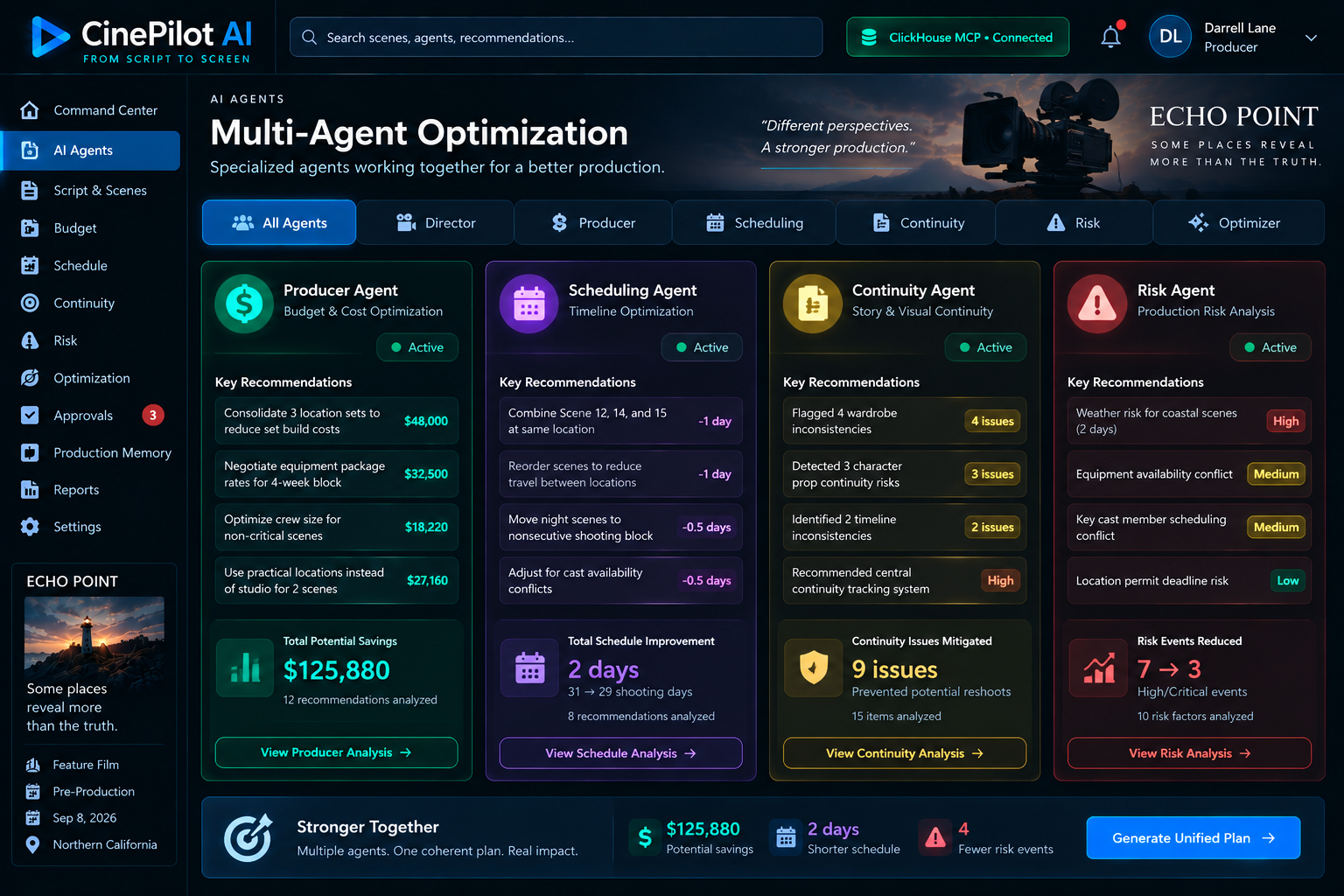
Multi-Agent Optimization — showing Producer, Scheduler, Continuity, and Risk Agent recommendations.
-
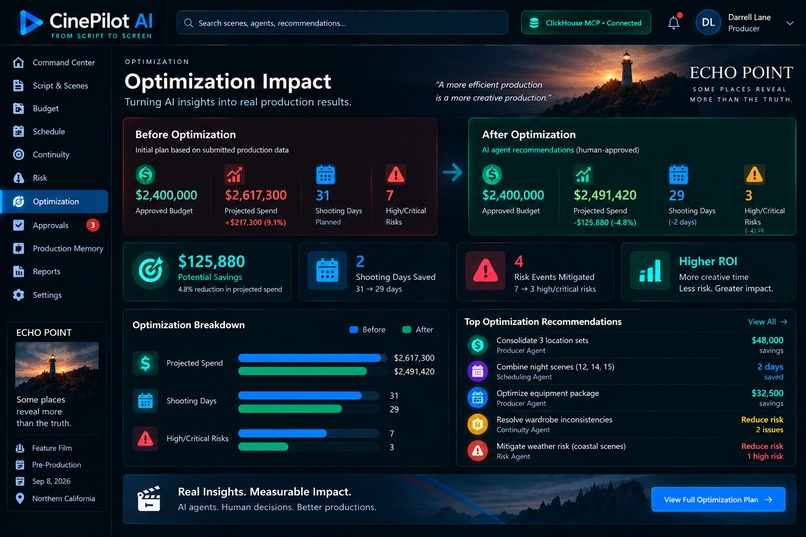
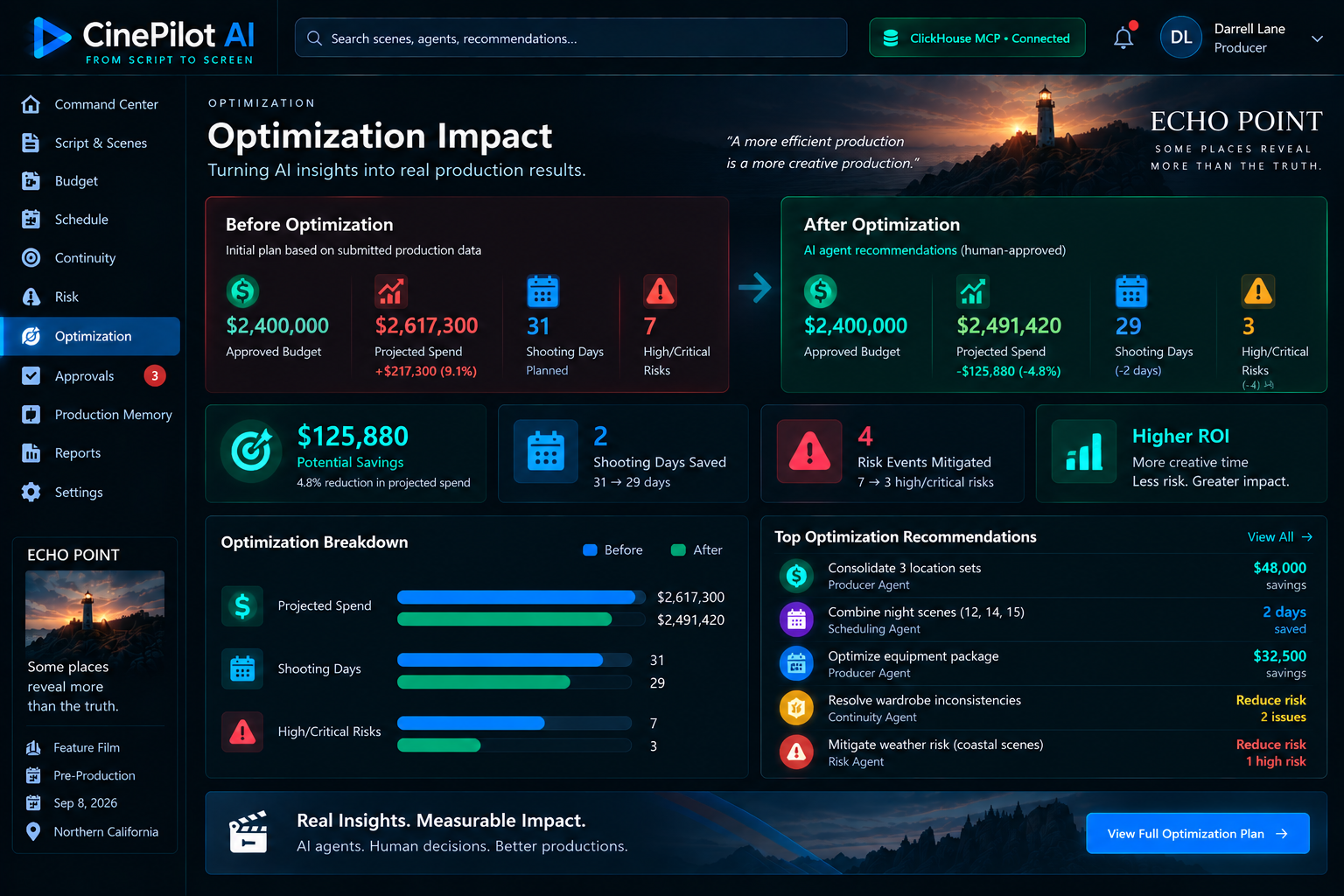
Optimization Impact — showing the $125,880 savings / 31→29 days / 7→3 risks story.
-
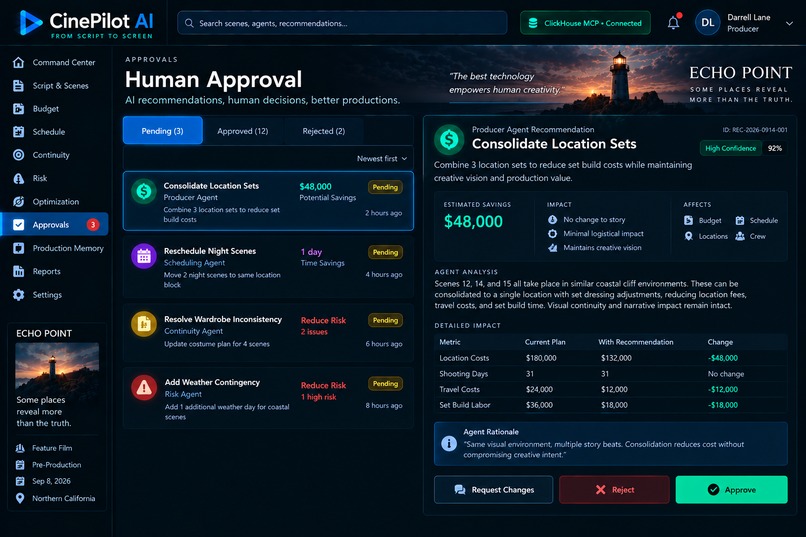
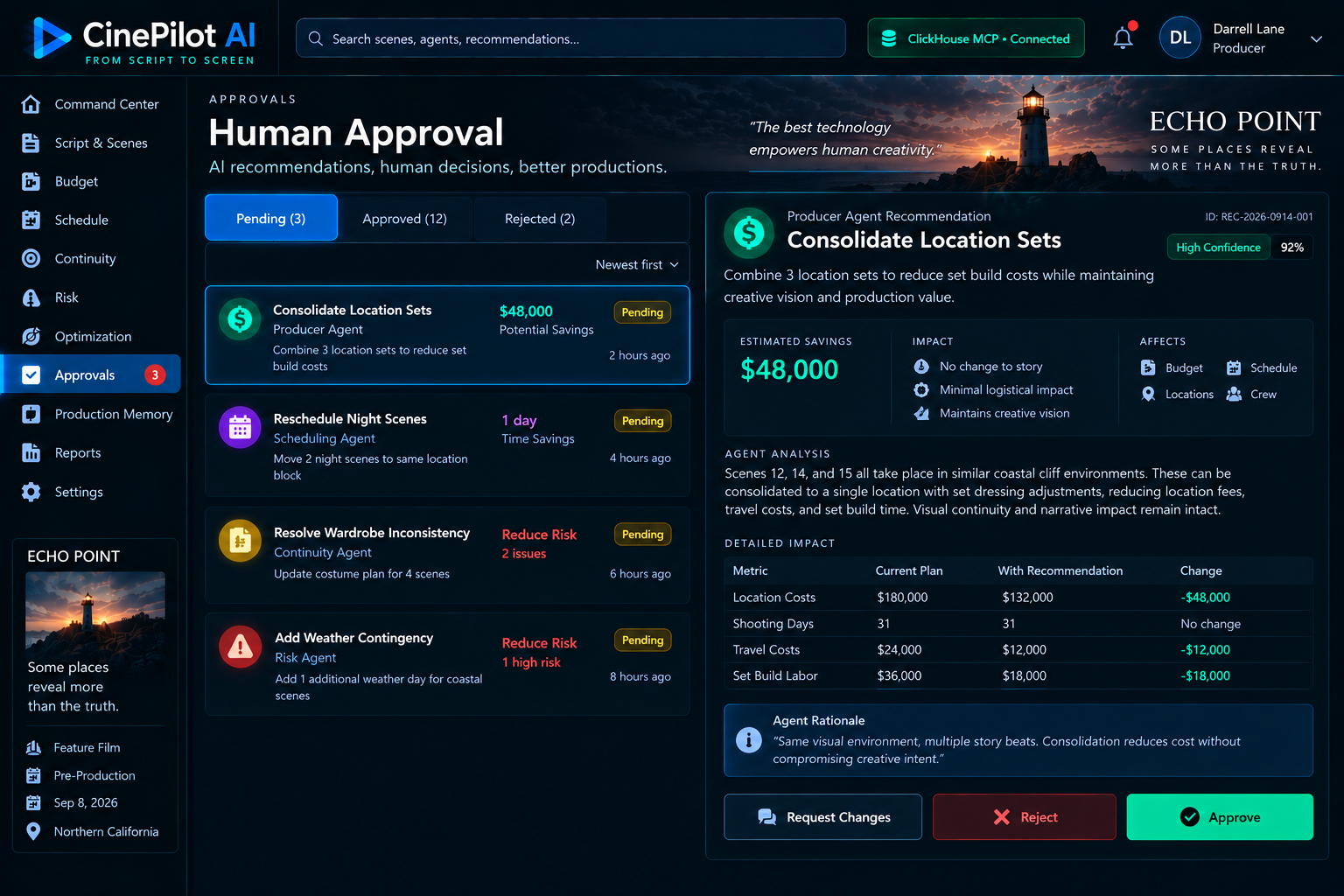
Human Approval — a recommendation with the Approve/Reject governance controls.
-
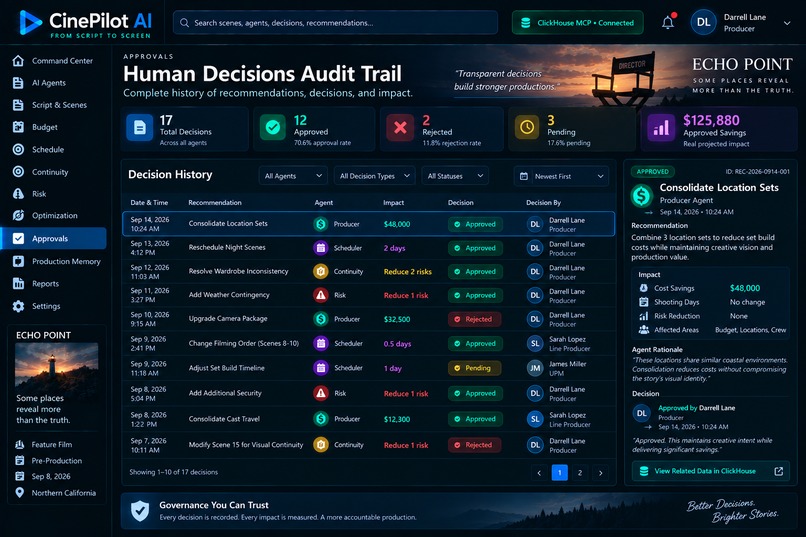
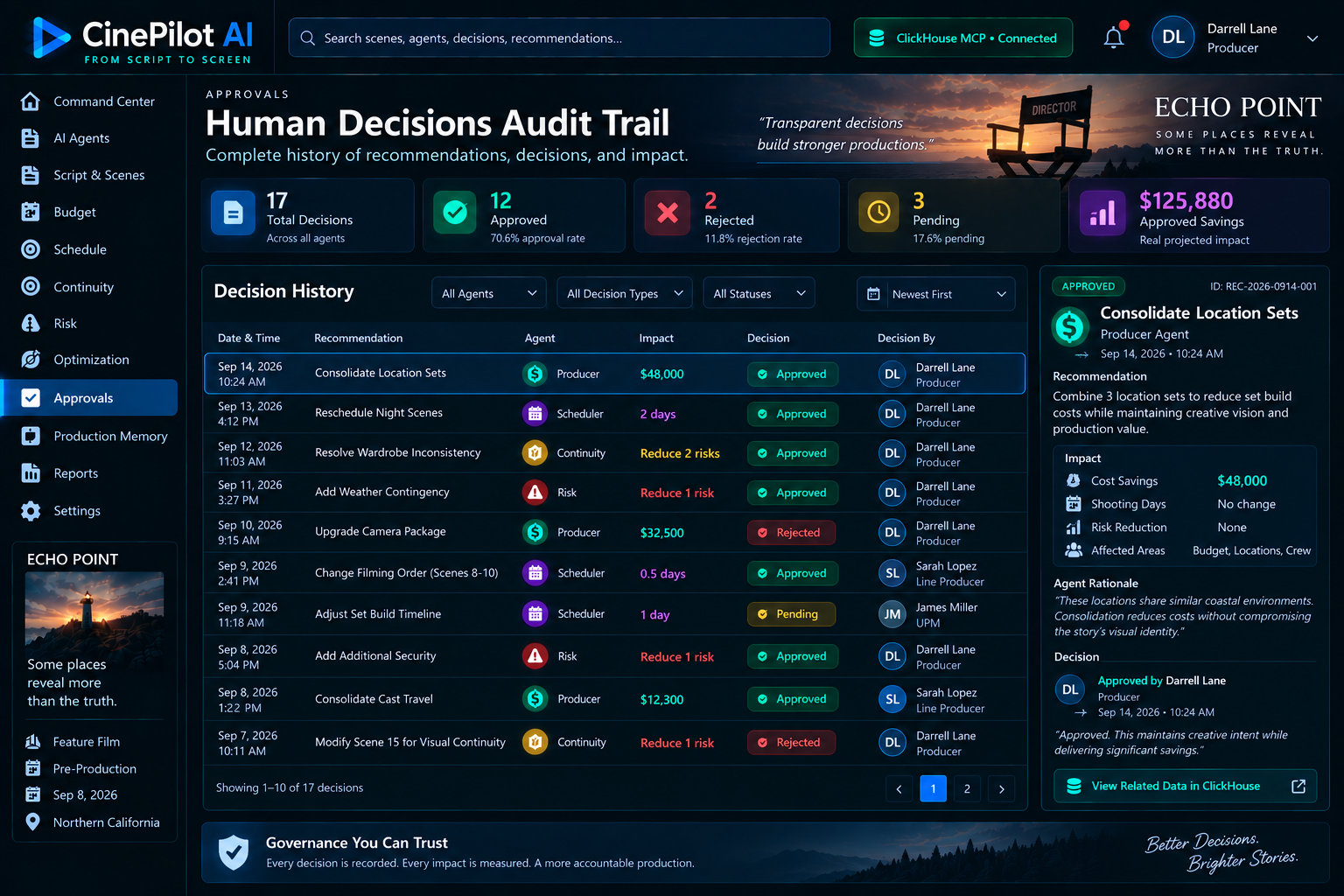
Human Decisions Audit Trail — especially valuable because it demonstrates persisted governance history.
-
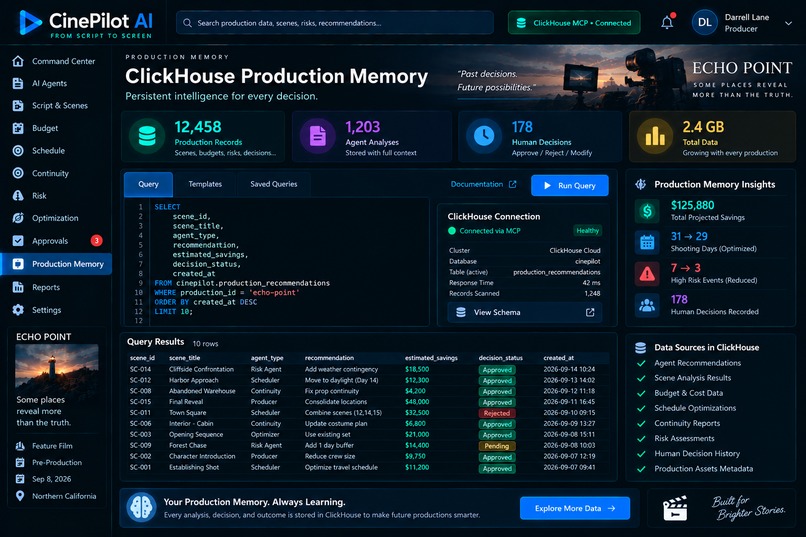
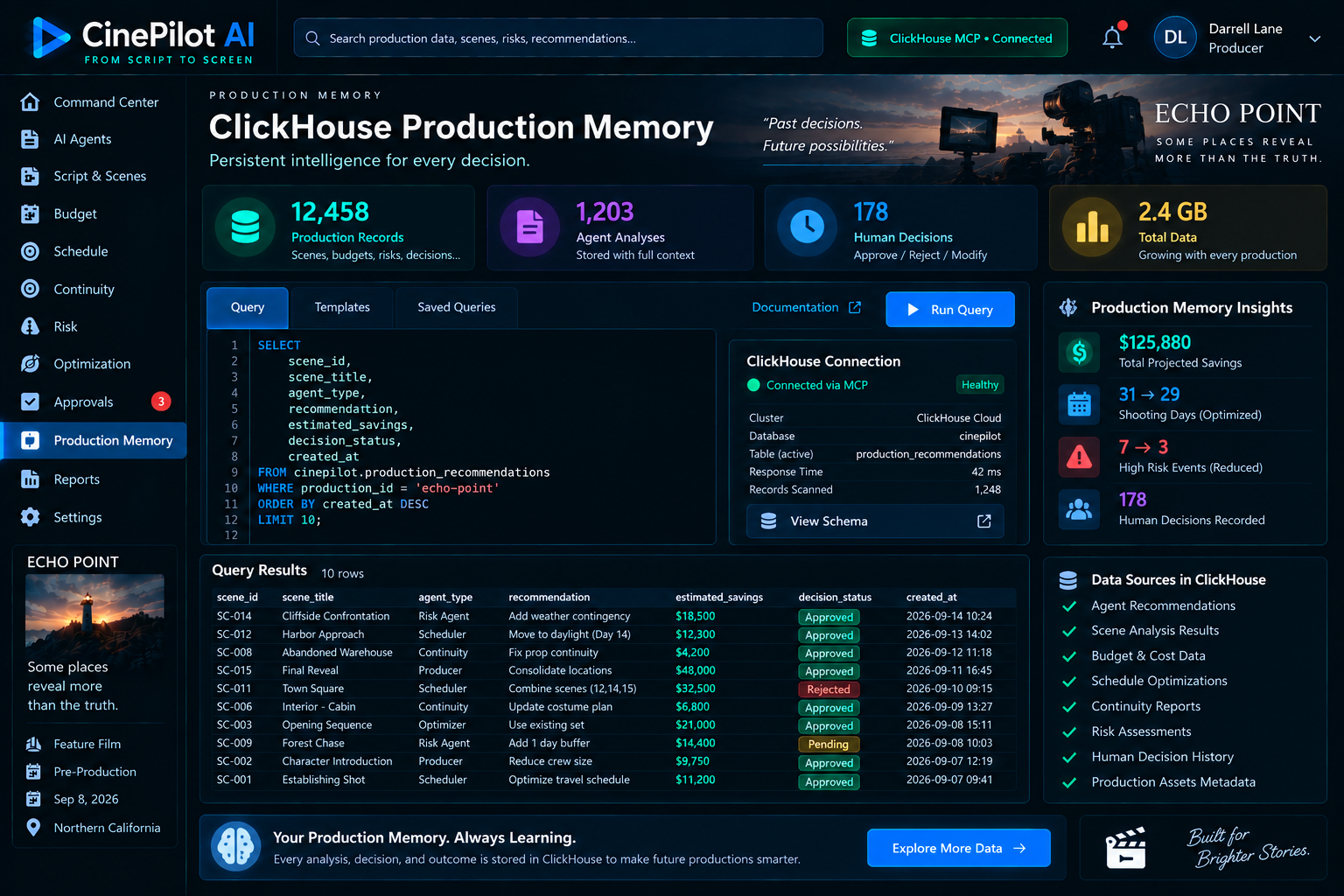
ClickHouse Production Memory — showing actual retrieved analysis history.
-
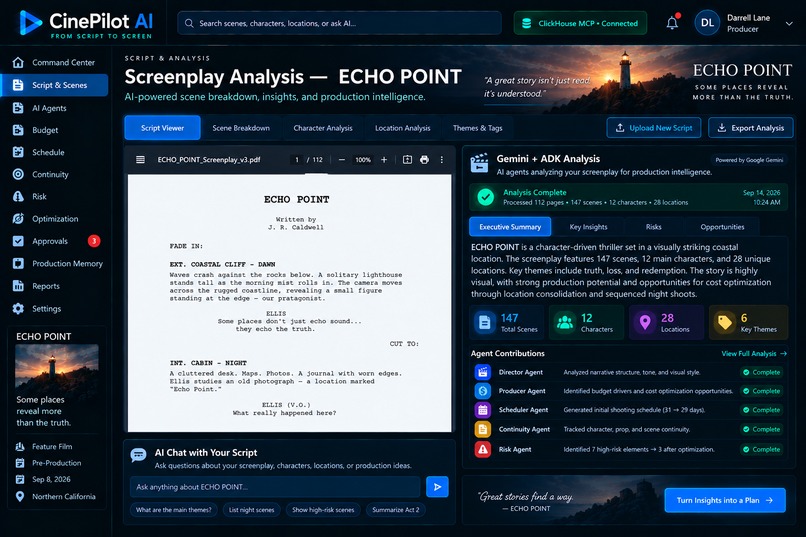
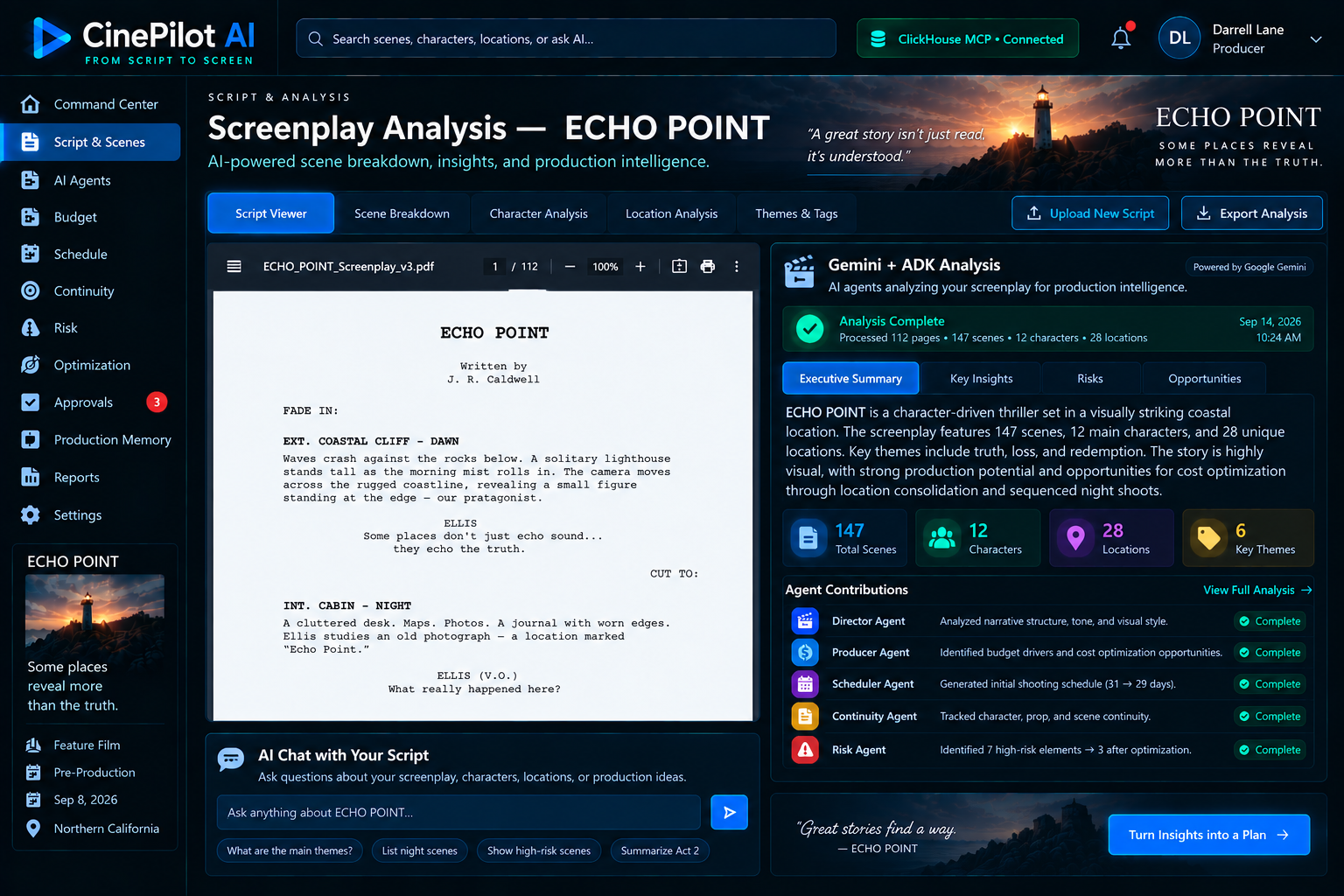
Screenplay/Agent Analysis — demonstrating Gemini/ADK actually analyzing ECHO POINT.
-
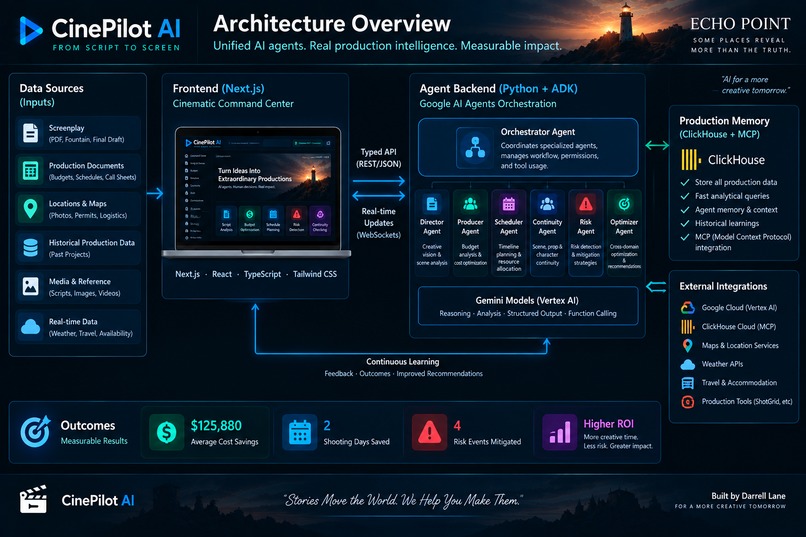
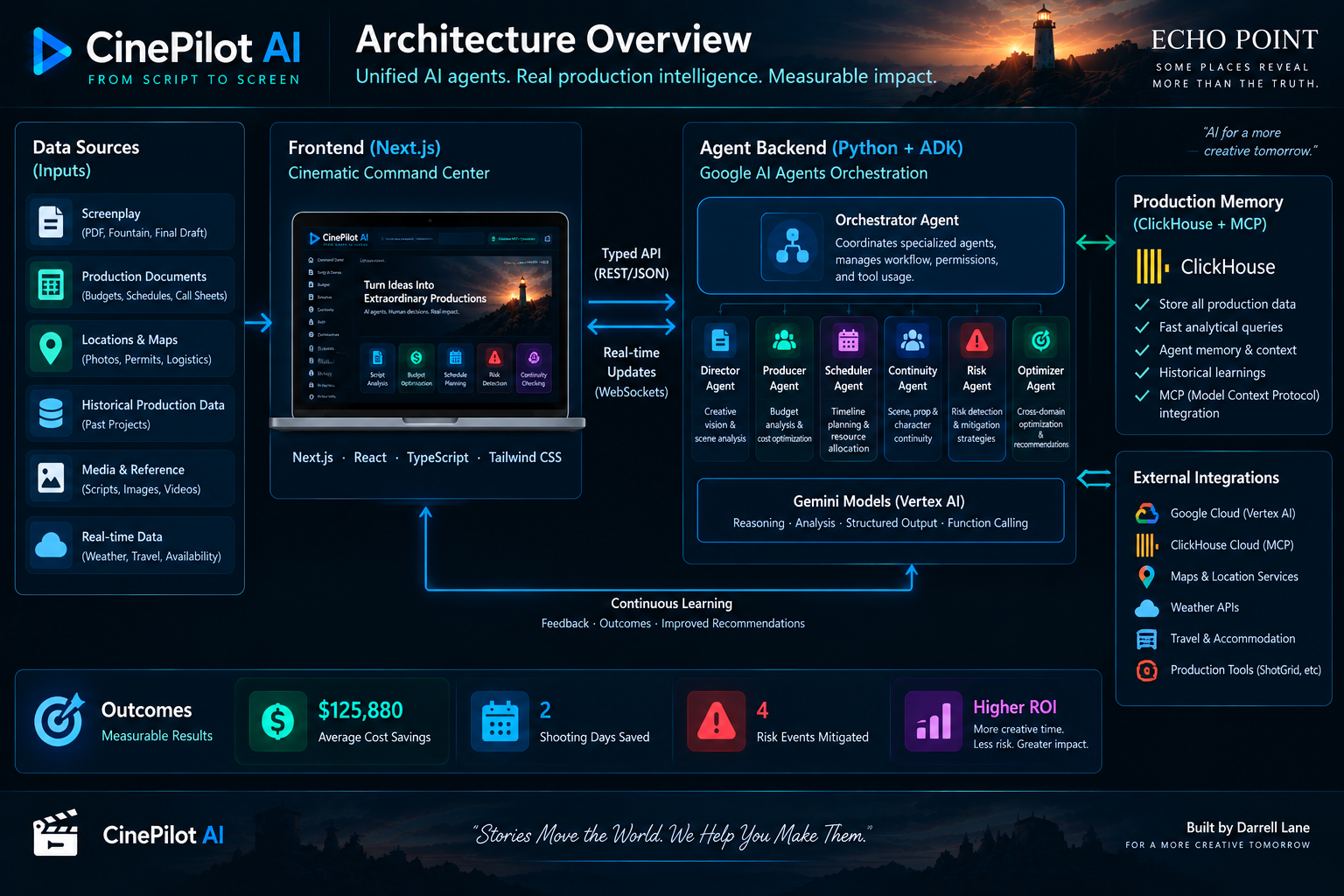
Architecture diagram — Google ADK/Gemini/Vertex AI → CinePilot → official ClickHouse MCP → ClickHouse Cloud.
Inspiration
Film and television productions generate enormous amounts of information across scripts, budgets, schedules, continuity notes, locations, cast availability, equipment, and production risks. Yet many consequential decisions are still made by manually combining information spread across different systems.
We built CinePilot AI around a simple question:
What if a production could continuously understand its own operational state and coordinate specialized AI agents to help the production team make better decisions?
CinePilot AI is designed as an AI production command center—not a generic chatbot. It transforms screenplay and production data into actionable production intelligence while keeping consequential decisions under human control.
Our demonstration production, ECHO POINT, shows CinePilot AI identifying opportunities to reduce projected spend, shorten the shooting schedule, mitigate production risks, and preserve an auditable history of human-approved decisions.
What it does
CinePilot AI is a multi-agent production intelligence platform for film and television.
Specialized AI agents collaborate across key production domains:
- Director Agent — analyzes screenplay and scene requirements.
- Producer Agent — evaluates budget exposure and cost-saving opportunities.
- Scheduling Agent — identifies scheduling conflicts and consolidation opportunities.
- Continuity Agent — detects story, wardrobe, character-state, and production continuity risks.
- Risk Agent — evaluates operational and production risks.
- Optimizer Agent — combines recommendations into measurable production optimization opportunities.
Instead of allowing AI to silently change a production, CinePilot follows a governed workflow:
Analyze → Recommend → Quantify Impact → Validate → Human Approval → Execute → Record Decision
For ECHO POINT, the demo begins with:
- Approved budget: $2,400,000
- Projected spend: $2,617,300
- Budget variance: +$217,300
- Planned shooting days: 31
- High/Critical risk events: 7
The coordinated optimization plan identifies up to:
- $125,880 in potential savings
- 2 shooting days saved
- 4 high-risk events mitigated
- Projected spend reduced to approximately $2,491,420
- Shooting schedule reduced from 31 to 29 days
- High-risk events reduced from 7 to 3
Most importantly, projected recommendations and committed results are different. Production metrics change only when a human approves a recommendation.
How we built it
CinePilot AI uses a hybrid frontend, agent-runtime, and production-memory architecture.
The command center is built with Next.js, React, TypeScript, and Tailwind CSS.
The authoritative agent backend uses Python, Google Agent Development Kit (ADK), Gemini, and Vertex AI / Google Cloud to coordinate specialized production agents and return structured production intelligence to the application.
For persistent production memory, CinePilot integrates ClickHouse Cloud through the official mcp-clickhouse MCP server.
This allows the system to preserve and retrieve production intelligence such as agent analysis history and human governance decisions. The application exposes this directly in the command center so production teams—and hackathon judges—can see the history behind the AI's recommendations and human decisions.
The Human Decisions Audit Trail records information including:
- Recommendation ID
- Human actor
- Approval state
- State transition
- Committed impact
- Reason notes
- Timestamp
This creates a durable production-memory layer rather than treating every AI interaction as an isolated prompt.
Challenges we ran into
One of the biggest challenges was coordinating multiple AI domains without allowing the system to become an uncontrolled autonomous agent.
Production decisions can affect real budgets, schedules, safety, cast, and crew, so we designed explicit human-in-the-loop governance into the architecture.
Another challenge was keeping projected optimization and committed production state separate. A recommendation may estimate savings or risk reduction, but those values should not alter the production dashboard until a human approves the change.
We also integrated several runtime layers—Next.js, a Python ADK agent service, Gemini through Vertex AI, Google Cloud, ClickHouse Cloud, and the official ClickHouse MCP server—while maintaining typed contracts and reliable production-memory retrieval.
Accomplishments that we're proud of
We're especially proud that CinePilot AI is more than an AI interface.
We built a working multi-agent production workflow in which specialized agents analyze production problems, quantify recommendations, surface them for human review, and preserve governed decisions in persistent production memory.
We also created a measurable before-and-after demonstration. ECHO POINT gives judges concrete production outcomes rather than abstract AI responses.
CinePilot demonstrates that agentic AI can assist with consequential operational decisions while maintaining human authority, explainability, measurable impact, and an auditable decision history.
What we learned
Building CinePilot reinforced that useful agentic systems need more than powerful models.
They need specialized responsibilities, structured outputs, deterministic business rules where appropriate, persistent memory, clear system boundaries, and governance.
We also learned that production memory becomes substantially more valuable when both AI analysis and human decisions can be retrieved later. ClickHouse and MCP provide CinePilot with a foundation for analyzing not just the current production state, but the history of how that state evolved.
What's next for CinePilot AI
Our next step is expanding CinePilot from a hackathon demonstration into a production intelligence platform capable of supporting real film and television workflows.
Future capabilities include deeper screenplay ingestion, live call-sheet and scheduling integrations, vendor and equipment optimization, richer continuity tracking, predictive cost-overrun detection, historical production benchmarking, and organization-wide production intelligence.
Longer term, CinePilot could allow studios to build a reusable institutional memory across productions—learning from previous schedules, risks, decisions, and outcomes while maintaining human control over consequential actions.
CinePilot AI is our vision for a production command center where AI agents don't replace filmmakers—they give production teams better intelligence to make the decisions that keep stories moving.
Built With
- ai-agents
- clickhouse
- clickhouse-cloud
- fastapi
- google-adk
- google-cloud
- google-gemini
- mcp
- mcp-clickhouse
- multi-agent
- next.js
- python
- react
- tailwind-css
- typescript
- vertex-ai


Log in or sign up for Devpost to join the conversation.