Inspiration
Film production is one of the most collaborative and complex creative processes in the world. A single production can involve directors, producers, screenwriters, actors, cinematographers, production designers, editors, accountants, and dozens of other specialists. Everyone depends on the same screenplay, schedule, budget, and production information, yet much of this coordination is still handled through disconnected documents, spreadsheets, messages, and meetings.
We were inspired by the gap between the rapid progress of AI in creative content generation and the lack of AI systems that actually help manage the production process after a screenplay has been written.
Instead of building another AI tool that simply generates scripts, we wanted to ask a different question:
What if AI could behave like an entire production team?
That idea became CinePilot AI — an intelligent production command center where specialized AI agents collaborate to transform a screenplay into an organized, trackable production workflow.
What it does
CinePilot AI is an AI-powered multi-agent production management platform designed for filmmakers, producers, directors, and production teams.
A user can create their own production and upload a screenplay. CinePilot then uses AI to analyze the screenplay and extract important production information such as:
- Scenes
- Characters
- Locations
- Props
- Costumes
- Production requirements
- Scheduling requirements
- Budget considerations
- Potential production risks
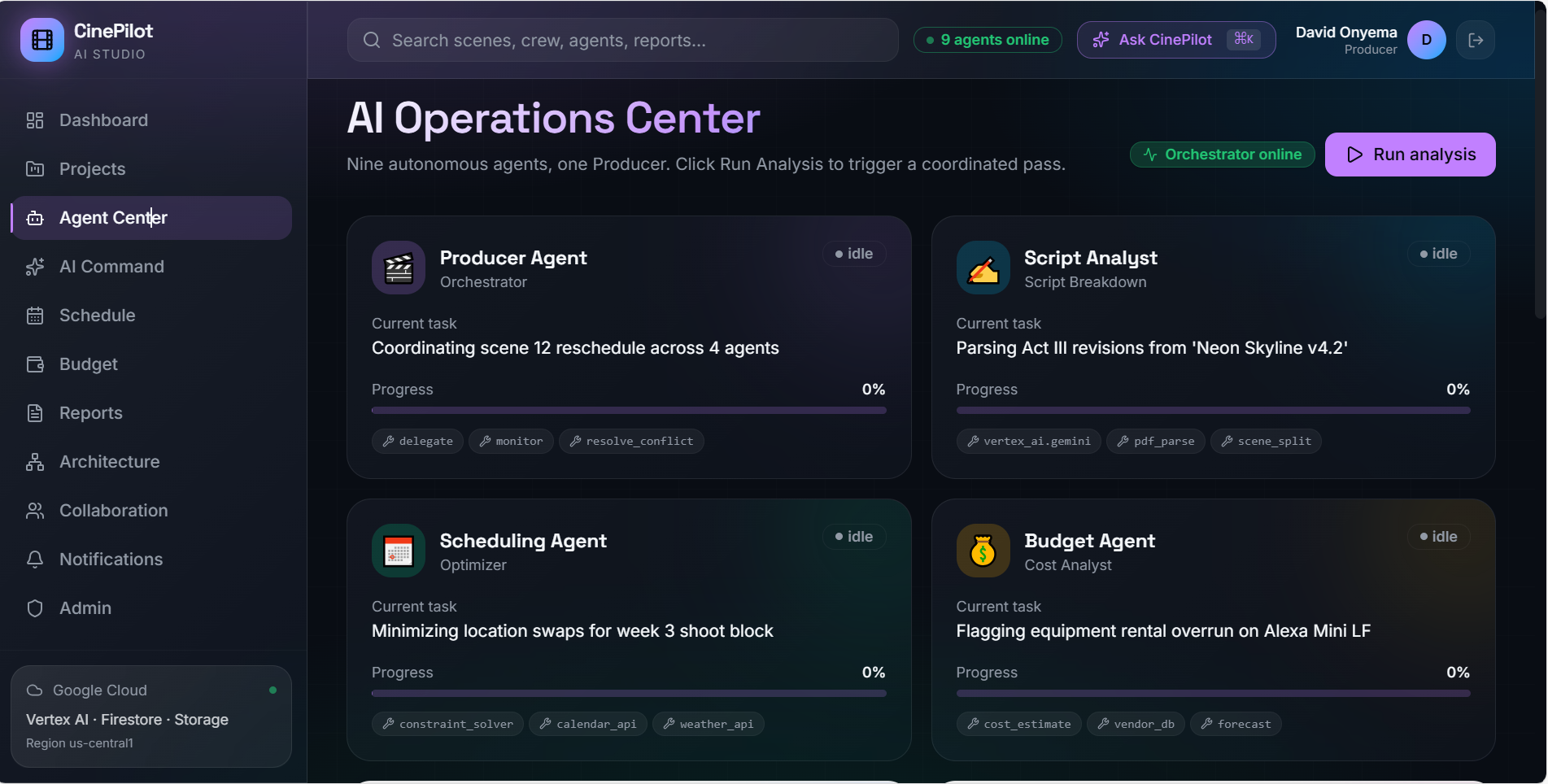
Instead of relying on one generic chatbot, CinePilot uses specialized AI agents that work together like members of a real production team.
For example, a screenplay analysis agent can break down the script, while scheduling, budgeting, risk, and production agents use that information to create actionable production plans.
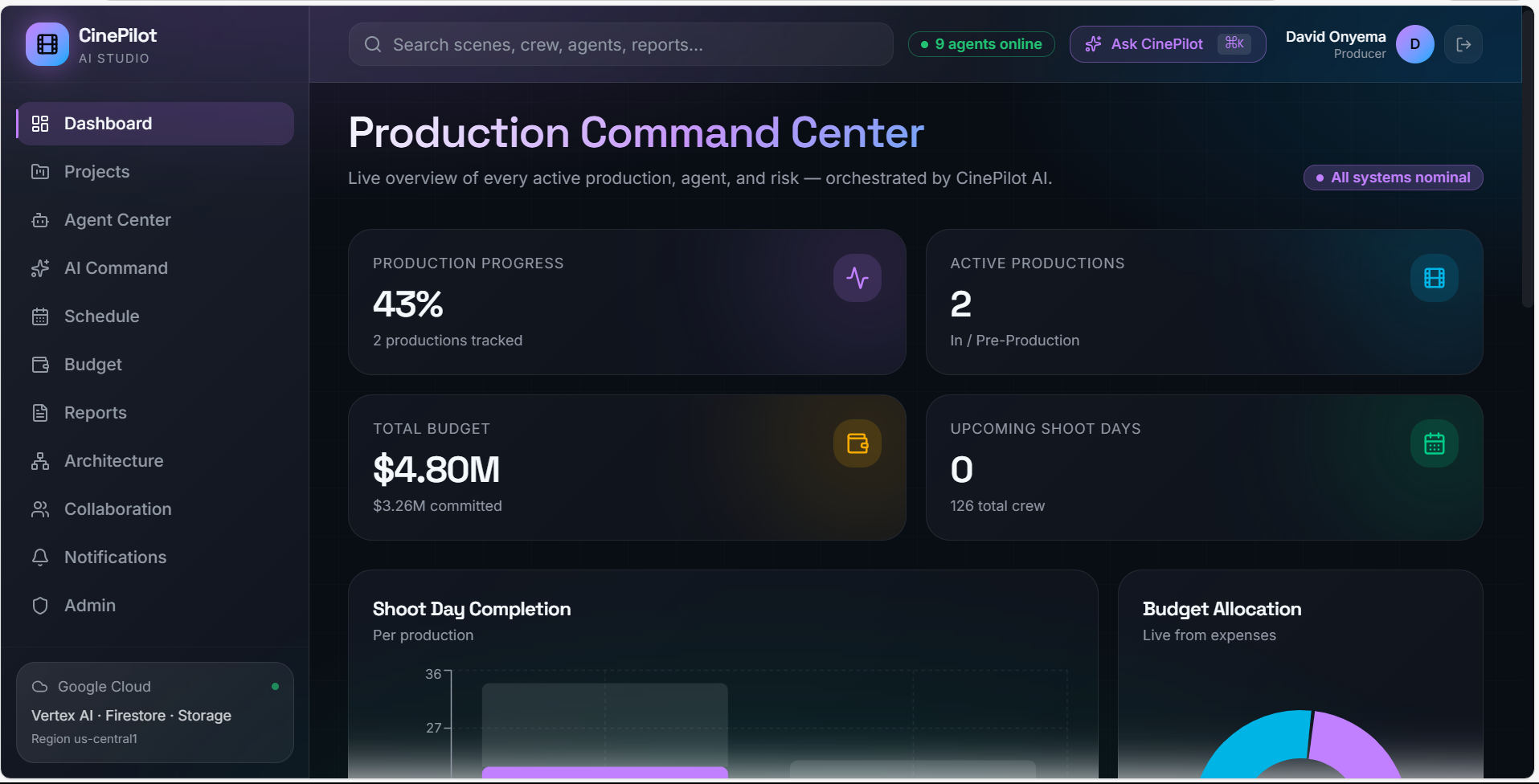
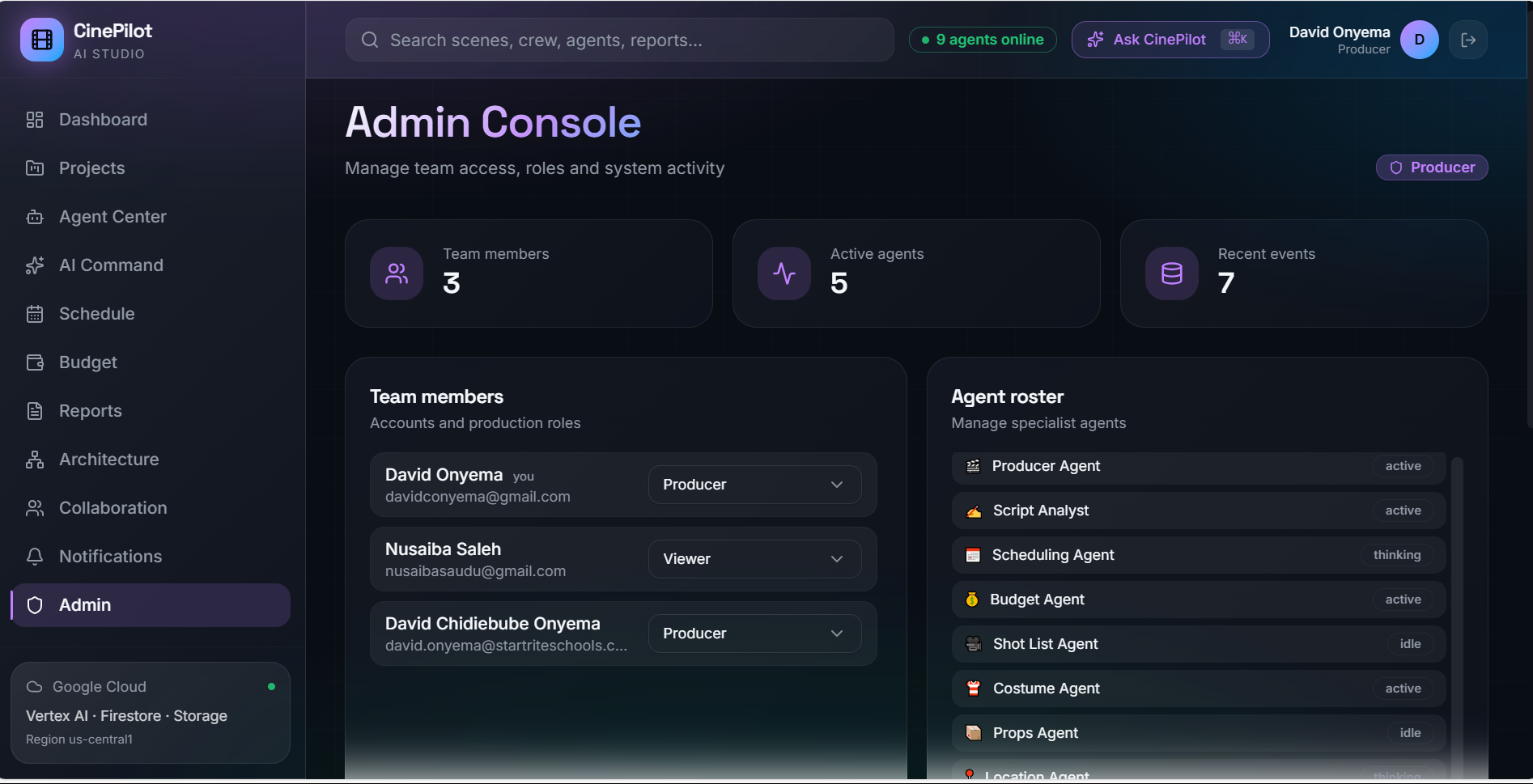
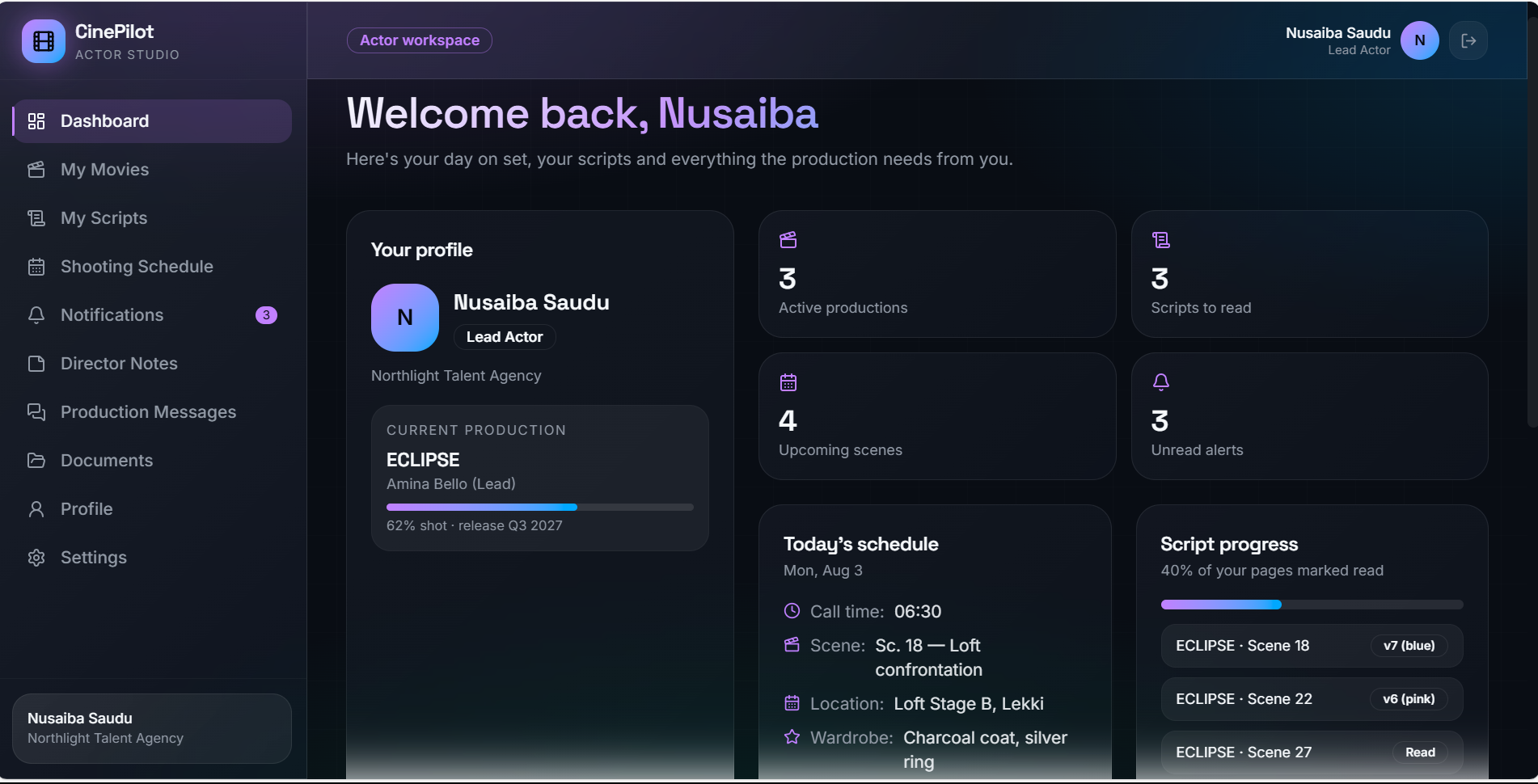
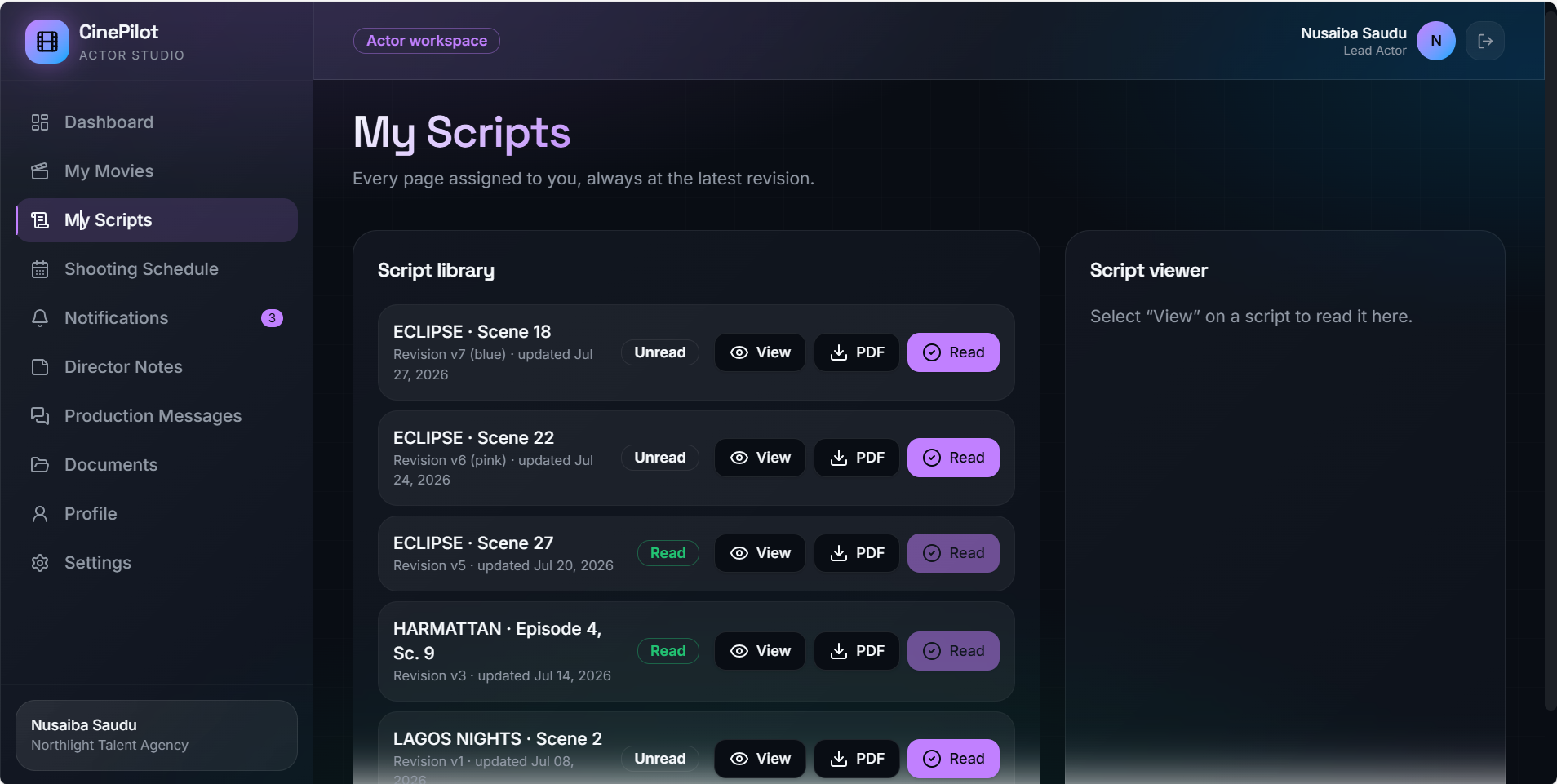
The platform provides filmmakers with a centralized production workspace containing dashboards, schedules, budgets, reports, AI agents, production analytics, and collaboration tools.
The goal is simple:
Turn a screenplay into a production plan — and keep that production plan intelligent as the project evolves.
How we built it
CinePilot AI was built as a multi-agent application centered around Google Cloud and Gemini.
At the core of the system is Gemini-powered AI reasoning, which allows CinePilot to understand screenplay content and extract structured production information.
We designed the application around a multi-agent architecture where different agents specialize in different areas of production.
The main architecture includes:
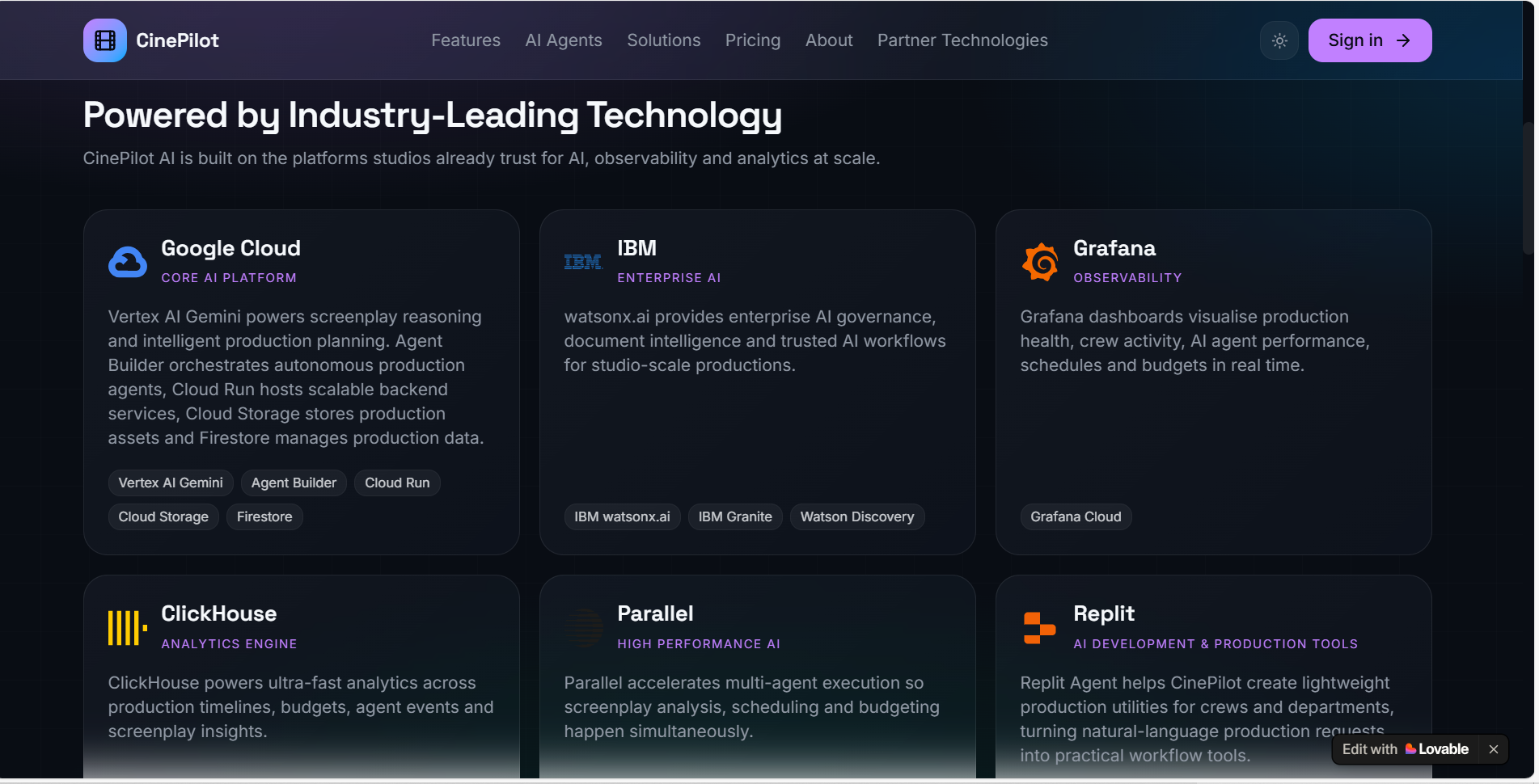
- Google Cloud / Vertex AI Gemini for screenplay reasoning and AI-powered production analysis
- Google Cloud Agent Builder for orchestrating intelligent production agents
- Cloud Run for scalable backend services
- Cloud Storage for production assets and screenplay files
- Firestore-compatible data architecture for production information and user data
- LangGraph-compatible agent orchestration for coordinating specialized agents
- IBM watsonx.ai for enterprise AI and document intelligence workflows
- Grafana for production and AI-agent observability
- ClickHouse for high-speed production analytics
- Parallel for accelerating parallel AI-agent execution
- Replit as part of the development and application workflow
We also designed the application so that filmmakers are not locked into one predefined production. Users can authenticate, create their own production, upload their own screenplay, and allow CinePilot's agents to build the workflow from that production's actual data.
The frontend was developed as a modern production command center with a public marketing homepage, authentication flow, production workspace, dashboards, agent center, reports, schedules, budgets, and collaboration functionality.
Challenges we ran into
Our biggest challenge was turning unstructured screenplay information into useful production decisions.
We also had to coordinate multiple specialized AI agents while ensuring they shared the correct production context. Integrating several cloud and partner technologies into one coherent application was another major challenge.
Finally, we needed to make CinePilot flexible enough for producers to create and manage their own productions rather than relying on a predefined project.
Accomplishments that we're proud of
We are proud to have created a functional prototype that goes beyond a traditional AI chatbot.
CinePilot combines screenplay analysis, multi-agent collaboration, scheduling, budgeting, risk analysis, analytics, reporting, and production management in one platform.
Our biggest accomplishment is creating a workflow where filmmakers can:
Create a production → Upload a screenplay → Analyze it with AI → Generate production intelligence → Manage the production.
What we learned
We learned that building useful AI is about more than connecting a model to an interface. The AI needs to be designed around a real-world workflow.
We also learned the importance of structured data, agent orchestration, shared context, and giving each AI agent a clear responsibility.
Most importantly, we learned that AI can become significantly more useful when it is focused on solving a specific industry problem.
What's next for CinePilot AI
We want to expand CinePilot with automated call sheets, intelligent location and equipment planning, crew management, advanced casting, predictive production risks, budget forecasting, weather-aware scheduling, logistics, and post-production coordination.
Our long-term goal is to make CinePilot an intelligent operating system for film and television production — allowing filmmakers to spend less time managing complexity and more time creating great stories.
Built With
- clickhouse
- cloud-run
- cloud-storage
- firestore
- google-cloud
- google-cloud-agent-builder
- google-identity-services
- grafana
- ibm-watsonx
- langgraph
- lovable
- parallel
- react
- replit-agent
- tailwind-css
- typescript
- vertex-ai-(gemini)


Log in or sign up for Devpost to join the conversation.