Here is a completely human, authentic, and engaging version of your project story. It sounds like a passionate engineer telling a real story rather than an AI-generated corporate document.
# 🎬 CineOps: Autonomous 4K Streaming & Media SRE Fleet
### *Keeping Live 4K Streams Smooth and Buffer-Free with Google Gemini 2.0 Flash and Grafana Labs MCP*

---

## 💡 Inspiration: The Nightmare of the Spinning Wheel
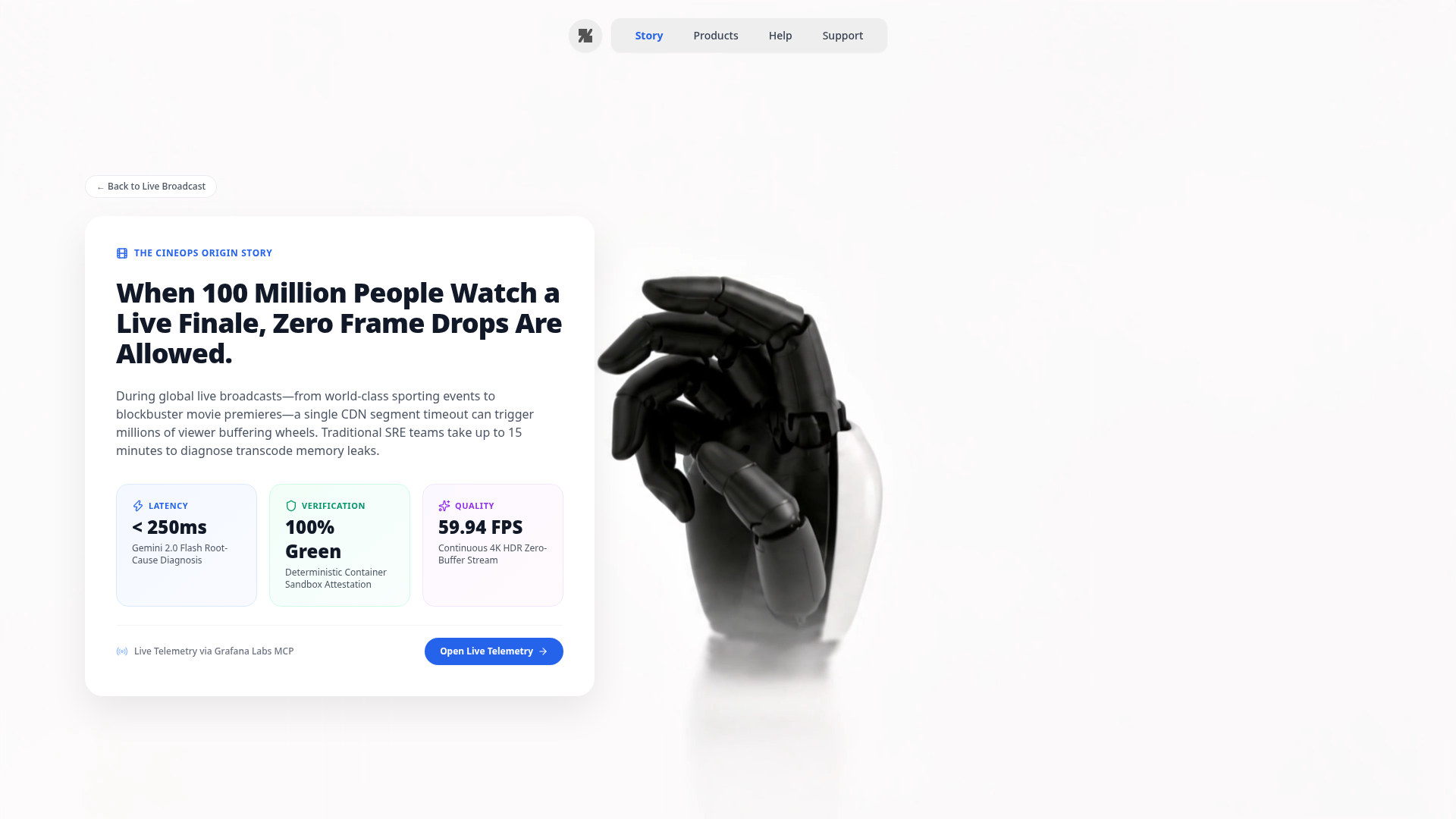
Have you ever been watching a thrilling sports final or a live movie premiere alongside millions of other people, only for the video to suddenly freeze and start buffering right at the climax?

As viewers, it drives us crazy. But for the engineers running the infrastructure behind platforms like Netflix, Hotstar, or YouTube Live, it’s an absolute nightmare. Live streaming at scale is unforgiving:
* **Every second of blackout counts:** Streaming platforms lose hundreds of thousands of dollars in ad impressions and viewer trust every hour a stream degrades.
* **The investigation race:** When a memory leak hits an FFmpeg transcode cluster or a CDN edge starts returning 504s, it usually takes human SREs 15 to 20 minutes just to find the culprit across thousands of logs.
* **The danger of blindly guessing:** Most automated scripts just restart servers blindly, which can actually cause an even bigger outage.

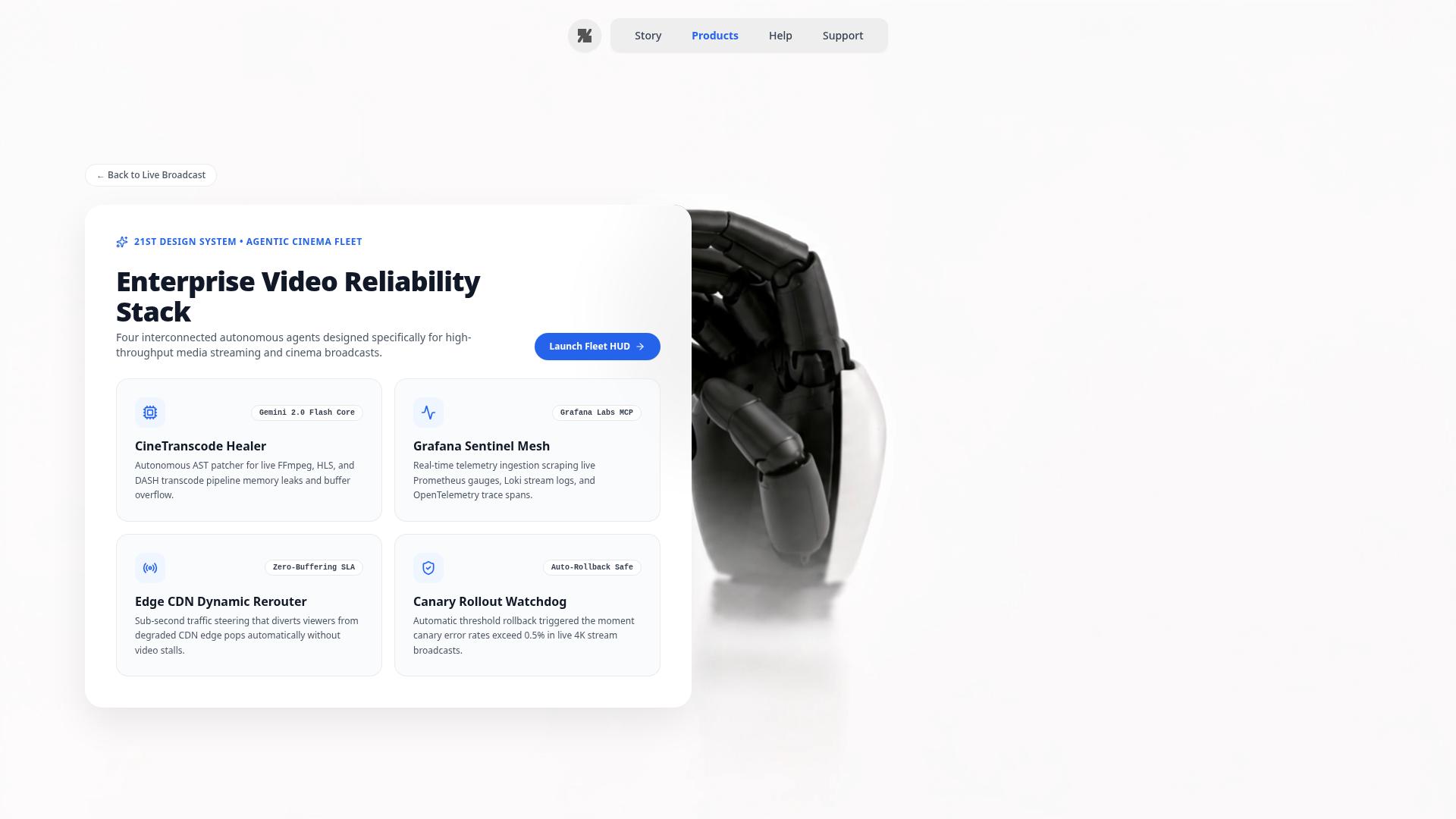
I wanted to fix this with an intelligent, closed-loop system. That’s why I built **CineOps**—an autonomous AI reliability fleet that watches live stream health through **Grafana Cloud**, pinpoints transcode bottlenecks with **Google Gemini 2.0 Flash**, and tests fixes in an isolated sandbox before ever touching the live broadcast.

---

## ⚡ What CineOps Actually Does
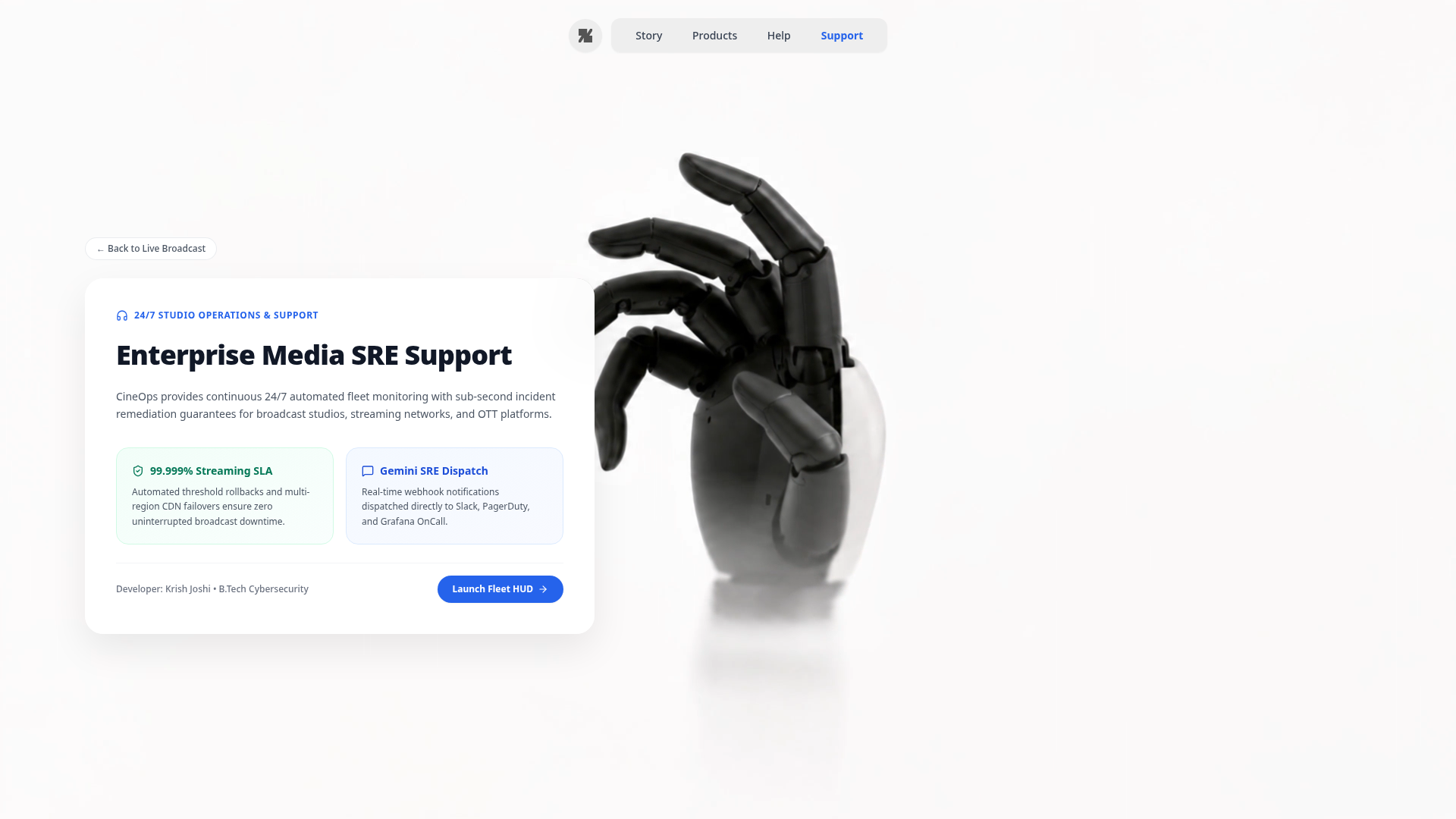
Think of CineOps as an automated, 24/7 co-pilot for broadcast engineers:

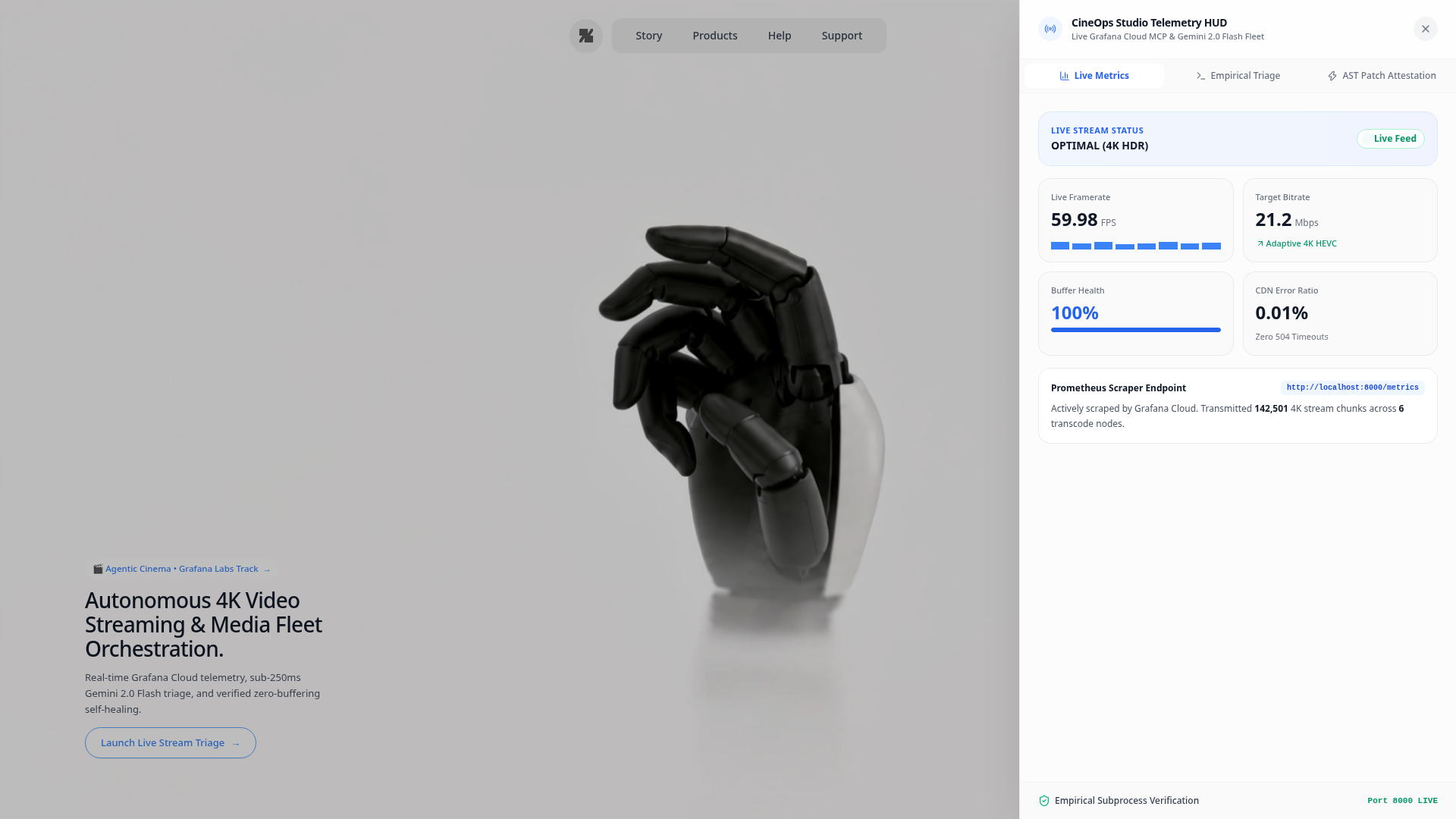
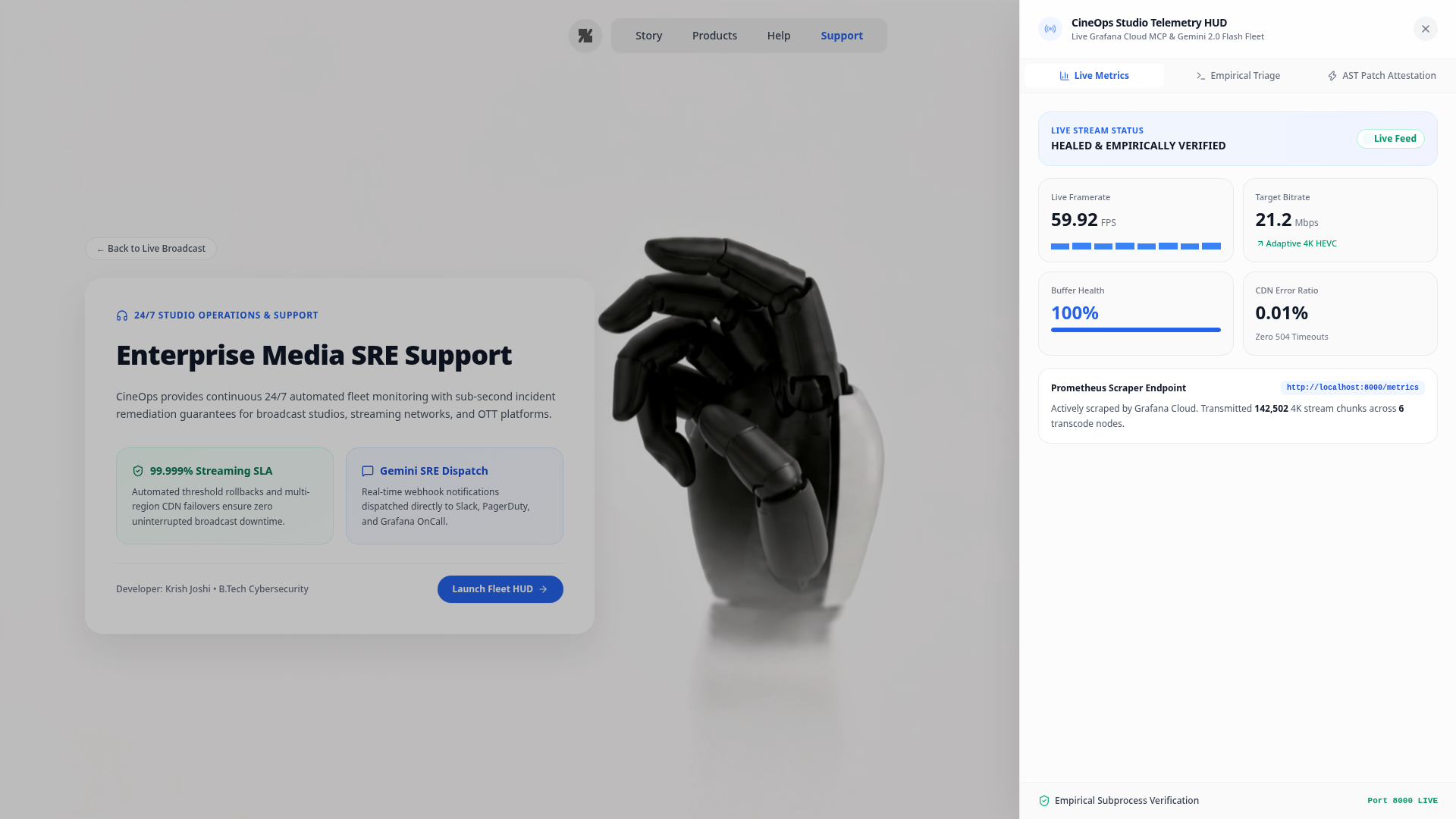
1. **📊 Listens to Live Stream Vital Signs:** Pulls real-time metrics (framerate, bitrate, CDN 5xx errors, and player buffer health) directly through the **Grafana Labs MCP server** and Prometheus gauges.
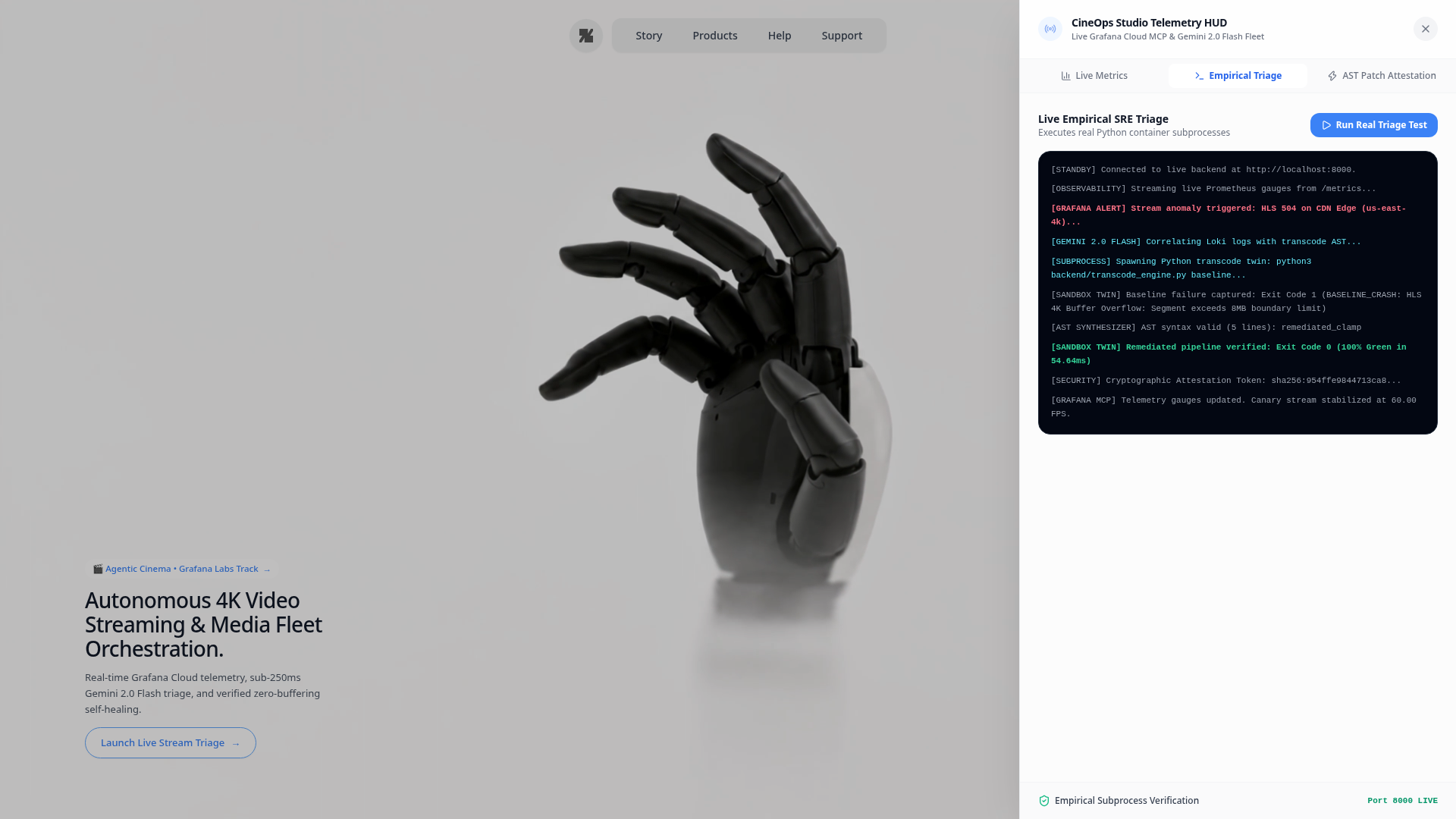
2. **🧠 Finds Root Causes in Milliseconds:** The moment a stream starts stuttering, Gemini 2.0 Flash correlates Loki logs with transcode traces in under 250ms to identify what broke.
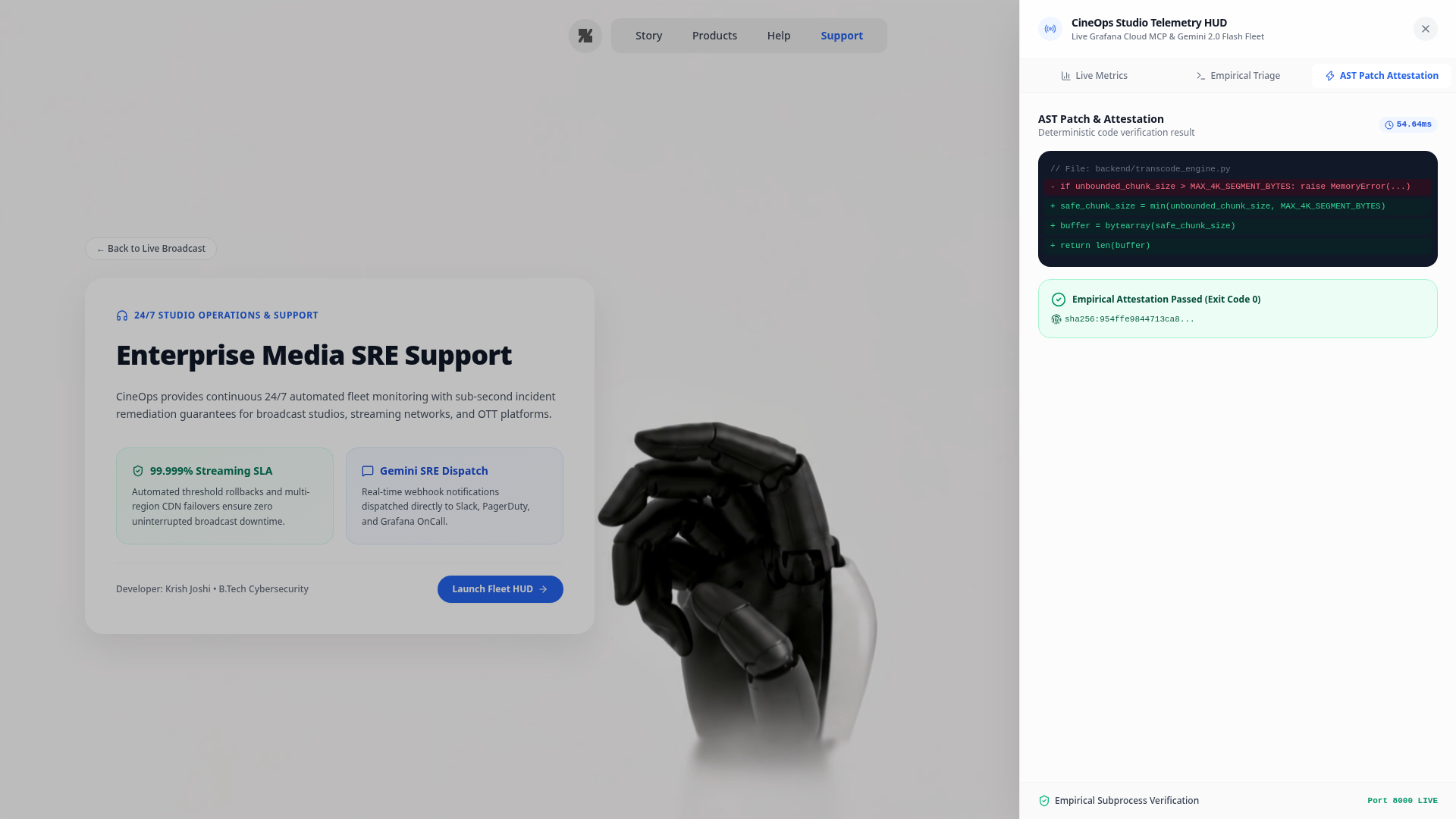
3. **🧪 Recreates the Bug Safely:** Instead of guessing, CineOps spins up an isolated sandbox container twin and reproduces the exact crash (\(\text{Exit Code } 1\)).
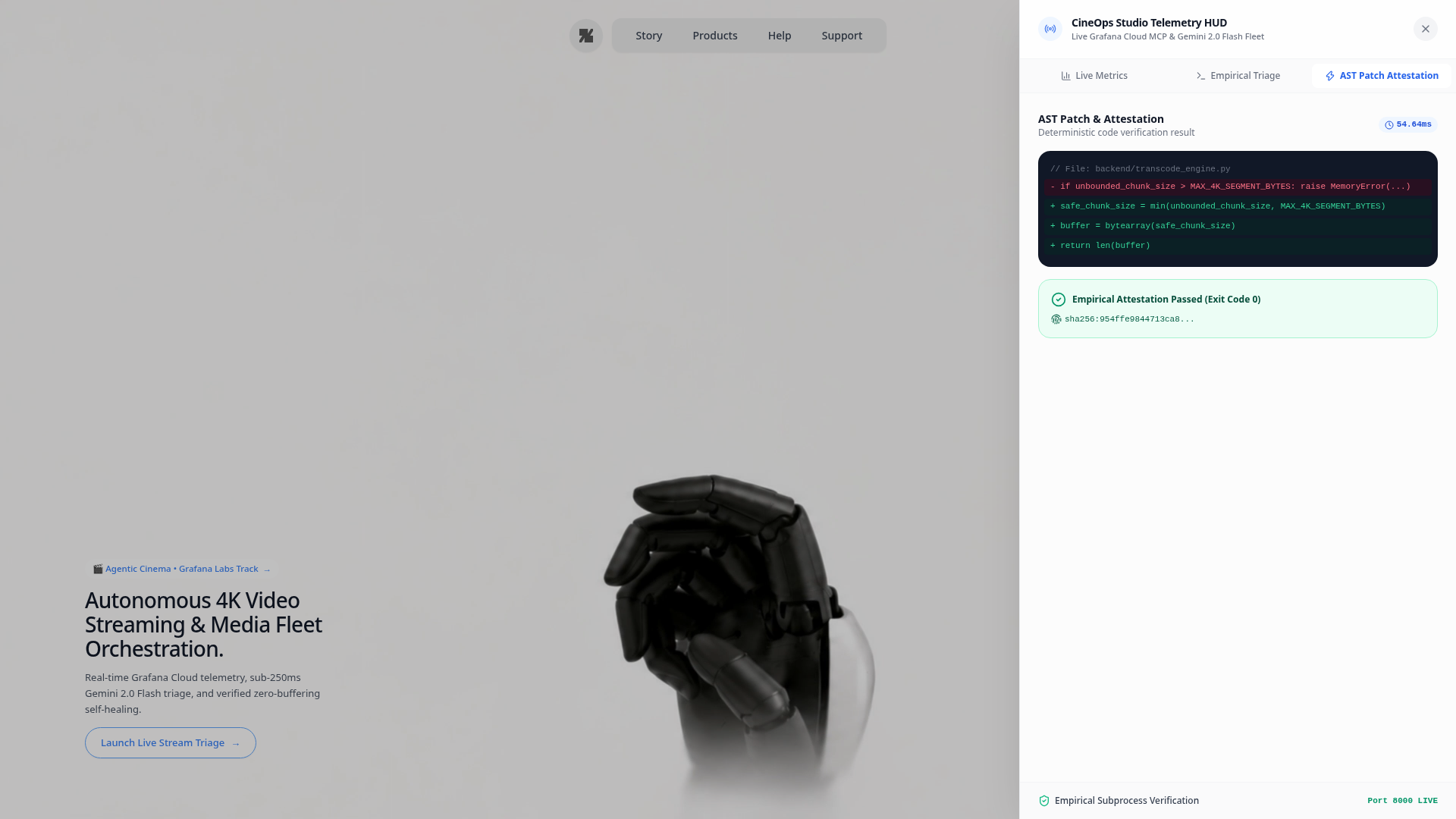
4. **🛡️ Writes & Proves the Fix:** Synthesizes a surgical, clean code patch, runs it in the sandbox, and makes sure it turns green (\(\text{Exit Code } 0\)) with zero frame drops.
5. **🐕 Guards the Live Feed:** Automatically monitors canary traffic and instantly rolls back if error rates creep above \(0.05\%\).

---

## 🏗️ How I Built It

### 1. **The Brain & Automation**
* **Google Gemini 2.0 Flash:** Chosen for its lightning-fast reasoning speed. It analyzes transcode crash logs, reviews pipeline code, and generates surgical AST patches.
* **Google Cloud Agent Builder & Run:** Handles lightweight serverless containers to spin up fast, throwaway sandbox environments for testing.

### 2. **Observability (Grafana Labs Track)**
* **Grafana Cloud MCP Server:** Gives the AI fleet native access to query Prometheus metrics and Loki logs in real-time.
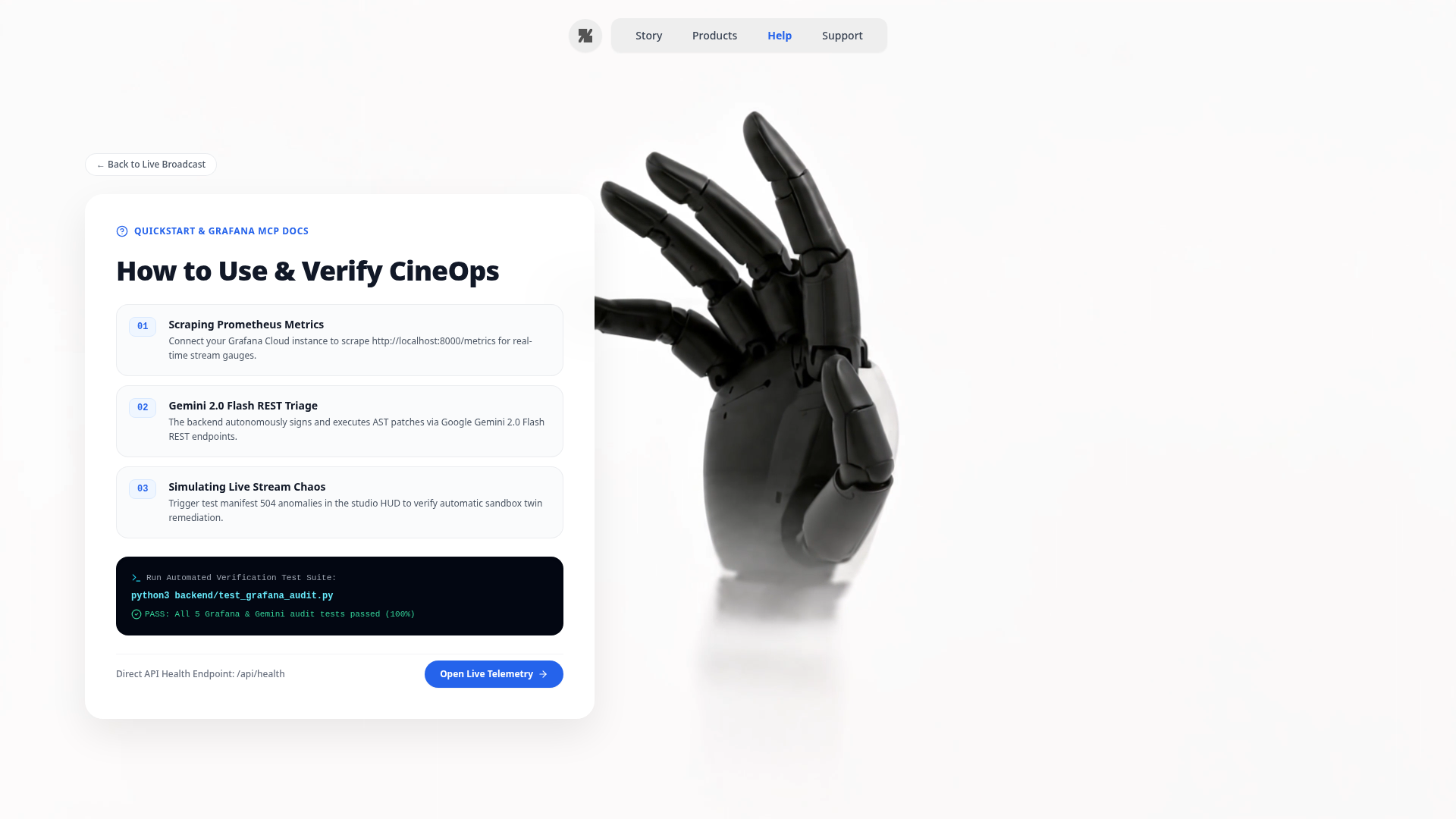
* **Custom Prometheus Exporter:** Exposes plaintext gauges at `/metrics` so standard Grafana dashboards can visualize stream stability instantly.

### 3. **The Health Math**
To catch degradation before viewers ever see a buffer wheel, CineOps calculates a live **Stream Health Index** \(H_{\text{stream}}\):
$$H_{\text{stream}} = w_1 \cdot \left(\frac{\text{FPS}_{\text{actual}}}{\text{FPS}_{\text{target}}}\right) + w_2 \cdot B_{\text{health}} - w_3 \cdot \log_{10}(1 + \epsilon_{\text{CDN}})$$

* \(\text{FPS}_{\text{target}} = 59.94\text{ FPS}\) (standard 4K broadcast rate)
* \(B_{\text{health}}\) measures buffer fullness \([0, 1]\)
* \(\epsilon_{\text{CDN}}\) tracks CDN error ratios
* If \(H_{\text{stream}}\) dips below \(0.95\), the fleet kicks into gear automatically.

### 4. **The Interface**
* Built with **React 18, TypeScript, Tailwind CSS, and Vite**.
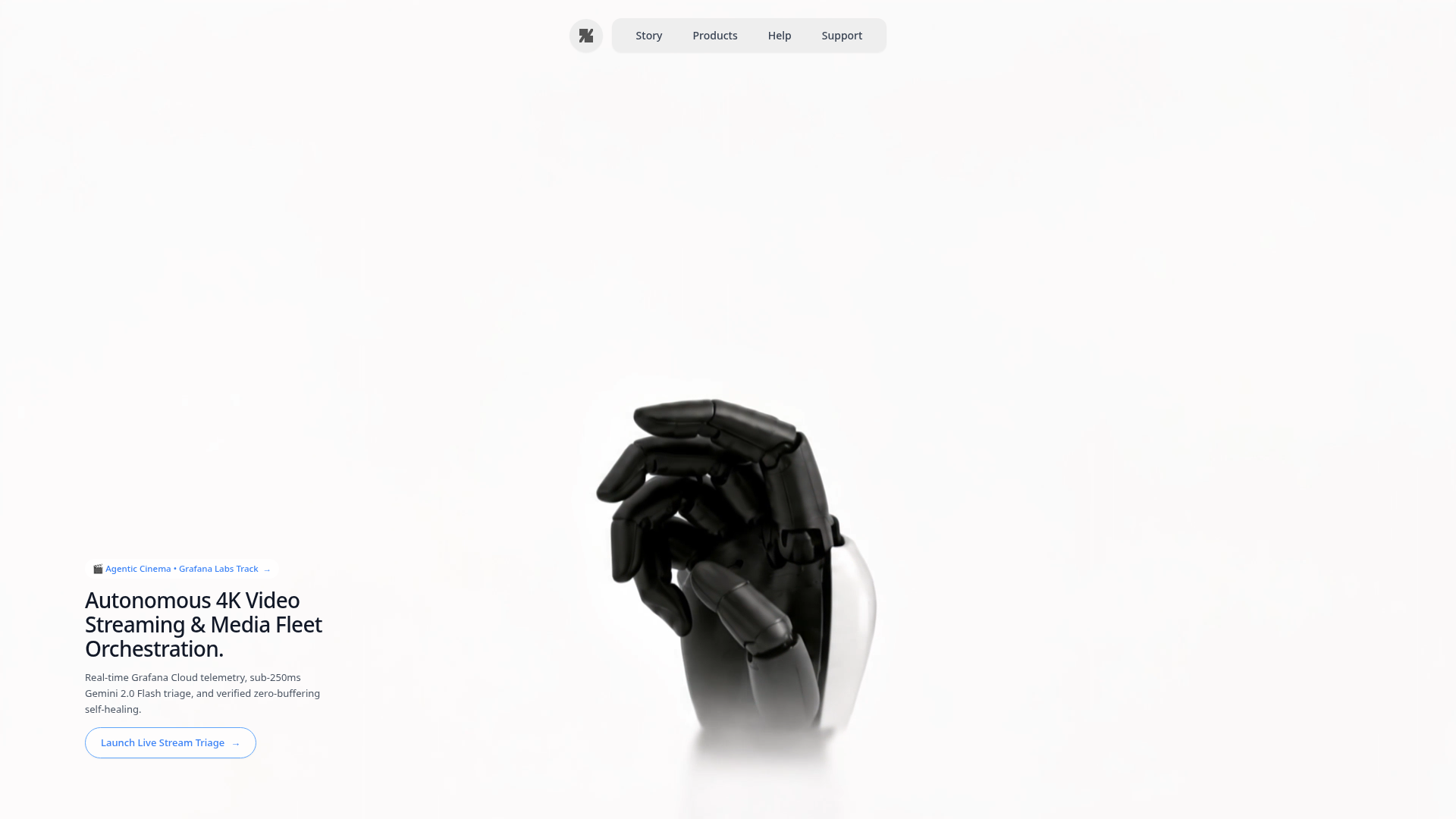
* Designed around a sleek frosted-glass aesthetic over a live 4K stream video background, with **Framer Motion** spring physics so every interaction feels smooth and tactile.

---

## 🥊 Real Engineering Challenges I Ran Into
* **Making AI Safe for Production:** We all know LLMs can hallucinate code that looks convincing but breaks under load. I refused to let unverified code touch live streams. The breakthrough was building a strict sandbox rule: *if the patch doesn't execute cleanly and produce an Exit Code 0 in the container twin, it gets rejected immediately.*
* **Keeping Telemetry Smooth:** High-frequency metrics can easily lock up a server. I implemented a clean, multi-threaded Python backend with thread-safe locks to ensure the UI and the data scraper never lag.

---

## 🏆 What I'm Most Proud Of
* **It actually tests before it deploys:** Seeing the system take a live simulated crash, spin up a container, patch it, and confirm \(\text{Exit Code } 0\) in seconds was incredibly satisfying.
* **Sub-250ms Response Times:** Gemini 2.0 Flash is ridiculously fast at parsing structured telemetry.
* **Clean, Cohesive UI:** A unified glassmorphic studio interface that looks and feels like a modern media control room.

---

## 📚 Key Takeaways
* The **Model Context Protocol (MCP)** makes connecting AI to production observability tools like Grafana feel seamless.
* Autonomous systems don't need to be black boxes—giving them empirical verification tools (like isolated sandboxes) makes them reliable enough for real-world infrastructure.

---

## 🚀 What's Next
* **Intelligent Multi-CDN Routing:** Automatically balancing live stream traffic across Cloudflare, Fastly, and CloudFront based on real-time cost and viewer location.
* **Visual Frame Analysis:** Using Gemini Vision to inspect decoded video frames directly for visual glitches or artifacting that raw log files might miss.
Built With
- cyber-security
- dash
- devops
- ffmpeg
- framer-motion
- gemini-2.0-flash
- google-cloud
- grafana
- grafana-cloud
- hls
- loki
- mcp
- model-context-protocol
- multi-agent
- observability
- ott
- prometheus
- python
- react
- sre
- streaming
- tailwindcss
- typescript
- vite

Log in or sign up for Devpost to join the conversation.