-
-
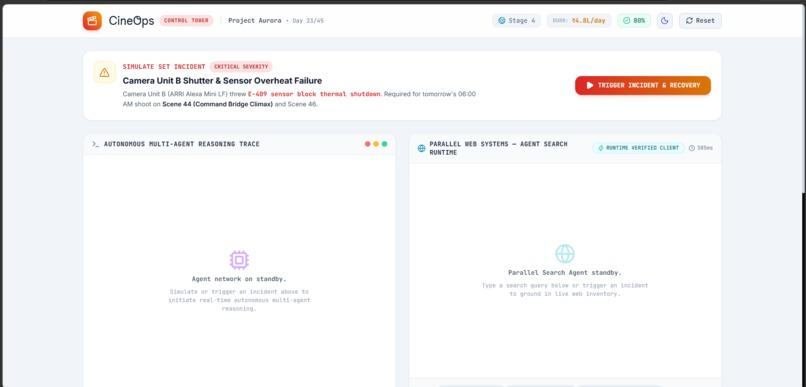
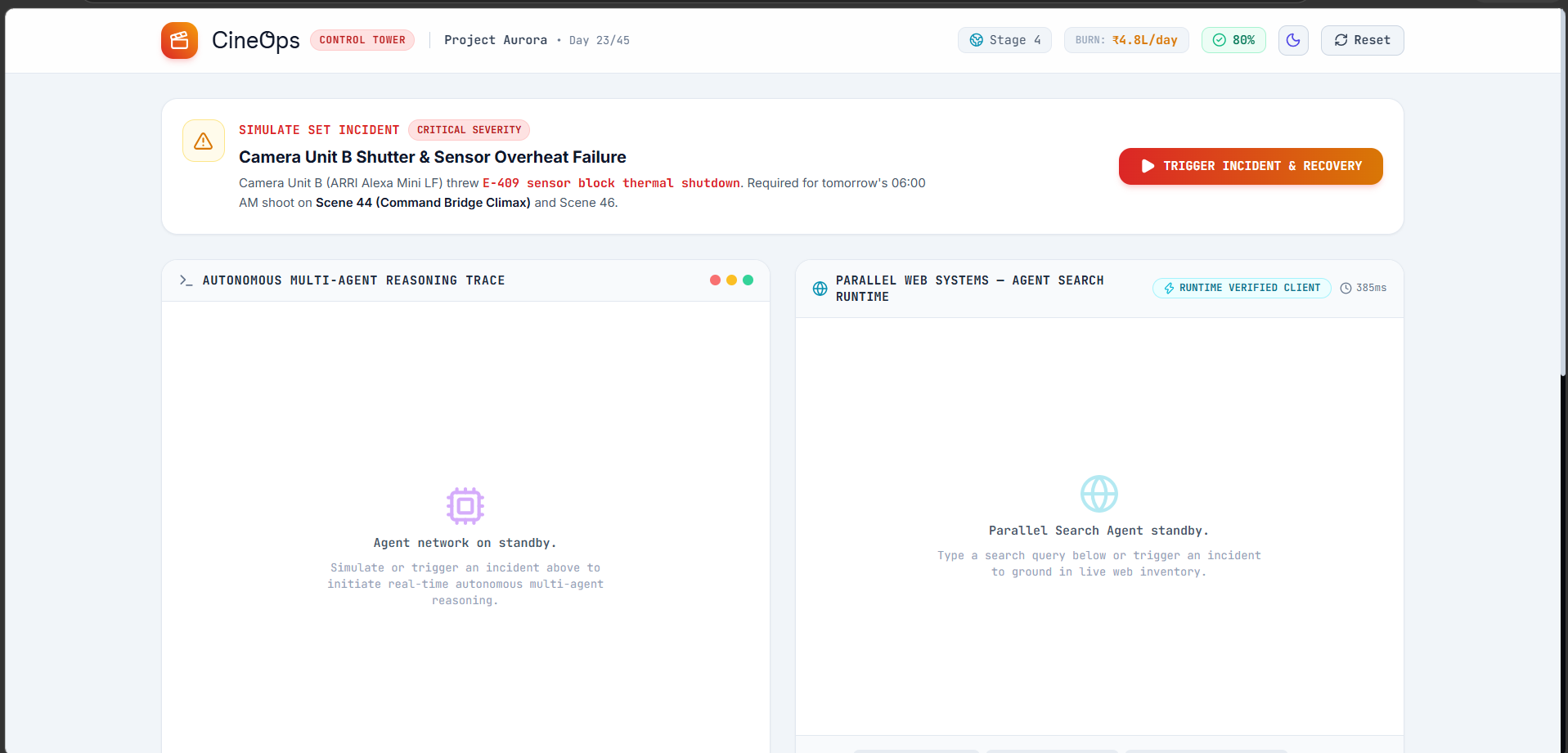
ACTIVE PRODUCTION INCIDENT
-
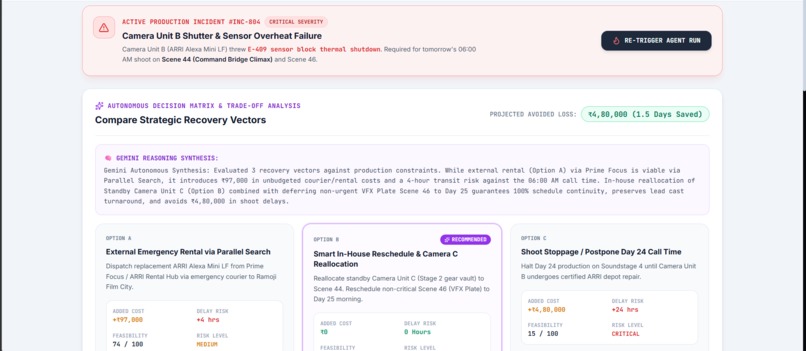
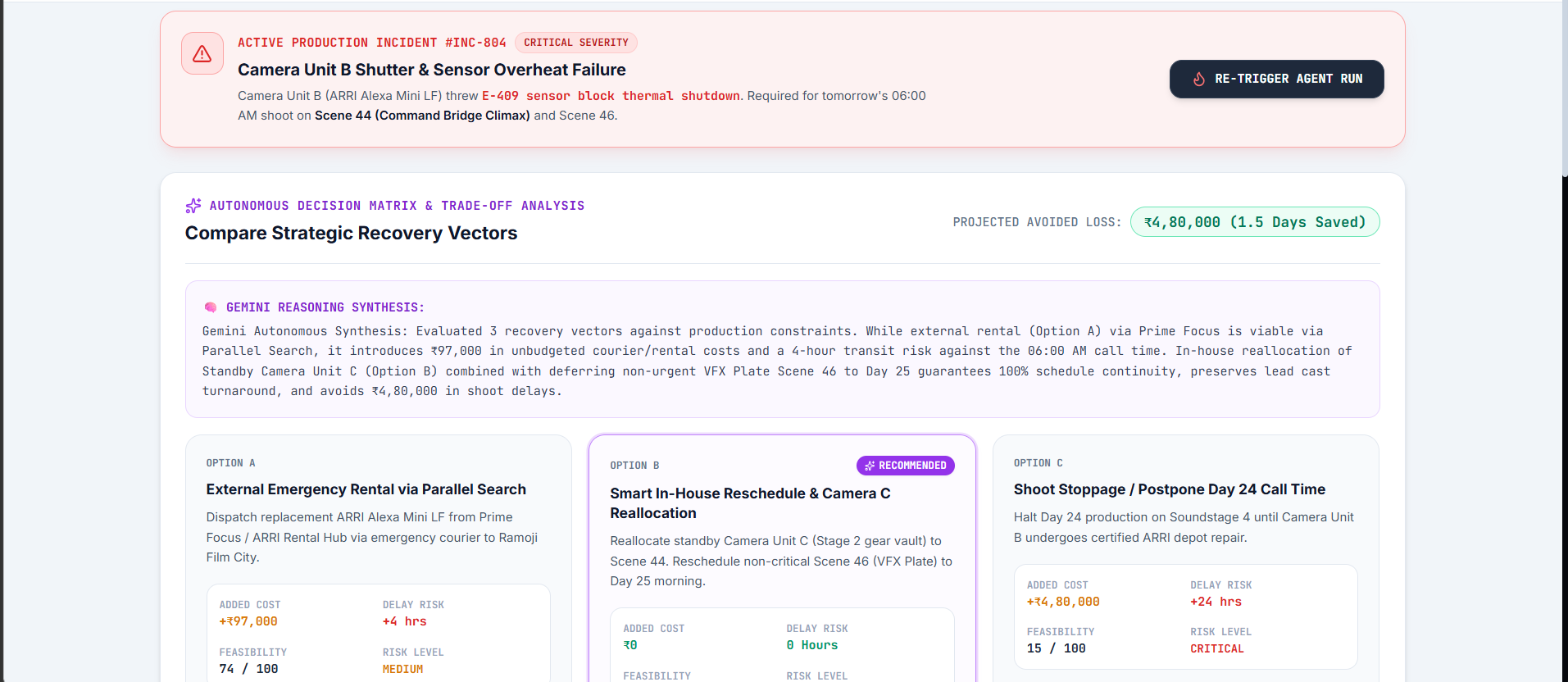
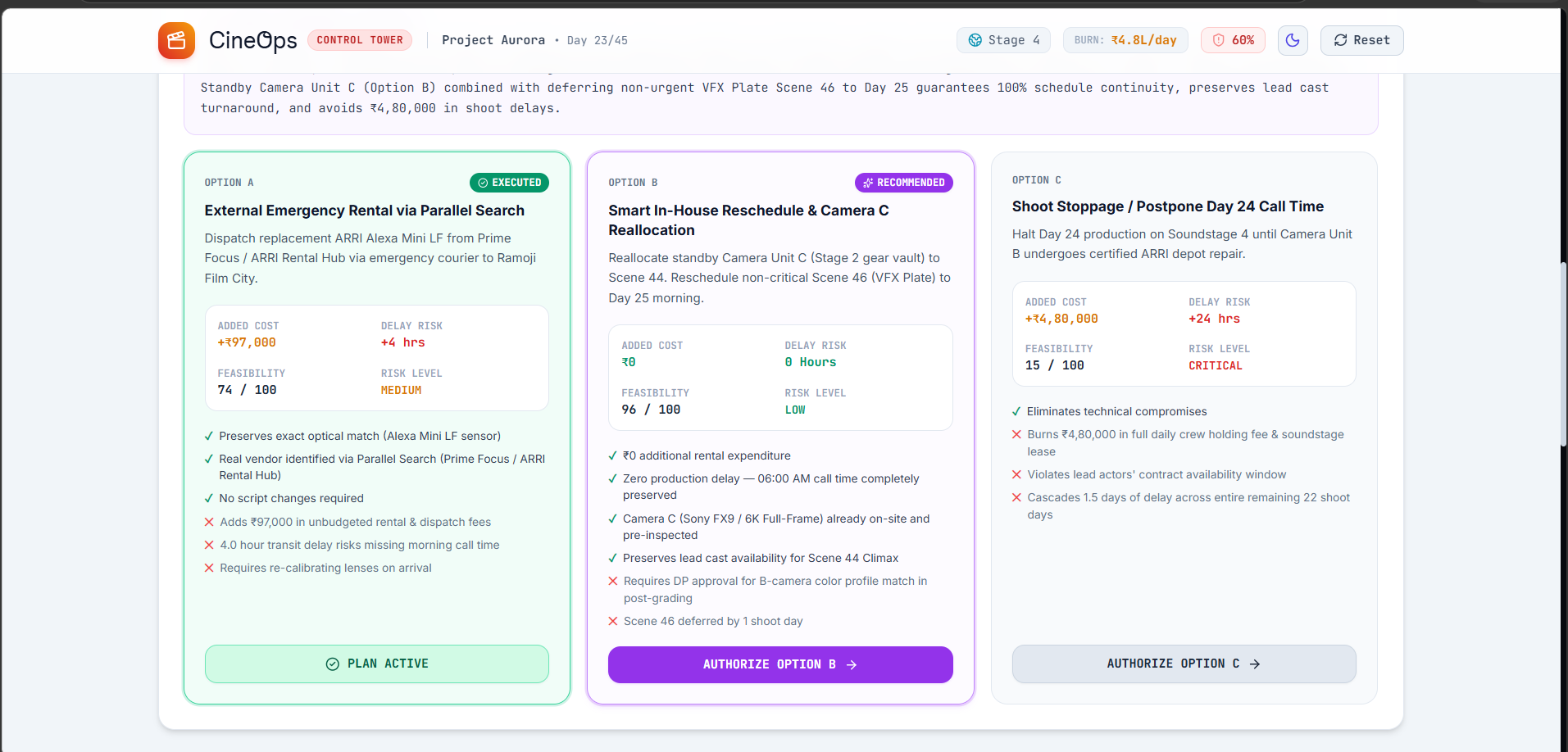
Compare Strategic Recovery Vectors
-
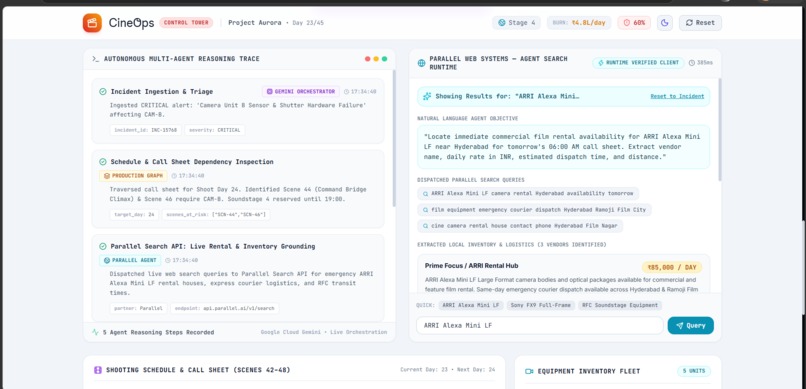
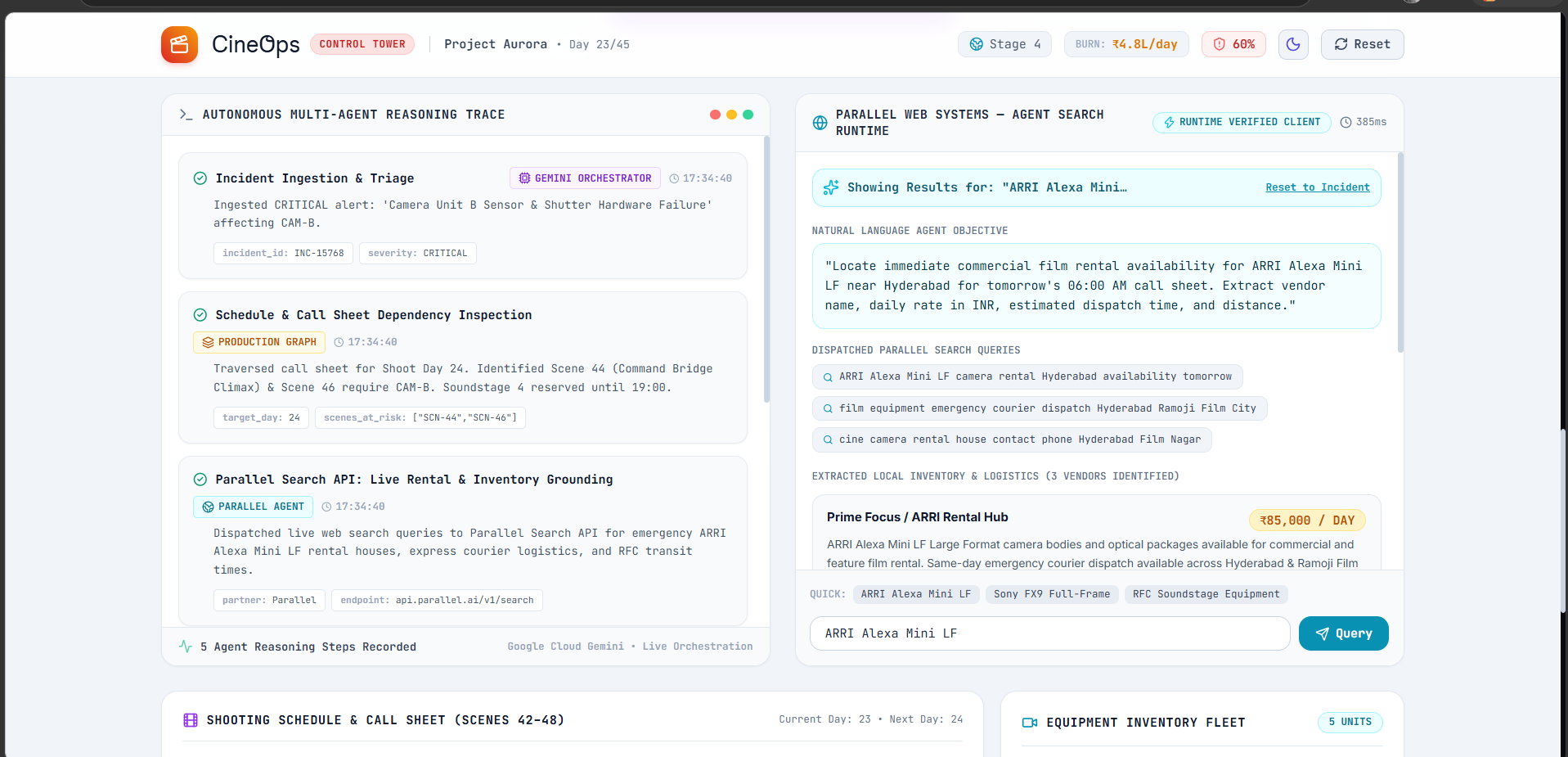
AUTONOMOUS MULTI-AGENT REASONING TRACE
-
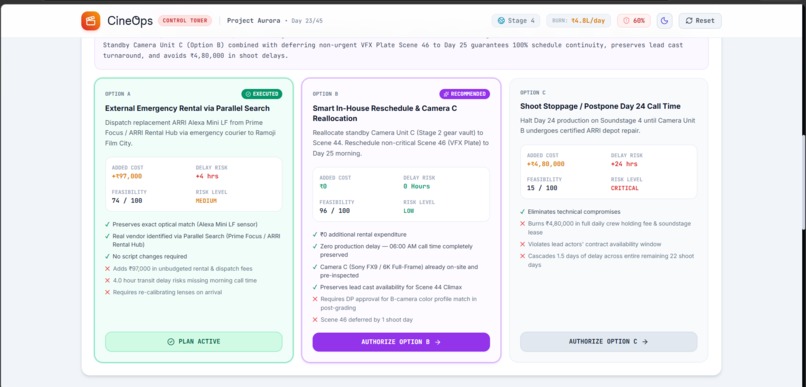
Compare Strategic Recovery Vectors
-
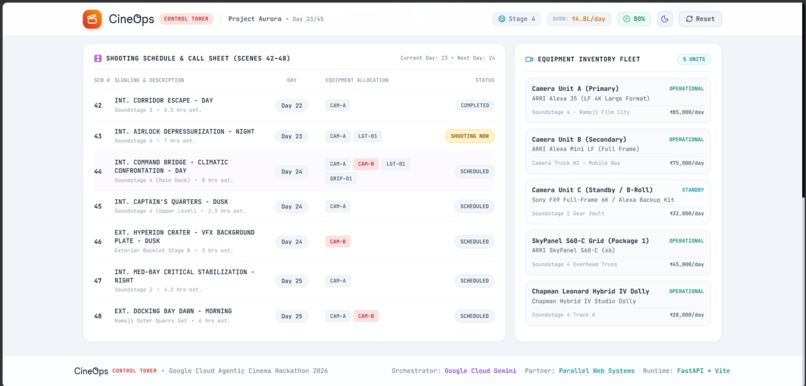
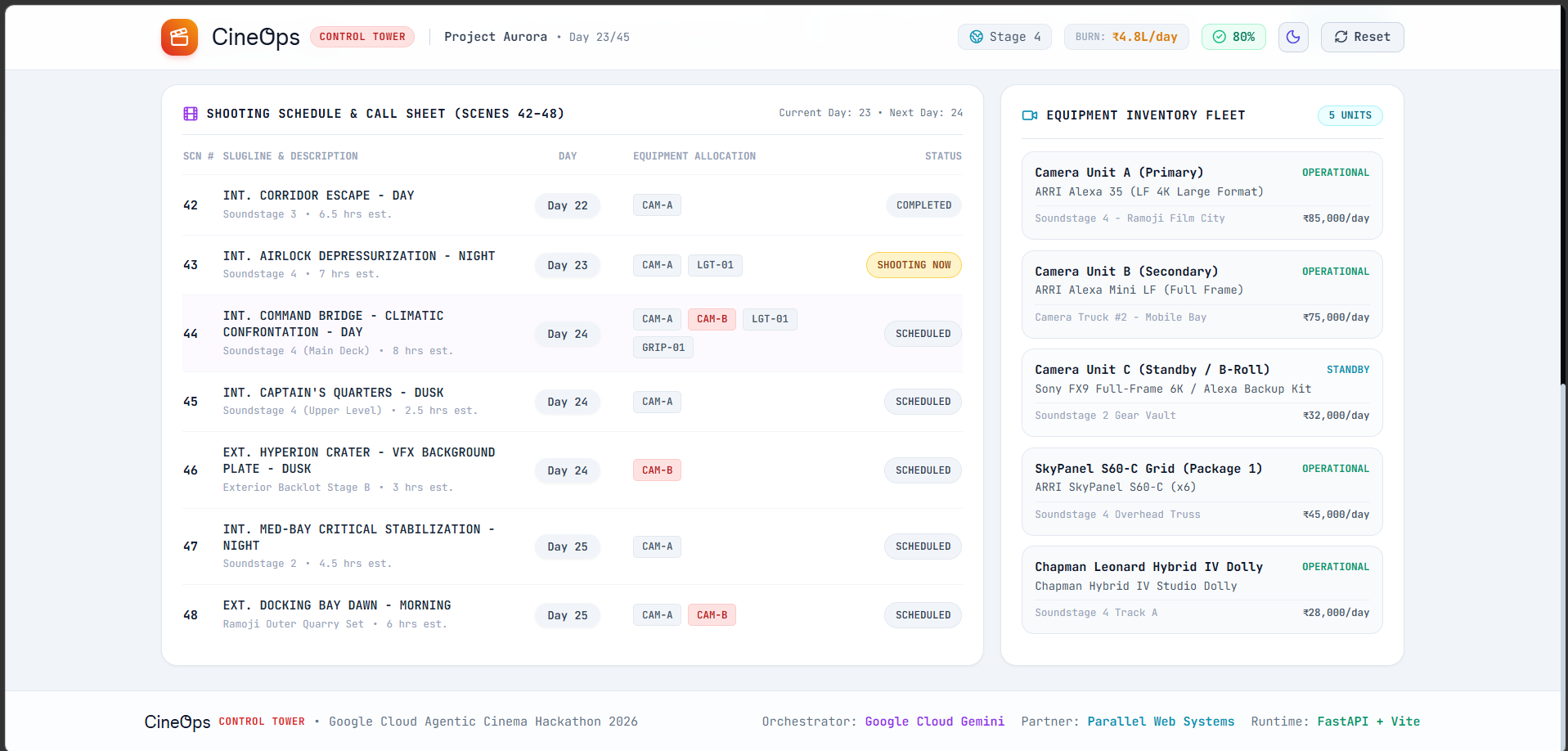
SHOOTING SCHEDULE & CALL SHEET
Inspiration
Film production is a highly coordinated operation involving people, equipment, locations, schedules, vendors, budgets, and deadlines. When one dependency changes unexpectedly, the impact can propagate across the entire production.
A camera can become unavailable. A crew member can be delayed. A location can become inaccessible. A critical production resource may no longer be available when it is needed. In each case, production teams must quickly gather information, understand dependencies, evaluate alternatives, and decide how to respond.
We asked a simple question:
What if an AI system could perform that operational investigation and help production teams make better decisions in real time?
This led to CINEOPS, an autonomous film production control tower designed to help production teams respond to operational disruptions.
Rather than building another AI chatbot or content-generation tool, we focused on the operational side of filmmaking: identifying what has changed, determining what is affected, evaluating possible responses, and producing an actionable recovery plan.
The hackathon's emphasis on agentic systems and real media and entertainment workflows provided the opportunity to turn this concept into a functional prototype.
What it does
CINEOPS acts as an AI production operations manager.
A producer can describe an operational problem in natural language, for example:
"Camera B is unavailable for tomorrow's shoot. Determine how we can keep the production on schedule."
CINEOPS transforms the request into a structured, multi-step workflow.
It can:
- Understand the production incident and its constraints.
- Identify affected scenes, resources, and dependencies.
- Analyze production schedules and available resources.
- Research relevant external information and alternatives.
- Evaluate possible recovery strategies.
- Assess operational and scheduling risks.
- Compare available options.
- Recommend an appropriate course of action.
- Generate an actionable recovery plan.
The core workflow is:
$$ \text{Incident} \rightarrow \text{Investigation} \rightarrow \text{Research} \rightarrow \text{Risk Analysis} \rightarrow \text{Decision} \rightarrow \text{Action} $$
The fundamental design principle is that CINEOPS should not simply report what happened.
It should help answer:
What should the production team do next?
This makes the system an operational decision-support agent rather than a conventional conversational interface.
How we built it
CINEOPS is designed around a multi-agent architecture using Gemini and Google Cloud.
A central orchestration agent receives a production request, determines the required workflow, and coordinates specialized agents.
Director Agent
Interprets the producer's request, establishes the objective, identifies constraints, and determines what information is required.
Production Agent
Works with production information including scenes, schedules, crew, equipment, locations, and dependencies.
Research Agent
Uses the selected partner technology to obtain relevant external information and investigate potential alternatives.
Risk Agent
Evaluates the consequences of different decisions, including schedule disruption, resource conflicts, operational risks, and potential production impact.
Decision Agent
Compares the available options against the production constraints and determines the recommended strategy.
Action Agent
Converts the selected strategy into a structured recovery plan that can be communicated and executed by the production team.
The resulting architecture follows a controlled progression:
Production Request
        |
        v
Gemini Orchestrator
        |
        +-------------------+
        |                   |
        v                   v
Production Agent      Research Agent
        |                   |
        +---------+---------+
                  |
                  v
             Risk Agent
                  |
                  v
           Decision Agent
                  |
                  v
            Action Agent
                  |
                  v
       Recovery Plan
Google Cloud provides the application and agent infrastructure, while Gemini provides the reasoning and orchestration capabilities.
The selected partner technology is incorporated into the actual application workflow as an agent capability. This is important because the hackathon requires the partner service to be used at runtime rather than simply referenced in the project documentation.
Challenges we ran into
The primary challenge was designing a system that demonstrated meaningful agentic behavior rather than simply placing an LLM behind a user interface.
Production incidents are rarely isolated problems. A single equipment failure can affect scenes, schedules, crew, locations, vendors, and downstream activities.
The system therefore needed to reason across multiple dependencies and determine which information was relevant before recommending an action.
We addressed this by dividing the workflow into specialized responsibilities and giving the orchestration layer control over how those responsibilities are executed.
Another challenge was balancing system complexity with reliability.
There are many possible features for an autonomous production platform, but attempting to automate every aspect of film production would have reduced the quality and reliability of the prototype.
We instead focused on a clearly defined incident-response workflow that could demonstrate the complete process from an initial production problem to an actionable recommendation.
We also faced the challenge of making agent activity understandable to users. Autonomous systems can become difficult to trust when users cannot understand how a decision was reached.
For that reason, CINEOPS presents the process as:
Problem → Evidence → Options → Recommendation → Actions
This provides a clear connection between the original incident and the resulting recommendation.
Accomplishments that we're proud of
Our primary accomplishment is moving the concept of an AI production assistant beyond conversational question answering.
CINEOPS demonstrates a multi-step agent workflow in which the system can interpret a problem, delegate tasks, gather information, evaluate alternatives, and produce an operational recommendation.
We are also proud of focusing on a less explored area of AI in entertainment.
Many AI applications in media focus on generating scripts, images, video, or marketing content. CINEOPS focuses instead on the operational infrastructure required to produce that content.
Another important accomplishment is the integration of the partner technology into the agent workflow. Rather than treating the partner platform as a superficial addition, we designed it as a functional capability that contributes to the agent's investigation process.
We also designed the system to be extensible. The same architecture can support additional production workflows without requiring the entire system to be redesigned.
What we learned
The most important lesson was that effective agentic systems require more than a capable language model.
The surrounding architecture matters just as much.
We learned how to:
- Decompose complex operational problems into specialized agent responsibilities.
- Design multi-step agent workflows.
- Define clear roles and boundaries for individual agents.
- Connect agents to external tools and data.
- Structure information so that agents can make more reliable decisions.
- Make agent decisions understandable to users.
- Balance autonomous reasoning with deterministic application logic.
- Design an AI system around a real operational workflow rather than around a chatbot interface.
We also learned that an effective agent should not attempt to perform every task itself.
A well-designed system delegates specialized work, gathers the necessary evidence, and brings the results together at the decision layer.
This principle became central to the design of CINEOPS.
What's next for CINEOPS — Autonomous Film Production Control Tower
The current prototype focuses on production incident response. Our long-term objective is to extend CINEOPS into a broader operational intelligence platform for film and media production.
Future capabilities include:
Predictive Production Risk
Identify potential production disruptions before they affect the shooting schedule.
Intelligent Schedule Optimization
Continuously optimize shooting schedules based on crew availability, equipment, locations, scene dependencies, and production constraints.
Crew and Equipment Allocation
Recommend efficient allocation of production resources across scenes and shooting days.
Vendor and Resource Coordination
Research vendors, compare alternatives, and support resource procurement workflows.
Location Intelligence
Evaluate locations based on availability, production requirements, logistics, and operational constraints.
Production Cost Analysis
Estimate the operational and financial consequences of schedule changes and resource decisions.
Post-Production Operations
Extend the same agentic architecture into editing, rendering, media pipelines, quality control, and content delivery.
Our long-term vision is for CINEOPS to become an intelligent operational layer for media production: a system that can continuously understand the state of a production, identify emerging problems, evaluate possible responses, and help teams take the right action.
The goal is not to replace production professionals.
The goal is to give them an intelligent operational system that helps them make faster, better-informed decisions when production conditions change.


Log in or sign up for Devpost to join the conversation.