-
-
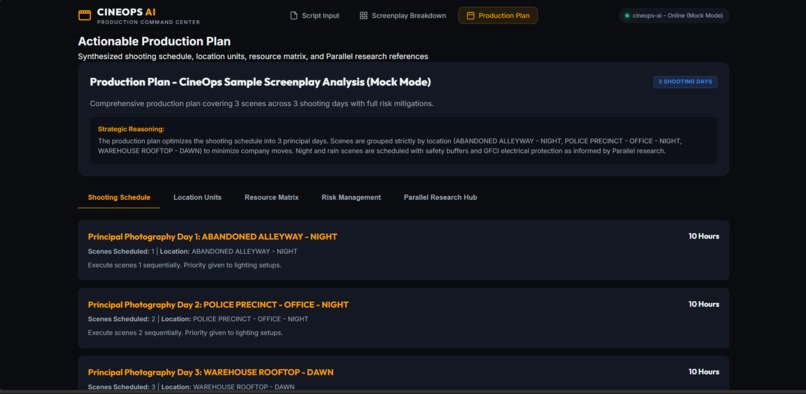
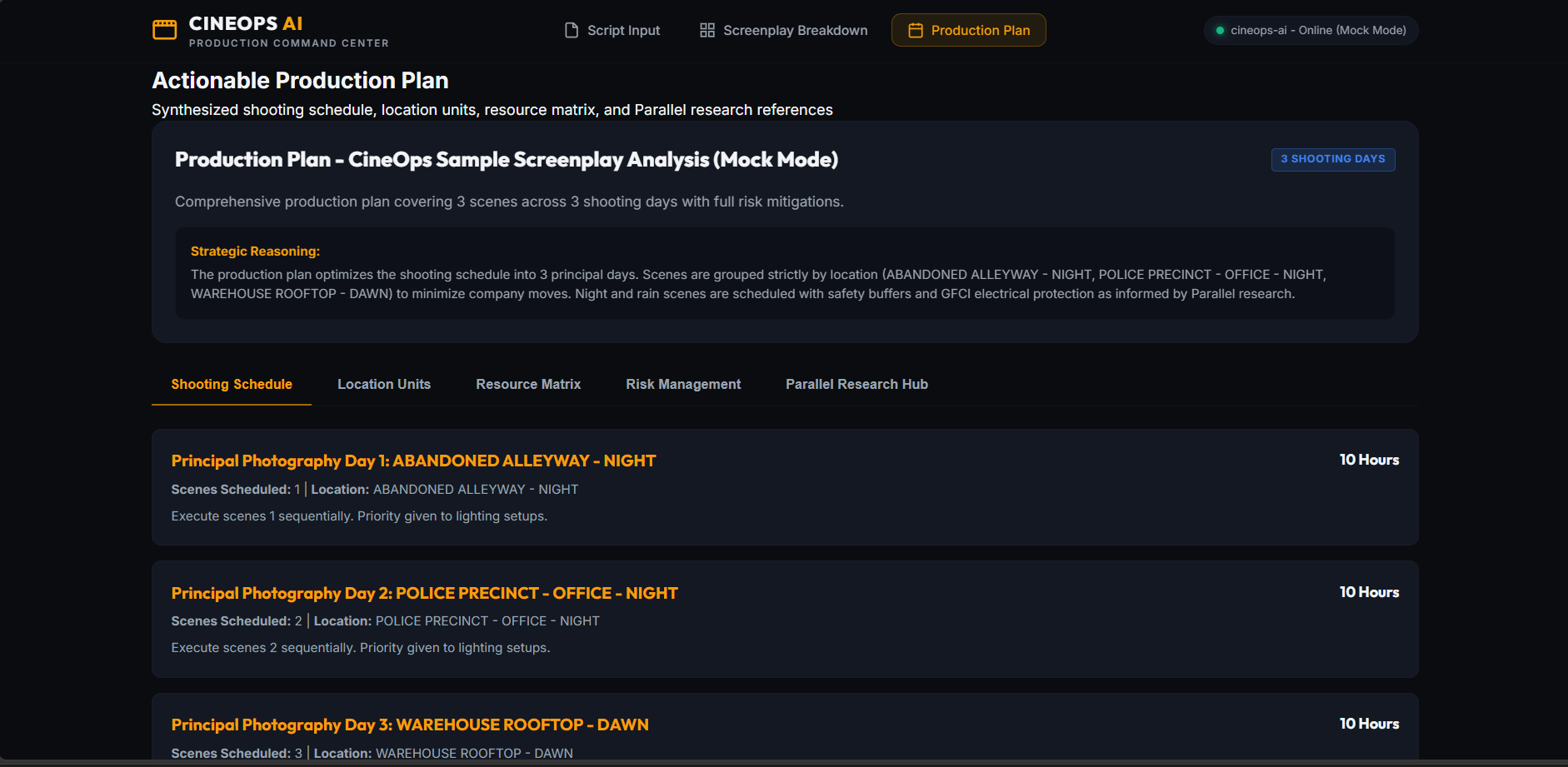
Production Plan
-
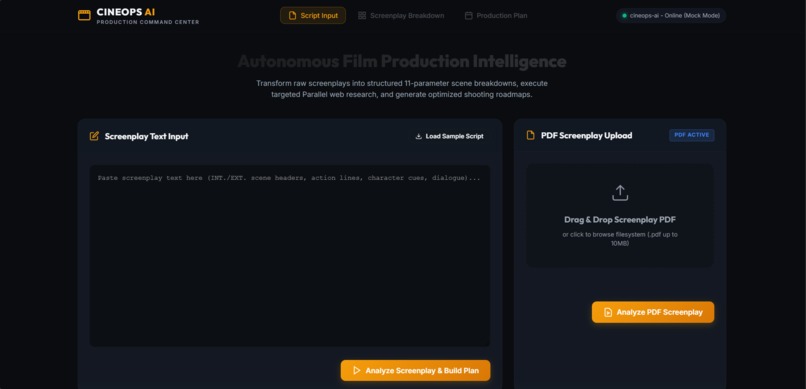
Dashboard
-
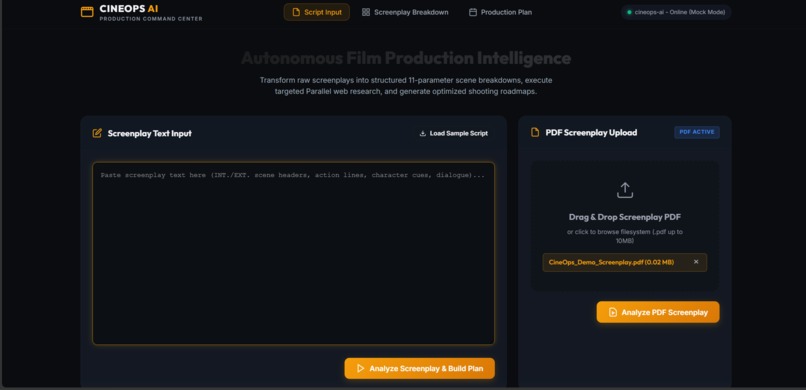
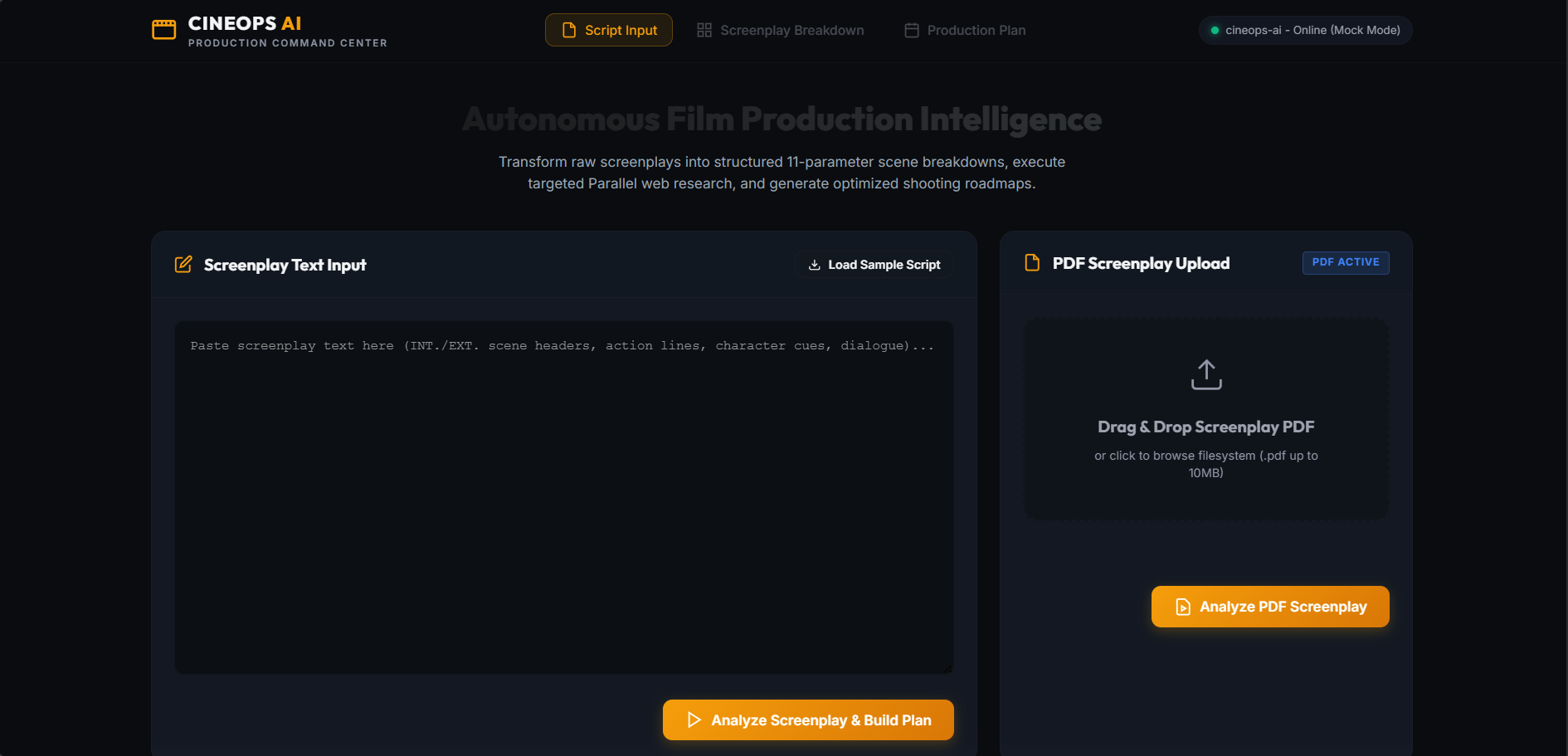
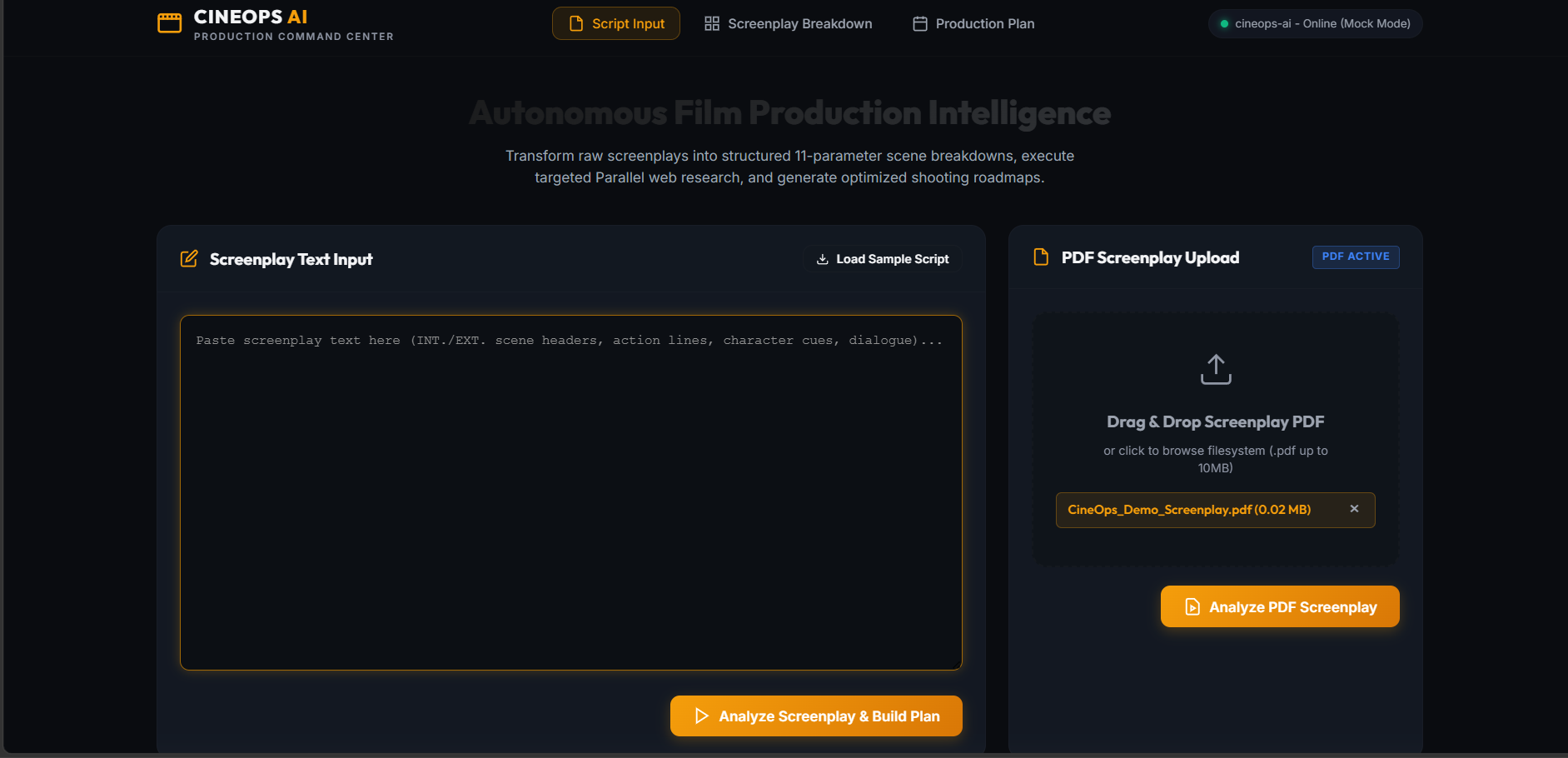
Script Input + PDF Upload
-
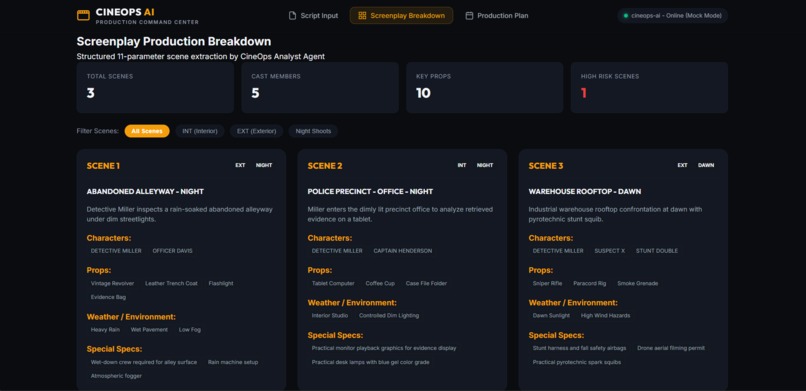
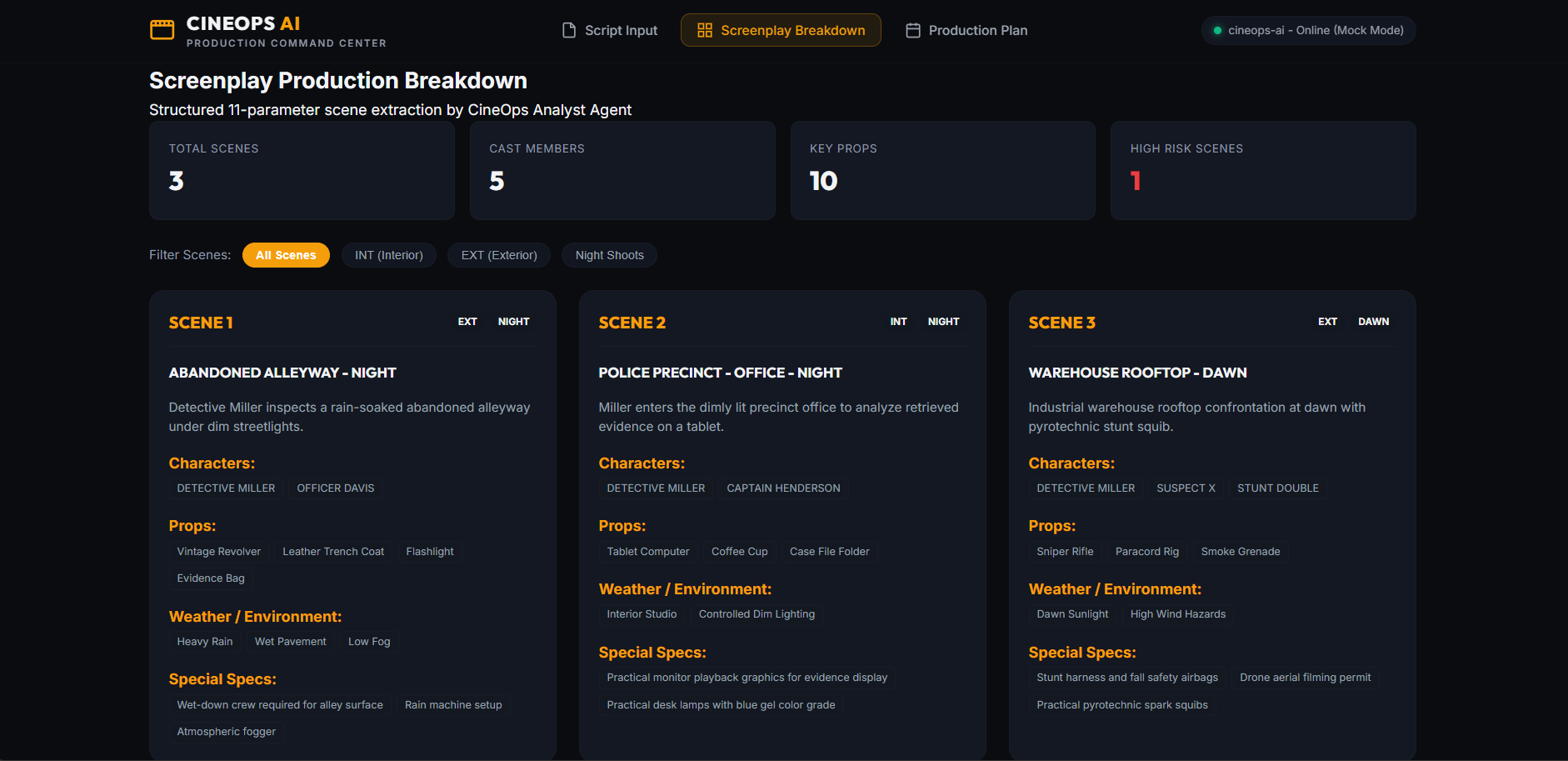
Screenplay Breakdown
-
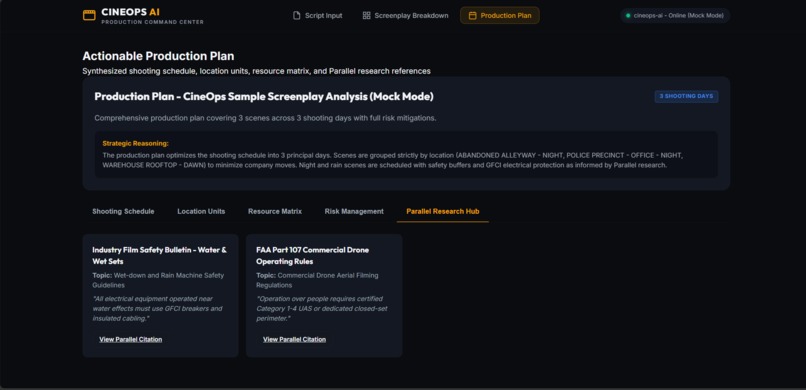
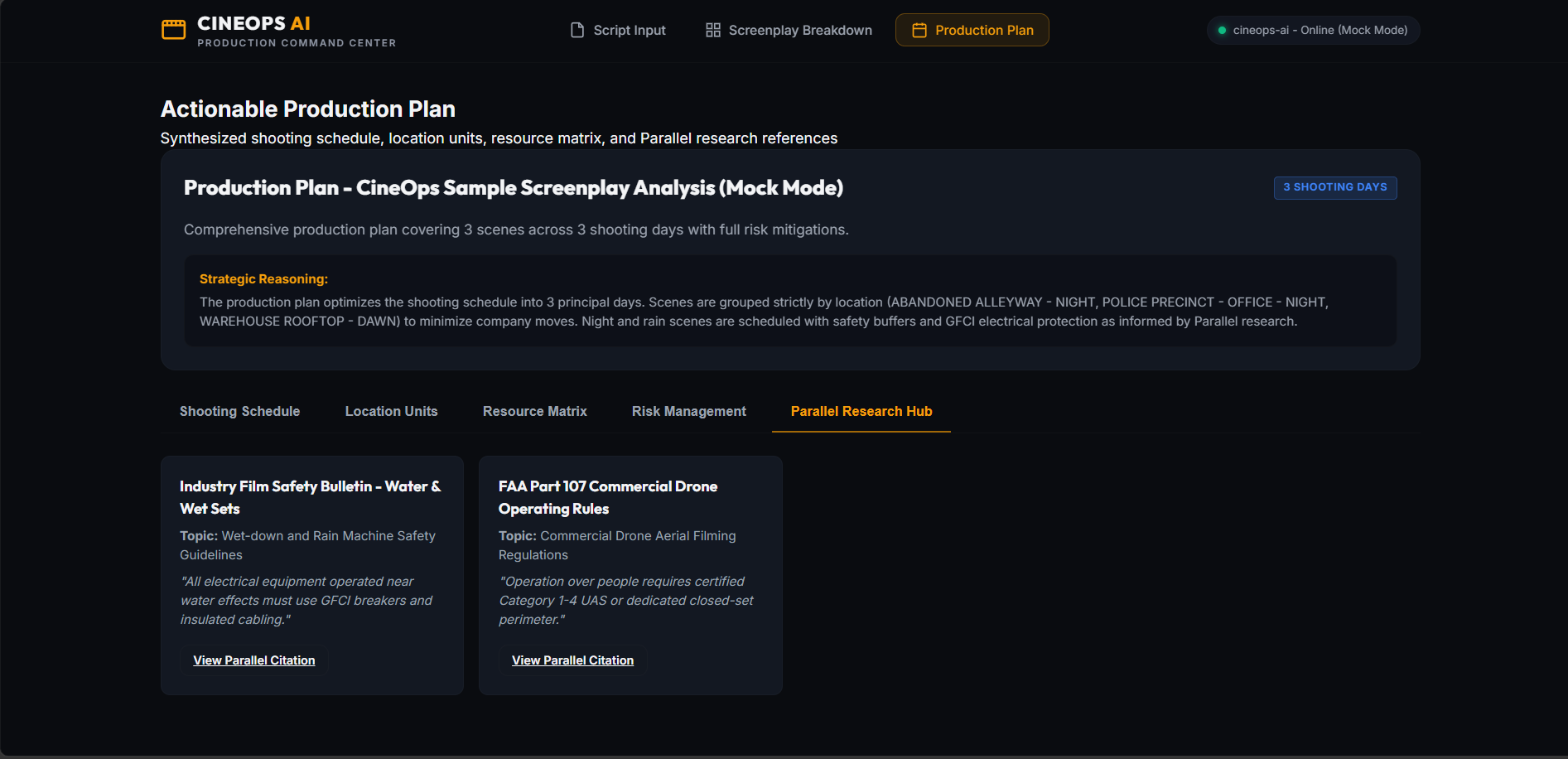
Parallel Research Hub
-
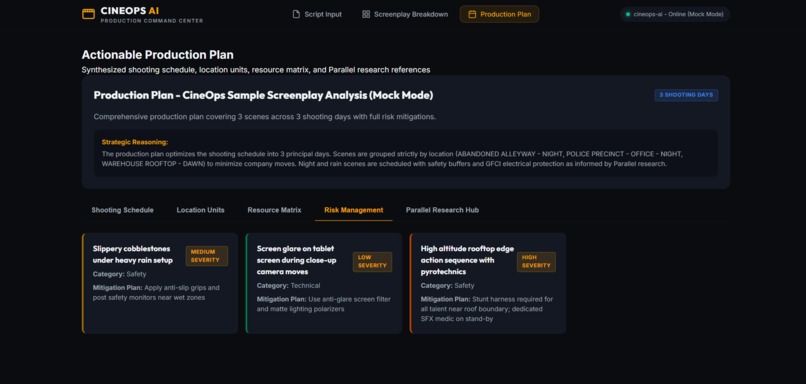
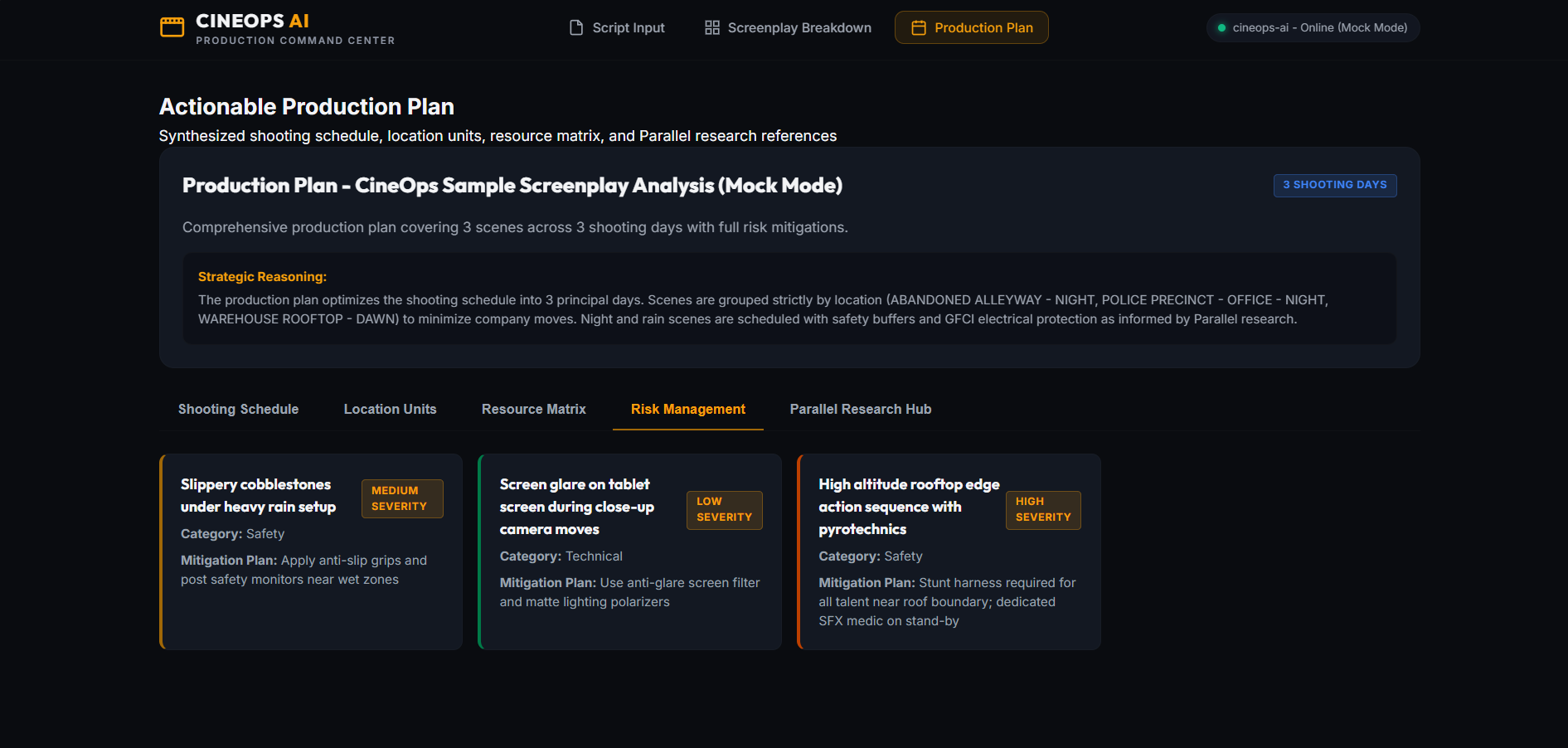
Risk Management
🎬 CineOps AI
From Screenplay to Production Plan — Autonomously
Film production is filled with decisions that happen between the lines of a screenplay.
A script may describe a location, a specific time of day, a weather condition, a prop, or a sequence of connected scenes—but turning those creative requirements into an actionable production plan can require hours of manual research, coordination, and planning.
CineOps AI is an agentic AI production assistant designed to bridge that gap.
Instead of simply summarizing a screenplay, CineOps AI uses Gemini-powered agents to understand production requirements, research relevant information, reason over the results, and turn them into actionable recommendations for filmmakers and production teams.
💡 The Inspiration
We were inspired by a simple question:
What if a filmmaker could hand an AI agent a screenplay and get back not just a summary, but a production-ready starting point?
Modern AI can understand scripts remarkably well, but understanding a screenplay is only the first step.
The real challenge is connecting creative intent with operational decisions.
A production team needs to know:
- Which scenes require the same location?
- Which characters and resources are needed for each scene?
- What external information needs to be researched?
- Which scenes have dependencies or production risks?
- How can related scenes be grouped to make production more efficient?
We wanted to explore how agentic AI could move from answering questions to actually performing a multi-step production workflow.
🚀 What CineOps AI Does
CineOps AI transforms a screenplay into structured production intelligence.
1. 📄 Screenplay Understanding
The system analyzes the screenplay and identifies important production elements such as:
- Scenes
- Characters
- Locations
- Props
- Environmental requirements
- Scene dependencies
- Production considerations
2. 🤖 Agentic Reasoning
Instead of relying on a single prompt, CineOps AI uses an agentic workflow where tasks can be broken into multiple steps.
The agents can:
Understand → Research → Reason → Plan → Recommend
This allows the system to work toward a production objective rather than simply generating a piece of text.
3. 🔎 Intelligent Research
The research stage connects the agent to Parallel's Search API, allowing it to retrieve relevant external information at runtime.
The retrieved information becomes part of the agent's decision-making process rather than being manually copied into the application.
4. 📅 Production Planning
After analyzing the screenplay and research results, CineOps AI generates an actionable production plan containing information such as:
- Scene groupings
- Required resources
- Location considerations
- Production risks
- Scheduling recommendations
- Reasoning behind important decisions
5. 📊 Production Dashboard
The results are presented through a production-focused interface so that filmmakers can move from raw screenplay information to an understandable operational view.
🧠 How We Built It
CineOps AI is built around Google's agentic AI ecosystem.
Core Technologies
- Gemini — screenplay understanding, reasoning, and generation
- Google Cloud Agent Development Kit (ADK) — agent orchestration and tool integration
- Google Cloud — cloud infrastructure and deployment
- Parallel Search API — real-time external research performed by the agent
- Python — backend and agent logic
- Web application — user-facing production workspace
The core workflow looks like:
                    SCREENPLAY
                         │
                         ▼
                ┌─────────────────┐
                │ Script Analyst  │
                │     Agent       │
                └────────┬────────┘
                         │
                         ▼
                Production Requirements
                         │
                         ▼
                ┌─────────────────┐
                │ Research Agent  │
                └────────┬────────┘
                         │
                    Parallel Search
                         │
                         ▼
                ┌─────────────────┐
                │ Planning Agent  │
                └────────┬────────┘
                         │
                         ▼
              Production Intelligence
                         │
                         ▼
                 🎬 CineOps Dashboard
The goal was to make the partner integration part of the actual agent workflow, rather than simply mentioning the technology in the project.
🛠️ Challenges We Faced
One of the biggest challenges was deciding where an AI agent genuinely adds value.
It is easy to build a chatbot that can discuss a screenplay. It is much harder to design a workflow where the agent has a clear objective, uses tools, processes external information, and produces a useful result.
We therefore focused on separating the workflow into meaningful stages:
script understanding → research → reasoning → production planning.
Another challenge was designing the system around the hackathon's requirement for an actual partner integration. Rather than treating Parallel as an optional add-on, we designed the research stage around its Search API so that external information can directly contribute to the agent's final recommendations.
We also had to balance ambition with reliability. A production tool should make its reasoning and recommendations understandable rather than producing impressive-looking but unverifiable output.
📚 What We Learned
Building CineOps AI taught us that agentic AI is less about making a model generate more text and more about giving it a meaningful workflow.
We learned how to:
- Structure multi-step agentic workflows with Google's ADK
- Use Gemini for multimodal and document-oriented reasoning
- Connect agents to external tools
- Use search results as part of an agent's reasoning process
- Design AI around a real operational problem instead of a generic chatbot
- Think about reliability and explainability when agents make recommendations
- Turn unstructured creative information into structured operational data
Most importantly, we learned that the best agentic applications are often created by identifying the repetitive decisions that sit between a user's input and their desired outcome.
🌟 Why It Matters
Film production combines creativity with an enormous amount of coordination.
CineOps AI is designed to reduce the operational friction between "this is what the screenplay says" and "this is what the production team needs to do."
Our vision is for CineOps AI to become an intelligent production layer that helps filmmakers spend less time organizing information and more time focusing on the creative work.
🎬 Creative vision in.
🤖 Agentic production intelligence out.
CineOps AI is our exploration of what happens when AI doesn't just understand the story—but helps move the story toward production.
What it does
CineOps AI transforms an unstructured film screenplay into a research-backed production plan.
Users can upload a screenplay PDF and receive a structured breakdown of scenes, locations, characters, props, weather/environment, production requirements, dependencies, and production risks.
CineOps AI then uses AI agents to identify production constraints and the Parallel Search API to research real-world production requirements such as safety considerations, permits, equipment needs, and technical constraints.
Gemini 2.5 Flash synthesizes the screenplay analysis and external research into a practical shooting schedule, resource requirements, prioritized risks, and research references.
In short:
Screenplay → AI Analysis → Real-World Research → Production Plan
How we built it
CineOps AI is built as an agentic workflow using Google ADK and Gemini 2.5 Flash through Vertex AI.
The core workflow is:
PDF Screenplay ↓ PDF Extraction ↓ Screenplay Analyst Agent ↓ Structured Production Analysis ↓ Parallel Search API ↓ Production Planner Agent ↓ Production-Ready Plan
The backend is built with Python and FastAPI, with Pydantic models used for structured screenplay analysis and production planning.
The frontend is built with HTML, CSS, and JavaScript and provides an interactive dashboard for screenplay breakdown, production planning, risk management, and research results.
Parallel Search API provides real-world production research, while Gemini 2.5 Flash synthesizes screenplay information and research into actionable production decisions.
The application is containerized with Docker and deployed on Google Cloud Run.
Challenges we ran into
One of our biggest challenges was reliably converting an unstructured screenplay into structured production information without losing important details.
We also had to handle incomplete AI outputs and ensure that important scenes, locations, resources, and production requirements were not silently dropped during planning.
Another challenge was integrating real-world research into the agent workflow. We needed to make Parallel Search dynamic and relevant to each screenplay instead of relying on generic research queries.
Performance was another challenge because the workflow combines screenplay analysis, external research, and production planning. We optimized the pipeline to avoid unnecessary duplicate AI and research calls while maintaining a responsive user experience.
Accomplishments that we're proud of
We are proud to have built a complete end-to-end agentic workflow rather than just a screenplay summarizer.
CineOps AI can take a screenplay PDF and transform it into structured production intelligence, identify high-risk scenes, research real-world production requirements using Parallel Search API, and generate a production-ready shooting plan.
We are especially proud of the system's ability to reconcile screenplay information with the generated production plan so that important locations, scenes, resources, and risks remain represented.
We also successfully deployed CineOps AI on Google Cloud Run with live Gemini 2.5 Flash through Vertex AI and live Parallel Search API integration.
What we learned
We learned that building a useful agentic application is about more than generating good AI responses.
Strong schemas, validation, reconciliation, error handling, and reliable data flow are equally important for turning AI outputs into dependable product functionality.
We also learned how valuable external research can be when combined with AI reasoning. Parallel Search allowed CineOps AI to move beyond screenplay interpretation and provide real-world production intelligence.
Most importantly, we learned how to combine AI agents, structured data, external research, and cloud infrastructure into a complete production workflow.
What's next for CineOps AI
We want to expand CineOps AI across more stages of film production.
Future improvements include:
- Intelligent location scouting
- Equipment and crew planning
- Budget estimation
- Permit and compliance workflows
- Automated call-sheet generation
- Weather-aware scheduling
- More detailed safety planning
- Collaborative production workspaces
Our long-term vision is to build an AI-native production operations layer that helps filmmakers move from screenplay to shoot with greater clarity, speed, and confidence.
CineOpsAI #GoogleCloud #Gemini #VertexAI #GoogleADK #Parallel #AI #AgenticAI #FilmProduction #GenerativeAI #CloudRun #Hackathon
Built With
- agenticai
- artificialintelligence
- fastapi
- gemini
- google-cloud
- machine-learning
- parellel
- python

Log in or sign up for Devpost to join the conversation.