-
-
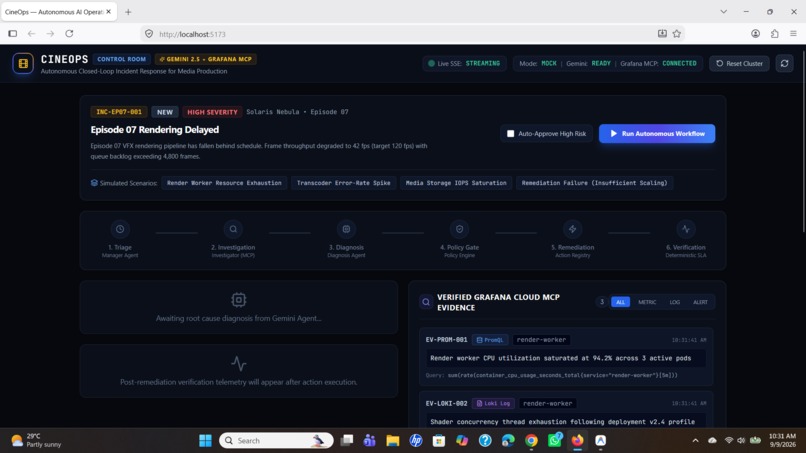
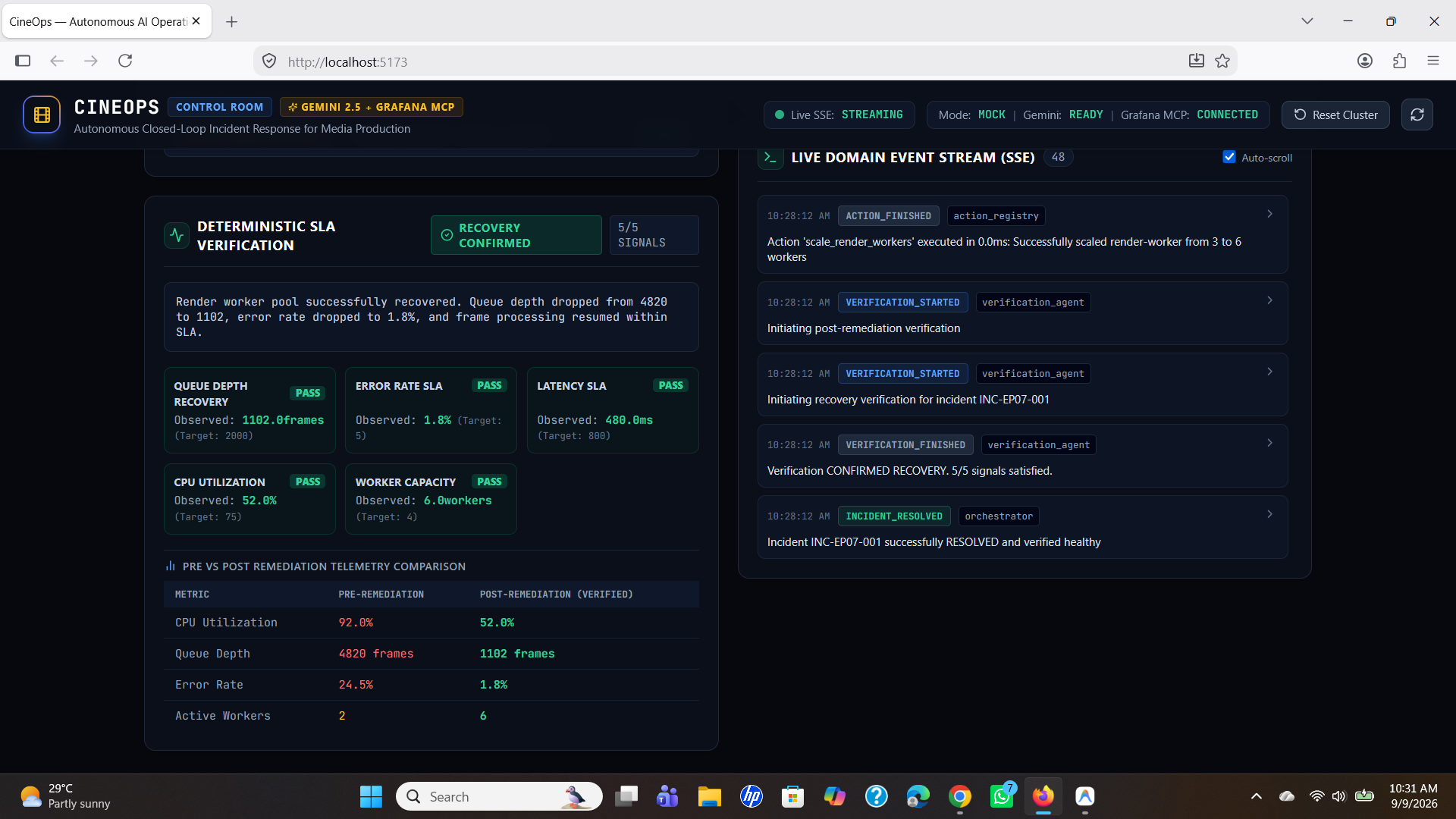
verification + event stream
-
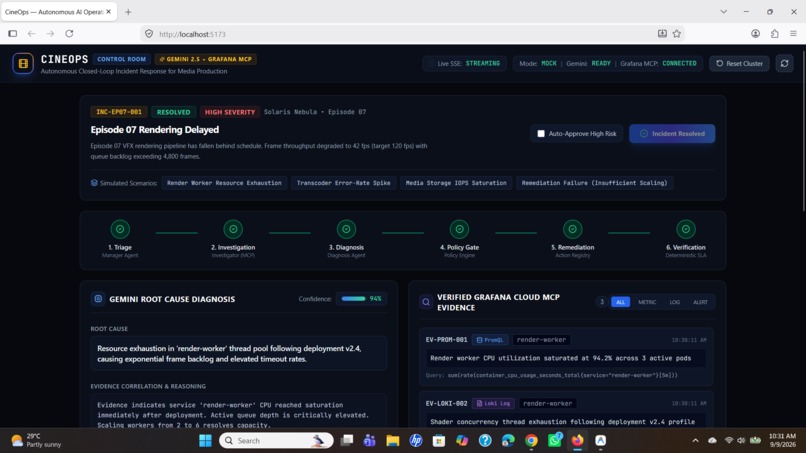
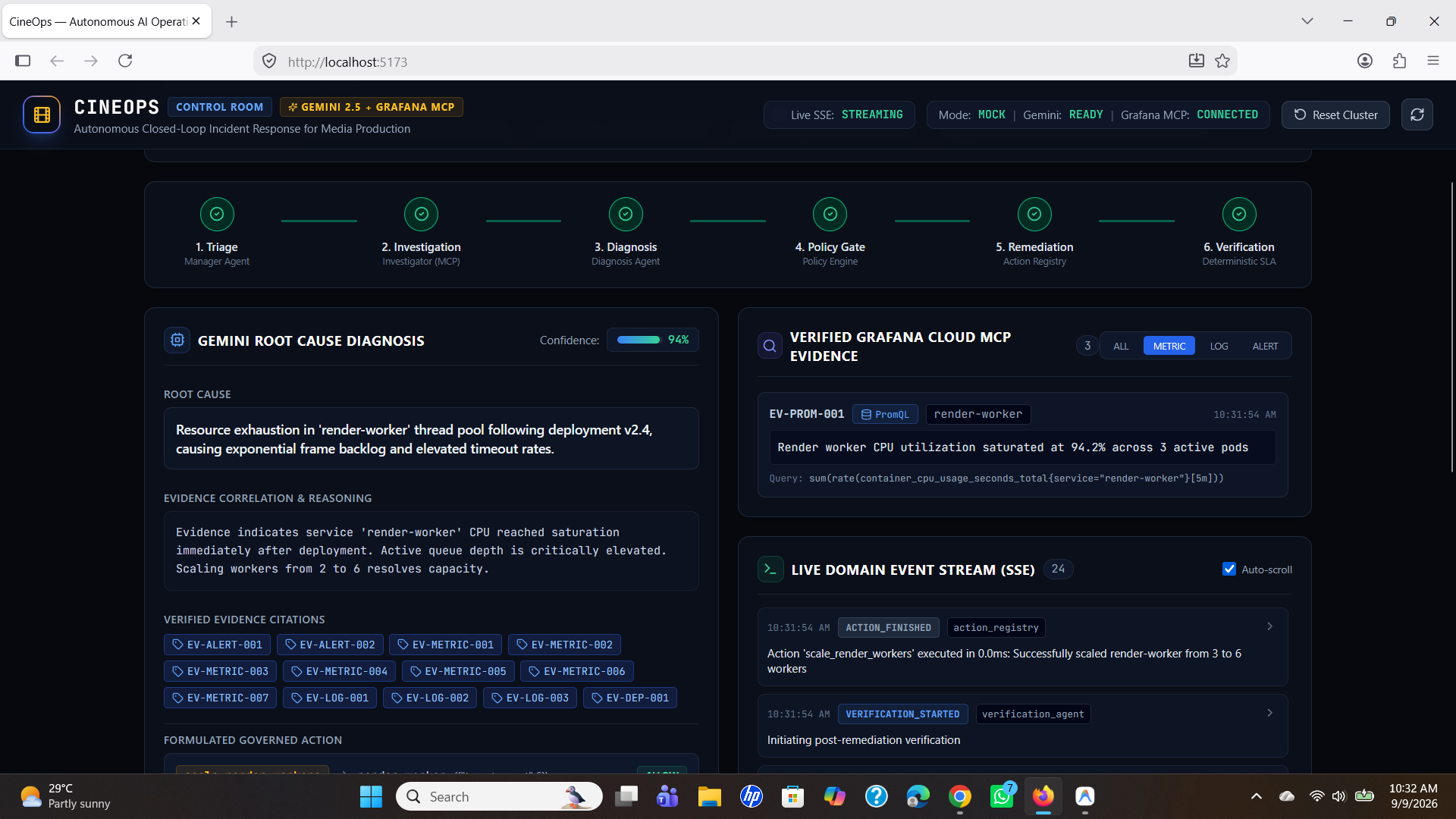
Control Room hero
-
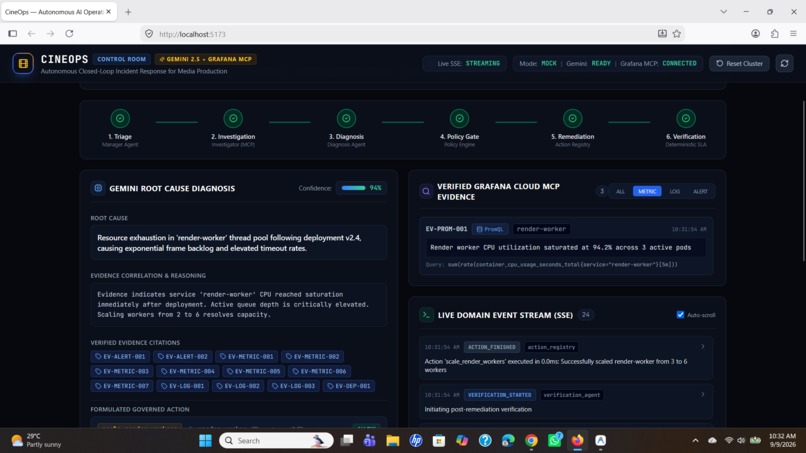
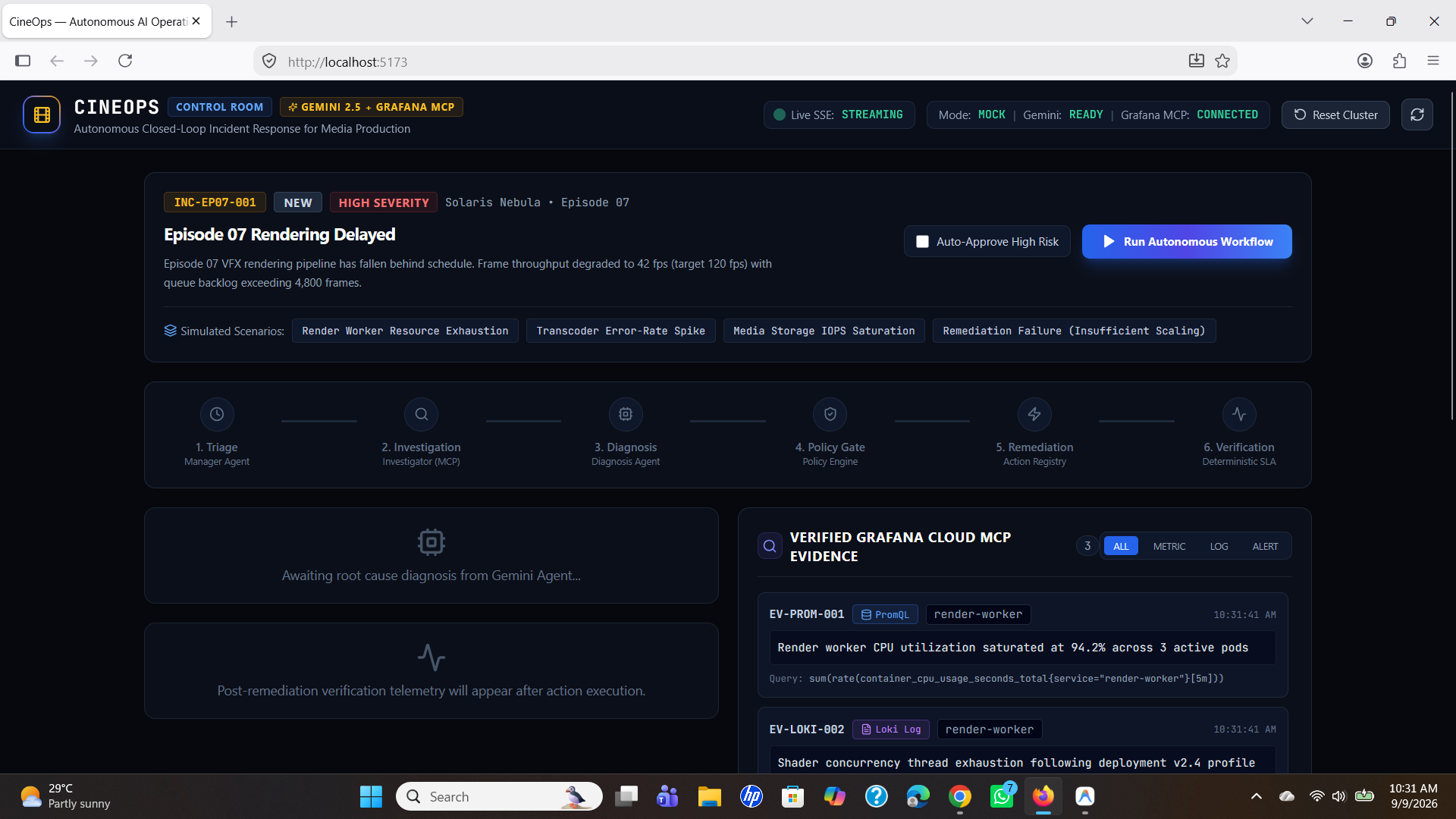
incident starting state
-
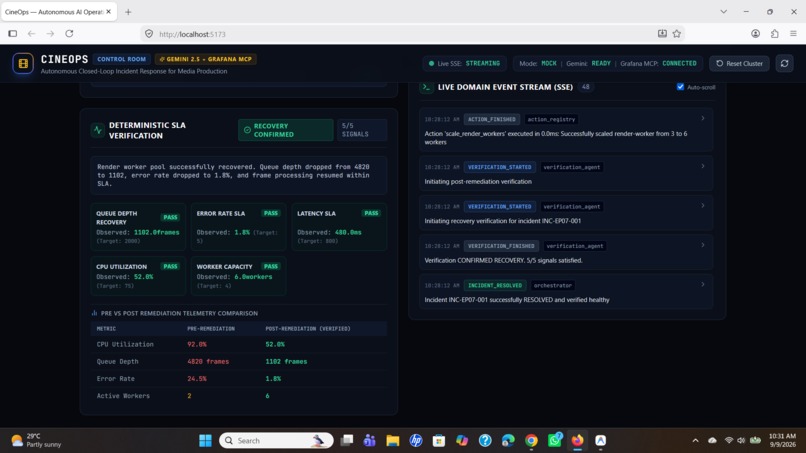
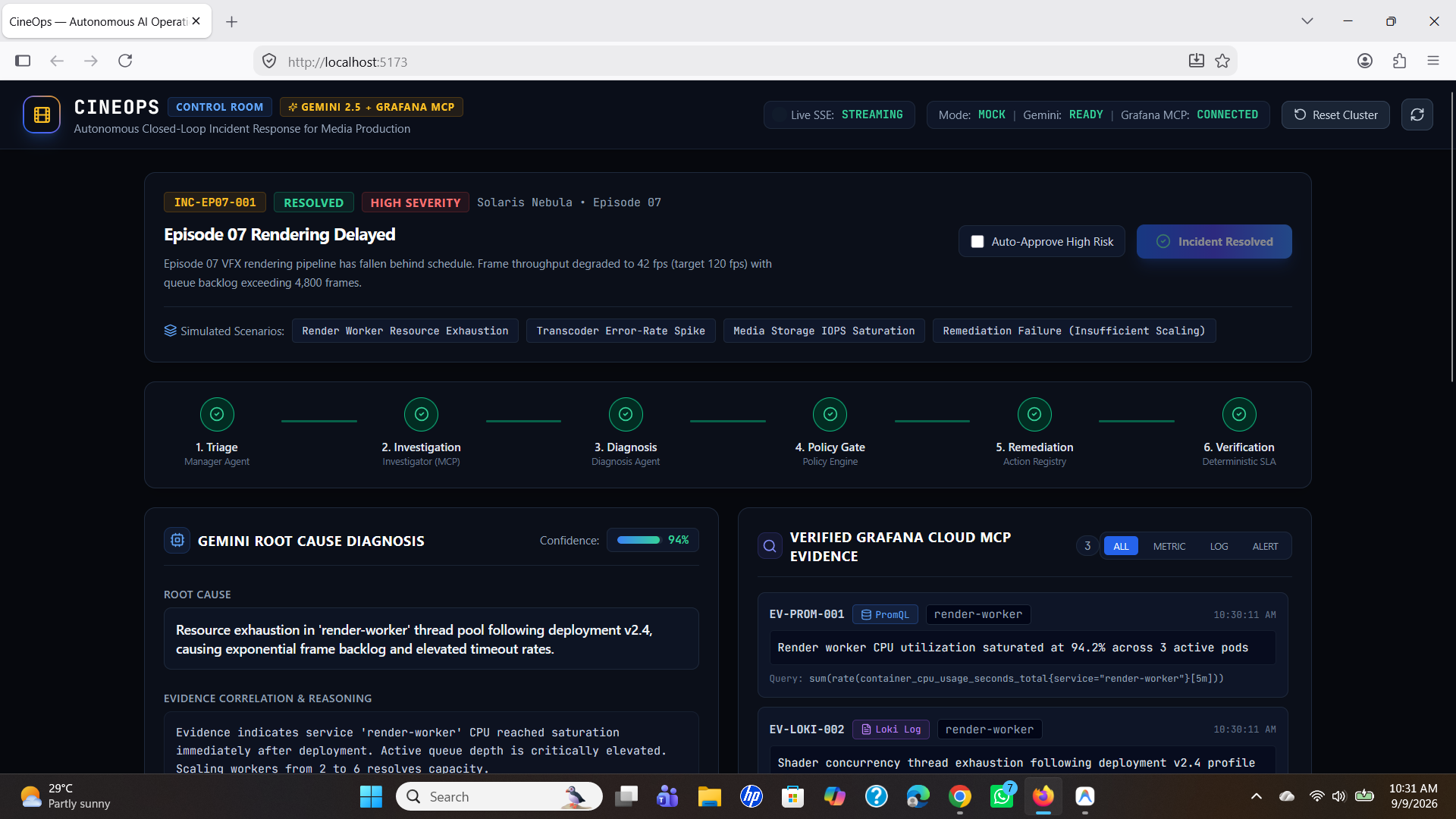
Gemini diagnosis + evidence
Inspiration
What it d## Inspiration
Media production pipelines are becoming increasingly complex. A single rendering or transcoding problem can affect an entire production schedule, yet diagnosing these incidents often requires engineers to manually move between alerts, metrics, logs, dashboards, and deployment information.
We wanted to explore a different question:
What if an AI agent could investigate a production incident, reason over observability data, take a safe corrective action, and then prove that the system actually recovered?
That idea became CineOps.
Instead of building another conversational AI assistant, we built an autonomous media-production operations workflow around the principle:
Observe → Investigate → Correlate → Diagnose → Govern → Act → Verify → Report
The media and entertainment domain gave us a concrete environment where reliability directly matters: rendering backlogs, resource saturation, processing latency, failed workers, and production deadlines.
What CineOps Does
CineOps is an autonomous AI operations platform designed for media-production workflows.
When an incident occurs, CineOps can:
- Triage the incident and create an investigation plan.
- Investigate operational evidence through the observability layer.
- Correlate metrics, logs, alerts, and deployment context.
- Generate an evidence-backed root-cause diagnosis.
- Propose a typed remediation action.
- Apply policy and safety constraints before execution.
- Execute an approved remediation through a controlled action registry.
- Collect fresh post-remediation telemetry.
- Deterministically verify whether recovery criteria were satisfied.
- Produce an auditable incident timeline and final report.
The most important design decision was that the AI does not control the entire system.
Gemini is responsible for reasoning and proposing decisions. The application controls state transitions, permissions, action validation, retry limits, and recovery verification.
How We Built It
CineOps is built as a multi-layer agentic system.
AI Layer
We use Gemini with Google ADK for bounded reasoning tasks such as triage, investigation planning, evidence interpretation, diagnosis, remediation proposals, and verification summaries.
Orchestration Layer
A deterministic workflow engine controls the incident lifecycle:
NEW
 ↓
TRIAGING
 ↓
INVESTIGATING
 ↓
DIAGNOSING
 ↓
POLICY
 ↓
REMEDIATING
 ↓
VERIFYING
 ↓
RESOLVED / ESCALATED
The state machine prevents invalid transitions and keeps workflow control outside the model.
Observability Layer
CineOps integrates with the Grafana ecosystem and is designed around Grafana Cloud MCP for operational evidence such as metrics, logs, alerts, dashboards, and governed annotations.
Safety Layer
Every remediation proposal passes through a policy engine and typed action registry.
For example, scaling render workers within a configured limit can be automatically permitted, while higher-risk operations can require human approval.
Verification Layer
CineOps does not consider an incident resolved simply because an action returned successfully.
It compares fresh post-action telemetry against deterministic SLA criteria such as:
- CPU utilization
- queue depth
- latency
- error rate
- worker capacity
This creates a closed-loop system:
Observe
   ↓
Diagnose
   ↓
Act
   ↓
Verify
The Hero Scenario
Our main scenario focuses on a fictional media production called Solaris Nebula, where Episode 07 experiences severe rendering degradation.
The system observes a combination of:
- render-worker saturation
- growing frame backlog
- increasing latency
- elevated errors
- recent deployment changes
CineOps investigates these signals, produces an evidence-backed diagnosis, proposes a safe worker-scaling action, applies policy checks, executes the controlled remediation, and then evaluates fresh telemetry to determine whether the production pipeline recovered.
The result is not just:
"I think the problem is fixed."
It is:
"The recovery criteria were satisfied by post-remediation telemetry."
What We Learned
Building CineOps taught us that agentic systems are much more than connecting an LLM to a set of APIs.
We learned the importance of:
- deterministic workflow orchestration
- structured model outputs
- typed tool interfaces
- evidence provenance
- policy-based authorization
- idempotent actions
- fresh telemetry verification
- human-in-the-loop controls
- prompt-injection defenses
- reproducible simulation
- real-time event streaming
- cloud deployment architecture
One of our biggest lessons was that autonomy without verification is not reliable automation.
An agent can make a convincing diagnosis and still be wrong. That is why CineOps separates model reasoning from deterministic verification.
Challenges
The hardest part was designing the boundary between AI reasoning and application control.
We had to ensure that:
- logs are treated as untrusted external data
- malicious text inside telemetry cannot become an instruction
- Gemini cannot bypass the policy engine
- arbitrary infrastructure commands cannot be generated
- duplicate actions cannot execute
- stale telemetry cannot falsely indicate recovery
- failed remediation cannot automatically become a successful incident
- workflow loops have strict retry limits
We also had to make the system reproducible for demonstrations while keeping the architecture representative of a real enterprise environment.
That led us to build a deterministic media-production simulator, a complete incident state machine, an event-driven Control Room, and an explicit verification layer.
Why This Matters
CineOps demonstrates a broader idea:
Observability systems can become operational interfaces for autonomous agents—not just dashboards for humans to inspect.
By combining Gemini's reasoning capabilities with governed tools, observability evidence, deterministic policies, and post-action verification, we created a system designed to move from:
"Something is wrong."
to:
"Here is the evidence, here is the safe action, and here is proof that the system recovered."
Project Status
The project has been extensively tested locally, including the complete hero workflow, policy enforcement, verification logic, security controls, SSE event streaming, and frontend production build.
The repository is open source and includes the application code, tests, simulator, deployment configuration, security documentation, and operational runbooks.
Where external cloud credentials or hosted infrastructure are required, those prerequisites are documented rather than hidden.
Future Vision
CineOps could eventually evolve beyond the demonstration environment into a broader media reliability platform covering:
- render farms
- post-production pipelines
- transcoding infrastructure
- live-event systems
- content delivery workflows
- automated incident postmortems
- predictive production reliability
Our long-term goal is simple:
Make autonomous operations trustworthy enough that engineers can delegate the repetitive parts of production incident response while retaining control over high-risk decisions. oes
Built With
- 15
- 3:2
- 5-mb-max-file-size.-for-best-results
- a
- and
- apis
- app-store-listing
- choose
- cloud-services
- databases
- drag
- etc.-"try-it-out"-links-add-links-where-people-can-try-your-project-or-see-your-code.-url-for-demo-site
- etc.-add-another-link-project-media-image-gallery-jpg
- etc.-languages
- files
- frameworks
- github-repo
- images.
- or
- platforms
- png-or-gif-format
- ratio.
- to
- up
- use

Log in or sign up for Devpost to join the conversation.